Ohia And The Thieving Deer
Ohia And The Thieving Deer: There once lived upon the earth a poor man called Ohia, whose wife was named Awirehu. This unfortunate couple had suffered one
Among the folk tales the Gold Coast carried into print in the early twentieth century, “Ohia and the Thieving Deer” stands out for its unusual shape: it begins as a tale of poverty and a clever thief, and ends as a creation story that explains why jealousy and selfishness are loose in the world. A poor palm-wine tapper, a deer that steals his harvest, a court of animals presided over by a leopard the storytellers call “King Tiger,” a magical gift of understanding animal speech, and a fatal vow of silence — the tale moves through all of these and arrives, in its closing lines, at the edge of myth. It is one of the most layered narratives in the West African oral repertoire, and it rewards a close reading.
Origin and Canonical Attribution
“Ohia and the Thieving Deer” was collected and arranged by W. H. Barker and Cecilia Sinclair in West African Folk-Tales, published in London by George G. Harrap & Co. in 1917. William Henry Barker (1882–1929) served as an inspector of schools in the Gold Coast — the British colony that became modern Ghana — and the volume he assembled with Sinclair drew its material directly from the Akan-speaking peoples of the region, principally the Ashanti and Fanti. The collection is freely available today through Project Gutenberg (ebook no. 66923).
The story carries clear internal marks of its Akan origin. The hero’s name, Ohia, is the Twi word for poverty itself — the man is, in effect, named “Poverty” — while his faithful wife Awirehu bears a recognisably Akan name. The palm-wine economy at the centre of the plot, in which a landless man taps another man’s trees and splits the proceeds three ways, mirrors a real sharecropping arrangement of the Gold Coast forest belt. The animal court is a transposition of the Akan chief’s assembly, complete with a presiding ruler, deliberation, testimony, and a formal apology. One detail regularly confuses modern readers: the “King Tiger” who rules the beasts. There are no tigers in Africa. “Tiger” was the colonial-era English word the collectors used for the leopard (Twi: ɒsebɔ), the true apex predator of the West African forest and a natural choice for the king of the animals.
In the international classification of folk narrative, the tale’s spine belongs to Aarne–Thompson–Uther type ATU 670, “The Animal Languages” — the widespread story of a man granted the power to understand the speech of animals, bound by a strict prohibition against revealing the gift, and threatened with death if he breaks it. The relevant motifs in the Stith Thompson Motif-Index of Folk-Literature are B216, “Knowledge of animal languages,” and C420, “Tabu: uttering secrets” (with C423, the prohibition on revealing the source of magic power). The Akan version is distinctive for the etiological coda it appends to this international plot, turning a personal tragedy into an explanation for a universal human flaw.
The Tapper Who Could Not Win
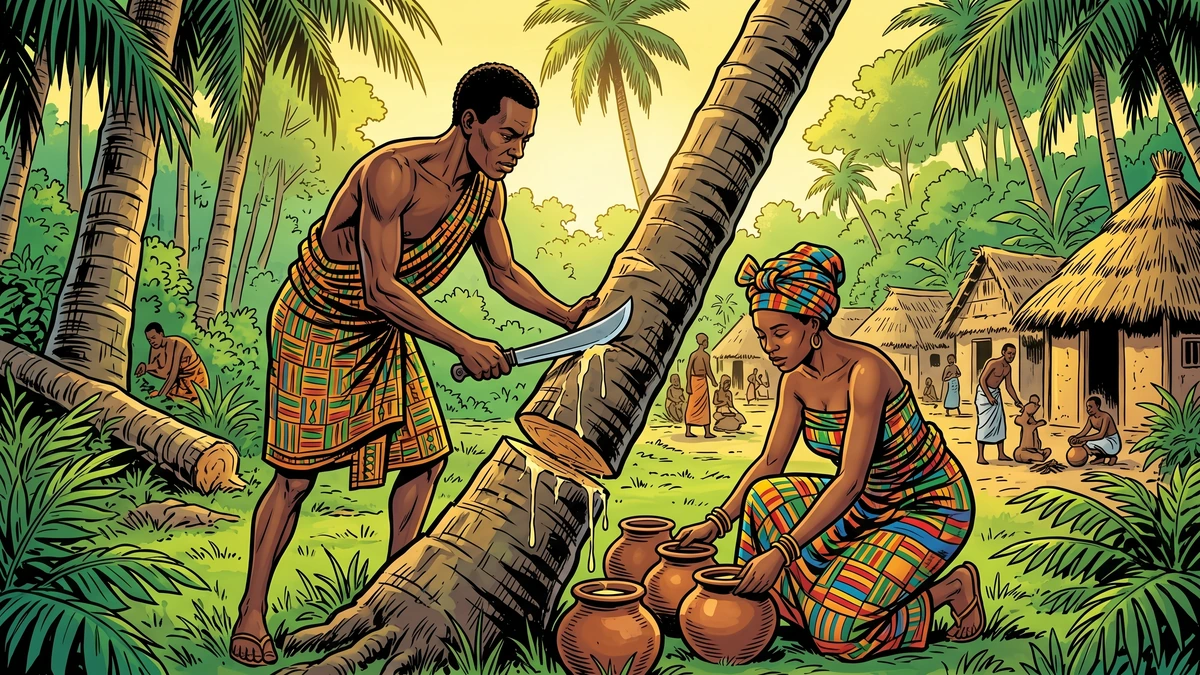
Ohia and Awirehu were a couple whom misfortune followed like a shadow. Whatever they set their hands to failed; one disaster gave way to the next until they were too poor to afford even a cloth to cover themselves. At last Ohia turned to a plan his neighbours had used with success. He went to a prosperous farmer and offered to fell several of his palm trees, tap their sap, and brew it into palm wine; Awirehu would carry the wine to market, and the proceeds would be divided three ways — a share each for the farmer, for Ohia, and for his wife. The farmer agreed, and generously supplied the earthen pots Ohia was far too poor to buy.
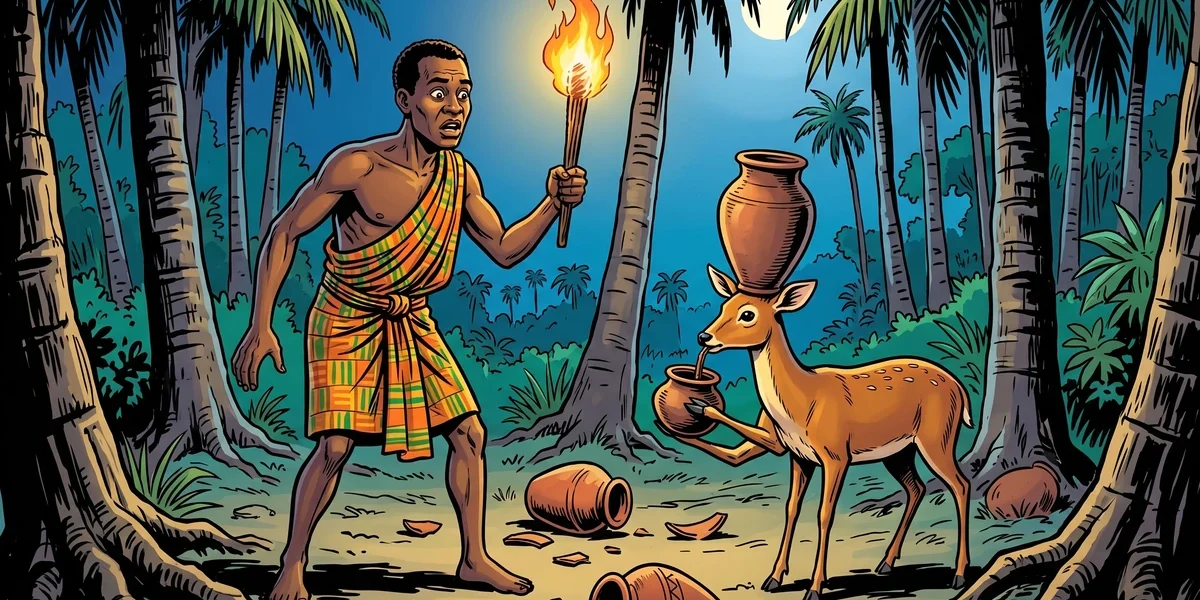
The couple worked with real hope. They cut the trees, dressed them, and set the pots beneath to catch the rising sap. Before cock-crow on market morning, Ohia went out with a lighted torch to gather the wine — and found the first pot smashed on the ground, the sap gone. So it was at the second tree, and the third, and every tree after. Awirehu, dressed for market, read the ruin in his face. They agreed that a thief had drunk the wine and broken the pots to hide the crime. Three times more Ohia borrowed pots from the patient farmer and set them out; three times more he found only fragments at dawn. Awirehu wanted to abandon the whole effort — their bad luck, she felt, could not be beaten. But Ohia made one last resolution: he would not try again to brew the wine until he had caught the thief.
The Night Watch and the Chase
Ohia set his pots in order and hid himself among the palms to keep watch. Midnight passed quietly. Then, toward two in the morning, a dark shape glided to the nearest tree, and he heard the crack of a breaking pot. Creeping near, he saw the thief plainly: a bush-deer, balancing a great jar on its head, pouring his palm wine into it and tossing the emptied pots carelessly aside to shatter. Ohia lunged to seize the culprit, but the deer was far too quick. It bolted, dropping its jar, and Ohia — exhausted, furious, determined — gave chase.
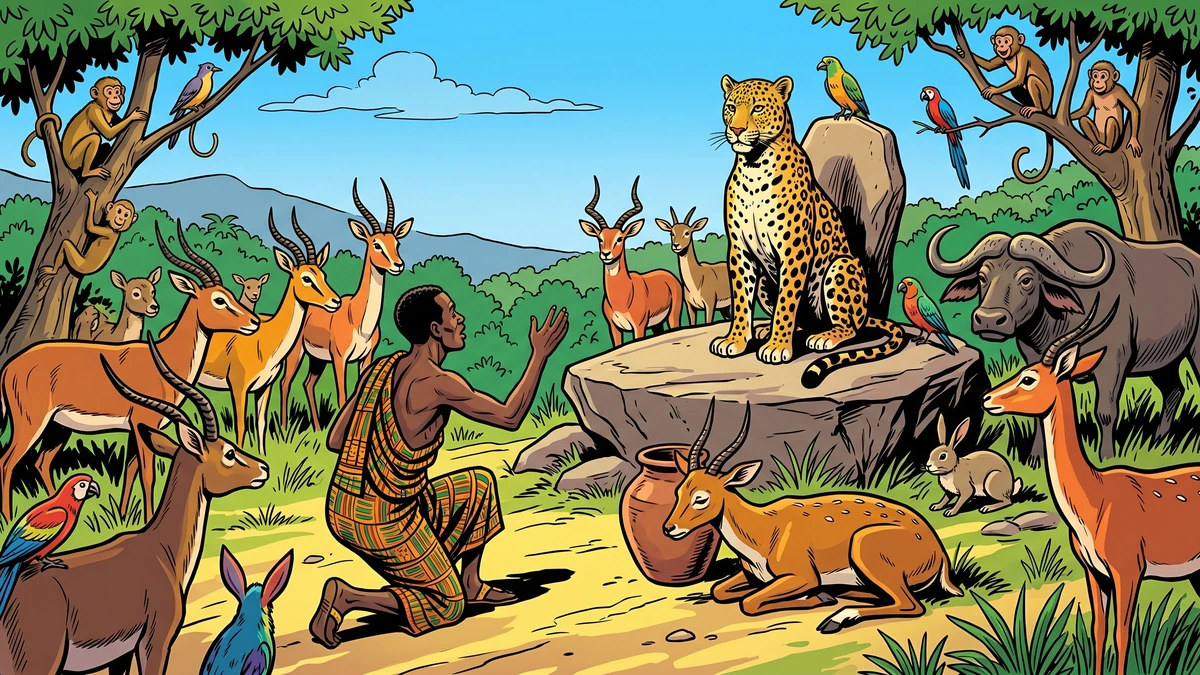
The pursuit ran for many miles, the fleet deer always ahead, until at midday they reached the foot of a high hill. The deer climbed, and Ohia, near the end of his strength, climbed after it. At the summit he stumbled into something he had never imagined: a vast assembly of four-footed animals in solemn conference. The deer flung itself, panting, before King Tiger — the leopard who ruled them — and the king ordered the intruding man seized and punished for breaking into so grave a meeting.
Ohia begged to be heard before he was condemned. King Tiger consulted the other animals and consented. Ohia then told the whole story of his unlucky life: trial after failed trial, the palm-wine scheme, the four nights of stolen wine and broken pots, and the chase that had carried him, all unwilling, into their court. The animals listened with close attention. At the end they agreed unanimously that the man was blameless and the deer was the thief. The truth, it emerged, was worse than ordinary theft: King Tiger had each morning given the deer money to buy palm wine for the entire assembly, and the deer had stolen Ohia’s wine and pocketed the king’s gold. The deer was sentenced; Ohia received a formal apology in the name of the whole conference.
The Gift and the Rising Fortune
To make good Ohia’s losses, King Tiger offered him a remarkable gift: the power to understand the speech of every animal. Such knowledge, the king promised, would quickly make him rich. But the gift came with one iron condition. Ohia must never — on pain of instant death — tell any living person that he possessed it.
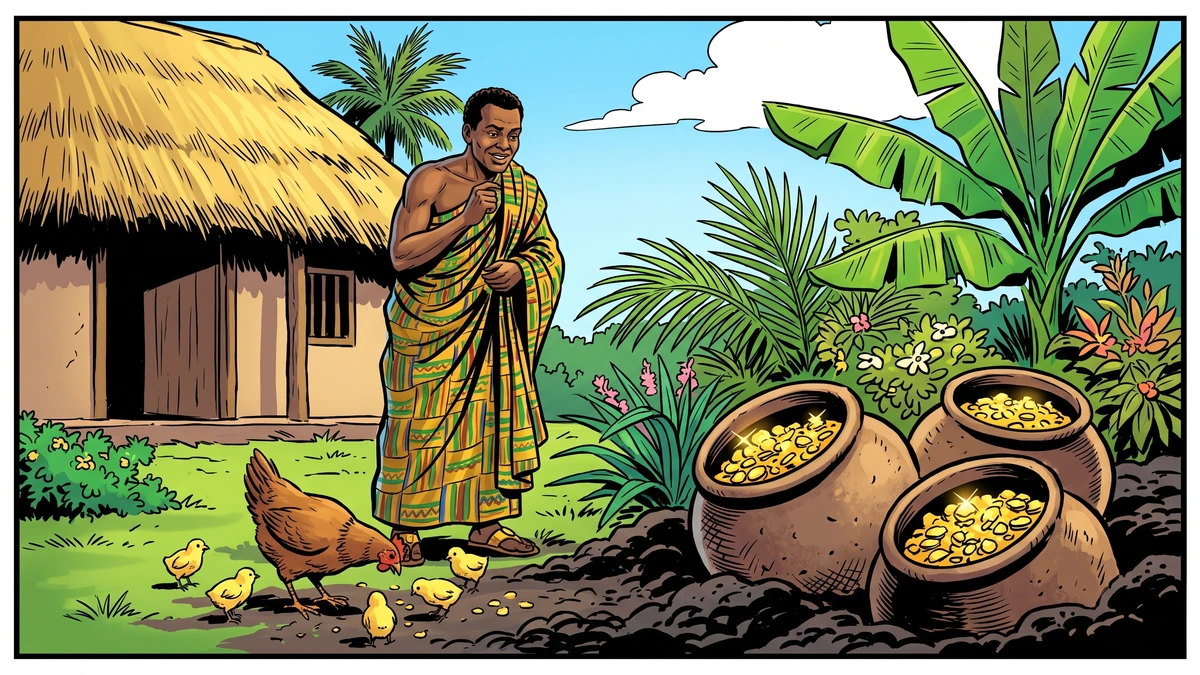
Ohia accepted gladly and went home. From that day his long run of bad luck simply ended. His palm wine was never touched again; he and Awirehu grew steadily more prosperous. One morning, bathing in a pool near his house, he overheard a hen instructing her chicks in his garden — and caught a chick mentioning three jars of gold buried in the ground, with the hen warning the brood not to scratch near the spot lest their master notice. Ohia showed no sign that he had understood. When the birds had moved off, he dug where they had pecked and unearthed three great jars of gold, enough to keep him in comfort for life. He told no one but Awirehu, and hid the treasure inside his house. Before long the couple were among the richest in the district, owners of substantial property.
Wealth, however, brought a fateful decision. Ohia judged that he could now afford a second wife, and he married again. The new wife was nothing like the kind, honest Awirehu. She was jealous and selfish by nature, and she was lame — and she had convinced herself that everyone mocked her for it. She became fixed on the idea that Ohia and Awirehu, whenever they were together, were laughing at her. They never were. But she took to listening at doors, straining to catch the words that would prove her suspicion.
The Joke That Could Not Be Told
One evening, after Awirehu had fallen asleep, Ohia lay awake and overheard two mice in the corner of the room plotting to raid the larder as soon as their watching master slept. The plan struck him as so comic that he laughed aloud. The lame wife heard him and burst into the room, certain at last that he had been mocking her to Awirehu. Ohia denied it — truthfully — but she would not be moved. If the joke were innocent, she demanded, let him simply repeat it. And that was the one thing Ohia could not do, for to explain the joke was to confess that he understood the speech of animals, and that confession carried death.
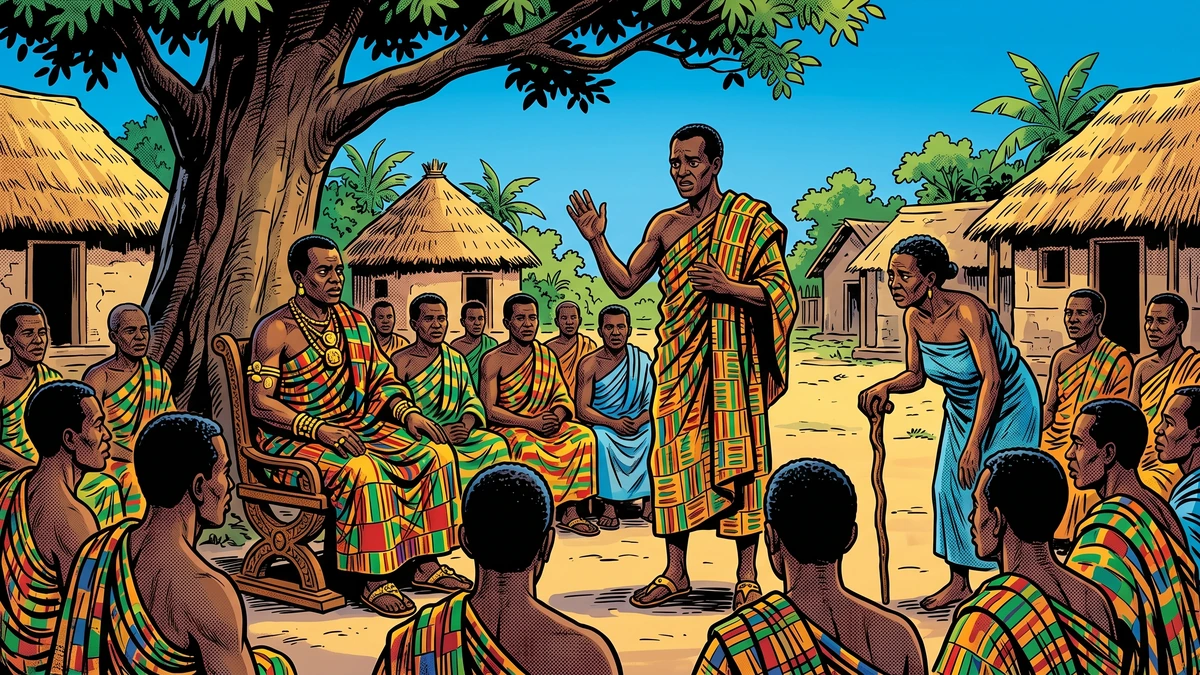
His refusal hardened her suspicion into certainty. She gave the village chief no peace until he summoned Ohia to answer her charge before the assembly. Finding no escape, Ohia prepared to die. He called his friends and relatives to a great farewell feast, set his affairs in order, left his gold to the faithful Awirehu and his property to his son and servants, and went to the Assembly Place. There he took his leave of the chief and told the gathered people the whole of it — his misfortunes, the deer, the animal court, King Tiger’s gift, and the iron condition attached to it — and explained, at last, the joke of the two mice that had set his wife against him. As the words left his mouth, he fell dead, exactly as the leopard king had warned.
Ohia was buried amid genuine mourning, for he had been liked and respected. The jealous wife who had hounded him to his death was seized and, in the harsh idiom of the tale, burnt as a witch; her ashes were scattered to the four winds of heaven. And it is for this reason, the storytellers conclude, that jealousy and selfishness are now spread so widely through the world — where, before her ashes were carried on the wind, they had scarcely existed at all.
The Moral
The tale refuses a single tidy lesson, and that is part of its power. Ohia is never punished for any fault of his own. His ruin is not the wage of greed or cruelty; it is the price of a vow he kept faithfully until a jealous accuser made silence impossible. The deer’s cunning, King Tiger’s gift, and the lame wife’s envy each turn the plot, and only the last is genuinely wicked. What the story teaches is sober and adult: that a blessing can carry a burden inseparable from it, that the things which destroy a good life often come from outside it, and that an envious will, once fixed on a target, can dismantle even an innocent man.
The Akan storyteller’s instrument for that lesson is the tongue itself — Ohia’s gift is the understanding of speech, and speech is also what kills him. An Akan proverb frames the danger exactly:
“Tɛkrɛma tɛ sɛ sekan: ɛwɔ ano abien.”
— “The tongue is like a knife — it has two edges.” (Akan / Twi proverb)
The same tongue that brought Ohia wealth, by letting him overhear the hen and her gold, brought him death the moment a laugh escaped it. The proverb’s two edges are the whole story in miniature.
The Tale Type and Its Wider Family
As an instance of ATU 670, “The Animal Languages,” “Ohia and the Thieving Deer” belongs to a story family found from West Africa across the Middle East to India, Sri Lanka, the Balkans, and Scandinavia. The constant elements are three: a man receives the power to understand animal speech, the power is hedged by a prohibition against revealing it, and a member of his own household — very often a wife — presses him to break the prohibition and so endangers his life. What varies is the ending. In many European and Asian versions the man finds a way out and survives, sometimes after a second animal overheard speaking gives him the wit to master the situation.
The Akan telling is darker and more ambitious. It does not let Ohia escape, and it does not stop at his death. Instead it grafts onto the international plot a piece of etiological myth — a “pourquoi” ending of the kind that explains why the world is the way it is. The scattering of the jealous wife’s ashes to the four winds becomes the origin of jealousy and selfishness everywhere. This fusion of a migratory tale type with a local origin myth is characteristic of mature West African oral tradition, where a single performance can move between entertainment, moral instruction, and cosmology without any sense of strain.
Palm Wine, Property, and the Akan World of the Tale
The tale is rooted in a recognisable economy. Palm wine — the lightly fermented sap of the oil palm and the raffia palm — was, and remains, central to social and ceremonial life across the Akan forest belt. Tapping it is skilled, dawn-and-dusk labour, and a man without land of his own could enter the trade only through exactly the arrangement the story describes: a three-way split with the landowner who provided the trees and even, in Ohia’s case, the pots. The plot’s opening crisis is therefore not a fairy-tale invention but a real economic vulnerability — the tapper bears the work and the risk while owning none of the capital, so a thief in the night can wipe out his entire livelihood at a stroke. An Akan audience would have felt the weight of Ohia’s ruined pots immediately.
The animal assembly, too, draws on lived institutions. The conference on the hilltop — a presiding ruler, deliberation among elders, the hearing of testimony, a verdict reached by consensus, and a formal apology offered to the wronged party — is a faithful miniature of the Akan chief’s court, where disputes were settled in public by a process the community trusted. By staging that process among the animals, the storyteller signals that justice is part of the natural order, not merely a human contrivance. When King Tiger compensates Ohia for a wrong done by one of the king’s own officers, the tale is also quietly teaching what good rulership looks like.
Stories of this kind were performed, not merely recited. In Akan tradition the evening tale — the world of anansesem, the “spider stories” named for the trickster Ananse — was an interactive event, with a narrator who acted out the parts, songs that the audience joined, and listeners free to comment and respond. A tale that ends in death and a cosmic explanation, like Ohia’s, gave such a gathering something to talk over long after the fire burned low: a story that entertained with a chase and a clever thief, then turned, in its final breath, into a meditation on why the world contains as much envy as it does.
Why the Story Has Lasted
“Ohia and the Thieving Deer” has survived because it tells a hard truth that simpler fables avoid: good people are not always protected by their goodness. Ohia is patient, honest, and brave. He keeps his vow to the letter. None of it saves him, because the force that destroys him — corrosive envy with a grievance to nurse — does not care whether its target deserves ruin. Audiences across generations have recognised that pattern, and recognised, too, the quieter warning folded inside it: that Ohia’s second marriage, the one decision he made out of comfort rather than need, is the door through which his death walks in.
The tale also lasts because it is genuinely strange. It refuses to be only a trickster story or only a tragedy or only a creation myth; it is all three at once, and it carries a listener from a poor man’s broken wine-pots to an explanation of why the human heart is the way it is. That reach — from a single household’s misfortune to a statement about all of humankind — is what the best of the West African oral tradition does, and “Ohia and the Thieving Deer” does it as well as any tale Barker and Sinclair set down.
You May Also Like
 African Folk Tales
Ages 6-8
African Folk Tales
Ages 6-8
The Lost Message
A southern African folk tale: the many kinds of ants fail to agree at their council, and the saving message of unity, entrusted to the slow Beetle, never arrives.
 African Folk Tales
All Ages
African Folk Tales
All Ages
Quarcoo Bah-Boni
Quarcoo Bah-Boni: Once upon a time in a certain village lived a man and his wife who were childless. One day, however, when the husband was away hunting, the
 African Folk Tales
Ages 6-8
African Folk Tales
Ages 6-8
How Wisdom Became The Property Of The Human Race
How Wisdom Became The Property Of The Human Race. Long ago, wisdom belonged only to a few. Learn how one person changed everything by sharing knowledge.