Thing To Do
A young person learns that the most important accomplishments are the small, caring things we do.
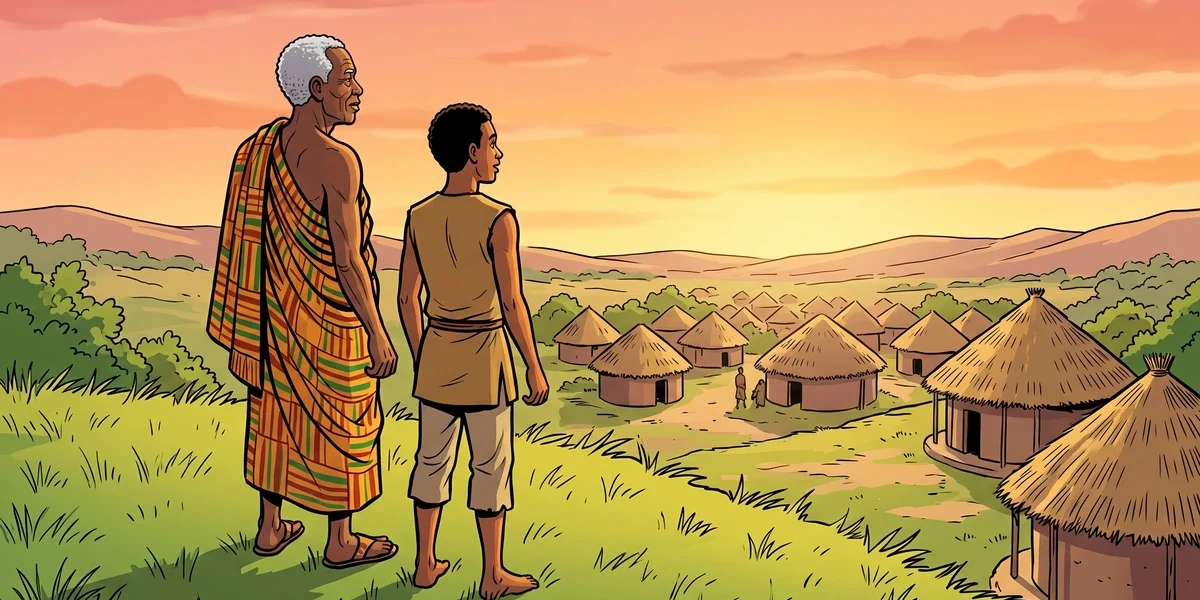
Every people on earth has kept a particular kind of story close at hand: the short, quiet tale in which a young person carries a large question to an old one, and walks away changed. “Thing To Do” belongs to that family. It is a wisdom tale — a teaching story whose entire plot is a single lesson, unfolded slowly enough that the listener arrives at the answer a heartbeat before the sage says it aloud. There are no giants in it, no magic rings, no talking animals. Its only marvel is the ordinary one: that a scraped knee, kissed by a tired mother at dusk, might be the most important thing done anywhere in the world that day.
Where This Story Comes From
“Thing To Do” is a modern didactic parable rather than a tale recovered from a single named manuscript, and honesty about that origin matters more than a borrowed pedigree. It is presented here within Indian Folk Tales’ world-folklore collection, in the company of West African teaching stories, because it shares their purpose — a community’s elders handing the young a working definition of a good life — even though its setting is left deliberately placeless.
Its shape, however, has a long and traceable ancestry. The frame — an ambitious seeker asks a recognised sage “what is the most important thing to do?” and is answered not with a sentence but with a guided day of looking — is one of the most widely distributed structures in world wisdom literature. The closest and most famous literary cousin is Leo Tolstoy’s short story “The Three Questions” (Russian: «Три вопроса», first published 1885), in which a king seeks a hermit to learn the right time to act, the right people to heed, and the most important thing to do. Tolstoy’s hermit answers, in effect, that the most important time is now, the most important person is the one you are with, and the most important pursuit is to do that person good. “Thing To Do” keeps the third of those questions and dramatises its answer.
The same architecture appears far older still: in the guru–shishya teaching dialogues of the Indian Upanishads and the Panchatantra, in the Zen mondo exchange between master and student, in the desert sayings of the early Christian Apophthegmata Patrum, and in the West African convention — preserved in collections such as W. H. Barker and Cecilia Sinclair’s West African Folk-Tales (1917) — of the village elder who answers a question by showing rather than telling. In folkloristic terms the tale carries the motifs J0 (“acquisition and possession of wisdom”), J150 (“wisdom acquired from experience”) and J1170–J1199 (“clever or wise judgments”) in the Stith Thompson Motif-Index of Folk-Literature. It is not an Aarne–Thompson–Uther wonder tale with a fixed type number; it is the older, plainer thing the wonder tales grew out of — a lesson in narrative form.
The Seeker Who Wanted To Be Great
There was once a young person who wanted, very badly, to matter. Not in a small way — in a way the world would notice. They wanted to raise a bridge across a wide river, or a building so tall that travellers would see it from a day’s walk away. They wanted to discover something no one had ever known, to cure a sickness, to help not ten people or a hundred but thousands upon thousands, and to be remembered long after they were gone. The wish was not a vain one. It was generous at its root. But it was loud, and it was hungry, and it gave the young person no peace.
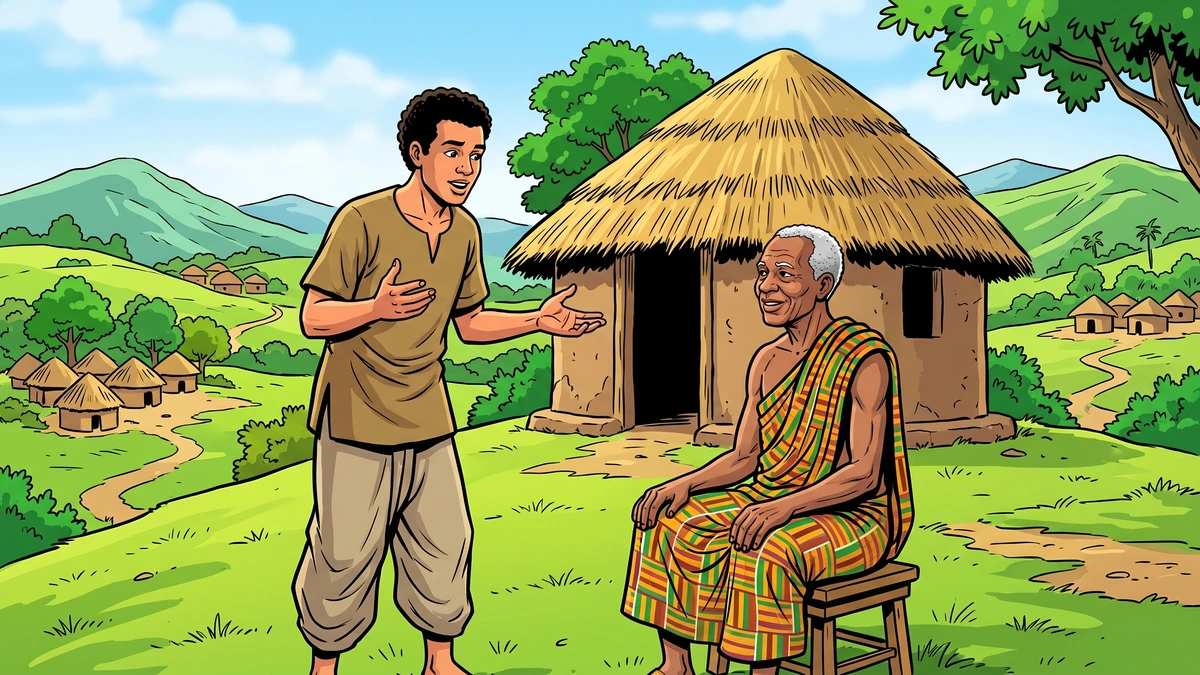
So they climbed the hill above the town to the house of the Elder — the oldest and, everyone agreed, the wisest person anyone there had known. The Elder had answered hard questions for three generations of that town, and had buried many of the people who asked them.
“Wise Elder,” the young person said, breathless from the climb, “I want to do something great with my life. Tell me — of all the things a person can do, what is the most important Thing To Do? Name it, and I will spend every year I have left doing it.”
The Elder did not answer the question. The Elder had been asked it many times, always by the young, always with that same shine of impatience in the eyes. “Come with me tomorrow, from the first light,” the Elder said. “Do not ask again until the sun has set. Only follow, and only watch. By dark you will have your answer, and it will be one you can keep.”
A Day Of Small Labours
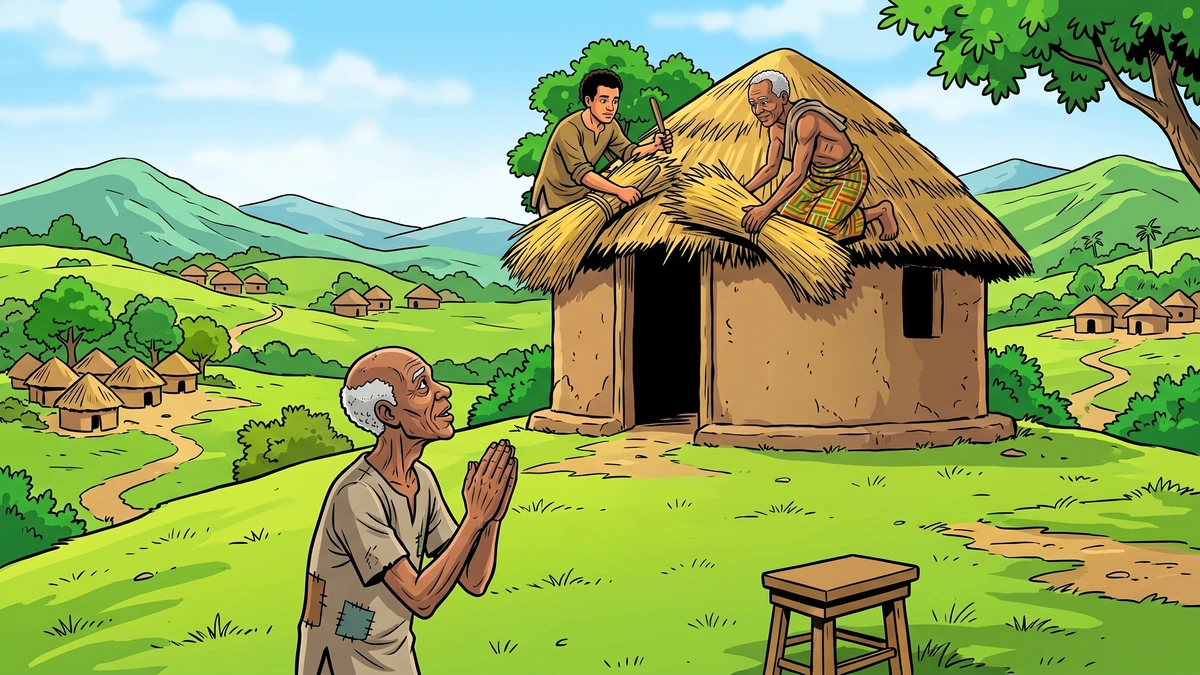
They set out as the sun came up. The Elder led the young person down off the hill and into the waking town, past the shuttered shops and the first smoke of the morning fires, and stopped at the house of a poor man whose roof had been torn open by a storm. The man was old. His back had given out years before, his hands had lost their strength, and the rain had been coming into his one room for a week. He had tried to mend it alone and could not.
The Elder and the young person climbed up and mended it for him. It was hard, plain work — lifting beams that did not want to be lifted, driving nails straight, fitting the thatch so the next storm would run off it instead of through it. It took most of the morning, and their hands were raw by the end of it. When it was done the old man wept, and held them both, and could not stop thanking them.
“This is an important Thing To Do,” the Elder said, as they walked on. “But it is not the most important. Keep watching.”
They went next to a small house where a child lay sick with fever, alone, because the mother had to work far off and could not be home in the daylight hours. The child was frightened. The young person sat down on the edge of the mat and stayed. They cooled the child’s forehead with a wet cloth, gave water and the bitter medicine a little at a time, told foolish stories until the fear loosened its grip, and sang until, by evening, the child slept easily with one small hand still holding theirs.
“This too is an important Thing To Do,” the Elder said. “Still not the most important. Come.”
So the whole long day went. In the crowded market they bought food with their own coin and put it into the hands of people who had none. They walked a lost and weeping traveller back to a road they recognised. They sat a while with a person bowed under fresh grief and simply did not leave. They listened — truly listened, without hurrying — to a very old man who needed to say the names of everyone he had loved and outlived. They helped a struggling student past the knot in a lesson until the student’s face cleared. Each act was small. Each act left someone steadier than before. And after every one the Elder said the same gentle, maddening thing: important, yes — but not the most important. Keep watching.
The Mother And The Scraped Knee
The sun was going down, laying its last orange and rose light along the rooftops, when the Elder brought the young person to a low, plain house and asked them only to stand at the open door and look.
Inside lived a woman with two small children. She had cleaned other people’s houses since dawn to earn the day’s bread, and she was not finished: there was still the children’s supper to cook, their lessons to hear, their washing, their hundred small needs, and only her two tired hands to meet them with. The young person watched her move through it — weary, unhurried, entirely ordinary.
“Every single day,” the Elder said quietly, “this woman does a thousand small Things To Do for those children. She wakes before them. She feeds them, clothes them, teaches them right from wrong, hears their fears, mends what they tear. Watch now. The most important Thing To Do is about to happen, and if you blink you will miss it.”
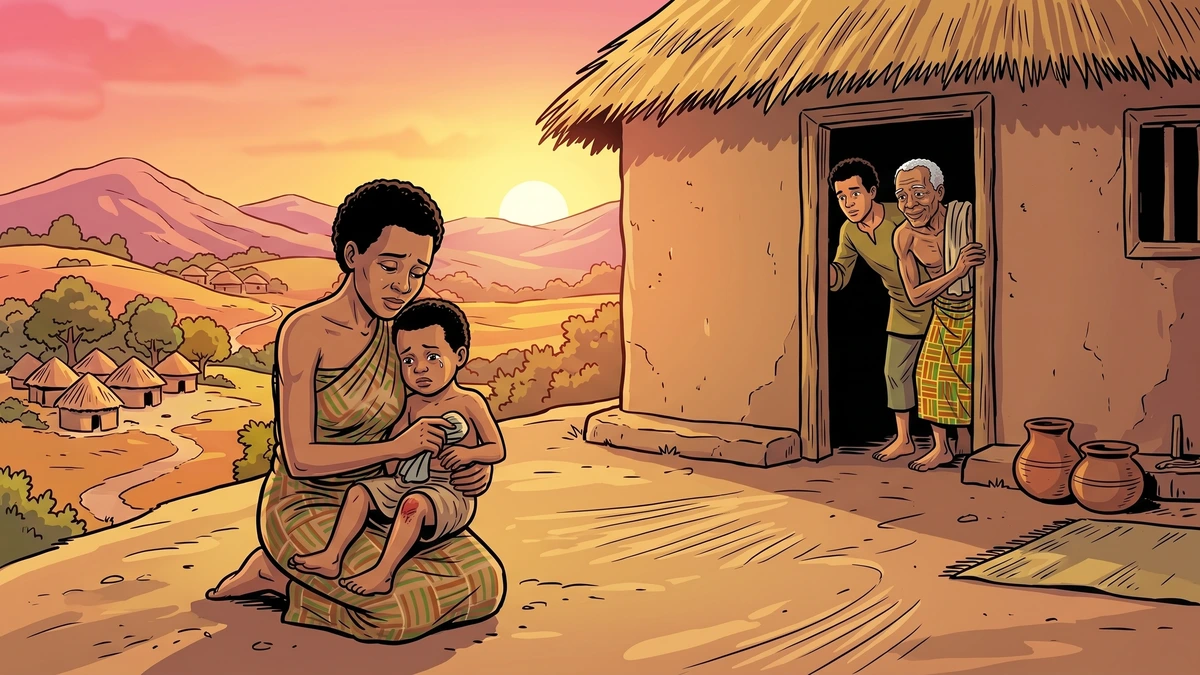
As they watched, the smaller child ran across the swept yard, caught a foot, and fell. A knee was scraped; a thin line of blood welled up; the child’s face crumpled into a wail of pain and fright. The mother heard it and came at once. She did not call out that it was nothing. She did not say stop crying, it is not so bad. She knelt down into the dust, gathered the child up, and gave that child the whole of her attention — as though, for that moment, there were no roof to fix, no fever in the town, no bridge unbuilt anywhere in the world.
She washed the small hurt with clean water. She dried it gently. And then she did the smallest thing of all: she bent her head and kissed the place where it hurt, and held the child close, and said the old soft words — you are safe; I am here; it will ease soon; you are brave. The pain did not vanish. But the fear did. The child grew quiet against her, and was, plainly and completely, comforted.
“That,” said the Elder, “is the most important Thing To Do.”
What The Seeker Came To Understand
The young person sat down slowly in the fading light, and for a while said nothing. Then the old objection came — the one the Elder had been waiting all day to hear.
“But Elder, that is such a small thing. It took a minute. It was not grand. No one will write it in a book. No one will give a prize for it. In a hundred years no one will know it happened at all. How can it matter more than a bridge, more than a cure, more than helping a thousand people at once?”
“You are right that it will not make you famous,” the Elder agreed, without arguing. “It will not make you rich, and it will not put your name in any history. But understand what you saw. That child will remember being loved. Not the words — the child is too young for the words. The child will carry, for a whole life, the knowing of what it feels like to be held when you are hurt and afraid. And one day that child will kneel in the dust for a child of their own, and do the same thing, in the same way, without ever being taught it. So will that child’s children. The kindness you watched will not stop at this yard. It will travel on, person to person, generation into generation, the way a stone’s ring travels out across still water and does not come back.”
The Elder let that settle, then went on. “The grand works are not nothing. Build your bridge if you can; the town will thank you. But a bridge with no one you love to cross it is a lonely bridge. Fame with no one who loves you behind the cheering is a cold kind of fame. The person who has loved well and been well loved holds the one thing that cannot be taken and does not rust. Everything else is built on top of it — or it is built on sand.”
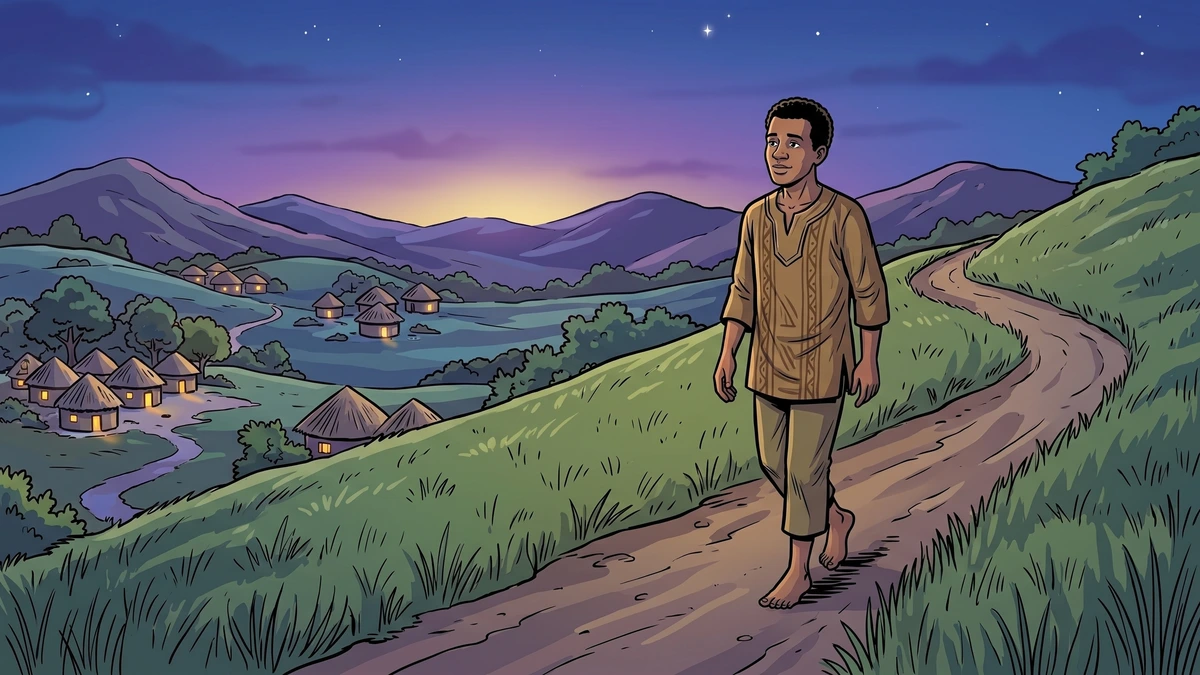
The young person walked back down the hill in the dark, and did not, after all, build the famous bridge. They built something harder to see and harder to lose. They raised children patiently and with love. They stood by their friends through the bad years. They taught whoever wanted to learn. They were never famous, and no book carries their name. But everyone who knew them was steadier for knowing them, and when at last they died, a great many people wept — not for a monument, but for the plain daily kindness that had gone out of their lives. That grief, the Elder would have said, is the truest monument a person can leave.
The Moral Of The Tale
The lesson of “Thing To Do” is not that ambition is wrong, nor that great works should not be attempted. It is that greatness and importance are not the same measurement. A thing can be enormous and matter little; a thing can be tiny and matter for a hundred years. What decides the difference is not the size of the act but the love carried inside it — and love is delivered almost entirely in small parcels: an hour given, a hurt attended to, a full and unhurried attention paid to one person who needs it now.
Tolstoy, whose “The Three Questions” asks the same thing this tale asks, put the answer in the mouth of his hermit, and the line has been quoted ever since:
«Запомни же: время самое важное — одно: теперь… а самое нужное дело — делать тому человеку добро.»
— “Remember then: there is only one time that is important — Now… and the most necessary work is to do good to the person you are with.” (Leo Tolstoy, The Three Questions, 1885)
That is the whole of what the Elder spent a day teaching. The most important time is the present one. The most important person is the one in front of you. The most important Thing To Do is whatever good that person needs from you right now — even, especially, if it is only to kneel down and kiss a scraped knee.
Why This Story Has Lasted
Wisdom tales of this kind survive because they solve a problem every generation meets fresh. The young are told, rightly, to be ambitious — and ambition, left alone, quietly teaches them that small daily care is a lesser thing, a delay, a distraction from the real work. “Thing To Do” was made to interrupt exactly that lesson. It does not shame the seeker’s hunger; it widens it, until the hunger to matter and the willingness to kneel in the dust become the same hunger.
It lasts, too, because it can be carried whole in the memory and acted on the same day. A child who hears it once can repeat its plot and, more to the point, can recognise its truth the next time someone near them is hurt or frightened. The story asks for nothing rare. It does not need wealth, or talent, or a particular faith, or even good fortune. It needs only attention and kindness, which everyone already owns, and which most people spend too little of on the people closest to them.
And it lasts because it is, very quietly, true. The mended roof and the kissed knee in this tale are invented, but the pattern they stand for is not. The kindness shown to a young child really does tend to be passed on by that child when grown; cruelty and neglect, sadly, travel the same way. Whichever a person chooses to set in motion will outrun them by generations. “Thing To Do” simply makes that ordinary fact visible for the length of one story — long enough for a listener to decide, deliberately, which ripple they would like to be remembered for starting.
Frequently Asked Questions
What is the folk tale "Thing To Do" about?
“Thing To Do” is a wisdom tale about an ambitious young person who climbs to the home of a wise village Elder and asks what the single most important thing a person can do with their life is. Instead of answering in words, the Elder leads the seeker through an ordinary day of small kindnesses — mending a poor man’s roof, comforting a sick child, feeding the hungry at the market — calling each act important but not the most important. At dusk the lesson finally arrives: a tired mother kneels to kiss her small child’s scraped knee, and the Elder names that quiet act of love the most important Thing To Do of all.
What is the moral of "Thing To Do"?
The moral is that greatness and importance are not the same thing. An act can be enormous yet matter little, and tiny yet matter for generations; what decides the difference is the love carried inside it. The story does not condemn ambition — it widens it, teaching that the most important work is almost always delivered in small parcels: an hour given, a hurt attended to, full and unhurried attention paid to one person who needs it now. A kindness shown to a child is remembered for a lifetime and passed on to the next generation, so a small loving act outlasts most monuments.
Is "Thing To Do" a traditional African folk tale?
“Thing To Do” is a modern didactic parable rather than a tale recovered from a single named African manuscript. It is presented within Indian Folk Tales’ world-folklore collection alongside West African teaching stories because it shares their purpose — elders handing the young a working definition of a good life — but its setting is left deliberately placeless. Its structure, however, belongs to a genuinely ancient and worldwide tradition of the sage who answers a seeker’s question by showing rather than telling, a convention preserved in West African collections such as W. H. Barker and Cecilia Sinclair’s West African Folk-Tales (1917).
How is "Thing To Do" related to Tolstoy's "The Three Questions"?
The two stories share the same architecture. In Leo Tolstoy’s short story “The Three Questions” (Russian: «Три вопроса», first published 1885), a king seeks a hermit to learn the right time to act, the right people to heed, and the most important thing to do. The hermit answers that the most important time is now, the most important person is the one you are with, and the most important pursuit is to do that person good. “Thing To Do” keeps the third of those questions and dramatises its answer across a single guided day, making it the closest and most famous literary cousin of this tale.
Why does the story say a small act of kindness matters more than a great accomplishment?
Because kindness compounds. The Elder explains that the child whose knee is kissed will not remember the words but will carry, for a whole life, the knowing of what it feels like to be held when hurt and afraid — and will one day comfort a child of their own in exactly the same way, without being taught. The kindness travels on, person to person and generation into generation, like the ring of a stone spreading across still water. A grand bridge with no one you love to cross it is a lonely bridge; the person who has loved well and been well loved holds the one thing that cannot be taken away.
You May Also Like
 African Folk Tales
Ages 6-8
African Folk Tales
Ages 6-8
Anansi and the Pot of Wisdom
The Akan (Ashanti) trickster tale of how Kwaku Anansi the spider tried to hoard all the wisdom of the world in one clay pot - and how his own small son taught him the lesson that scattered wisdom across the whole earth.
 African Folk Tales
Ages 6-8
African Folk Tales
Ages 6-8
How The Tortoise Got Its Shell
How The Tortoise Got Its Shell: A few hundred years ago, the chief Mauri (God) determined to have a splendid yam festival. He therefore sent his messengers to
 African Folk Tales
Ages 9-12
African Folk Tales
Ages 9-12
Tit For Tat
Tit For Tat: There had been a great famine in the land for many months. Meat had become so scarce that only the rich chiefs had money enough to buy it. A