Abiyoyo: The Monster and the Boy
Abiyoyo: The Monster and the Boy: In a small South African village nestled at the edge of the high veld, where grasslands stretched endlessly toward a horizon
Origin: Xhosa, isiXhosa-speaking communities of the Eastern Cape, South Africa · Tradition: Bantu lullaby cycle (imibongo yokulalisa) · First widely circulated print source: Pete Seeger, Abiyoyo and Other Story Songs for Children (Folkways FC 7525, 1958), expanded as Abiyoyo: Based on a South African Lullaby and Folk Story, illustrated by Michael Hays (Macmillan, 1986; reissued Aladdin Paperbacks, 1994; Simon & Schuster, 2001) · Tale-type cousins: ATU 1115 (“Killing the Ogre by Trick”) and the “Singing Ogre” subgroup of Bantu monster tales catalogued by Sigrid Schmidt in Catalogue of the Khoisan Folktales of Southern Africa (Buske, 1989) and by Harold Scheub in African Oral Narratives (University of Wisconsin, 1975) · Closest oral analogues: the Xhosa intsomi tradition documented by Scheub, in which a child-hero neutralises a cannibal giant (isikhulu) through speech, song, or instrumental magic rather than weapons.
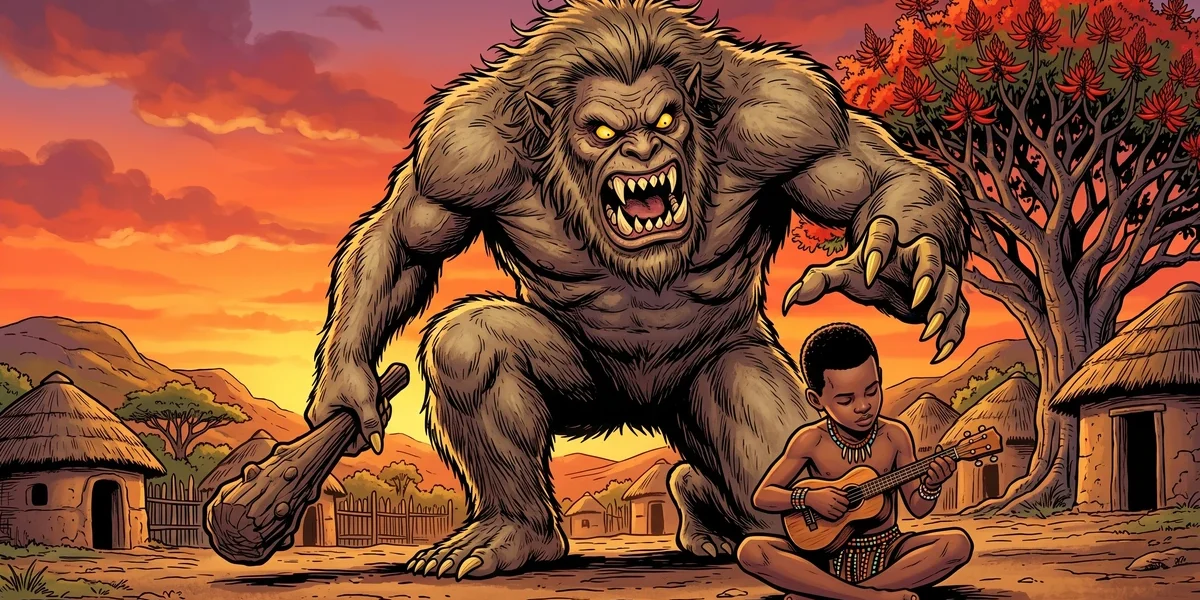
In the rolling hills of the Eastern Cape, where the high veld tilts down toward the Indian Ocean and the sky stretches wider than any village can imagine, there once lived a boy named Sipho and his father, a magician. Their hut stood at the edge of the kraal, a little apart from the others, because nobody in the village was quite sure what to make of them. Sipho carried a small ukulele wherever he went, a curious instrument that had travelled to the cape on a Portuguese trading ship and ended up in the hands of a quiet, music-loving boy. His father, meanwhile, owned a magic wand — a slender stick of mountain-acacia wood — with which he could make things vanish: cooking pots, hoes, the chief’s snuff-box, even a goat once, briefly, to general consternation.
The chief and the elders were patient people, but their patience had limits. Sipho’s plinking ukulele kept the babies awake; his father’s vanishing tricks were funny once and irritating the second time and unbearable the third. After yet another disappearing pot returned with a clang into a cousin’s lap during the evening meal, the chief gathered the council under the great umsintsi tree and announced the verdict. The boy with his strange music and the father with his disappearing wand were to leave the village. They could keep their belongings; they could not keep their place by the fire.

The Banishment Beneath the Umsintsi Tree
The Xhosa intsomi tradition almost always begins with a separation. Harold Scheub, whose recordings of Nongenile Masithathu Zenani and other Xhosa storytellers fill thousands of pages of fieldwork, observed that the imbongi‘s opening move is to push a small protagonist out of the safe centre of village life and into a wide, dangerous edge. Only at that edge, exposed to wind and monsters, can the child discover what they are made of. The expulsion of Sipho and his father is the tale’s first ngqi, the structural hinge on which everything else turns.
So Sipho rolled up his sleeping mat, slung his ukulele on his back, and walked out of the gate behind his father. They did not look back. The village watched them go, and most of the watchers felt a small, unfamiliar tug of regret — not enough to call them back, but enough to remember the shape of the boy and his small instrument as they shrank into the distance. The father carried his wand in his belt. The boy, as he walked, plucked one quiet note, then another, until the path through the long grass had a soundtrack of its own.
They built a new home in a copse of yellowwoods half a day’s walk from the village. They drew water from a stream where reedbuck came in the evening. They were lonely, but they were free. The ukulele played whatever Sipho asked of it, and the wand made hoes and water-pots come and go for the entertainment of nobody but themselves. Days passed. The grass grew higher. The village half a day away forgot them, or almost forgot them, the way villages forget anything inconvenient.
The Coming of Abiyoyo
Then, one morning, the watchman on the hill above the kraal began to scream.
What he had seen, the elders did not at first believe. A shape on the horizon, taller than the tallest fig tree, taller than the smoke columns from the cooking-fires, taller than anything that had any business being on two legs. The shape moved with a long, slow, deliberate stride, and with each step the ground shivered like the hide of a frightened cow. It was Abiyoyo, the giant of the old lullaby, the monster that grandmothers had used for generations to hush restless toddlers: “Thula, sana, uzobuya uyihlo— uAbiyoyo uyeza, hush, little one, or Abiyoyo will come.” The grandmothers had not meant it literally. The grandmothers had been wrong.

Abiyoyo came over the ridge in the late afternoon, and he was every inch of the terror the song had promised. His teeth were the colour of old ivory and his eyes burned like cooking-fires. His fingernails were yellow and long and curled like the talons of a martial eagle. He stank of swamp-water and old blood. He picked up a calf in one hand and a sheep in the other and chewed them as a man would chew biltong, and he laughed a laugh like rocks falling into a gorge. The villagers ran for the huts. The chief locked the council-house. The mothers gathered their children behind the cattle-byre and prayed to ancestors who had never had to confront anything as large as Abiyoyo and did not, frankly, know what to do.
The Boy with the Ukulele Returns
Word travels fast on the veld, even in a panic. By nightfall, Sipho and his father, half a day away in their yellowwood copse, had heard the news from a breathless herder who had run all the way through the long grass to find them. The herder fell at their feet and gasped that Abiyoyo had come, that Abiyoyo was eating the cattle, that Abiyoyo would surely eat the children next, that the village — the same village that had thrown them out — needed them back.
The father looked at his son. The son looked at his ukulele. Neither of them spoke for a long moment, because the situation contained a question that could only be answered in silence: Do you go back to the people who banished you, when they need you? The Xhosa storyteller Nongenile Zenani, in a story Scheub transcribed in 1972, gives a similar moment its own term: ukubuyela ngenkohlakalo, “to return through the wickedness,” meaning the act of going home along the very road that hurt you. Sipho slung his ukulele on his back. His father tucked the magic wand into his belt. They set out at a run.
They came into the village from the western gate just as Abiyoyo was finishing his second cow. The giant turned his cooking-fire eyes on them and grinned, because two more morsels — a small boy and a thin man — were exactly the kind of dessert he had been hoping for. The villagers, watching from behind their shutters, had a fleeting and shameful thought: Well, perhaps he will eat the strange ones first, and the rest of us can flee while he is busy.

Sipho did not run. Sipho sat down in the dust at the centre of the kraal, settled the ukulele on his lap, and began to play. The melody was simple, four notes, climbing and falling and climbing again, the kind of tune a grandmother might hum to a sleepless baby. To the melody he fitted a single word, the giant’s own name, the lullaby word that had hushed Xhosa children for hundreds of years. “Abi-yoyo. Abi-yoyo. Abi-yoyo, yoyo, yoyo.”
The Song That Made the Giant Dance
The giant stopped chewing.
Nobody had ever sung Abiyoyo’s name to Abiyoyo before. Nobody had ever dared. The giant tilted his enormous head, like a dog hearing an unfamiliar whistle, and listened. The lullaby was the song his own mother had hummed to him in the long ago of giant-childhood, before he grew large enough to terrify villages, and a long-buried memory of being small and loved twitched behind his cooking-fire eyes. He took a step toward the music. The ground shook. He took another step. He could not help it. His enormous foot lifted in something that was not quite a stamp and not quite a dance. The boy played faster. The giant moved faster. “Abi-yoyo, Abi-yoyo, yoyo, yoyo.” Abiyoyo began, in a slow and terrible way, to dance.
He danced until his great chest heaved and the sweat ran down his swamp-stinking arms in rivers. He danced until his teeth chattered and his eyes rolled. He danced until his enormous legs gave way and he collapsed, panting, into the dust of the very kraal he had come to destroy. The drumming, dancing, instrument-as-weapon motif is a signature of Bantu monster tales; Scheub catalogues at least eleven variants from the Eastern Cape alone in which a child-hero immobilises a cannibal giant through song before any decisive blow is struck. The song is the trap. The dance is the binding. What follows is only the formality.

Sipho’s father stepped forward, drew the acacia wand from his belt, pointed it at the gasping mountain of giant on the ground, and spoke a single word. “Zip.” Abiyoyo blinked once. Abiyoyo vanished. Where the giant had been, there was only a depression in the dust the size of a kraal cattle-pen, and a faint, fading smell of swamp.
The Return of the Banished
The villagers came out from behind their shutters. The chief came out from the council-house. The mothers came out from behind the cattle-byre with their children clinging to their skirts. For a long moment nobody knew what to say. The chief, who was a proud man but not a stupid one, opened his mouth and closed it again. He had banished a boy with a ukulele and a man with a vanishing wand because their gifts had been a nuisance, and the same gifts had just saved his village.
In the Xhosa intsomi, the conclusion is almost never a punishment of the elders who got it wrong. It is, instead, a quiet reabsorption of the exiled hero into the centre of the village — an unspoken admission that the community needs precisely the gifts it was tempted to throw away. The chief stepped forward, took Sipho’s small hand in his very large one, and said only: “Come home.” The father followed. The ukulele played itself a little tune of returning, and the village, hesitantly at first and then with great enthusiasm, joined in. The children, who had heard the lullaby their whole lives without ever meeting its monster, learned that night that their grandmothers had been singing about something real, and that the song that could make a giant come could also, in the right hands, make him go.
The Moral and the Lullaby
The lullaby in its plain Xhosa form is short:
Thula thu, thula sana, thula sana, thul’ u sa na.
Abiyoyo, Abiyoyo. Abiyoyo, yoyo, yoyo.
— Traditional Xhosa lullaby, isiXhosa text as collected by Pete Seeger from a 1947 songbook of South African children’s songs (Folkways liner notes, FC 7525, 1958)
The lullaby’s lesson, the one mothers in the Eastern Cape have been singing into their children’s ears for centuries, is that the things we are most frightened of can be quieted, not by stronger weapons but by the right song at the right moment. The boy’s ukulele is small. The father’s wand is a stick. Abiyoyo is a mountain of teeth. Yet the small thing wins, because the small thing knows the giant’s name, and the small thing is willing to sit down in the dust and sing it. That is the moral. It is not “be brave.” It is something quieter and stranger: know the name of the thing that scares you, and the thing that scares you can be made to dance.
Why This Tale Has Lasted
Pete Seeger, who first heard the Abiyoyo lullaby on a 1947 South African songbook recommended to him by his sister Peggy, said decades later that the story changed his life. He recorded it for Folkways in 1958, told it to his own children, and finally, in 1986, wrote it down as a picture book with the painter Michael Hays. The book has never been out of print. It has been adapted as an opera, a Reading Rainbow episode, a ballet, and an animated short. It travelled from a Xhosa grandmother’s hut to a Folkways studio in New York to a children’s bookshelf in Mumbai because it offers something that almost no other monster-tale offers: an instruction manual, in four bars of melody, for how to face the unfaceable.
The tale also belongs to a deep stratum of Bantu narrative in which song, drum, and instrument are not entertainment but technology — tools as practical as a spear, and considerably more powerful. From the Zulu amahubo war-chants to the Sotho likoma initiation cycles to the Xhosa imibongo praise-poems, southern African oral cultures have always understood that the right sequence of sounds can bind a king, summon rain, or, in this case, exhaust a giant into helplessness. Abiyoyo is a children’s story about that understanding. It is, in the end, why a small boy with a small instrument can defeat a mountain — and why, eighty years after a Xhosa grandmother first hummed her grandchild to sleep with the giant’s name, the song is still being sung.
Frequently Asked Questions
Where does the Abiyoyo folk tale come from?
Abiyoyo is a Xhosa folk tale and lullaby from the isiXhosa-speaking communities of the Eastern Cape, South Africa, part of the wider Bantu monster-tale tradition. It belongs to the imibongo yokulalisa (lullaby cycle) and was widely circulated in print by the American folk singer Pete Seeger, who learned the song from a 1947 South African songbook and recorded it on Folkways FC 7525 in 1958. The illustrated picture book by Seeger and Michael Hays (Macmillan, 1986) is the version most readers encounter today, but the tale itself is much older, sung by Xhosa grandmothers for centuries to hush restless toddlers.
Is Abiyoyo a real Xhosa folk tale or did Pete Seeger invent it?
It is a genuine traditional Xhosa lullaby and folk tale, not a Seeger invention. The lullaby Thula thu, thula sana – Abiyoyo, Abiyoyo predates Seeger by at least a century. Seeger’s contribution was the prose narrative wrapped around the song: the banished boy with the ukulele, the magician father with the wand, the giant defeated by music. Folklorist Harold Scheub documents at least eleven Eastern Cape variants in which a child-hero immobilises a cannibal giant (isikhulu) through song before the giant is dispatched, placing Abiyoyo squarely in the intsomi tradition.
What ATU tale type does Abiyoyo belong to?
Abiyoyo is most closely related to ATU 1115 (Killing the Ogre by Trick) and to the broader Singing Ogre subgroup of Bantu monster tales catalogued by Sigrid Schmidt in her Catalogue of the Khoisan Folktales of Southern Africa (Buske, 1989). It also overlaps with ATU 327 cluster motifs in which a small protagonist outwits a giant or cannibal through cleverness rather than strength. Within Xhosa intsomi tradition the controlling motif is the giant’s neutralisation through song and instrumental magic – a pattern Scheub identifies in at least eleven Eastern Cape variants.
What is the deeper meaning of the lullaby in this story?
The lullaby’s lesson is that fear can be quieted not by stronger weapons but by the right song. To name the monster – to sing his own name back at him – is to take its terror away. In the wider Bantu narrative tradition, song and instrument are not entertainment but technology: as practical as a spear and far more powerful. The Zulu amahubo war-chants, the Sotho likoma initiation cycles, the Xhosa imibongo praise-poems all share this conviction that the right sequence of sounds can bind a king, summon rain, or, in Abiyoyo’s case, exhaust a giant into helplessness.
How can a parent or teacher read this story with children?
Read the four narrative beats slowly – banishment, arrival of the giant, return of the boy, song-and-dance – and pause after each to let the child predict what happens next. Sing the four-note Abiyoyo lullaby aloud (it is in the public domain) so the child experiences the song as the tool that defeats the monster, not just a description of it. Discuss the unspoken question the father and son face: do you go home to people who hurt you when they need help? Xhosa storyteller Nongenile Zenani calls this ukubuyela ngenkohlakalo, returning through the wickedness. The story is an early lesson in courage and forgiveness without the moralising tone of European fairy tales.
You May Also Like
 African Folk Tales
Ages 6-8
African Folk Tales
Ages 6-8
Jackal And Monkey
A captive jackal escapes a Cape farmer's wip snare by tricking a gloating monkey into taking his place - a dark South African trickster tale from the Khoikhoi jackal cycle, retold from James A. Honey's South-African Folk-Tales (1910).
 African Folk Tales
Ages 6-8
African Folk Tales
Ages 6-8
Lion Who Thought Himself Wiser Than His Mother
A Khoikhoi animal fable from the Cape of southern Africa, recorded in James A. Honey's South-African Folk-Tales (1910): a proud young lion ignores his mother's threefold warning about Man, his white dogs and his pinching weapons — and dies in the very ambush he set at Aroxaams.
 African Folk Tales
Ages 6-8
African Folk Tales
Ages 6-8
Tink-Tinkje
The southern African folk tale 'Tink-Tinkje', the Cape form of the worldwide 'election of the king of birds' fable, in which the smallest bird wins the crown by cleverly riding unfelt on the soaring vulture's wing.