Lion Who Thought Himself Wiser Than His Mother
A Khoikhoi animal fable from the Cape of southern Africa, recorded in James A. Honey's South-African Folk-Tales (1910): a proud young lion ignores his mother's threefold warning about Man, his white dogs and his pinching weapons — and dies in the very ambush he set at Aroxaams.
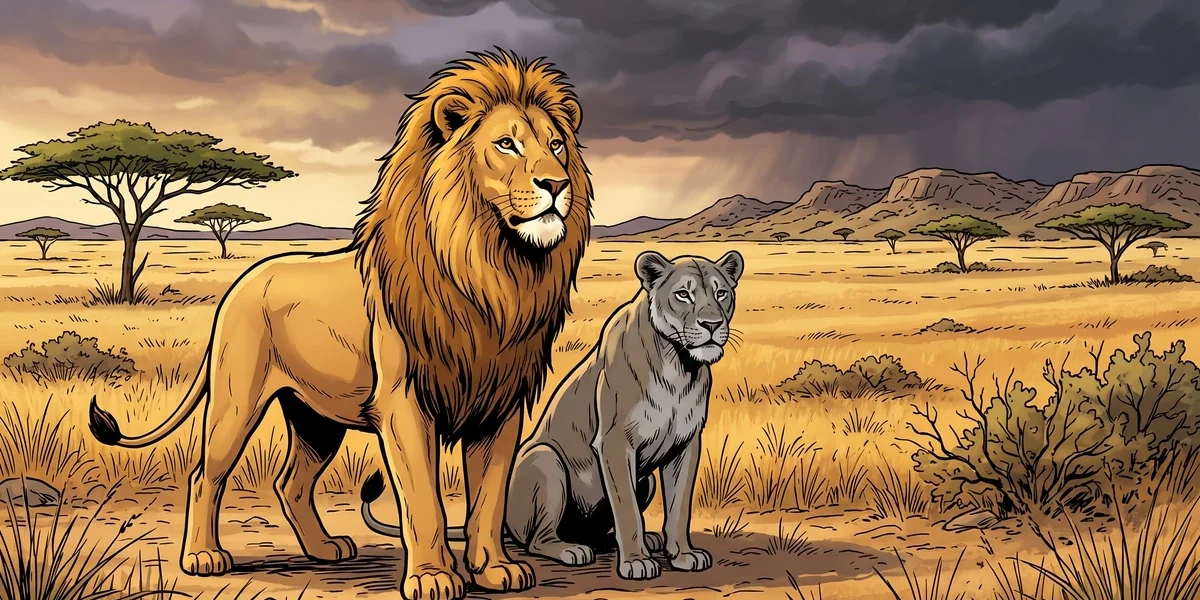
The Lion Who Thought Himself Wiser Than His Mother is one of the best-loved animal fables of the Khoikhoi people of southern Africa — a short, sharp tale in which the king of beasts learns, too late, that knowing a danger and respecting it are not the same thing. It belongs to the great corpus of Cape orature gathered in James A. Honey’s South-African Folk-Tales (New York: Baker & Taylor, 1910), where it stands as the thirty-eighth tale in the collection. Beneath its plain hunting-veld setting lies a piece of moral teaching as old as parenthood itself: the young will not be warned, and pride is a poor shield against a spear.
A Khoikhoi Tale from the Cape Veld
This story comes from the Khoikhoi (historically called the “Hottentots” by European settlers, a term now considered offensive and abandoned by scholars), the cattle-and-sheep-herding people of the dry plains and stony hills of the western and central Cape. Theirs is a landscape of thornveld and karoo scrub, of sudden thunderstorms that turn dust to mud in an afternoon, and of rain-fields — patches of ground that green briefly after a storm and draw both grazing herds and the hunters who follow them.
Khoikhoi storytelling places animals and human beings in the same moral world. Lion is a person of rank, with a mother, a temper, and a reputation to defend; Man is a neighbour to be reckoned with, not merely prey or predator. The tale’s antagonist is named Gurikhoisip — “the First Man” or “the Only Man” — a near-mythic figure who stands for humankind itself. When the lioness describes Man to her son, she is not describing one hunter but the whole dangerous, clever, tool-bearing species. That is what gives the fable its weight: it is the lion’s refusal to learn the single most important lesson of his world.
The Story Retold
1. The Quarrel in the Thunderstorm
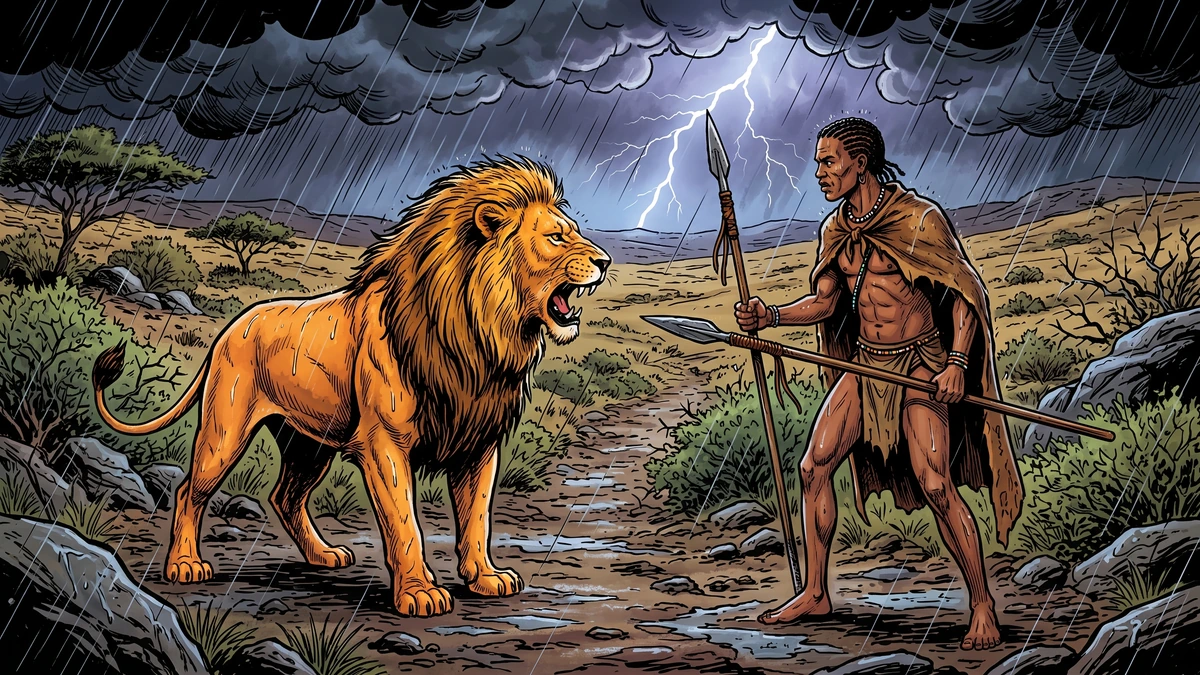
It happened, the Khoikhoi storytellers say, that a great thunderstorm rolled across the veld, and the rain came down hard upon the dry earth. A young Lion, strong and certain of himself, set out toward a rain-field where the new grass would soon draw the game. On the same path, hurrying through the same downpour, came Gurikhoisip — the Only Man.
The two met where the track narrowed, and at once they fell to quarrelling. Each insisted that the other should be the one to step aside and run for the rain-field by the longer way. Lion would not yield, for he was a king and kings do not give ground. Man would not yield, for he had business of his own and no fear in his face. They argued in the rain until both were soaked and angry, and at last they parted without settling anything, each going his own way with a grievance kept warm in his chest.
2. The Mother’s Warning
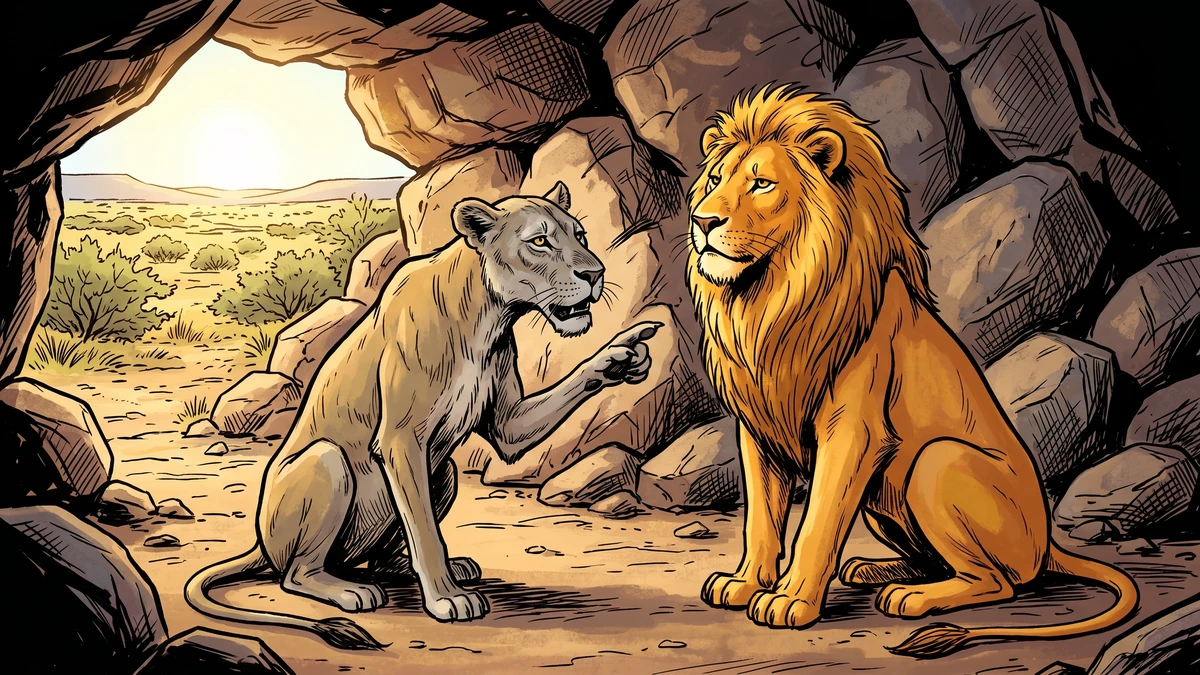
Lion went home to his mother. She was old; she had lived through droughts that emptied the water-holes and seasons when the game vanished from the plain, and her quiet wisdom was famous among the beasts. Lion told her of the quarrel in the storm — how a creature on the path had dared to stand against him and refused to step aside.
The old lioness listened, and then she grew grave. “My son,” she said, “that was the Man. Beware of him. You must be on your guard against that thing whose head stands in a line with his shoulders and his breast; who carries pinching weapons that bite from far off; who keeps white dogs about him; and who goes about wearing the tuft of a tiger’s tail. Do not lie in wait for that one. Of all the creatures of the veld, he is the one you cannot afford to meet in anger.”
She told him this once, and then she told him again, and a third time, pressing the warning on him as a mother does when she knows her child is not truly listening.
3. The Pride of the Young Lion
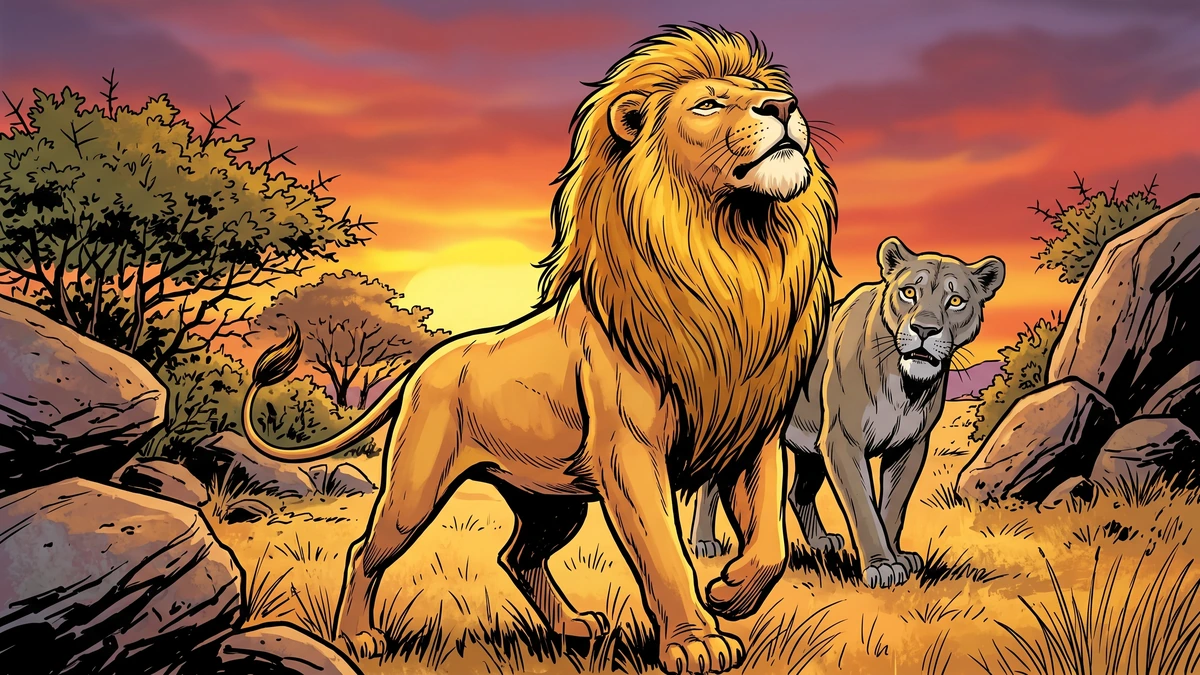
But Lion only tossed his great maned head. “Why,” he said, “need I be on my guard against those whom I know?”
It was a careless answer, and a proud one. To the young Lion, knowing the Man — having seen him, having quarrelled with him, having measured him on a narrow path — felt the same as being safe from him. He believed that recognition was protection, that because he could name the danger he had already mastered it. He had the strength of his shoulders, the thunder of his roar, and the certainty of youth, and he could not imagine that a creature with its head set flat upon its breast could undo him.
His mother saw the gap in his thinking, but she could not close it for him. No warning, however true, can travel into a mind that has already decided it knows enough. Lion lay down that night pleased with himself, planning how he would settle the score.
4. The Ambush at Aroxaams
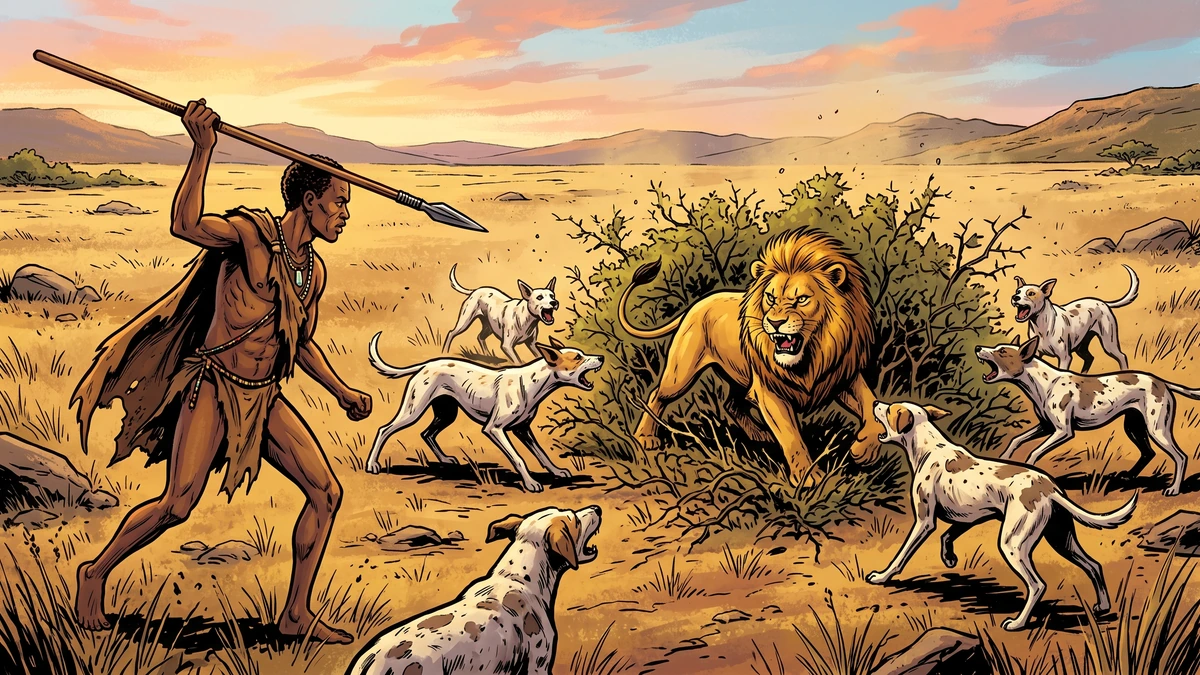
In the early morning Lion went out to a place called Aroxaams, where he knew the Man would pass, and there he lay down in the scrub to wait. He meant to take his enemy by surprise and finish the quarrel his own way.
Gurikhoisip came along the path as Lion had foreseen — but he did not come alone, and he did not come unready. Around him ran his white dogs, casting through the bush, and the moment they caught the lion’s scent they swung toward the thicket and ringed it, baying. They held Lion exactly as the old lioness had said they would: pinned, surrounded, his ambush turned inside out. And while the dogs held him, the Man came up with his pinching weapon — his spear — and Lion was struck down at Aroxaams, in the very ambush he had set, undone by every single danger his mother had named and he had waved away.
The Moral of the Tale
The Khoikhoi did not append a tidy sermon to this story; the ending carries the lesson on its own. Lion is not destroyed by an unknown danger or an unlucky chance. He is destroyed by a danger that was named to his face, three times over, in plain words — the flat-headed shape, the biting weapons, the white dogs, the leopard-tail tuft. He dies of the gap between hearing a warning and heeding it.
The Cape herding peoples and their Afrikaans-speaking neighbours kept a proverb that states the matter exactly, and it could serve as the tale’s closing line:
“Wie nie hoor nie, moet voel.”
— “He who will not hear must feel.”
The fable’s deeper point is a precise one about the nature of knowledge. Lion’s fatal sentence — “Why need I be on my guard against those whom I know?” — mistakes acquaintance for understanding. He had met the Man, so he assumed the Man held no surprises. But his mother’s warning was not about the Man’s face; it was about his dogs, his reach, his weapons, his patience — the whole system of human danger. To know a thing’s name is the beginning of caution, not the end of it. Wisdom, the tale insists, is not collected; it is accepted, and accepted from those who have earned the right to give it.
Origin, Source and Attribution
The tale was published in English as “Lion Who Thought Himself Wiser Than His Mother” in James A. Honey’s South-African Folk-Tales (New York: Baker & Taylor Company, 1910), where it appears as tale 38. Honey’s slim anthology gathered animal stories from the Cape — Khoikhoi, San (Bushman) and Cape-Dutch material — and made them available to a general American and British readership for the first time.
Honey’s book draws heavily on the foundational nineteenth-century scholarship of Wilhelm Heinrich Immanuel Bleek, the German-born philologist whose Reynard the Fox in South Africa; or, Hottentot Fables and Tales (London: Trübner, 1864) was the first serious published collection of Khoikhoi narrative. Bleek, later joined by his sister-in-law Lucy Lloyd, did pioneering work recording the orature and languages of the Cape’s indigenous peoples; the Bleek and Lloyd Archive remains one of the most important records of |Xam San and Khoikhoi storytelling in existence. Stories of Lion and the Only Man, and of Lion and Jackal, form a recurring cycle within this tradition — the same cycle that supplied the neighbouring tales recently retold on this site.
The figure of Gurikhoisip, the First or Only Man, belongs to Khoikhoi cosmology, where he is connected to the broader mythic complex around the culture-hero Heitsi-Eibib. In a fable like this one, however, he functions simply as Man-in-general — the species against whom even a lion must be on his guard.
Folklore Classification
In international folktale scholarship, “The Lion Who Thought Himself Wiser Than His Mother” sits among the cautionary animal fables rather than the trickster cycle proper. It has no Aarne–Thompson–Uther (ATU) tale-type number of its own, but it is built from motifs catalogued in Stith Thompson’s Motif-Index of Folk-Literature: J1050, “Attention to warnings” (and its inverse, the disregarded warning); J652, “Inattention to warnings”; W165, “Pride” / overconfidence; and the broad family of L-motifs in which the proud and powerful are humbled. The structural pattern — a warning given three times and three times waved aside, followed by an ending that fulfils every word of it — is one of the most widespread shapes in world folklore, and the rule of three gives the Khoikhoi version its tight, inevitable rhythm.
Thematically the fable is a near cousin of Aesop’s warnings against overconfidence and of countless Indian, Jataka and Panchatantra tales in which a strong animal is undone by refusing counsel. What marks the Khoikhoi telling as distinctly southern African is its concrete detail: the rain-field, the thunderstorm quarrel, the white hunting dogs, the leopard-tail ornament, and the named place, Aroxaams.
Themes and Cultural Context
Three threads run through the tale. The first is respect for elders, a cornerstone of Khoikhoi and broader southern African social life, where the experience of those who have survived drought and hardship is treated as a community resource. The old lioness is not merely a worried parent; she is the keeper of survival knowledge, and her son’s death is, in part, a waste of an inheritance freely offered.
The second is the danger of human beings. Khoikhoi animal stories often turn on the realisation that Man, physically unimpressive beside lion or elephant, is the most dangerous creature on the veld because he carries tools, keeps allies, and plans. The lioness’s catalogue — flat head, pinching weapons, white dogs, leopard-tail tuft — is a small field-guide to that danger, and the tale is partly a teaching device for the young.
The third is the fable’s sharp distinction between strength and wisdom. Lion has every physical advantage and still loses, because the contest was never really about strength. He is beaten by counsel ignored, by allies he did not have, and by a patience he lacked. In a herding society where cooperation and accumulated know-how mattered more than individual force, that was a lesson worth telling to every new generation.
The Tale Beside Its Neighbours
This fable is best understood as one panel in a larger Cape mural. The Khoikhoi and San traditions preserve a whole cycle of stories in which Lion — proud, strong and slow to take advice — is repeatedly outmatched: by the cunning Jackal, by the patient Tortoise, and here by Man himself. Read alongside its neighbours in Honey’s anthology, the tale rounds out a consistent southern African portrait of lionhood: magnificent, royal, and fatally certain that strength is the same thing as sense.
Its threefold-warning structure also links it to a worldwide family of fables. The Aesopic tradition warns again and again against the overconfidence of the powerful; the Indian Panchatantra and the Buddhist Jataka tales are full of mighty animals undone by refusing counsel; European household tales repeat the pattern of advice given thrice and ignored. What the Khoikhoi version contributes is its lean economy and its grounding in a real working landscape — the rain-field, the storm, the hunting dogs, the named ambush-place — so that a universal lesson arrives wearing unmistakably local dress. Tales like this one were the practical curriculum of a herding
You May Also Like
 African Folk Tales
Ages 6-8
African Folk Tales
Ages 6-8
Thing To Do
A young person learns that the most important accomplishments are the small, caring things we do.
 African Folk Tales
Ages 9-12
African Folk Tales
Ages 9-12
The Tail Of The Princess Elephant
The Tail Of The Princess Elephant: There once lived a woman who had three sons. These sons were very much attached to their mother and always tried to please
 African Folk Tales
Ages 6-8
African Folk Tales
Ages 6-8
How Wisdom Became The Property Of The Human Race
How Wisdom Became The Property Of The Human Race. Long ago, wisdom belonged only to a few. Learn how one person changed everything by sharing knowledge.