The Grinding-Stone That Ground Flour By Itself
A poor brother borrows a magic mill — and that is why, to this very day, the sea tastes of salt.
In the Akan villages of the old Gold Coast, there is a stone that knows a secret about hunger — and a spider who never learned it. The Grinding-Stone That Ground Flour by Itself is one of the best-loved anansesem, the “spider stories” told after dark in the forest country of what is now Ghana. It begins, as so many of these tales do, with a famine, a clever cousin, and Kwaku Anansi the spider, whose appetite for more is always larger than his sense. By the time the story ends you will know why, even today, you can lift a heavy stone in the bush and find a knot of tiny spiders huddled underneath it.
Where the Story Comes From
This tale was set down in print in West African Folk-Tales, collected and arranged by W. H. Barker and Cecilia Sinclair and first published in 1917 (George G. Harrap & Co., London, with an edition prepared in Lagos). It appears in that volume as Tale XIII, “The Grinding-Stone That Ground Flour by Itself.” William Henry Barker was a missionary and the principal of a government training college at Accra; Cecilia Sinclair worked alongside him to gather and arrange the oral material. Their collection drew on the living storytelling tradition of the Akan peoples — the Ashanti, Fanti and related groups of the Gold Coast — and it remains one of the most widely read English-language windows onto West African oral literature.
The tale belongs to the great cycle of Anansi the spider (Akan: Kwaku Ananse), the trickster who dominates Akan folklore so completely that the very word for “folk tale” in Twi, anansesem, means literally “Anansi stories.” Anansi is clever, lazy, hungry and vain, and the tales use him in two ways at once: as a figure of delighted mischief, and as a cautionary mirror in which listeners are invited to recognise — and laugh at — their own worst impulses. This particular story is one of the cautionary kind.
Folklorists place it among the magic-object tales: in the Aarne–Thompson–Uther international index it stands close to ATU 565, “The Magic Mill,” the family of stories about a mill or stone that grinds food (or salt, or porridge) of its own accord. The European cousins of that type — the Norse and German tales of the mill that explains why the sea is salt — keep the mill running forever. The Akan version turns the same wonder to a sharper moral end. In the motif-index of Stith Thompson the heart of the story is D1601.21, the self-grinding mill, joined here to a punishment motif (the magic object that destroys the greedy thief) and rounded off with a pourquoi or etiological coda — the kind of “why things are as they are” ending that explains a feature of the natural world.
The Setting: A Land Emptied by Famine
The story opens in hard times. “There had been another great famine throughout the land,” the tellers begin — and that small word another does a great deal of work. Famine, in the world of these tales, is not a freak event but a recurring season of the year and of life, a danger every Akan listener understood in their bones. The villagers are described as thin and pale; the forest, usually generous, has closed its hand.
Into that grey landscape the story sets one startling exception. “Only one family appeared healthy and well.” In a community where everyone is starving together, to be visibly plump is not a comfort — it is a question. How? The household that thrives is that of Anansi’s cousin, and the contrast between his family’s round cheeks and the village’s hollow ones is the spark that lights the whole tale. Hunger here is the engine of the plot, but it is also the moral test: famine strips people down to what they really are, and the story is about to show us two very different answers to the same scarcity.
The Characters
Kofi, the cousin. The fortunate kinsman is named Kofi — an Akan “day name” given to a boy born on Friday (Fiada). He is the moral centre of the tale: a hunter, modest, and — the tellers are careful to say — “not a greedy man.” When he stumbles on a miracle, he takes from it only what his family needs for a single day, and returns the next morning for no more. Kofi is not weak or simple; he is something the story values far above cleverness, namely a man who knows the difference between enough and more.
Anansi, the spider. Against him stands his cousin Anansi, “the greedy fellow,” the trickster spider of a thousand Akan tales. Anansi’s defining trait is not malice but appetite: he cannot bear the thought that someone else has a good thing and he does not. He is genuinely clever — the story will show off his cunning in full — but his cleverness is harnessed entirely to his hunger, and that is precisely his undoing. In the anansesem tradition Anansi is both hero and warning, and here the tellers have turned the dial firmly toward warning.
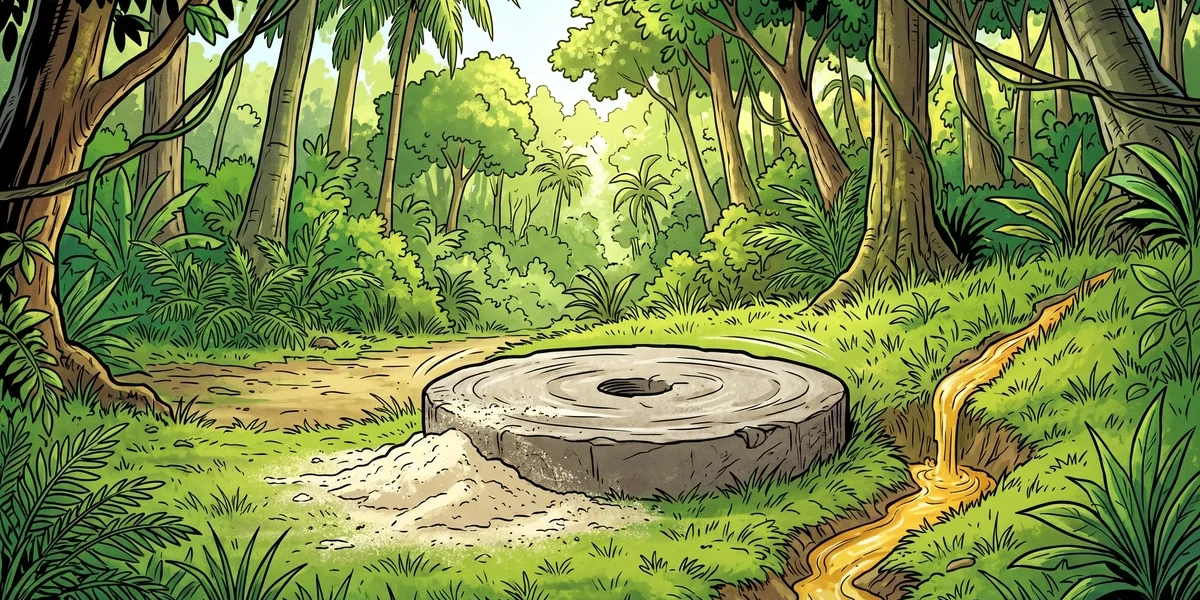
The grinding-stone. The third character is not a person at all. It is a stone lying in a forest clearing that grinds flour of its own accord, with a stream of honey running beside it — a small, perfect image of effortless plenty. But the stone is not a passive thing. It speaks; it has its own dignity and its own rule; and when that rule is broken it acts. The wonder of the tale is also its judge.
Beat One: Kofi and the Wonderful Stone
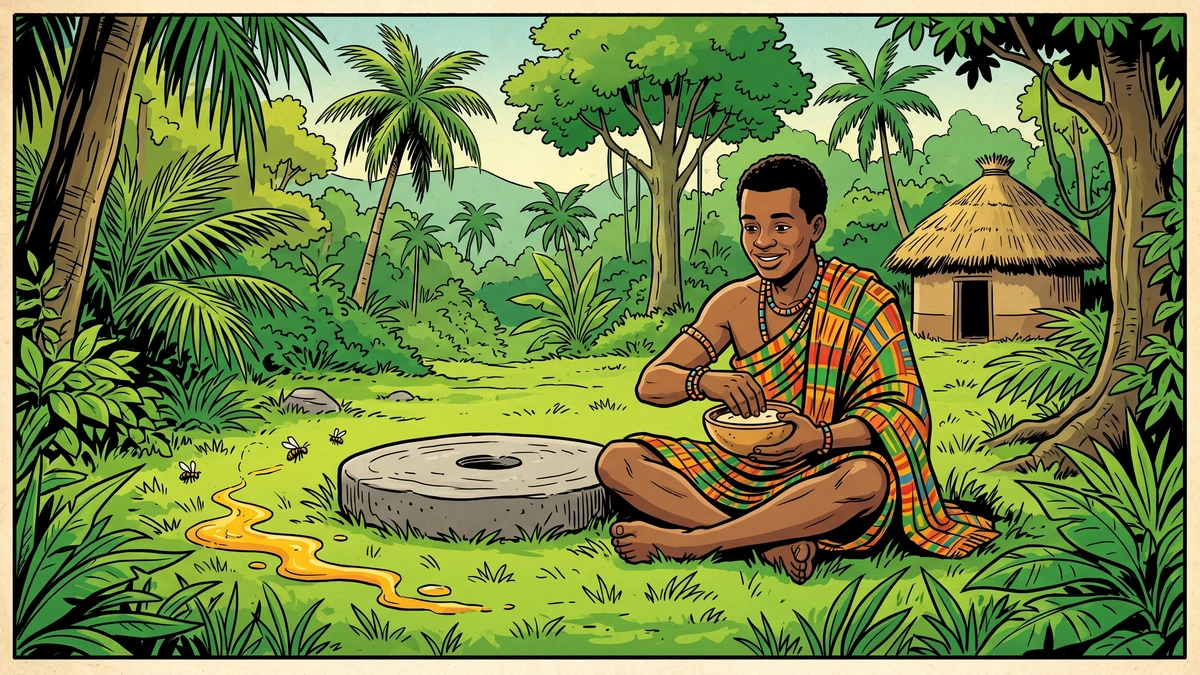
The story doubles back to explain Kofi’s good fortune. One morning, hunting in the forest, he had come upon the stone lying on the grass — grinding flour by itself, untended, with honey flowing in a stream nearby. Kofi was delighted. He sat down and ate a good meal on the spot. And then he did the thing the whole story turns upon: “Not being a greedy man, he took away with him only enough for his family’s needs.”
Each morning afterward he walked back to the clearing and gathered exactly one day’s food — no hoard, no surplus, no plan to sell. In this quiet, repeated act the tale draws its first portrait of virtue: not heroism, not sacrifice, simply the daily discipline of taking what is sufficient and leaving the rest. While the surrounding villages grew “starved and miserable-looking,” Kofi’s family stayed well and plump — and, crucially, the stone stayed where it was, still grinding, still generous, for anyone who would respect it.
Beat Two: Anansi’s Hunger for the Secret
Anansi could not understand how his cousin’s family stayed healthy, and “felt sure his cousin was getting food in some way.” That certainty is the spider all over: he does not suspect a crime so much as resent a secret. He began to give Kofi no peace, pressing him with questions until at last the worn-down cousin promised to show him the stone the next morning — “as soon as the women set about their work.”
Kofi made that promise “most unwilling”-ly. He knew his cousin’s wicked ways; he “felt sure that when Anansi saw the stone he would not be content to take only what he needed.” This is the moral hinge of the tale, and the story is honest about it: Kofi can see the disaster coming and still cannot refuse a relative who simply will not stop asking. Generosity, the tellers gently observe, can be worn down into folly by a person determined to abuse it.
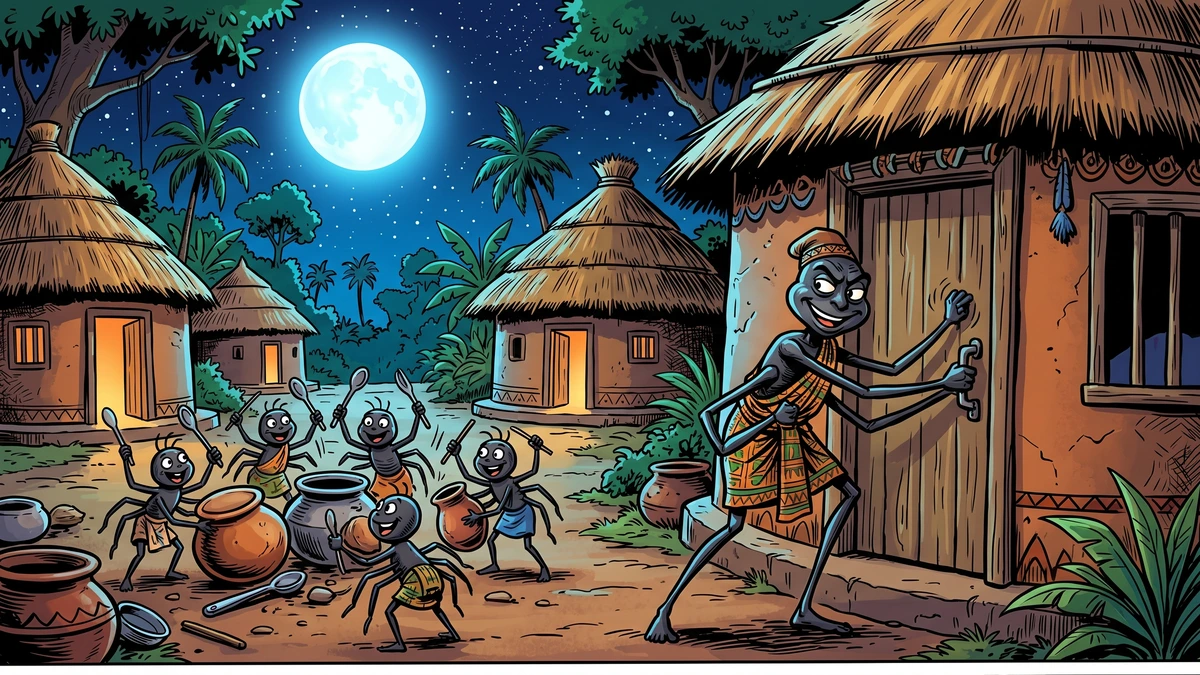
Then comes the comic centre of the story — Anansi’s impatience. Too eager to wait for morning, he woke his own children in the dead of night and had them clatter the cooking pots, “as if they were the women at work,” then ran to rouse Kofi: “Quick! It is time to start.” Kofi saw the trick and went back to bed. So Anansi had the children take brooms and sweep noisily; again he woke his cousin; again Kofi recognised the deception and slept on. The audience for an anansesem would have laughed aloud here — this is Anansi at his most gleefully ridiculous, unable to govern even his own haste.
Beat Three: The Trail of Ashes
Twice outwitted at his own game, Anansi turned from comedy to cunning. He slipped into his sleeping cousin’s room and cut a small hole in the bottom of Kofi’s carrying-bag, then filled the bag with ashes. After that he went away quietly and let Kofi sleep in peace — which was itself the trap.
When morning came and there was no sign of the spider, Kofi was glad. He set off alone for the forest, “thinking he had got rid of the tiresome fellow.” But behind him, with every step, a thin line of ash leaked from the cut bag and lay along the forest floor. He had no sooner seated himself by the stone than Anansi appeared at his shoulder, having simply followed the pale trail through the trees. It is a small, brilliant piece of trickster craft — and the tellers want us to feel its cleverness fully, because the whole point of the ending is that cleverness was never Anansi’s problem.
Beat Four: “Spider, Spider, Put Me Down”
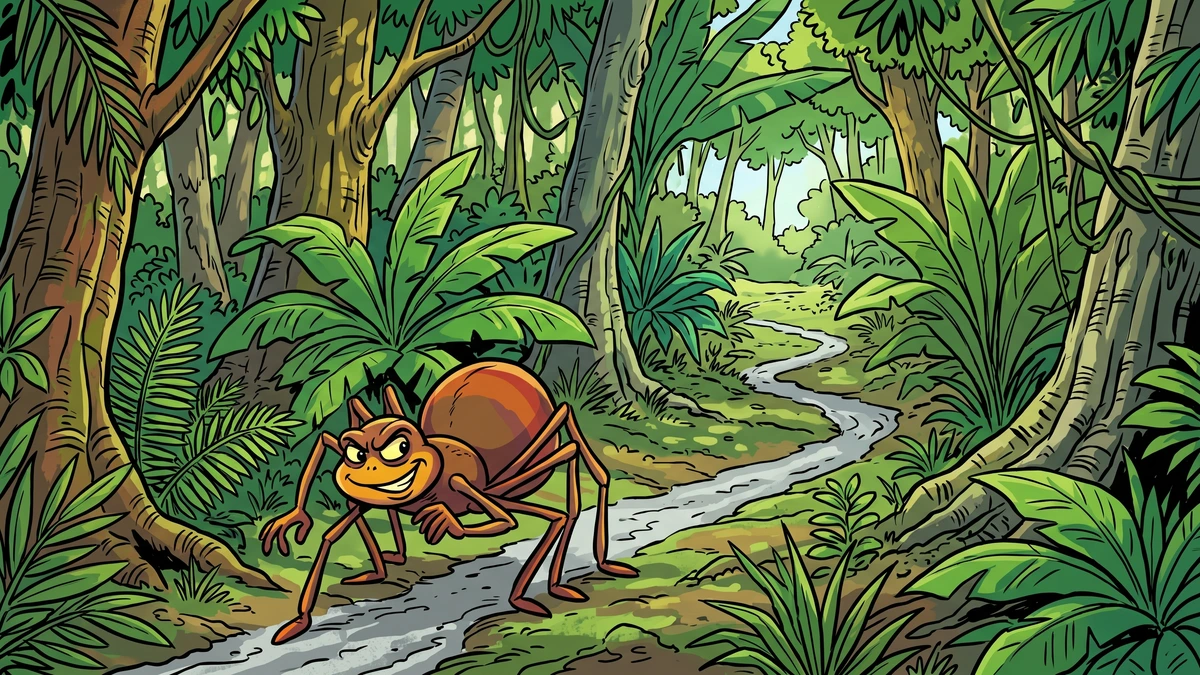
“Aha!” cried Anansi at the sight of the clearing. “Here is plenty of food for all. No more need to starve.” Kofi hushed him — “You must not shout here. The place is too wonderful. Sit down quietly and eat.” They ate well, and Kofi gathered his usual single day’s portion to carry home. But Anansi announced that he was going to take the stone.
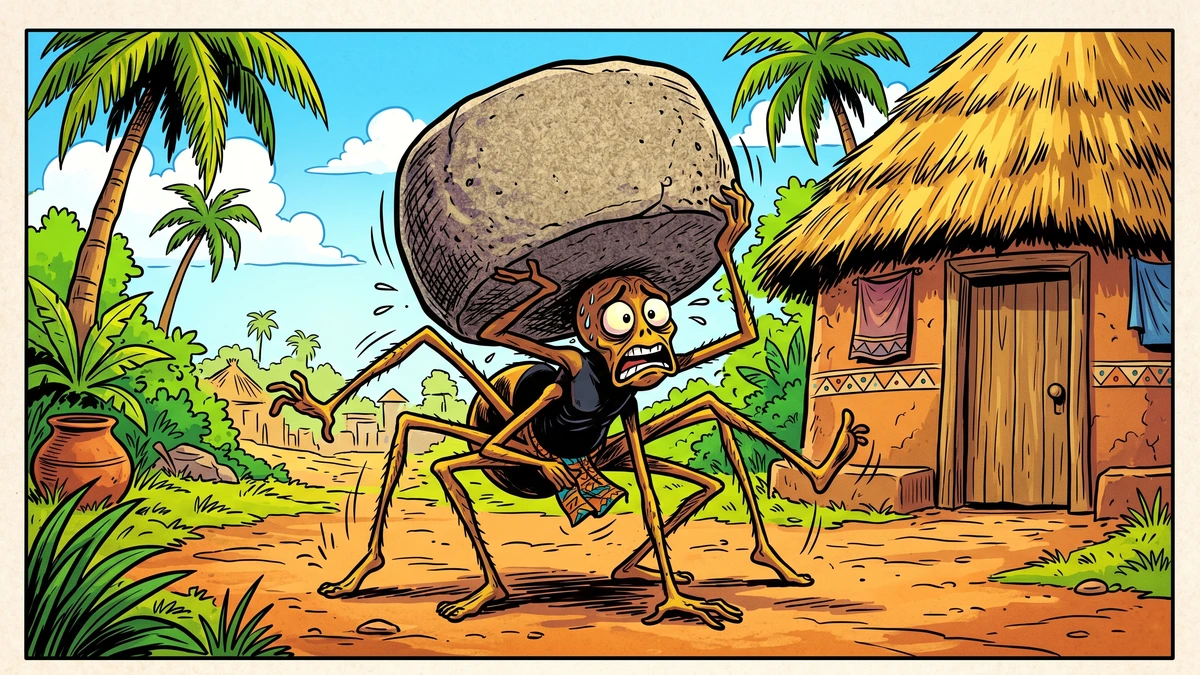
In vain his cousin pleaded with him. Anansi heaved the grinding-stone onto his head and set off for the village — and the stone began to sing:
“Spider, spider, put me down.
The pig came and drank and went away,
The antelope came and fed and went away:
Spider, spider, put me down.”
The song is the stone’s law spoken aloud. Pig and antelope came, took what they needed, and went away — they left the stone where it lay, for the next hungry creature. The stone is not asking for mercy; it is reminding Anansi of the single rule of the place. He refuses to listen. Instead he carries the stone from village to village, selling its flour, until his bag is “full of money,” and only then turns toward home.
Tired at last, he reached his hut and bent to set the stone down — and it would not be moved. It had stuck fast to his head. No effort could displace it, and its weight slowly grew “too much for Anansi, and ground him down into small pieces, which were completely covered over by the stone.” Then comes the etiological close that every listener was waiting for: “That is why we often find tiny spiders gathered together under large stones.” The wonder of the forest has become the explanation of an ordinary thing — and a permanent monument to one spider’s greed.
The Moral: The Difference Between Enough and More
The tale draws no line under its lesson; it does not need to. Two cousins met the same miracle in the same famine. Kofi asked the stone for a day’s bread and was fed for as long as the famine lasted. Anansi tried to own the miracle outright — to carry plenty home and turn it into a hoard of money — and the miracle destroyed him. The story is not against cleverness, and not even against wealth. It is against the particular sin the Akan call pɛsɛmenkominya, the craving to have everything for oneself: the inability to stop at enough.
The Akan have an old emblem for exactly this idea. Among the adinkra symbols is one called Funtunfunefu Denkyemfunefu — two crocodiles joined at a single belly. The proverb attached to it runs, in Twi:
“Funtunfunefu, denkyemfunefu, wɔwɔ yafunu baako, nanso wɔredidi a wɔko.”
“The two crocodiles share one stomach, yet when they eat they fight.”
The crocodiles’ quarrel is pure folly: whatever either one swallows feeds them both. Anansi is that crocodile. He lived in a community that the stone had quietly fed, refusing nothing to anyone who took only their share — and he could not see that hoarding the source for himself starved the very world he depended on. The grinding-stone, in the end, simply gave him what he had insisted on: the whole stone, and nothing else, forever.
Why the Story Has Lasted
For more than a century since Barker and Sinclair printed it, and for who knows how many generations of firelit telling before that, this small tale has survived because it does three things at once, and does them lightly. It entertains: Anansi banging the pots in the dark and sweeping with brooms at midnight is genuinely funny, and the trail of ashes is a clever stroke any listener can admire. It explains: the huddle of spiders under a stone in the bush is a thing children really do find, and the story hands them a memorable reason for it. And it instructs, without ever lecturing, by setting two answers to hunger side by side and letting the stone decide between them.
It also carries, very quietly, a piece of communal wisdom that the Akan storytelling tradition returns to again and again: that a shared resource survives only if each person takes a share. The stone fed a whole region as long as everyone treated it as Kofi did. It is a parable about the commons — about wells and forests and fisheries and every good thing held in trust — told centuries before anyone used that word, and it has lost none of its point. The next time you tip a stone in the grass and find the small spiders scattering beneath it, you may remember Anansi, who wanted the whole stone, and got it.
About This Retelling
This version follows the narrative of “The Grinding-Stone That Ground Flour by Itself” as recorded in West African Folk-Tales by W. H. Barker and Cecilia Sinclair (1917), Tale XIII, an Akan (Ashanti/Fanti) anansesem of the Gold Coast, modern Ghana. The stone’s song is quoted from that public-domain text. The classification notes (ATU 565 “The Magic Mill” affinity; Stith Thompson motif D1601.21, the self-grinding mill; the pourquoi/etiological ending) and the adinkra proverb of the joined crocodiles are provided as scholarly context for readers who wish to explore the tale’s place in the wider world of folk literature.
You May Also Like
 African Folk Tales
Ages 6-8
African Folk Tales
Ages 6-8
Anansi and the Pot of Wisdom
The Akan (Ashanti) trickster tale of how Kwaku Anansi the spider tried to hoard all the wisdom of the world in one clay pot - and how his own small son taught him the lesson that scattered wisdom across the whole earth.
 African Folk Tales
Ages 6-8
African Folk Tales
Ages 6-8
Abiyoyo: The Monster and the Boy
Abiyoyo: The Monster and the Boy: In a small South African village nestled at the edge of the high veld, where grasslands stretched endlessly toward a horizon
 African Folk Tales
Ages 9-12
African Folk Tales
Ages 9-12
The Story Of Hare
The Story of Hare is a Xhosa folktale from South Africa. Five careless watchmen die guarding the animals' fat from the monstrous inkalimeva, until the clever hare alone outwits the beast by its own trick - then nearly undoes himself through greed.