How the Leopard Got His Spots
The canonical story of how the leopard got his spots: Rudyard Kipling's pourquoi tale from Just So Stories (1902), retold with full scholarly attribution.
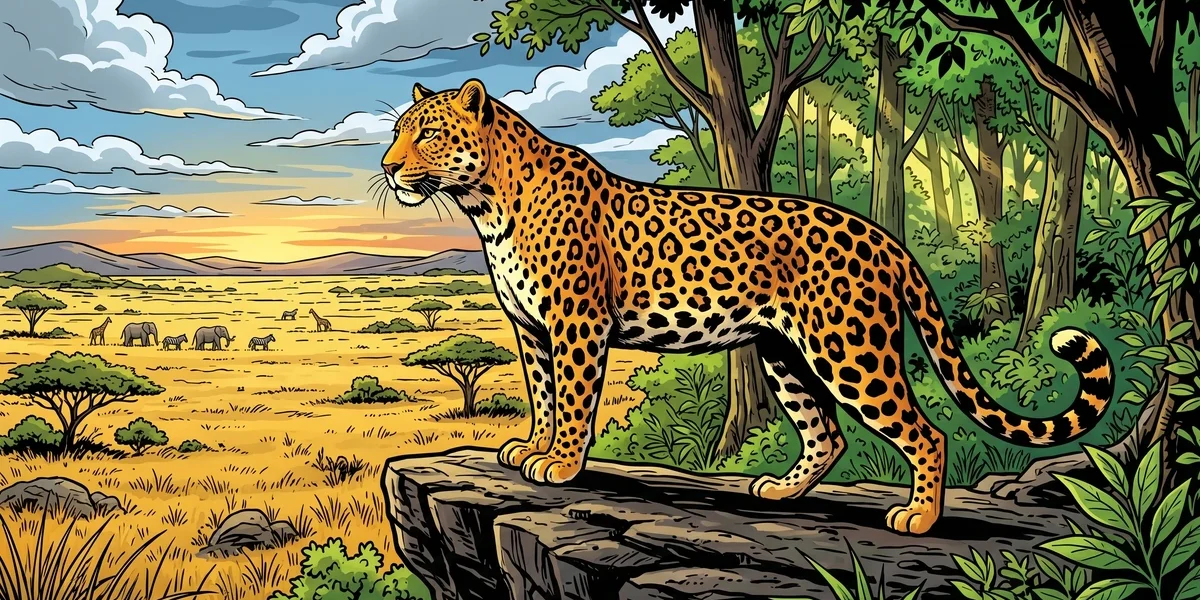
Sooner or later every child looks at a leopard — in a picture book, behind the glass of a zoo, or padding across a wildlife film — and asks the obvious question: why is it covered in spots? It is one of those questions that science answers one way and stories answer another, and the most famous storyteller’s answer in the English language belongs to Rudyard Kipling. In his telling, the leopard was not born spotted at all. He began life a plain sandy gold, the exact colour of the dry African grassland, and his spots were pressed onto him, one cluster of five at a time, by the black fingertips of a friend.
“How the Leopard Got His Spots” is a pourquoi tale — a story that exists to explain how some feature of the world came to be the way it is. But unlike most of the origin tales gathered on this site, it is not a story collected from the mouths of village storytellers. It is a literary invention: a tale composed, written down, and even illustrated by a single named author at the very start of the twentieth century. Knowing exactly where it came from changes nothing about its charm — but it matters, and an honest retelling should say so plainly.
Origins and Canonical Attribution
“How the Leopard Got His Spots” is the work of Rudyard Kipling, and it appears in Just So Stories for Little Children, the collection he published in 1902. The Just So Stories grew out of bedtime tales Kipling told his own children, refined over several years — he was famously particular that each one be retold “just so,” without a word altered, which is where the collection takes its name. Several of the stories, including this one, appeared first in magazines before the book gathered them together; Kipling also drew the distinctive pen-and-ink illustrations himself, complete with his own playful captions.
The story is set on what Kipling calls the “High Veldt” of southern Africa — a wide, open, sun-bleached grassland — and later in a deep, shadow-dappled forest. It is a literary pourquoi tale rather than a traditional one: there is no oral source community, no village from which it was transcribed. That distinction is worth making because Kipling’s Africa here is an imagined, story-book Africa, painted in the broad strokes of a tale for small children, and not an ethnographic record of any single people’s folklore.
Origin & Canonical Attribution
Type: An authored literary pourquoi (etiological) tale — a story explaining the origin of an animal’s appearance. It is not a collected oral folk tale.
Author and first book publication: Rudyard Kipling, “How the Leopard Got His Spots,” in Just So Stories for Little Children (London: Macmillan & Co., 1902). Kipling drew and captioned the illustrations himself.
Earlier magazine appearance: Like several of the Just So Stories, the tale was printed in a periodical before the 1902 book — appearing in the Ladies’ Home Journal in 1901.
Setting: The “High Veldt” grassland of southern Africa, and a neighbouring dappled forest.
Story type and motif: A pourquoi tale. Because the Aarne–Thompson–Uther index catalogues traditional oral tale-types rather than authored origin stories, it carries no ATU number; the relevant Thompson motif is A2412.1, “Markings on leopard,” within the A2200–A2599 group on the origin of animal characteristics.
Thematic root: The tale plays directly on the ancient proverb from the Book of Jeremiah (13:23), “Can the Ethiopian change his skin, or the leopard his spots?”
Copyright status: First published in 1902; the text and Kipling’s illustrations are in the public domain worldwide.
A World the Colour of Dry Grass
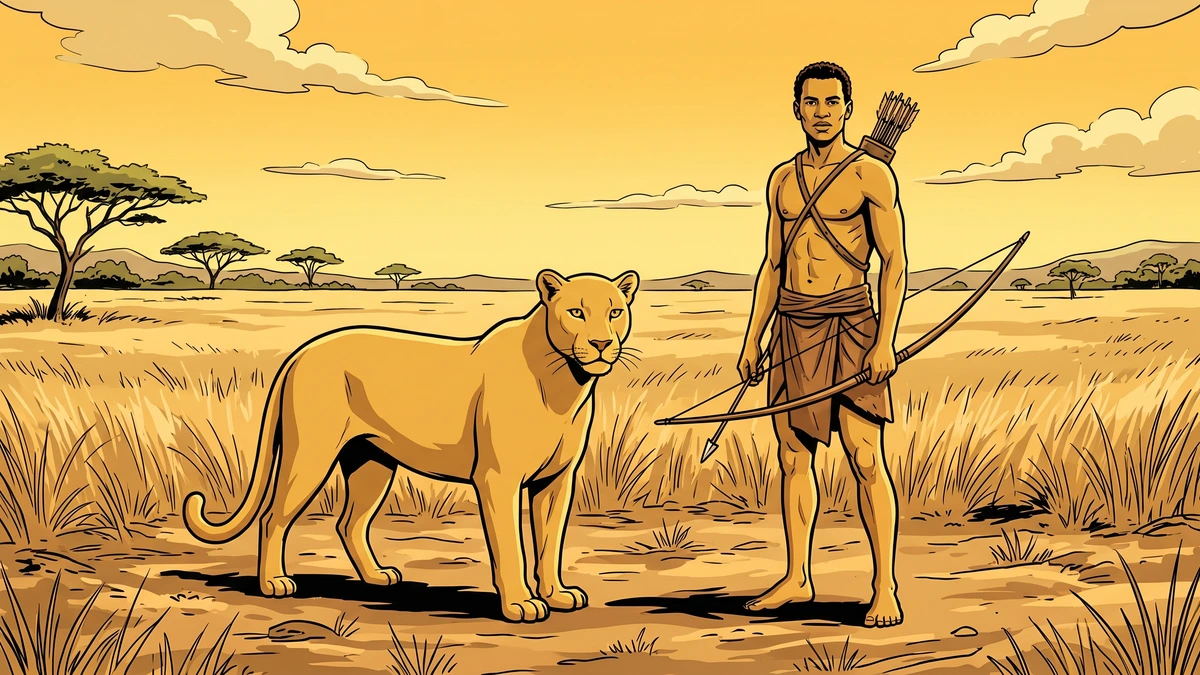
In the beginning of the story, the Leopard lived in a place where almost everything was the same colour. The High Veldt was a sweep of bare, sandy, yellowish-grey-brown grassland, and the creatures who lived on it had taken its colour for their own. The Giraffe, the Zebra, the Eland, the Koodoo and the Hartebeest were all a plain sandy gold. So was the Leopard — and so was his hunting companion, a man Kipling calls the Ethiopian, who carried a bow and arrows and was, in those days, exactly the same dusty sandy shade as everything around him.
This sameness was the Leopard’s great advantage. Because he matched the grass so perfectly, the grazing animals could not see him until it was far too late. He and the Ethiopian hunted side by side and never went hungry, and the Leopard was rather pleased with his plain golden coat. It was, after all, doing its job. A story that began and ended there would have no plot at all; the trouble — and therefore the story — begins when the prey animals decide they have had quite enough of being so easily caught.
The Animals Vanish Into the Forest
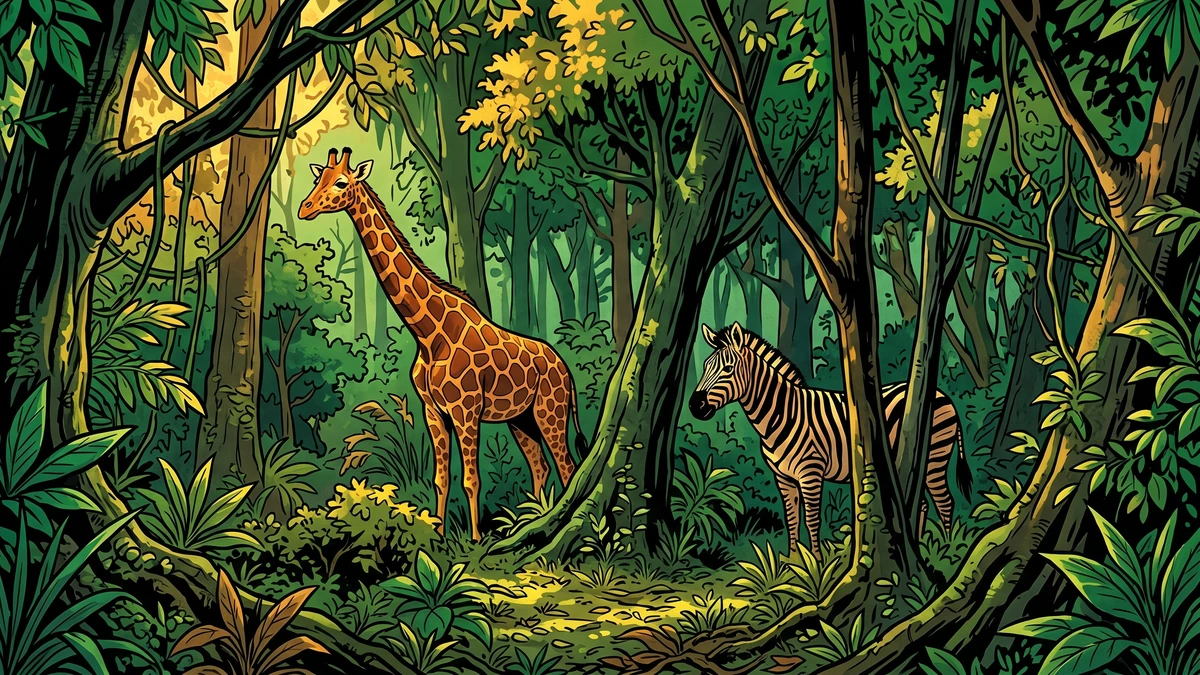
One by one, the hunted animals left the open grassland. The Giraffe and the Zebra and the rest moved away into a great forest — a place utterly unlike the bare veldt. There the light fell in broken pieces through the leaves, and the ground and the tree-trunks were patterned all over with stripes of shadow and blots of sun, dappled and speckled and streaked in a hundred shades of dark and bright.
And here Kipling does something quietly clever. As the animals lived in that broken light, year after year, their coats slowly changed to match it. The Giraffe grew brown blotches; the Zebra grew black stripes; the Eland and the Koodoo grew darker, with wavy grey lines on their backs like the bark of trees. When they stood still in the dappled shade, they simply disappeared. Their new markings were not decoration — they were camouflage, and the story treats this as the most natural thing in the world. Meanwhile, back on the empty veldt, the Leopard and the Ethiopian were still plain sandy gold, and they were beginning to wonder where all their dinners had gone.
The Counsel of Baviaan the Baboon
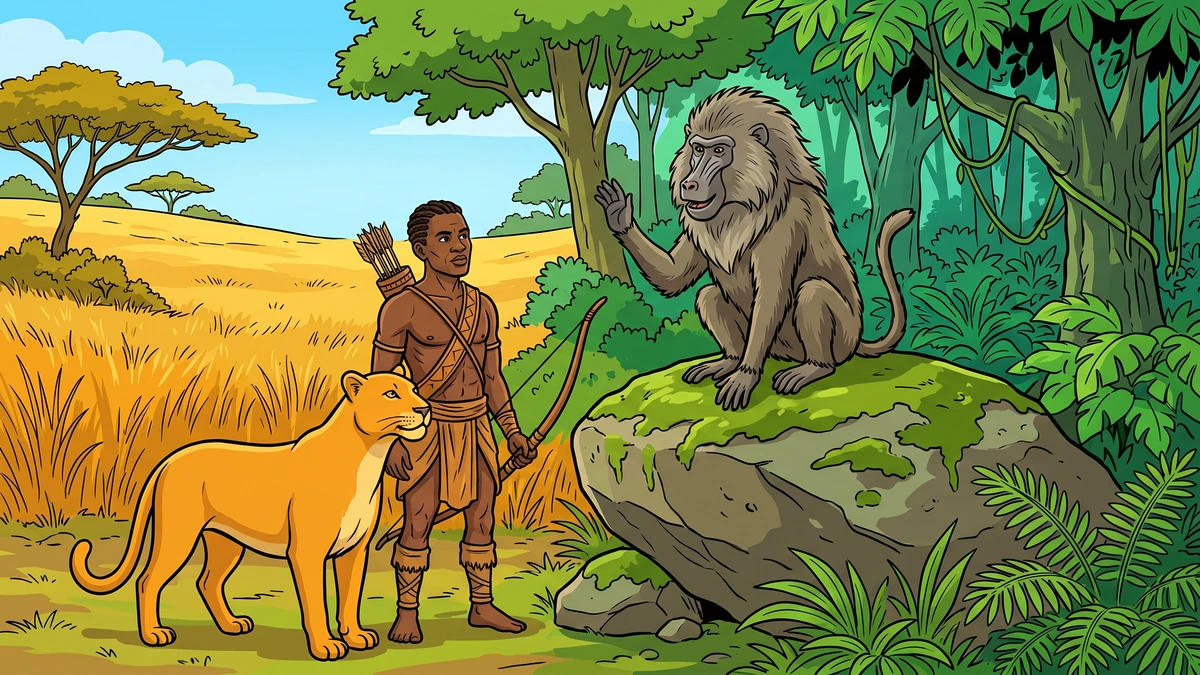
Hungry and puzzled, the Leopard and the Ethiopian went to ask advice from the wisest animal in all of southern Africa — Baviaan, the dog-headed, barking Baboon. Baviaan’s reply is one of the best-loved lines in the whole book. The game, he told them, had simply gone away to live among other kinds of spots; and if the Leopard and the Ethiopian had any sense, they would go and get a few spots of their own. It is a piece of advice built on a pun — “spots” meaning both places and markings — and small children adore it.
So the two friends set off and found the forest. The change was immediate and unsettling. They could smell Giraffe and Zebra everywhere; they could hear them breathing; but they could not see a single one of them. The animals were standing right there, in plain view, perfectly still — and the dappled shade had swallowed them whole. For the first time, the Leopard understood that his plain gold coat, so useful on the veldt, had become a glaring disadvantage. In the forest, being all one colour meant being visible, and being visible meant going hungry.
The Ethiopian’s Five Fingertips
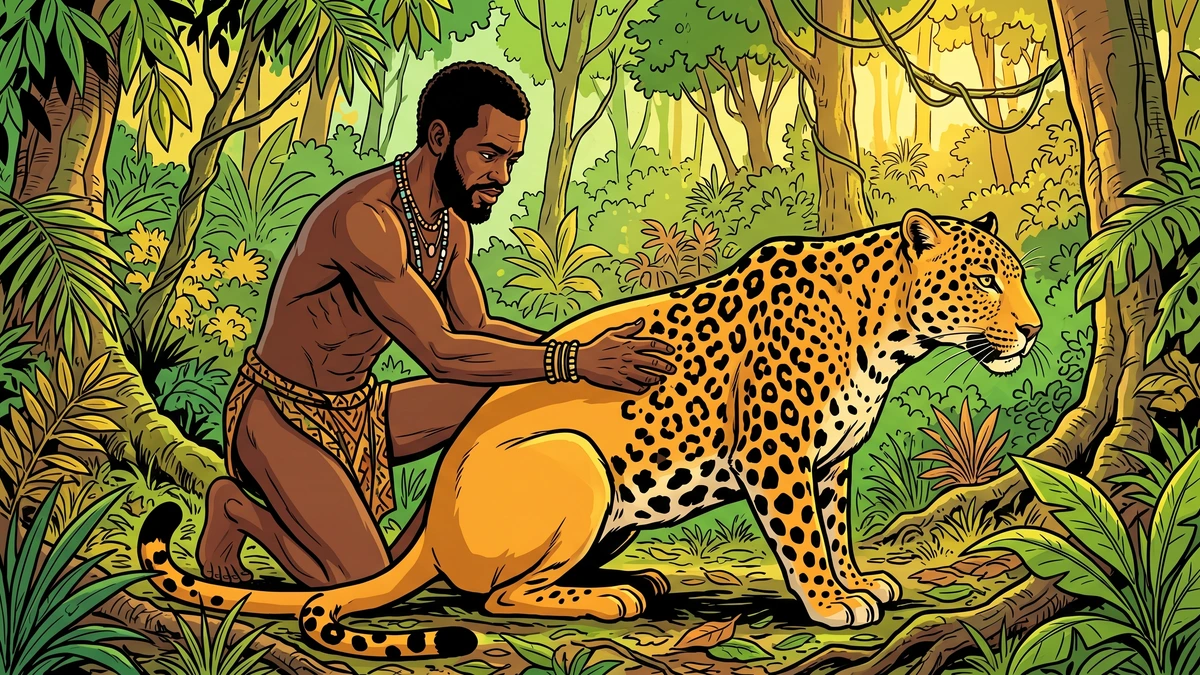
The friends finally caught a Giraffe and a Zebra by feeling for them in the dark, and asked, reasonably enough, why they no longer looked like proper Giraffes and Zebras. The two prey animals showed them: they walked a little way off, stood against the striped and blotched background, and vanished a second time. The lesson was plain. To hunt in this new world, the Leopard and the Ethiopian would have to change too.
The Ethiopian went first. He changed his own skin to a deep, even black-brown, so that he could melt into the shadows of the forest. Then it was the Leopard’s turn. The Leopard wanted to change as well, but he was not sure into what — should he take stripes, like the Zebra? The Ethiopian considered, and decided that broad stripes would not suit a leopard at all. Instead he bunched his five fingers close together, pressed them onto the Leopard’s coat again and again, and wherever the five black fingertips touched they left five small dark marks, all clustered tight together. He worked all over the Leopard — back, sides, legs — until the plain gold coat was covered in those neat clusters of five. And that, says Kipling, is why a leopard’s spots, if you look closely, still gather in little groups of five to this day. Once the Leopard and the Ethiopian had their new colours, they could hunt in the forest as easily as they once had on the veldt — and, the story is careful to add, they were so contented that they never bothered to change their appearance ever again.
The Moral of the Story
On its surface, “How the Leopard Got His Spots” is a light-hearted explanation of a coat pattern. Underneath, it is a small parable about belonging. The Leopard’s plain gold was never “wrong” — it was perfect for the open veldt. It became a problem only when the world around him changed and he did not. The story’s gentle point is that there is no single right way to look, or to be: what counts is whether you fit the place you actually live in. Survival, in Kipling’s playful telling, is not about clinging to what once worked, but about being willing to take on the pattern of a new world.
The story leans, too, on one of the oldest proverbs in the English language — a line from the Hebrew prophets that has come to stand for the impossibility of changing one’s deepest nature:
“Can the Ethiopian change his skin, or the leopard his spots?”
— Jeremiah 13:23 (King James Bible)
The proverb expects the answer “no” — a leopard cannot change its spots; people cannot change their fundamental character. Kipling’s whole story is a sly, affectionate reply to that ancient certainty. This once, he says, the Ethiopian and the leopard did change — and having changed, having finally found the colour that matched their home, they were happy enough never to change again. The tale turns a proverb about permanence into a story about one well-timed transformation, and then about the deep, settled contentment that comes after it.
Why This Tale Has Lasted
More than a century after it first appeared, “How the Leopard Got His Spots” is still read aloud in homes and classrooms all over the world, and several things keep it alive. The first is the sound of it. Kipling wrote the Just So Stories to be spoken, not skimmed, and the prose is full of rolling, rhythmic, repeated phrases and direct asides to the listening child. Read silently it is merely charming; read aloud it becomes a small performance, and children ask for it again precisely because it is fun to say.
The second is that the explanation is, in its own roundabout way, true. Camouflage is real biology: animals genuinely are shaped by the light and cover of the places they live, and a leopard’s rosettes really do break up its outline among dappled leaves. Kipling dresses a sound natural-history idea — that markings are a survival tool, not an ornament — in the costume of a fairy tale, and a child who has heard the story carries a real scientific intuition without ever feeling lectured.
The third reason is the company the story keeps. It sits inside Just So Stories alongside “The Elephant’s Child,” “How the Camel Got His Hump” and “How the Whale Got His Throat” — one of the most enduring children’s collections ever published, never out of print since 1902. Modern readers also meet the tale with clearer eyes than its first audience did: it is a product of the British Empire at its height, and its broad-brush, picture-book Africa is best read today as exactly that — an early-twentieth-century author’s imagined landscape, enjoyed for its music and its wit while its historical setting is understood and discussed honestly. Held that way, it remains what it has always been: a near-perfect example of how a story can answer a child’s “why?” in a way no textbook ever could.
Frequently Asked Questions
Is “How the Leopard Got His Spots” a traditional African folk tale?
No. Although it is set in southern Africa and feels like an old origin myth, it is an authored literary tale written by Rudyard Kipling and published in his collection Just So Stories for Little Children in 1902. It has no oral source community and was never collected from village storytellers. It belongs to the same family as traditional pourquoi (“why”) tales, but it is one writer’s deliberate invention.
Who is the Ethiopian, and who is Baviaan?
In Kipling’s story the Ethiopian is the Leopard’s human hunting partner — a man with a bow and arrows who, at the start, is the same plain sandy colour as the Leopard and the grassland. Baviaan is the wise, dog-headed, barking Baboon, described as the cleverest animal in all of southern Africa, whose punning advice — that the game has “gone into other spots” — sets the two friends on their journey.
How does the Leopard actually get his spots?
After the Ethiopian changes his own skin to a dark black-brown, he marks the Leopard by pressing his five bunched fingertips onto the coat over and over again. Each press leaves five small black marks clustered tightly together. Kipling uses this to explain a real detail of leopard markings — the way their rosettes appear to gather in little groups rather than spreading evenly.
Why does the Leopard get spots while the Zebra gets stripes?
Both changes are about camouflage. The grazing animals moved into a shadowy, dappled forest, and their coats slowly changed to match its broken light — blotches for the Giraffe, stripes for the Zebra. When the Leopard’s turn comes, he wonders about stripes too, but the Ethiopian decides that clustered spots, not broad stripes, are what will best suit a leopard moving through patches of light and shade. The story turns genuine animal camouflage into a piece of storytelling.
What does the story’s moral mean?
The tale plays on the old proverb from the Book of Jeremiah, “Can the Ethiopian change his skin, or the leopard his spots?” — a saying about how hard it is to change one’s deepest nature. Kipling answers it gently: this once, change was exactly what was needed. The Leopard’s plain coat was not bad, only mismatched to a new world, and the story’s lesson is about adapting to where you truly belong — and the contentment of having found it.
You May Also Like
 African Folk Tales
Ages 9-12
African Folk Tales
Ages 9-12
Maku Mawu And Maku Fia
Maku Mawu And Maku Fia: I will die God’s death’ and ‘I will die the King’s death’ Once upon a time there were two men who were such great friends that they
 African Folk Tales
Ages 6-8
African Folk Tales
Ages 6-8
The Hunter And The Tortoise
The Hunter And The Tortoise: A village hunter had one day gone farther afield than usual. Coming to a part of the forest with which he was unacquainted, he was
 African Folk Tales
Ages 6-8
African Folk Tales
Ages 6-8
The Ungrateful Man
The Ungrateful Man: A hunter, who was terribly poor, was one day walking through the forest in search of food. Coming to a deep hole, he found there a leopard