The Lion, The Jackal, And The Man
The Khoikhoi folk tale of a boastful lion whom a clever jackal humbles by leading him to meet a man — and the man, armed with dogs, fire and steel, proves the strongest creature of all.
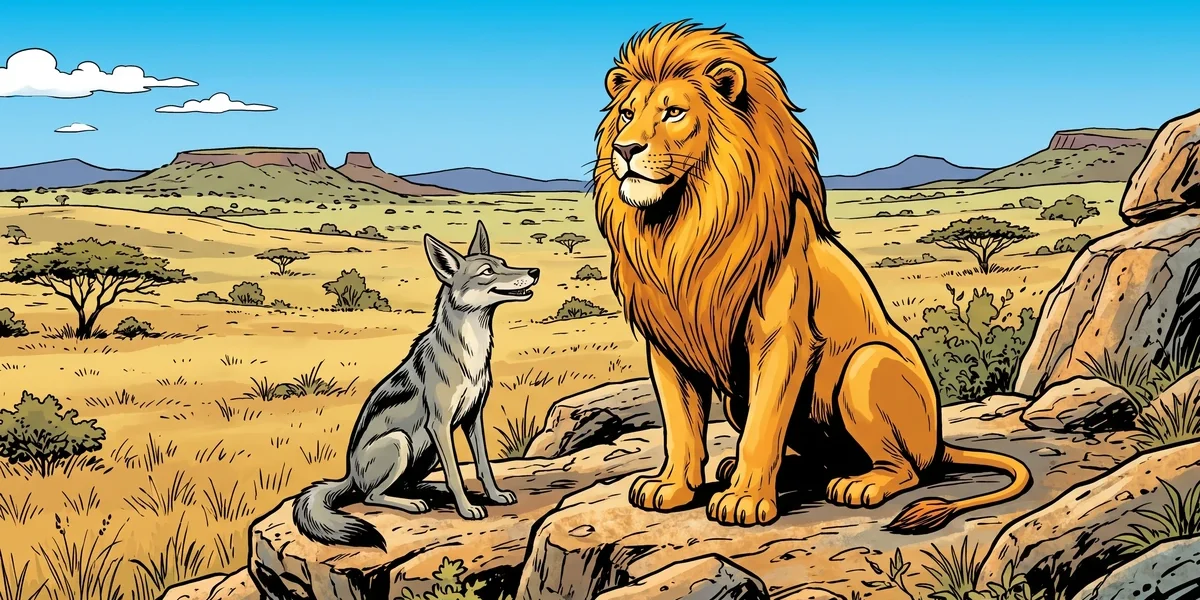
On the wide, sun-burnt veld of the southern African interior, the storytellers of the Khoikhoi long kept a small comedy of misjudged strength. A lion, proudest of all the beasts, struts and boasts of his might; a jackal, who has flattered that pride for his own safety, decides at last to puncture it. He promises to show the king of beasts a creature mightier than himself — and the creature he leads him to is only a man. The Lion, the Jackal, and the Man is a brief, sharply observed tale, but beneath its humour lies one of folklore’s oldest questions: what, in the end, is true power, and who truly holds it?
The answer the Khoikhoi gave is unsentimental. Strength of body, the tale insists, is not the same thing as strength of the earth. A lion can scatter a pack of hunting dogs with a few sweeps of his paw and still be driven, bleeding and bewildered, from the field — not by a stronger animal, but by a clever one armed with fire and steel. And the jackal, who arranges the whole demonstration and then trots off to a safe rocky outcrop to watch, embodies a third kind of power altogether: the power of the one who never fights at all.
Origins and Canonical Attribution
This tale belongs to the great body of Khoikhoi (Khoekhoe) animal stories gathered at the Cape of Good Hope in the nineteenth century. Its best-known printed form appears as the ninth tale in South-African Folk-Tales, compiled by James A. Honeÿ and published in New York in 1910. Honeÿ’s slim anthology drew heavily, and openly, on the earlier and more scholarly labours of the German-born philologist Wilhelm Heinrich Immanuel Bleek, whose Reynard the Fox in South Africa; or, Hottentot Fables and Tales (London, 1864) was the first published collection of indigenous southern African literature. Bleek’s translations were themselves made from manuscripts preserved in the library of Sir George Grey, Governor of the Cape, who had encouraged missionaries and colonial officials to record the oral narratives of the peoples among whom they worked.
Origin & Canonical Attribution
Tradition: Khoikhoi (Khoekhoe) oral narrative, Cape region, southern Africa.
Primary printed source: James A. Honeÿ, South-African Folk-Tales (New York: Baker & Taylor, 1910), tale IX, “The Lion, the Jackal, and the Man.”
Antecedent collection: W. H. I. Bleek, Reynard the Fox in South Africa; or, Hottentot Fables and Tales (London: Trübner & Co., 1864), translated from the Sir George Grey manuscripts.
Tale type: ATU 157, “Learning to Fear Men” (Aarne–Thompson–Uther index).
Principal motifs: J17, animal learns through experience to fear man; J950, presumption of the weak (or the boastful) against the strong; the “three ages of man” recognition sequence (boy – bent elder – man in his prime).
The classification matters because it places a modest Cape fable inside a worldwide family of stories. Tales catalogued under ATU 157, “Learning to Fear Men,” turn up across Europe, Asia and Africa: in each, a powerful wild animal — most often a lion, bear or wolf — sets out to measure itself against the human being and comes away convinced that man, for all his soft body and lack of claws, is the creature to be feared. The Khoikhoi version is distinctive for two things: the wry, diplomatic jackal who stage-manages the lesson, and the unforgettable closing speech in which the lion, having no words for gun or knife, describes them as parts of the man’s own body. Honeÿ’s text preserves that speech almost verbatim from the oral tradition, and it is the heart of the tale.
When the King Boasted
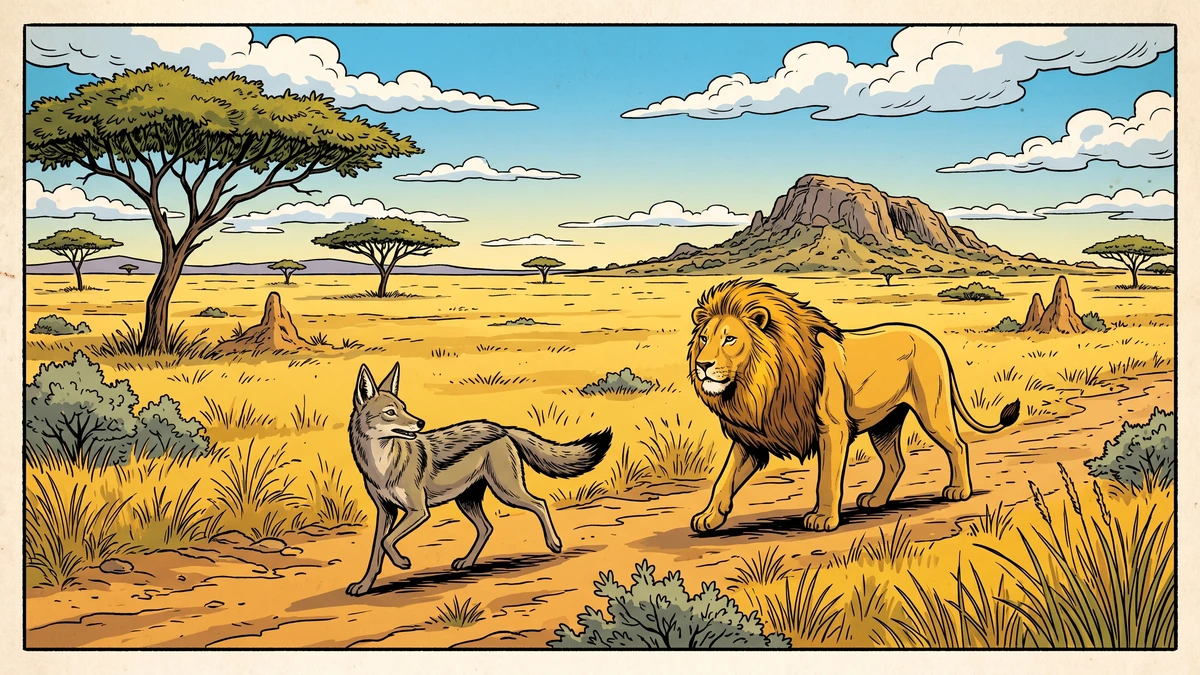
The story opens not with a hunt or a quarrel but with a conversation. Lion and Jackal have come together, in Honeÿ’s phrasing, “to converse on affairs of land and state” — for the jackal, we are told, was the king’s most important adviser. It is a small, telling detail. In the Khoikhoi imagination the jackal is never merely a scavenger; he is the counsellor who has made himself indispensable at court, the small creature who survives among the great by being useful, agreeable and quick.
For a while the two speak of public matters. Then the talk turns personal, and the lion begins to boast. He talks big about his strength, and the storyteller is careful to assign part of the blame to the jackal himself: “Jackal had, perhaps, given him cause for it, because by nature he was a flatterer.” Here is the tale’s first quiet irony. The lion’s swollen pride is partly the jackal’s own creation. Years of artful agreement have taught the king to believe his own legend.
But flattery has its limits, and the jackal has grown tired of the airs his master is assuming. “See here, Lion,” he says, “I will show you an animal that is still more powerful than you are.” It is a remarkable thing for an adviser to say to a king, and the jackal says it lightly, almost mischievously. He does not argue; he does not contradict. He simply proposes an experiment and offers to lead the way. The trickster’s method, here as everywhere in Khoikhoi lore, is not confrontation but demonstration. He will let the lion discover the truth with his own body.
A Boy, and a Man Bowed by Years
So the two set out across the veld, the jackal leading and the lion following, and the tale becomes a small procession of encounters. The first creature they meet is a little boy.
“Is this the strong man?” asks the lion.
“No,” the jackal answers. “He must still become a man, O king.”
They walk on, and presently they come upon an old man, walking with bowed head, supporting his bent figure with a stick.
“Is this the wonderful strong man?” the lion asks again.
“Not yet, O king,” says the jackal. “He has been a man.”
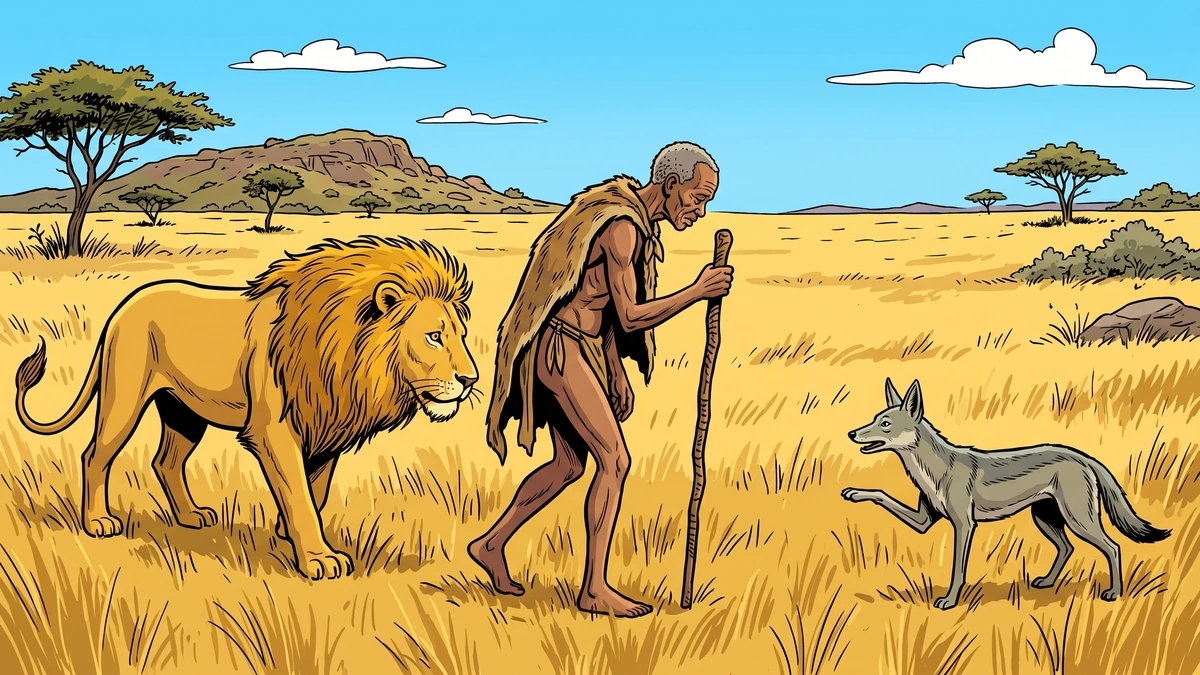
This little sequence — the boy, the bent elder, and (in the next scene) the hunter in his prime — is one of the most artful things in the story. Folklorists recognise it as a version of the “three ages of man” pattern, the same structure that underlies the riddle of the Sphinx and a hundred other tales of the human life-course. The jackal is not merely walking; he is teaching. He shows the lion that “man” is not a fixed thing but a passage. The child carries the promise of strength; the old man carries its memory; only in the middle of life does a human being hold that strength entire. The jackal’s two phrases — “he must still become a man” and “he has been a man” — frame human power as something that rises and falls, like the sun crossing the sky. The lion, impatient and literal, hears only that he has not yet been shown his rival. But the listener hears something larger: a quiet meditation on time.
The Hunter in the Strength of His Days
A short distance farther on, the procession meets its third human being: a young hunter in the prime of youth, accompanied by several of his dogs.
“There you have him now, O king,” the jackal says. “Pit your strength against his, and if you win, then truly you are the strength of the earth.”
The phrase — the strength of the earth — is the prize the whole tale is contending for. It is a title, an honour, a crown. And having named the stakes, the jackal does something that defines his character once and for all. He makes tracks to one side, toward a little rocky kopje, “from which he would be able to see the meeting.”
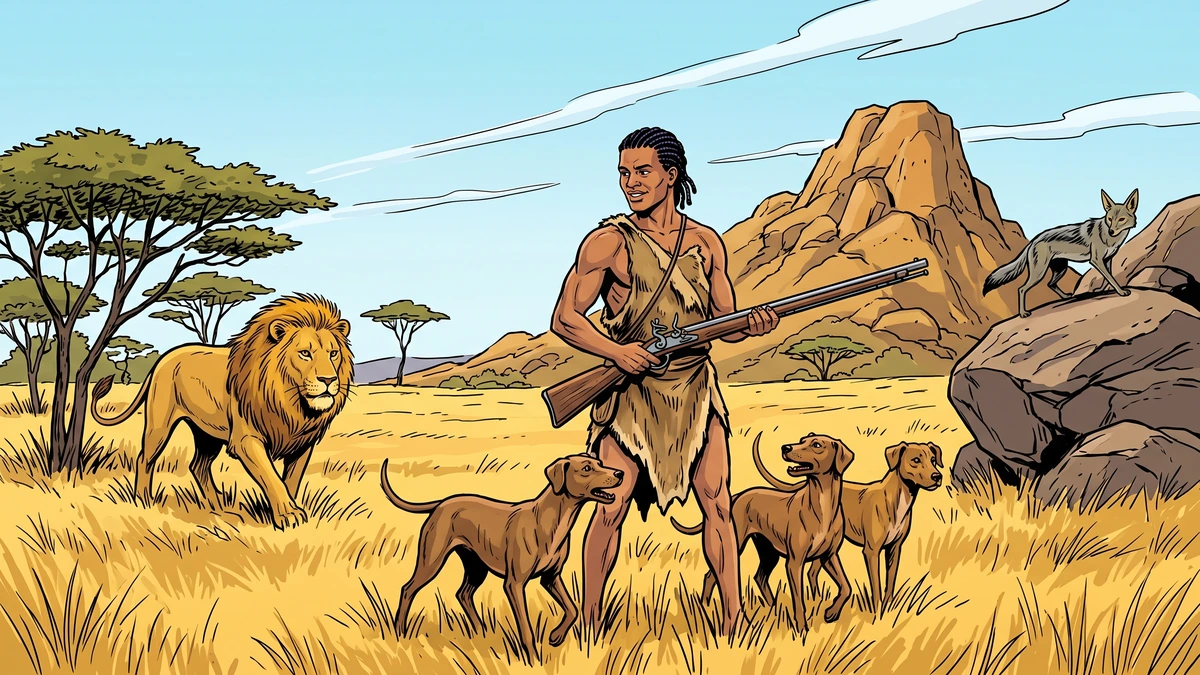
The jackal does not fight. The jackal does not even stay close. He has arranged the entire confrontation, named its terms, and now he withdraws to a vantage point to watch in perfect safety. This is the trickster’s signature gesture in Khoikhoi storytelling, and it is worth pausing over. The jackal has not lied to the lion; everything he has said is true. He has not laid a trap in the ordinary sense. He has simply understood, far better than his master, where real danger lies — and he has positioned himself accordingly. The clever survive not by being strong, the tale suggests, and not even by being cunning in the sense of dishonest, but by seeing clearly and standing in the right place.
Fire from the Mouth, a Rib of Steel
Now the lion does what lions do. Growling, he strides forward to meet the man. The dogs rush at him at once, and he scarcely notices — a few sweeps of his great front paws scatter them, howling, back toward their master. For a moment the lion’s confidence seems justified. No animal can stand against him.
Then the hunter raises his gun and fires a charge of shot into him, behind the shoulder. The lion, astonishingly, pays little attention even to this. He presses on. So the hunter draws his steel knife and gives him several hard, deep jabs, until at last the lion turns and retreats — and the man fires after him as he flees.
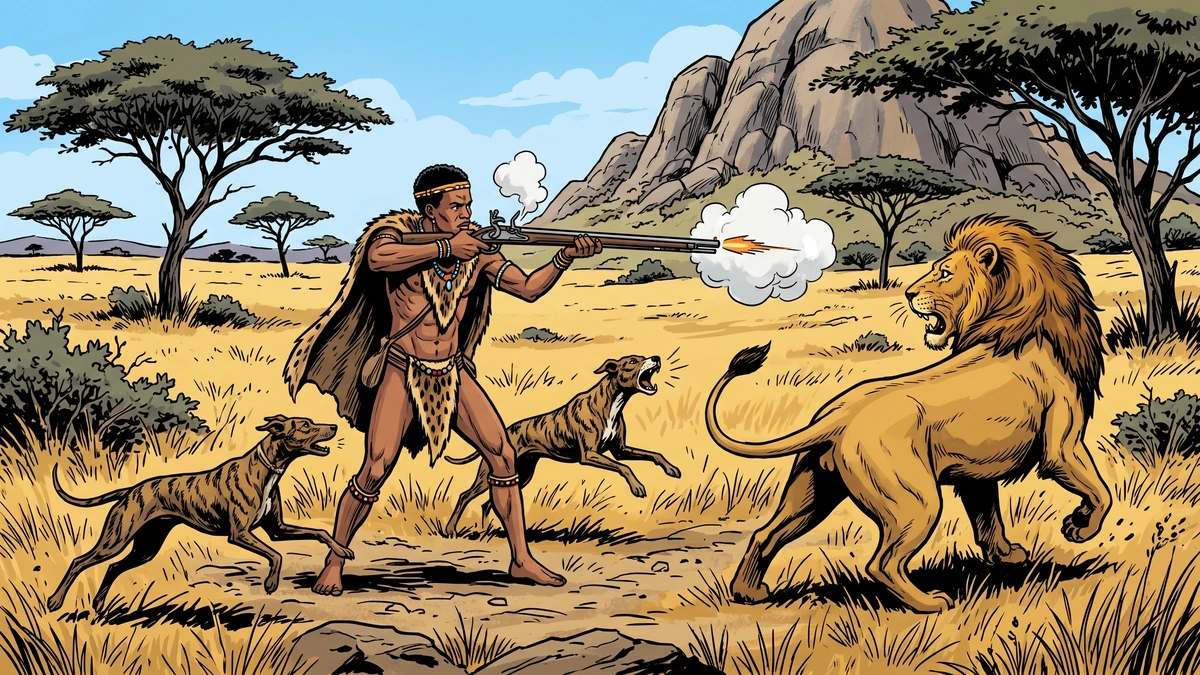
It is the lion’s report afterward, delivered at the jackal’s side on the safety of the kopje, that has kept this tale alive for a century and a half. “Well, are you strongest now?” the jackal asks — and the lion’s answer is a small masterpiece of comic bewilderment. He concedes the title at once: “let that fellow there keep the name and welcome.” Then he tries to describe what has happened to him, and he has no words for any of it. The dogs he calls “about ten of his bodyguard.” The gunshot he describes as the man spitting and blowing fire into his face, which “burned just a little.” And the knife — this is the tale’s finest stroke — he describes as a rib: “he jerked out from his body one of his ribs with which he gave me some very ugly wounds.”
The lion can only understand the man’s weapons as parts of the man’s own body, because in the lion’s world all power is bodily. He has claws; the man, he assumes, must have fire-breath and detachable ribs. The humour is exact, and so is the insight buried inside it. The man’s true strength is not in his body at all — it is in the tools his mind has made and his hands can wield. The lion has met a creature whose power lies outside its own flesh, and he has no category for it. He gives up the name of “strength of the earth” not because he was overpowered — he was not even seriously hurt — but because he was, for the first time in his life, comprehensively out-matched by something he could not understand.
The Meaning of the Tale
On its plainest level, The Lion, the Jackal, and the Man is a fable about the limits of brute strength. The lion is genuinely the most powerful animal on the veld, and the tale never pretends otherwise. His mistake is not weakness but a failure of imagination: he assumes that because nothing in his world is stronger than he is, nothing anywhere can be. The jackal’s lesson corrects exactly that error. Power, the story says, comes in kinds that cannot be compared on a single scale. The hunter does not out-roar or out-claw the lion; he wins on a different ground entirely — the ground of fire, steel, dogs and forethought.
There is a second lesson, quieter, carried by the jackal. To watch the jackal across this tale is to watch a portrait of the survivor. He is the smallest creature in the story and never once in danger. He flatters when flattery is useful and stops flattering when it ceases to be. He arranges the decisive event and removes himself from it. The Cape storytellers did not entirely approve of the jackal — he is too self-serving for that — but they understood him, and they passed his wisdom down with a half-smile. Among the Khoikhoi, and later among the Cape Dutch farmers who borrowed and retold these animal stories, the jackal’s kind of intelligence was summed up in a proverb:
“Slim is dom se baas.”
— Cape Afrikaans proverb: “Clever is the master of stupid.”
The proverb fits the tale at every level. The hunter, clever, masters the lion. The jackal, cleverer still, masters the situation without lifting a paw. And the lion — strong, proud, and slow to see — learns the hard truth that on the wide veld of the world it is not the loudest roar that rules.
Why This Story Has Endured
Few tales travel as far or as easily as the ones that ask who is really the strongest, and The Lion, the Jackal, and the Man has travelled a long way indeed. As an ATU 157 tale it has cousins in German, Russian, Scandinavian and Indian collections, each shaped by its own landscape and its own animals. What keeps the Khoikhoi version fresh is its economy and its wit. It wastes nothing. The whole drama runs from a boast to a confession in a few hundred words, and its single most memorable image — the lion describing a knife as the man’s rib — is the kind of detail no listener forgets.
It has also lasted because its meaning has kept pace with its readers. To the Khoikhoi herders who first told it, the tale explained, with a shrug and a laugh, why the most powerful predator of the veld nonetheless gave way before the hunting bands of human beings. To later generations it became a parable about technology and intelligence — about how a soft-skinned, clawless creature came to hold dominion over animals far stronger than itself. And in any age it carries a lesson about pride: the lion’s downfall is not that he is weak but that he cannot imagine being out-matched, and a mind that cannot imagine its own limits is a mind already half defeated.
That is why the story is still told to children on this site and elsewhere. It is funny, it is short, and it leaves behind it a thought worth keeping — that strength is real, but it is never the only thing in the room, and the wise creature is the one who keeps looking, from a safe rock, for whatever might be stronger still.
Frequently Asked Questions
What is the moral of “The Lion, the Jackal, and the Man”?
The tale teaches that brute strength is not the same as true power. The lion is genuinely the strongest animal on the veld, yet he is driven from the field by a hunter who is far weaker in body but armed with dogs, a gun, a steel knife and forethought. The story argues that intelligence, tools and clear judgement can master raw force, and that the proud creature who cannot imagine being out-matched is already halfway to defeat.
Why does the jackal lead the lion past a boy and an old man before showing him the hunter?
The procession of a boy, a bent old man, and finally a hunter in his prime is a version of the worldwide “three ages of man” pattern. The jackal answers “he must still become a man” for the boy and “he has been a man” for the elder, teaching the lion that human strength is not fixed but rises and falls across a lifetime. Only the man in the middle of life holds that strength entire, and it is against him that the lion must finally test himself.
Why does the lion describe the hunter’s gun and knife as parts of the man’s body?
In the lion’s world all power is bodily, so when he tries to report the fight he has no words for human tools. He describes the gunshot as the man spitting and blowing fire into his face, and the steel knife as a rib the man jerked out of his own side. The comic mistake carries the tale’s central insight: the man’s true strength lies not in his flesh but in the tools his mind has made, a kind of power the lion cannot even categorise.
Where does this folk tale come from, and who first recorded it?
It is a Khoikhoi (Khoekhoe) oral narrative from the Cape region of southern Africa. Its best-known printed form is tale IX of James A. Honey’s “South-African Folk-Tales” (New York, 1910), which drew on the earlier collection by the philologist W. H. I. Bleek, “Reynard the Fox in South Africa; or, Hottentot Fables and Tales” (London, 1864). Bleek translated his texts from manuscripts preserved in the library of Sir George Grey, Governor of the Cape.
What does the jackal represent in the story?
The jackal is the Khoikhoi trickster-counsellor: the small creature who survives among the great by being useful, agreeable and quick. He flatters the lion when flattery serves him and stops when it does not, arranges the entire confrontation with the hunter, and then withdraws to a safe rocky kopje to watch in perfect safety. He embodies a third kind of power beyond strength and cunning, the power of seeing clearly and standing in the right place.
You May Also Like
 African Folk Tales
Ages 9-12
African Folk Tales
Ages 9-12
Story Of Lion And Little Jackal
A string of clever escapes from southern African oral tradition: the small black-backed jackal outwits the mighty lion again and again, proving that wit, not muscle, rules the veld.
 African Folk Tales
Ages 6-8
African Folk Tales
Ages 6-8
Tink-Tinkje
The southern African folk tale 'Tink-Tinkje', the Cape form of the worldwide 'election of the king of birds' fable, in which the smallest bird wins the crown by cleverly riding unfelt on the soaring vulture's wing.
 African Folk Tales
Ages 9-12
African Folk Tales
Ages 9-12
The Tail Of The Princess Elephant
The Tail Of The Princess Elephant: There once lived a woman who had three sons. These sons were very much attached to their mother and always tried to please