The Lion And The Wolf
The Lion And The Wolf: A certain old lady had a very fine flock of sheep. She had fed and cared for them so well that they became famous for their fatness. The
Among the animal tales of West Africa there is a particular kind of story that delights in turning a predator’s own appetite into the instrument of his ruin. The Lion and the Wolf is one of the finest of these. It begins, as so many Gold Coast tales do, with an ordinary household in trouble – an old woman and a flock of sheep – and it ends with a flash of lightning that exposes a hunter who believed himself perfectly safe. Behind its simple surface lies a careful lesson about cunning, courage, and the difference between a creature who preys on the weak and one who protects them.
A Tale from the Gold Coast: Origins and Attribution
The Lion and the Wolf was set down in West African Folk-Tales, the collection compiled by William H. Barker and Cecilia Sinclair and published by George G. Harrap & Co. in London in 1917. Barker, an educationist who worked on the Gold Coast – the British colony that became the modern Republic of Ghana – gathered these stories with Sinclair so that the children of the colony might read in print the tales their grandmothers had always told aloud. The collection belongs squarely to the Akan oral tradition of the Gold Coast, the body of evening storytelling the Akan themselves call anansesem, literally “spider stories.”
Like most tales in that book, The Lion and the Wolf was not authored in the modern sense. It was carried for generations on the breath of storytellers – mothers, elders, professional tale-tellers – before Barker and Sinclair fixed one version on the page. The names of the animals in the printed English text are translations of convenience: the “wolf” of the Gold Coast bush is better understood as a generic raiding predator, and the “lion” as the unmatched king of beasts whose mere presence settles a dispute. What matters is not zoological precision but the moral architecture, and that architecture is unmistakably Akan.
The Old Woman and Her Vanishing Flock
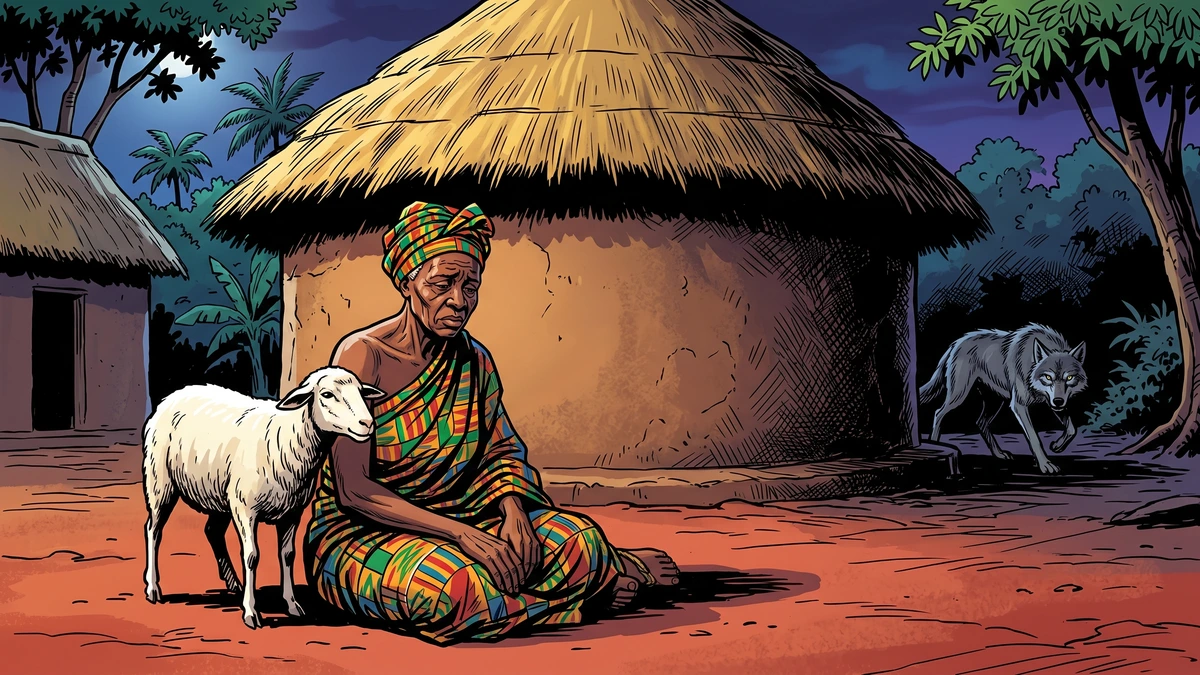
A certain old woman kept a flock of sheep so well fed and well tended that they grew famous throughout the district for their fatness. Fame, however, travels to hungry ears as readily as to friendly ones. A wicked wolf heard of the plump flock and resolved to eat his way through it. Night after night he crept to the old dame’s cottage and killed a sheep, and night after night the poor woman tried every device she knew to guard her animals – and failed. One by one the flock dwindled until a single sheep remained, and the old woman sat grieving, certain that this last one too would be carried off in spite of everything she could do.
The Lion’s Offer
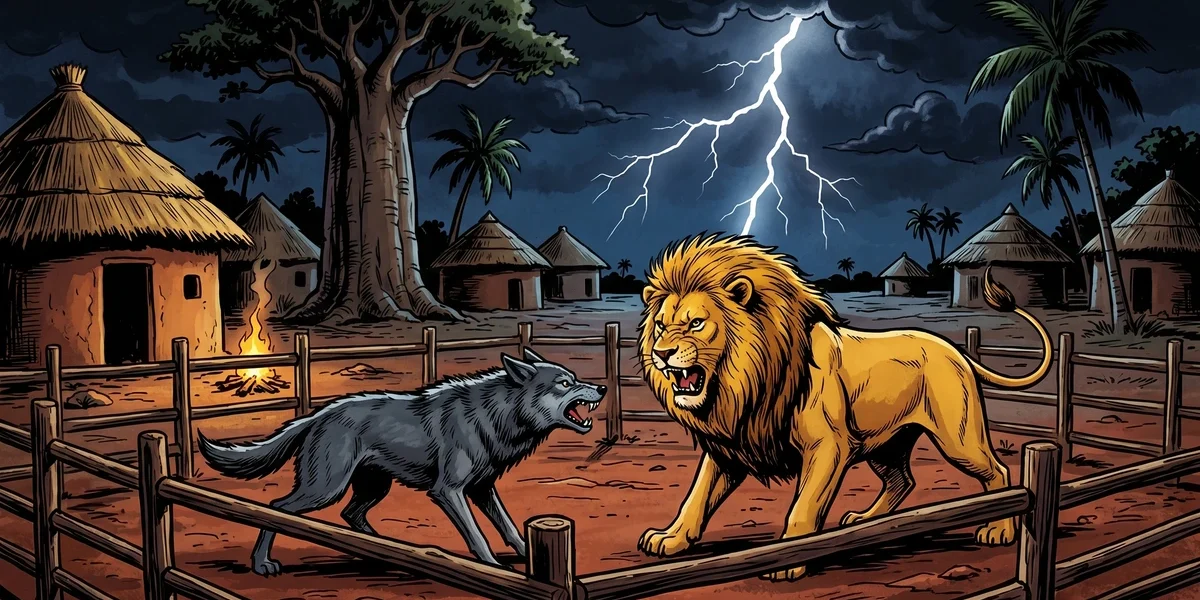
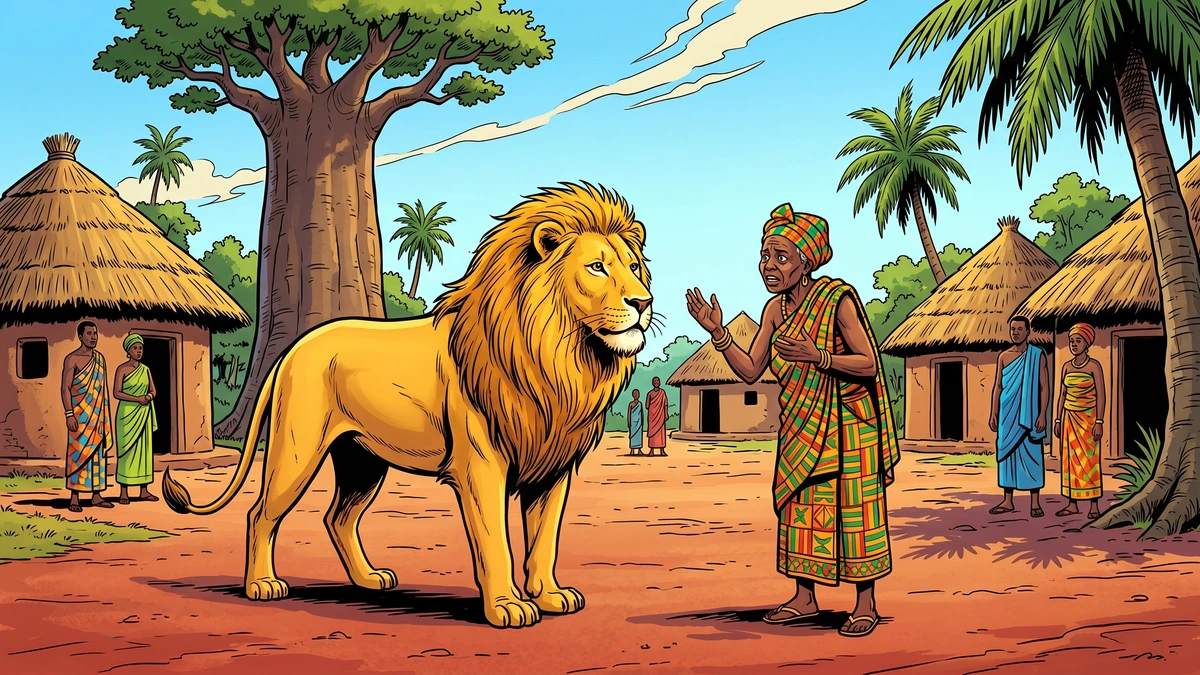
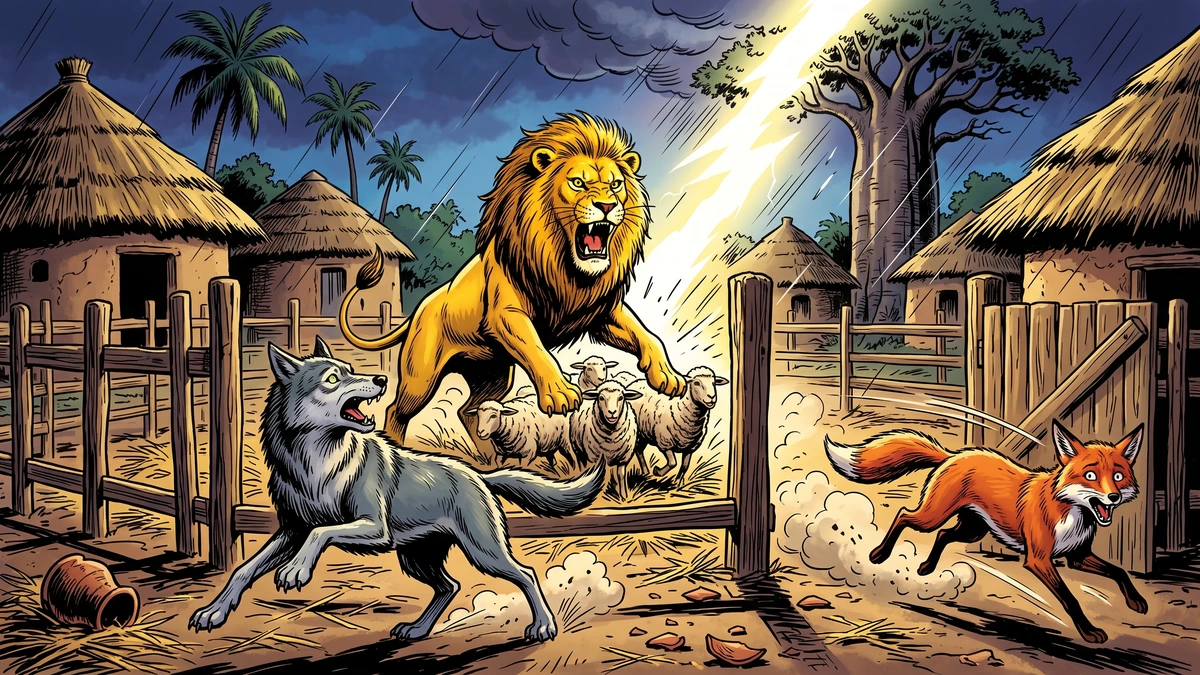
While she sat in her sorrow, a lion came into her village. Seeing the grief written on her face, he stopped and asked her what was wrong. She told him the whole miserable story of the wolf and the vanishing flock. The lion listened, and then he made an offer that changed everything: he himself would punish the wicked raider. His plan was quiet and exact. The last sheep was removed to a safe place elsewhere, and the lion took its place in the pen where the flock was generally kept. To any creature arriving in the dark, the sheep-fold would look exactly as it always had – occupied, unguarded, and waiting.
The Wolf and the Fox Set Out
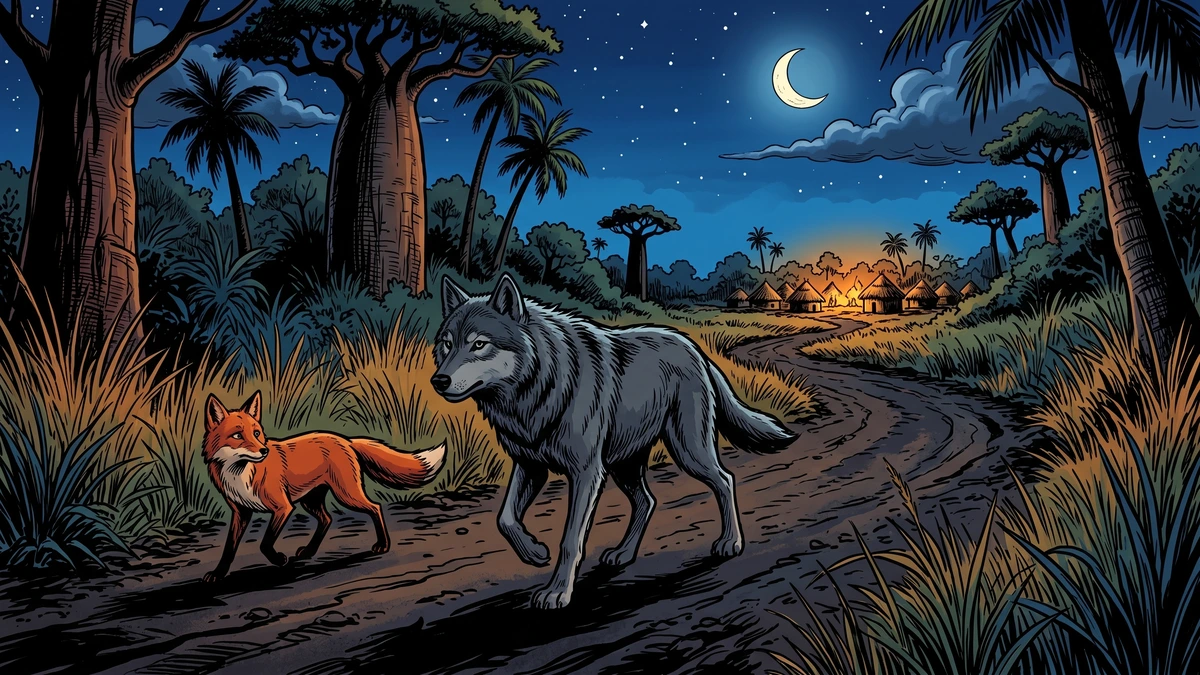
That same night the wolf was already on the road to the cottage. On the way he met a fox. The fox, knowing the wolf’s reputation, was afraid and made ready to slip away, but the wolf called out cheerfully where he was going and invited the fox to share the feast. The fox agreed, and the two set off together. They reached the cottage and went straight to the familiar place where the sheep slept. The wolf, bold and certain, rushed forward at the shape in the pen, while the more cautious fox hung a little way behind, deciding whether to follow his companion in.
The Flash of Lightning
At that very moment the sky split with a bright flash of lightning. By its sudden white light the fox saw clearly what the wolf in his haste had not: the creature in the pen was no sheep but a lion. The fox bolted, shouting over his shoulder as he ran, “Look at his face! Look at his face!” During the same flash the wolf at last looked at the thing he was attacking – and discovered his terrible mistake. He began at once to pour out humble apologies and explanations, but it was far too late. The lion refused to hear a word of them and swiftly put the wolf to death.
The Moral of the Tale
The Lion and the Wolf is built on a single, satisfying reversal. The wolf has spent the whole story as the hunter; in the final scene he becomes, without knowing it, the hunted. His downfall is not bad luck. It is the direct product of his own greed and his refusal to look carefully before he struck. The fox, by contrast, survives precisely because he hesitated, because he waited that extra moment, and because when the light came he was willing to see the truth and act on it instantly.
The deeper lesson is about who holds power and how it is used. The wolf preyed on a defenceless old woman; the lion, equally strong, chose to defend her. Strength is morally neutral – what matters is the direction in which it is turned. And the old woman, helpless on her own, prevailed the moment her trouble was joined to a willing protector. The Akan express this idea in a proverb still quoted today:
“Tikɔrɔ nkɔ agyina.” — One head does not go into council. No single person, however clever or however brave, can meet every danger alone; wisdom and safety are found in joining with others.
The old woman could not save her flock by herself, and the proverb tells us why she was never expected to. It is only when her plight is shared – spoken aloud to a passing stranger who happens to be willing and able to help – that the predator is finally stopped.
Tale Type and Motifs
Folklorists who study traditional stories classify them by recurring patterns, and The Lion and the Wolf sits comfortably among the world’s “deceiver deceived” tales – the broad family in which a trickster or predator is undone by the very trap he believes he is springing on someone else. The decisive device of the story is the disguised defender: a powerful protector takes the place of the expected victim so that the attacker rushes blindly to his own destruction. In the standard motif-index of folk narrative compiled by Stith Thompson, this belongs with the deception and captures grouping – the cluster of motifs (the K-numbers) in which an aggressor is lured into a fatal situation, here joined to the motif of the timely warning that lets one companion escape while the other perishes.
The lightning flash deserves attention as a piece of pure storytelling craft. It is not decoration. It performs three jobs at once: it reveals the truth to the fox, it reveals the truth to the wolf, and it freezes the moment of recognition so that the audience feels the shock alongside the characters. In an oral tradition, where a tale must land its climax cleanly on listeners gathered in the dark, such a single bright image is worth a page of explanation. Many West African tales use exactly this technique – a sudden sound, a sudden light, a single shouted line – to mark the instant the story turns.
The Akan World Behind the Story
To the families who first told this tale, every detail carried a weight that a modern reader can easily miss. A flock of well-fed sheep was not a quaint background prop; it was real, hard-won wealth, the savings of a household kept on four legs. For an old woman living alone, a flock represented security in age, and its slow destruction night after night was a genuine catastrophe, not a fairy-tale inconvenience. The story’s emotional grip on its first listeners came from that recognisable fear – the fear of watching one’s livelihood disappear and being powerless to stop it.
The village itself is the other quiet character in the tale. In Akan society a village was a dense web of mutual obligation, where a neighbour’s trouble was a shared concern and a stranger passing through could be drawn at once into the life of the place. The lion does not need to be begged at length; he simply sees a grieving face, asks, listens, and acts. That easy movement from a private sorrow to a public remedy is itself a portrait of how the Akan believed a healthy community ought to work. The tale teaches children, almost without their noticing, that troubles are meant to be spoken aloud and that the strong are meant to stand between the weak and those who would harm them.
The Trickster Tradition and Anansesem
The Lion and the Wolf belongs to the great Gold Coast institution of anansesem – the evening storytelling sessions named for Kwaku Ananse, the spider whose cleverness runs through Akan folklore. Not every anansesem story actually features the spider; the word came to cover the whole genre of instructive animal tales told after dark. These sessions were a school without walls. Children learned, through laughter and suspense, the difference between cleverness that builds and cleverness that destroys, between the boldness that protects and the boldness that merely takes.
This particular tale carries a subtle teaching about intelligence itself. The wolf is not stupid – he is cunning enough to learn of the flock, patient enough to raid it night after night, and persuasive enough to recruit a companion. Yet all that cunning fails him because it is married to greed and to haste. The fox shows the better pattern: caution first, observation next, and decisive action the instant the truth is clear. In the moral world of anansesem, the fox’s survival is not cowardice rewarded. It is the reward of a mind that looks before it leaps. The story hands its young listeners a tool they can use the next day in the schoolyard or the marketplace: when something looks too easy, slow down and look again.
The Fox Who Lived: A Lesson in Caution
It is worth pausing on the fox, the only one of the two raiders to walk away alive. When the story opens its account of him, it tells us plainly that he was afraid of the wolf and was already preparing to slip away when the wolf called him back. He joins the raid not out of boldness but out of a kind of nervous agreement, and even at the cottage he hangs behind while the wolf charges ahead. To a careless listener the fox might seem the lesser creature – timid where the wolf is brave. The tale insists on the opposite reading.
The fox’s hesitation is not weakness; it is judgement. Because he did not rush, he was still outside the pen, eyes open, when the lightning came. Because he was watching rather than lunging, he saw the lion’s face in the instant of light. And because he had not committed himself, he was free to turn and run while running could still save him. His shouted warning – “Look at his face!” – is the story’s gift to the wolf, an offer of truth that comes a heartbeat too late only because the wolf had already thrown himself forward. The Akan storyteller is teaching a precise distinction here. There is a difference between fear that paralyses and caution that informs. The fox is not paralysed; he acts, and acts fast, the moment he has something solid to act upon. That is the behaviour the tale quietly recommends to every child who hears it.
From the Evening Fire to the Printed Page
When William H. Barker and Cecilia Sinclair assembled West African Folk-Tales in 1917, they were doing something the storytellers of the Gold Coast had never needed to do: freezing a living, shifting tradition into fixed words on a page. For countless generations these stories had no single correct version. Each teller shaped the tale to the night, the audience, and the lesson at hand, lengthening a scene here, sharpening a line of dialogue there. A printed book cannot capture that fluidity, but it can do something the fireside cannot – it can carry the story across oceans and centuries unchanged.
That tension between the living telling and the fixed text is worth keeping in mind. The version of The Lion and the Wolf we read today is one good performance, caught and preserved, of a tale that once existed in a hundred slightly different forms. Its plainness – the unnamed old woman, the generic wolf and lion, the single decisive flash – is not a sign of a thin story. It is the residue of long polishing, the shape a tale settles into after thousands of tellings have worn away everything inessential. What survives is pure structure: a wrong, a plan, a trap, and a reckoning. Barker and Sinclair’s lasting service was to make sure that this particular polished stone was not lost when the firesides that produced it gave way to schools and books.
The Story Among the World’s Tales
The pattern at the heart of The Lion and the Wolf – an attacker destroyed by springing the trap he thought he had set – is one of the most widespread in all of world folklore, and recognising that does not diminish the West African tale; it places it in distinguished company. The fables gathered under the name of Aesop return again and again to the predator outwitted, and the European beast epic of Reynard the Fox is built almost entirely on raiders and tricksters caught in their own schemes. Indian story-collections such as the Panchatantra and the Hitopadesha are full of the same satisfying reversal, in which a creature’s cleverness, unguided by good judgement, leads it straight to ruin.
What gives the Gold Coast version its particular flavour is the moral framing around the trap. In many trickster tales the cleverest animal wins simply because it is cleverest. Here the contest is not really between clever and stupid at all – it is between strength used to prey and strength used to protect, and between a hunger that cannot wait and a caution that can. The lion never tricks anyone; he simply offers himself, honestly, as what the wolf must actually face. The wolf defeats himself. That shift of emphasis, from cleverness to character, is the signature of the anansesem tradition, and it is why this short tale has carried real moral weight for the children of the Gold Coast for as long as anyone can remember.
Why the Story Has Lasted
More than a century after Barker and Sinclair printed it, The Lion and the Wolf still works because its central reversal is something every generation rediscovers for itself. The image of a predator confidently attacking what turns out to be a far stronger creature is endlessly satisfying because it answers a deep wish for fairness – the wish that cruelty should one day rush headlong into its own punishment. Children feel the justice of the ending in their bones, and adults recognise in it the slower truth that those who make a habit of preying on the defenceless tend, in time, to meet someone they have badly misjudged.
The tale also lasts because it is beautifully economical. It can be told in five minutes around a fire or stretched out with a skilled storyteller’s pauses; it needs no scenery beyond a cottage, a pen, and a flash of light; and it ends on a line a child can shout – “Look at his face!” – which is half the fun of hearing it again. That portability is why a story born in the villages of the Gold Coast travelled into a printed English book, and from there into classrooms and homes far from where it began. A good folk tale travels light and travels far, and this one, with its grieving old woman, its quiet lion, its cautious fox, and its single bright bolt of lightning, has been travelling for a very long time. It still has a great distance left to go.
You May Also Like
 African Folk Tales
Ages 9-12
African Folk Tales
Ages 9-12
The Story Of A Dam
The Story of a Dam is a Khoikhoi folk tale of southern Africa in which veld animals dig a dam against drought, the idle Jackal fouls it and dupes its guard, is caught by a tar-coated Tortoise, and then escapes his sentence by abandoning Lion under a rock. It is the southern African form of the famous tar-baby tale.
 African Folk Tales
Ages 6-8
African Folk Tales
Ages 6-8
How We Got The Name ‘Spider Tales’
Anansi the spider climbs to the Sky God to buy the world's stories — and almost every folk tale in Africa now wears his name.
 African Folk Tales
Ages 6-8
African Folk Tales
Ages 6-8
The Hunt Of Lion And Jackal
A Khoikhoi trickster tale from the Cape of Good Hope: the jackal cheats his hunting partner the lion out of an eland's fat with a false blood-trail, talks his way out of being caught, and escapes scot-free with his family.