The Ungrateful Man
The Ungrateful Man: A hunter, who was terribly poor, was one day walking through the forest in search of food. Coming to a deep hole, he found there a leopard
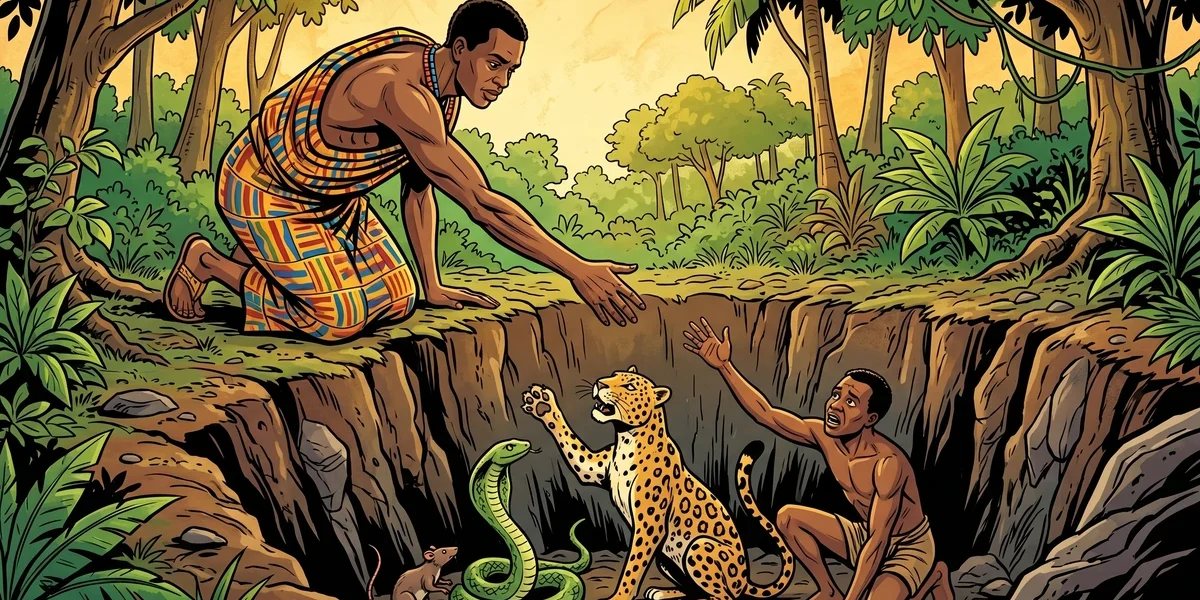
Among the folk tales of the Akan peoples of the West African Gold Coast – the region of modern Ghana – “The Ungrateful Man” is one of the most pointed moral stories ever told around an evening fire. It begins with a poor hunter standing at the edge of a pit, looking down at four trapped creatures who all beg for their lives. It ends with an execution – but not the one anyone in the story expected. Between those two moments lies a quiet argument about a question every community has had to answer: when someone owes you everything, what is their kindness worth, and what is their cruelty?
The tale is short, but it is built with great care. Three animals and one man are rescued by the same hand on the same day. The three animals repay the hunter so richly that he becomes wealthy. The one man – the only creature in the pit who shares the hunter’s own kind – repays him with a lie that nearly costs the hunter his head. The story does not rage against this. It simply lets the man’s ingratitude run its full course until it loops back, with terrible neatness, and destroys him. This is a tale about reciprocity, about the difference between a debt remembered and a debt resented, and about a poison that can only be mixed with a traitor’s blood.
The Hunter and the Pit of Four Captives
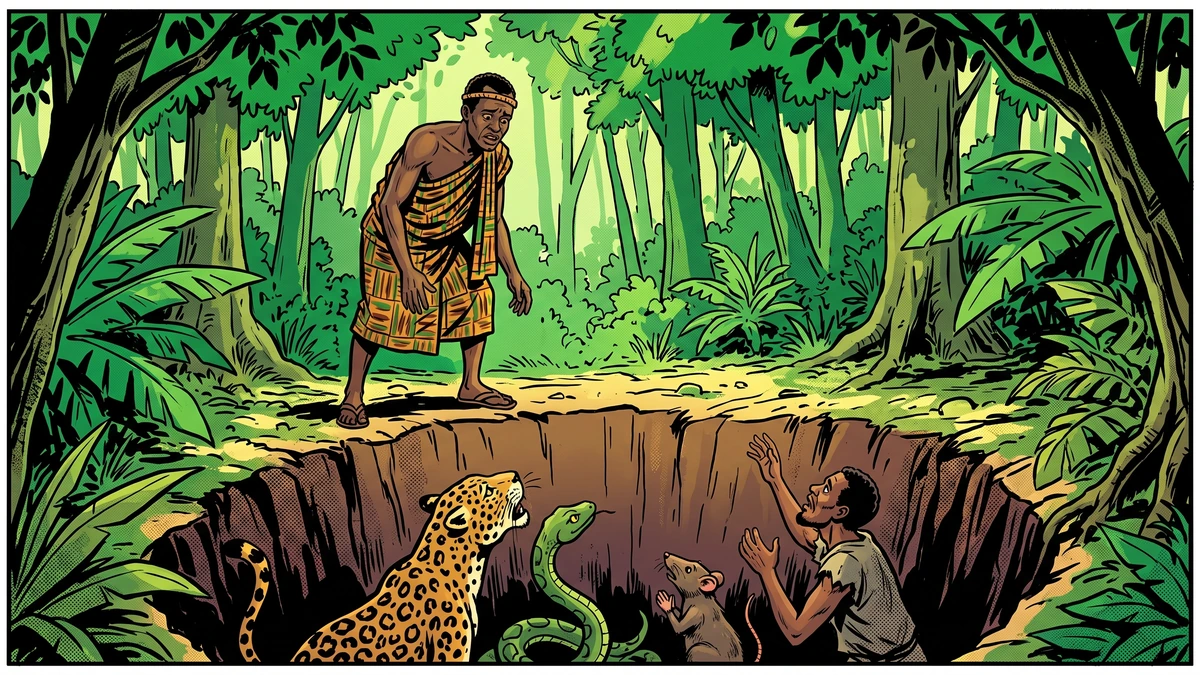
A hunter, so poor that he walked the forest hungry, came one day upon a deep hole in the ground. It was a trap, and four creatures had fallen into it and could not climb out: a leopard, a serpent, a rat, and a man. All four lifted their voices to the hunter and begged him to set them free.
The hunter hesitated, and his hesitation is the moral heart of the story’s opening. He did not want to release the animals at all. The leopard, he reasoned aloud, had often stolen and eaten his cattle. The serpent bit men and brought death into villages. The rat, as far as he could see, did no good to anyone. Why should he trouble himself to save creatures that the world might be better without? Only the man did he wish to help, for the man was of his own kind.
Here the tale plants its first careful seed. The hunter judges the three animals harshly and the man not at all – and the rest of the story will turn that judgement completely inside out. But the animals pleaded so earnestly for life that the hunter’s pity overcame his calculation. One by one he drew all four out of the pit. Each of the three animals, in turn, promised to reward him for his kindness. The man promised nothing. He explained that he was very poor and had nothing to give, and the kind-hearted hunter, asking for no promise at all, simply took the man home and let him live in his cottage.
Four Promises and Three Gifts
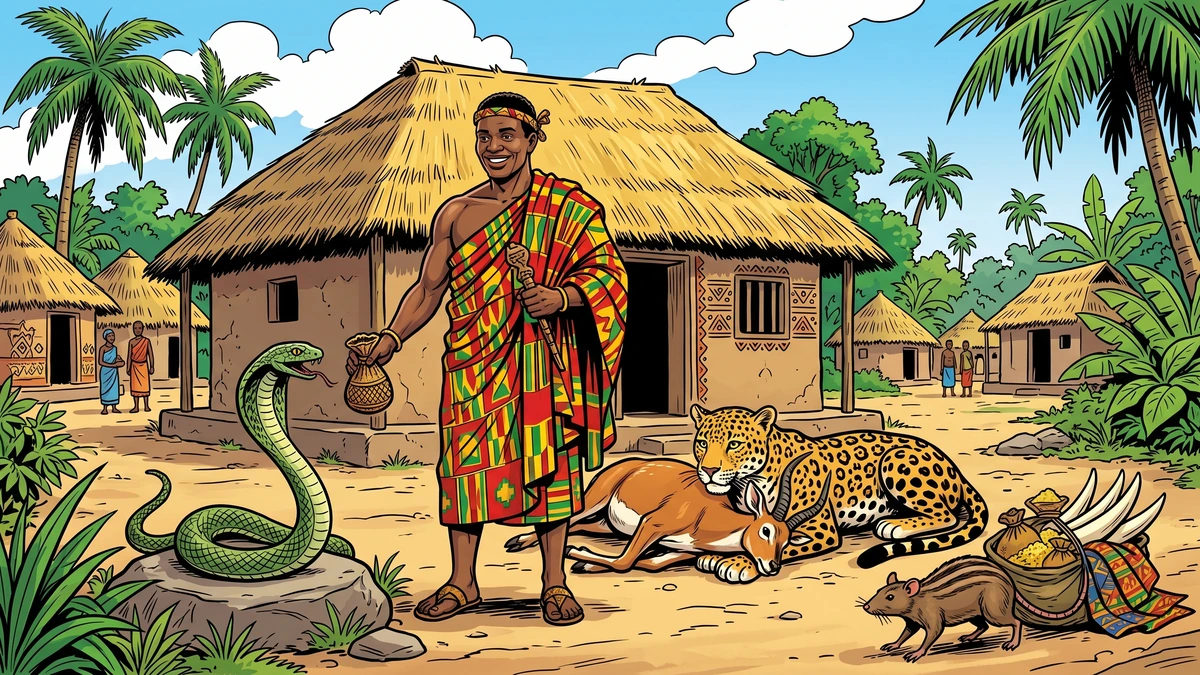
The animals kept their word, and they kept it generously. A short time later the serpent came to the hunter and gave him a powerful antidote for snake-poison. “Keep it carefully,” the serpent said. “You will find it very useful one day. When you use it, be sure to ask for the blood of a traitor to mix with it.” The hunter thanked the serpent, took great care of the powder, and carried it with him always – not understanding yet how exactly the gift had been designed.
The leopard repaid the hunter in the plain currency of the forest: it hunted and killed game for him, and for many weeks the once-starving man had meat in abundance. Then the rat – the creature the hunter had thought useless – arrived with a heavy bundle. “These,” said the rat, “are native cloths, gold dust, and ivory. They will make you rich.” And so they did.
The hunter who had walked the forest hungry now lived in great comfort. He built a fine new house and filled it with everything he needed. Every creature he had doubted – the cattle-thief, the man-killer, the useless rat – had proven faithful beyond his expectation. And the one guest he had trusted without asking for a promise, the man, still lived under his roof, watching the hunter’s good fortune grow. The story has now quietly completed its inversion: the despised animals are revealed as the loyal ones, and the trusted man is about to reveal what he truly is.
The Envy of the Rescued Man
The man whom the hunter had saved from the pit was of an envious disposition. He was not pleased by his host’s prosperity – he resented it. He had been lifted out of a death-trap, fed, sheltered, and asked for nothing in return, and instead of gratitude he nursed a slow, waiting ill-will. He only needed an opportunity to do the hunter harm, and soon enough an opportunity came.
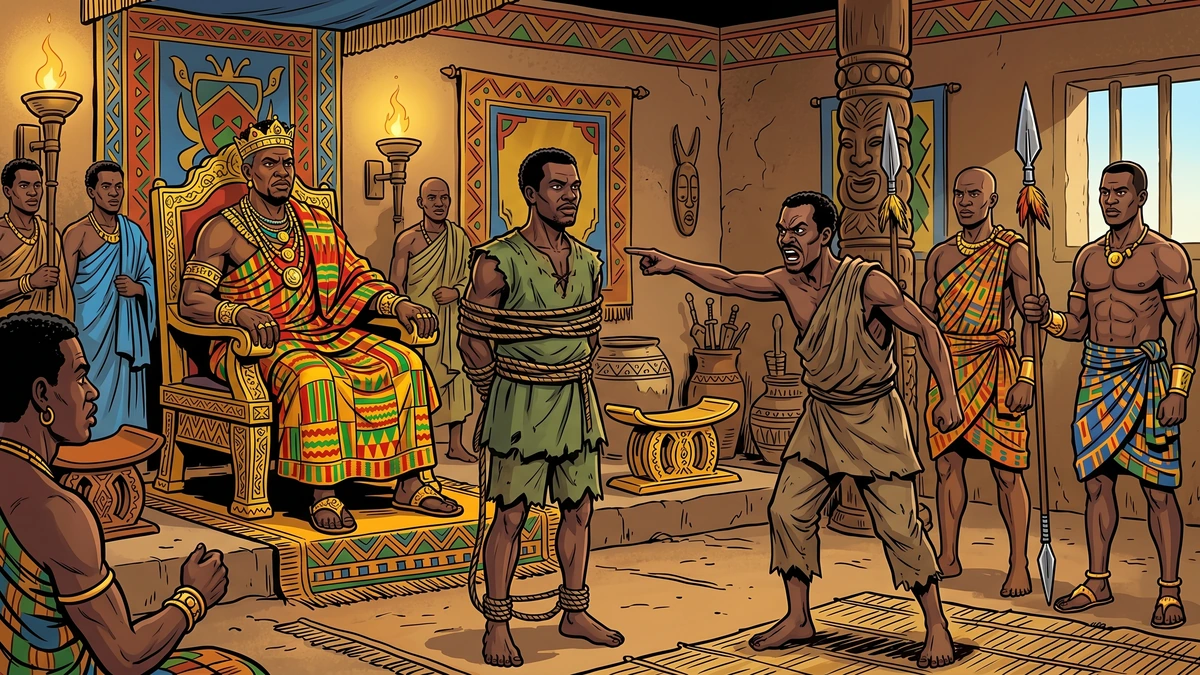
A proclamation was sounded throughout the country. Robbers had broken into the King’s palace and carried off his jewels and many other valuables. The ungrateful man hurried at once to the King and asked what reward would be given to anyone who pointed out the thief. The King promised half of the stolen goods. The wicked fellow thereupon accused his own host – the hunter who had saved his life and shared his home – though he knew perfectly well that the hunter was innocent.
The honest hunter was seized and thrown into prison. Brought before the court, he was ordered to explain how a once-poor man had grown so suddenly rich. He told the truth: the serpent’s powder, the leopard’s meat, the rat’s bundle of gold and ivory and cloth. But the truth of his story was so strange that no one in the court believed a word of it. A man who claimed that animals had made him wealthy was, to the judges, simply a thief inventing an excuse. The hunter was condemned to die the following day at noon.
The Traitor’s Blood
The next morning, while the preparations for the execution were already being made, urgent news reached the prison. The King’s eldest son had been bitten by a serpent and was dying. A desperate plea went out: anyone who could cure the prince was begged to come at once.
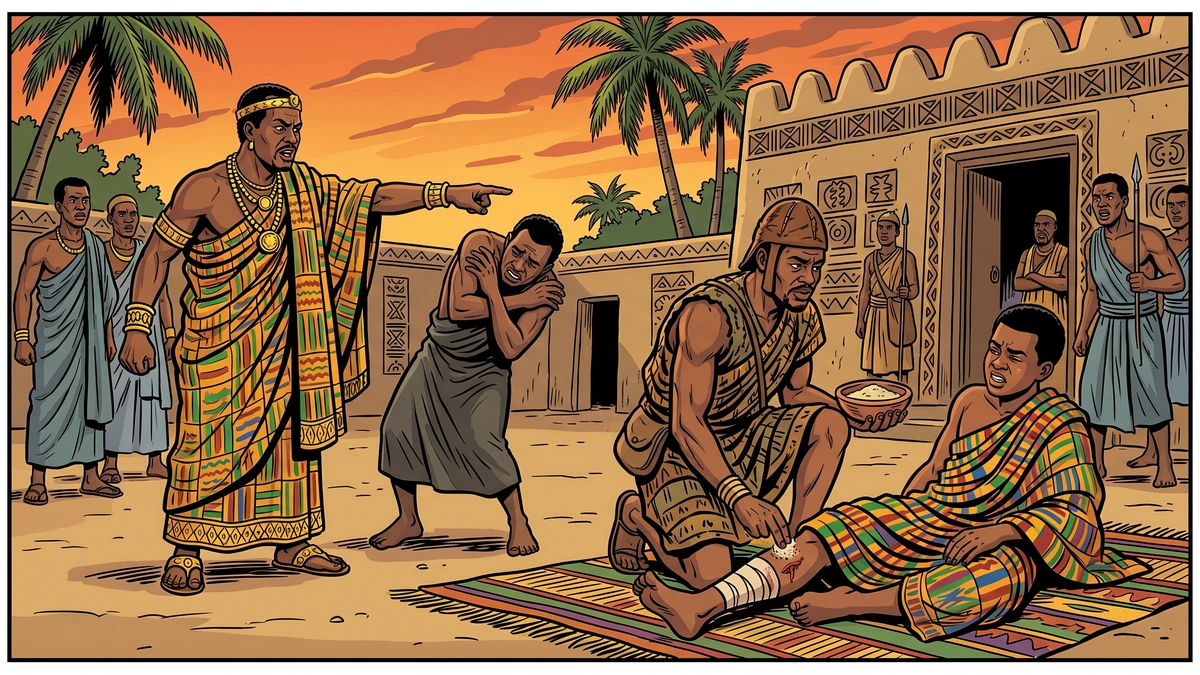
The hunter remembered the powder. He asked to be allowed to try it, and though the court was unwilling to trust a condemned man, they were more unwilling to let the prince die, and at last they granted permission. The King asked the hunter whether he needed anything to prepare the medicine. The hunter answered exactly as the serpent had instructed him long before: he needed a traitor’s blood to mix with it.
And now the serpent’s strange instruction revealed its purpose. The King himself supplied the answer. He pointed to the ungrateful man – the very accuser whose lie had condemned the hunter – and declared that there stood the worst traitor of all, for he had betrayed the kind host who had saved his life. The man was beheaded on the spot. His blood was mixed into the powder as the serpent had commanded, the medicine was applied to the prince’s wound, and the young man was cured.
In his great delight the King loaded the hunter with honours and sent him home in happiness. The serpent’s gift had been a prophecy folded inside a remedy. The antidote could only ever work by destroying a traitor – and on the day the hunter needed it, the country’s clearest traitor was the man he had pulled from the pit. Ingratitude did not merely fail in this story. It became the precise ingredient of its own punishment.
The Moral of the Tale
“The Ungrateful Man” teaches a lesson that the Akan storytellers framed not as a rule but as a warning carried in a memorable image. Kindness creates a debt, and a debt may be honoured or it may be betrayed – and the betrayal of kindness, the tale insists, carries the seed of its own ruin. The three animals, judged worthless by the hunter, repaid their rescuer many times over. The man, trusted without even being asked for a promise, repaid his rescuer with a lie meant to kill him. The story’s arithmetic is exact: the creatures who owed the smallest social debt paid the largest, and the one who owed the largest debt paid it with treachery.
The Akan peoples expressed this same truth in a proverb that this tale could almost have been built to illustrate – a saying about the danger that comes not from strangers but from those one has taken closest:
Aboa bi rebɛka wo a, ɔfiri wo ntoma mu.
The ungrateful man was exactly such an animal: not a robber from outside the village, but a guest sheltered within the hunter’s own house, wrapped in the hunter’s own generosity. The proverb and the tale agree that the most dangerous betrayal is intimate – and that a community survives only when those who are helped remember the help. Gratitude, in this telling, is not mere politeness. It is the thread that holds a society together, and the man who cuts it cuts the rope he himself is hanging from.
Where the Story Comes From
“The Ungrateful Man” was preserved for English-language readers in West African Folk-Tales, collected and arranged by William H. Barker and Cecilia Sinclair and published in London by George G. Harrap & Co. in 1917. Barker served as an educator on the Gold Coast – the British colonial territory that became independent Ghana in 1957 – and the collection gathers stories from the Akan-speaking peoples, including the Ashanti and Fanti communities whose oral storytellers kept these tales alive for generations before any of them were written down.
Barker and Sinclair’s volume belongs to a wave of early-twentieth-century folklore collecting in West Africa, the same period that produced R. S. Rattray’s landmark Ashanti studies. Their book deliberately set the animal-trickster stories of Anansi the spider alongside moral parables, etiological “why” stories, and tales of kings and hunters, presenting the Gold Coast oral repertoire as a complete moral literature rather than a collection of curiosities. “The Ungrateful Man” sits among the moral parables: it has no trickster hero and no magical transformation for its own sake, only a clean ethical machine in which a single act of generosity is tested four times and answered four ways.
The Tale Type: Grateful Animals and the Ungrateful Man
Folklorists recognise this story as a member of one of the most widespread tale types in the world. In the international Aarne–Thompson–Uther index it is classified as ATU 160, “Grateful Animals; Ungrateful Man.” The defining shape of the type is exactly the shape of this tale: a person rescues several animals and one human being from danger; the animals reward the rescuer faithfully; the rescued human betrays him; and the betrayal is finally exposed and punished.
The story also rests on a cluster of motifs catalogued in Stith Thompson’s Motif-Index of Folk-Literature. The grateful beasts belong to motif B360, “Animals grateful for rescue from peril,” and its relative B375, “Animals released: gratitude.” The man’s conduct is motif W154, “Ingratitude,” and his downfall is Q281, “Ingratitude punished.” The final courtroom turn – where the villain is unmasked because the remedy itself demands a traitor – is a striking local elaboration of the type, binding the punishment of ingratitude directly into the magical gift that the gratitude of the serpent had produced.
What makes ATU 160 so durable is its built-in comparison. By rescuing animals and a human in a single act, the rescuer runs a controlled experiment in character. The animals, who in the hierarchy of the old stories “owe” humans nothing, behave with perfect loyalty. The human, who shares the rescuer’s own nature and ought to understand the debt best, behaves worst. The type exists precisely to make an audience uncomfortable with the assumption that kinship guarantees loyalty.
Anansesem: The Akan Storytelling Tradition
On the Gold Coast, stories of this kind were told within a living performance tradition the Akan call anansesem – literally “spider stories,” named for Anansi, the trickster spider who presides over the whole body of Akan tales even when, as here, he never appears. Anansesem were performed in the evenings, after the work of the day, often by a skilled elder, and they were not a passive entertainment. The audience joined in: songs called mboguo could interrupt the narration, listeners responded aloud, and a story was as much a communal event as a recital.
Within that setting, a moral tale like “The Ungrateful Man” did real social work. Akan society placed enormous weight on reciprocal obligation – on the network of gifts, debts, hospitality, and remembered help that held an extended family and a town together. A guest taken into a household entered a relationship of mutual duty. To shelter a man, feed him, and ask nothing of him, as the hunter does, was to extend that web of obligation at its most generous. For the guest then to betray the host struck at the foundation of communal life. The story let listeners watch that foundation be attacked and then watch it reassert itself, with the traitor destroyed and the faithful man honoured by the King – the figure who, in the tale’s moral world, embodies the community’s justice.
How the Story Was Collected and Carried
For most of its life “The Ungrateful Man” existed only in the air – in the breath of storytellers and the memory of listeners. It was carried from one generation to the next by performance, and each performance refined it. Details that did not earn their place fell away; the four-captive structure, the serpent’s cryptic instruction, the courtroom reversal – the load-bearing parts – survived because audiences responded to them. By the time Barker and Sinclair recorded the tale, it had already been polished by countless retellings into the lean, exact form we read today.
The 1917 printing changed the story’s life. A tale that had travelled only as far as a human voice could carry it could now cross oceans. West African moral and trickster tales had already been carried across the Atlantic in the memories of enslaved people, where they took root and reshaped themselves – Anansi becoming “Aunt Nancy” in parts of the Caribbean and the American South, and the animal-trickster tradition feeding into the Brer Rabbit stories. Print added a second route of transmission alongside that older, painful one, and it is the route by which this version reaches a modern reader. The story remains, even on the page, a record of an oral art: its short paragraphs, its repetitions, its clean cause-and-effect are the fingerprints of a tale built to be spoken aloud and remembered.
The Same Story Across the World
Because ATU 160 is an international type, “The Ungrateful Man” has close cousins on nearly every continent. Medieval European collections told of a man who rescues a lion, a serpent, and a monkey from a pit along with an ungrateful goldsmith or courtier; the animals repay him and the human betrays him, exactly as here. The frame-tale literatures of India – the Panchatantra and its many descendants – carry versions in which a brahmin or traveller pulls a tiger, a snake, a monkey, and a man from a well, and the man alone proves treacherous. The motif of grateful animals and an ungrateful human runs through Persian, Arabic, and European medieval story-collections, a sign of how far and how easily the type travelled along trade routes and through translated books.
The West African telling has its own unmistakable signature. The serpent’s gift is not simply a reward but a sealed prophecy: an antidote that can only be completed with a traitor’s blood. That detail turns the story’s ending from a coincidence into a mechanism. In many versions of the type the ungrateful man is merely exposed; in this one the very medicine the hunter carries is built, from the beginning, to consume him. The grateful serpent and the punished traitor are joined in a single object. It is an elegant piece of storytelling craft, and it belongs to the Akan tradition that shaped it.
Why This Story Has Lasted
“The Ungrateful Man” has survived for the same reason it was told in the first place: it answers a question no community ever stops asking. Every society depends on people remembering the help they have been given – on debts of kindness being honoured rather than resented. And every society contains people who, lifted out of their own pit, choose envy over gratitude. The story does not pretend such people are rare. It simply shows, with great economy, what their ingratitude finally costs.
For a modern reader the tale keeps its edge because its central irony is so honest. The hunter’s first instinct – to save the man and doubt the animals – is the instinct most of us would share, and the story gently proves it wrong. Loyalty, it argues, cannot be predicted from category or kinship; it can only be revealed by conduct. The leopard, the serpent, and the rat are judged by what they do, and so, in the end, is the man. That is a lesson worth carrying out of a folk tale and into an ordinary life: watch what people do with the kindness they are given, because their answer to that small test is the truest thing they will ever tell you.
You May Also Like
 African Folk Tales
Ages 9-12
African Folk Tales
Ages 9-12
Why White Ants Always Harm Man’S Property
A West African (Akan) pourquoi tale from the Anansesem spider-story tradition: how Spider's greed, a broken promise, and one hasty mistake turned the white ant into the eternal enemy of every home.
 African Folk Tales
Ages 6-8
African Folk Tales
Ages 6-8
Why the Sun and Moon Live in the Sky
An Efik pourquoi tale from southern Nigeria: the Sun and his wife the Moon welcome their friend the Water too well, are flooded out of the great house they built, and are driven up to live in the sky forever.
 African Folk Tales
Ages 9-12
African Folk Tales
Ages 9-12
Why The Moon And The Stars Receive Their Light From The Sun
Why The Moon And The Stars Receive Their Light From The Sun: Once upon a time there was great scarcity of food in the land. Father Anansi and his son, Kweku