Why White Ants Always Harm Man’S Property
A West African (Akan) pourquoi tale from the Anansesem spider-story tradition: how Spider's greed, a broken promise, and one hasty mistake turned the white ant into the eternal enemy of every home.
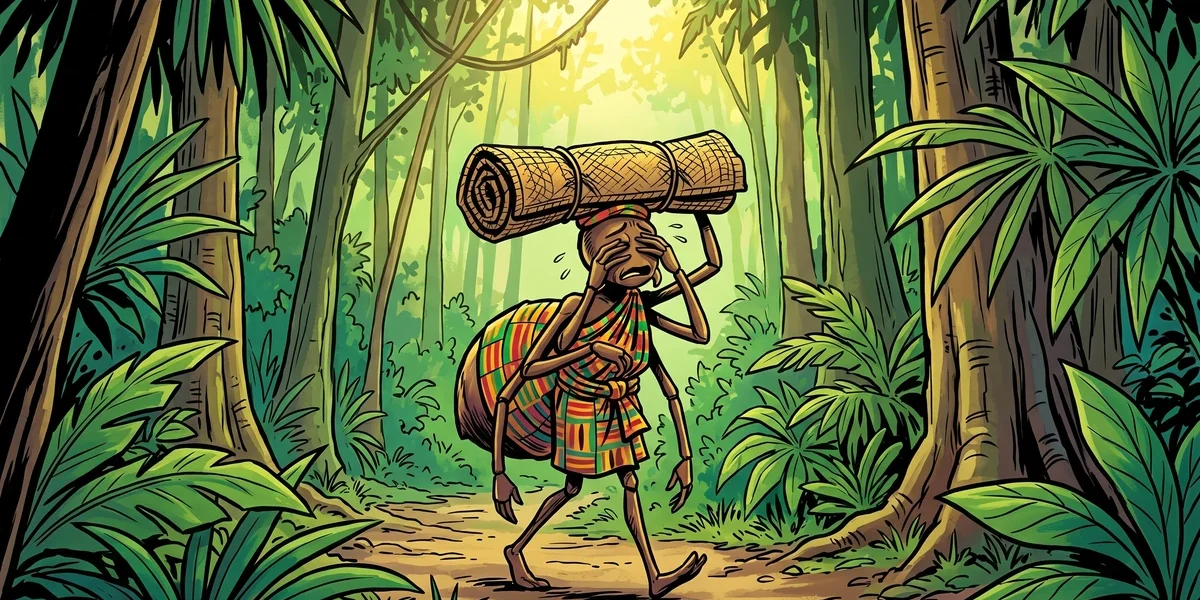
Long ago, when the forests of the Gold Coast were thick with cunning and hunger, a famine fell so hard upon the land that a single grain of corn was prized above its weight in gold. It was in that desperate season that Spider — the trickster of every West African fireside — set in motion a chain of greed, deceit, and broken hospitality. Before the tale was done, a small and patient creature would make a vow that explains, to this very day, why white ants gnaw away at the homes and harvests of human beings.
A Spider Tale from the Gold Coast
This is an Anansesem — a “spider story” — one of the trickster narratives that the Akan people of the Gold Coast (modern Ghana) have told for centuries beneath the moon and the cooking fire. In the Akan world almost every old story was credited to Anansi the spider, the small, weak, endlessly clever figure whose appetite forever outruns his conscience. To call a tale a “spider story” was to promise the listener wit, mischief, and a lesson hidden inside the laughter.
“Why White Ants Always Harm Man’s Property” is also a pourquoi tale, the kind of story that ends by explaining some plain fact of the world — here, why termites are the silent, ceaseless enemy of every farmer’s barn and every builder’s beam. But the explanation it offers is not really about insects at all. It is about gratitude betrayed, about the danger of acting on appearances, and about how a single careless cruelty can turn a friend into an enemy forever.

The Famine and the Spider’s Cunning Bundle
Spider was wandering the hungry forest when fortune smiled on him: he came upon a dead antelope. In a season when corn was worth gold, a whole antelope was a treasure beyond dreaming — and Spider knew at once that no one would let him carry such a prize home unchallenged. So he did what Spider always does. He thought.
He wrapped the carcass with great care in a long sleeping-mat, bound it tight and neat, and balanced the bundle on his head. Then, as he walked the forest paths toward home, he began to weep. To every traveller he met he sobbed out the same sorrowful story: this heavy bundle was the body of his dear dead grandfather, and he was carrying the old man home to be buried with honour. The villagers’ hearts went out to him. They sympathised warmly, stepped aside to let the mourner pass, and never once thought to ask what truly lay inside the mat.
It was a small, brilliant, shameless lie — the lie of a creature who understood that grief silences suspicion, and that a weeping man is rarely questioned. Spider had turned the whole forest’s kindness into cover for his theft. But cleverness, in a spider story, is never the end of the matter. It is only the beginning of the trouble.
Wolf and Leopard Outwitted
On the road Spider crossed paths with two animals far less gullible than the rest: Wolf and Leopard. They watched the weeping spider with his suspiciously heavy “grandfather,” and they did not believe a word of it. They knew Spider of old. They knew he was not to be trusted. Walking on a little way, they put their heads together and made a plan.
They took a short cut to a certain tree they knew Spider would have to pass, hid themselves behind it, and waited. When Spider came near, the two of them shook the branches violently and let loose the most frightful howls and screeches the forest had ever heard. Spider, certain that ghosts or monsters had risen to punish his lie, dropped his precious bundle and fled for his life.
Wolf and Leopard stepped out, untied the mat, and found — to their delight — the rich flesh of the antelope. They carried it off to their own cottage and began to prepare a feast. The trickster had been tricked. But Spider, once his fright wore off, sat down and reasoned coldly: who in all the forest was clever and bold enough to ambush him at that tree? Only Wolf and Leopard. And Spider resolved to take back what he considered his.

His revenge was a masterpiece of patience. He took a small lizard and carefully filed the little creature’s teeth to fine, gleaming, needle-sharp points. Then he sent the lizard to Wolf and Leopard’s house to beg for fire — and to smile, widely and often, so the two animals could not help but admire those marvellous teeth. When they asked, amazed, who had given the lizard such a beautiful set of teeth, the lizard answered exactly as Spider had taught him: it was “Filing Spider,” the great craftsman, who did such work.
Wolf and Leopard, thinking how easily such teeth would crack the bones of their stolen feast, hurried to the house of the disguised Spider and asked him to file their teeth in the very same fashion. Spider agreed at once — but explained, with a craftsman’s seriousness, that to do the work properly he would first have to hang each of them up on a tree. The two animals, dazzled by vanity, made no objection at all. And once Spider had them dangling helpless from the branches, he and his whole family gathered round to mock them. Then Spider strolled to their cottage, carried off the antelope a second time, and held a great village feast directly beneath the tree, so that everyone could laugh at the two fools hanging overhead.
White Ant’s Kindness — and the Boiling Betrayal
Wolf and Leopard hung on the tree through the night, shamed and miserable. Then, in the morning, a small procession passed below: White Ant and his many children, on their way to visit friends. Leopard called down and begged the ants — humbly now, all his pride gone — to set him and his companion free.
The ants did not hesitate. White Ant and his whole family set to work with the only tools they had: their tireless jaws. Grain by grain, fibre by fibre, they ate through the wood of the tree until at last it gave way and the two animals tumbled free. It was a true kindness, freely given, and it cost the little ants a great deal of labour. In gratitude, Wolf and Leopard promised the ants a splendid feast in return, and named the third day — the very day already set for their own meal — as the day of thanksgiving.
But Spider, that endless eavesdropper, overheard the invitation. And Spider could never bear to let a feast pass him by. On the third day he dressed his own children to look like ants, taught them the ants’ marching chorus, and sent them singing down the road to Wolf and Leopard’s house. The two hosts welcomed the disguised spiders warmly, spread out a magnificent feast, and watched with pleasure as their “guests” ate every dish with relish.

Soon after the false ants had gone, the real ants arrived — White Ant and his children, exactly as promised, coming to claim the meal their kindness had earned. But Wolf and Leopard, looking at the small creatures at their door, made the most terrible mistake of the whole tale. They were certain these must be Spider and his family come back for a second helping. And so, instead of a feast, they poured boiling water over their true benefactors and scalded them to death — every one of them but the father, White Ant himself, who alone escaped.
The Vow That Made Termites the Enemy of Every Home
White Ant crawled home alone, his children dead behind him, his kindness repaid with boiling water. And in his grief and fury he made a vow that the tale says has never been broken. Never again, he swore, would he help any living creature. From that day forward he would take every chance he could find to harm the property of others — to gnaw, to tunnel, to ruin, to destroy.
And so, the storytellers say, it has been ever since. The white ant — the termite — eats through the beams of houses and the posts of granaries; it hollows out furniture and devours stored grain; it brings down what men have built and labour to keep. It does this, the tale insists, not out of simple hunger but out of an ancient, unhealed wound: a promise of thanks that turned, through carelessness and haste, into a sentence of death.

It is worth noticing where the story places the true guilt. Spider lit the fuse with his lies and his greed, and his disguised children were the immediate cause of the fatal confusion. Yet the boiling water was poured by Wolf and Leopard — the very animals the ants had rescued. The tale does not let the rescued forget that they killed their rescuers. The termite’s curse is born not from one villain but from a whole chain of small failures: a lie, a theft, a revenge, a disguise, and finally a deadly assumption made without looking closely enough to be sure.
The Moral of the Tale
On its surface this is a story about insects. Underneath, it is a story about how communities destroy themselves. Every disaster in the tale comes from a creature acting on what it assumed rather than what it knew. The villagers assumed a weeping spider must be telling the truth. Wolf and Leopard assumed that beautiful teeth were worth being hung from a tree. And, most fatally of all, they assumed the small creatures at their door were enemies — and so they killed the only friends they had.
The Akan have a proverb that the elders set against exactly this kind of haste:
“Tikoro nkɔ agyina.”
“One head does not go into council.” — Akan (Twi) proverb
No single head, the proverb teaches, should decide a serious matter alone; wisdom is something a community arrives at together, by asking, by listening, by checking. Wolf and Leopard poured the boiling water on a private, hasty certainty. Had they paused — had they asked even one question, had they looked once more before they acted — they would have recognised their rescuers and the tragedy would never have happened. The story’s deepest lesson is that ingratitude is rarely a deliberate evil. More often it is a failure of attention: we harm those who helped us simply because we did not stop long enough to see who was standing in front of us.
And there is a quieter warning for the trickster, too. Spider’s cleverness wins him antelope after antelope, but it also poisons the whole forest around him. By the end, his lies have made the villagers easier to fool, the strong animals crueller, and a gentle family of ants into eternal enemies of mankind. Cunning that feeds only itself, the tale suggests, eventually spoils the world it lives in.
Origins: Anansesem and the “West African Folk-Tales” Collection
This tale was set down in print in West African Folk-Tales, the collection compiled by William H. Barker and Cecilia Sinclair and published in London by George G. Harrap in 1917. Barker was a Wesleyan missionary and educationist who worked on the Gold Coast and served as principal of a teacher-training institution there; Sinclair was a teacher associated with the same educational work. Together they gathered and rendered into English a body of stories drawn chiefly from the Akan-speaking peoples of the Gold Coast, with the spider Anansi standing at the centre of the collection as he stands at the centre of the living tradition.
The Akan word for these narratives is Anansesem, literally “Anansi stories” or “spider stories” — a term that, over generations, came to mean folk-tales in general, whether or not the spider actually appeared in them. They belonged to the evening, to the time after the day’s work when families and neighbours gathered and an experienced narrator could hold a circle of listeners with timing, song, and the call-and-response that West African storytelling prizes. Many Anansesem are pourquoi or etiological tales like this one, ending with an explanation of why the natural world looks as it does — why the moon waxes and wanes, why animals fear one another, why the termite is the enemy of the house.
In the international folktale system this story sits among the pourquoi narratives that explain a creature’s behaviour or characteristic — the broad family of animal-origin tales catalogued in the motif range A2200–A2599 (“Animal characteristics”), and specifically the motifs that account for the cause of an animal’s enmity toward humankind. Its trickster machinery — the false corpse used to smuggle food, the filed teeth, the disguise of one family as another — draws on the deception motifs of the Anansi cycle (the K-group of “Deceptions” in the Aarne–Thompson–Uther index). What gives the tale its lasting bite, though, is the way it fuses two ideas that rarely sit together: a light trickster comedy and a dark fable about ingratitude, so that the laughter and the lesson arrive in the same breath.
When Anansesem travelled — carried across the Atlantic in the terrible holds of slave ships — the spider travelled with them. Anansi became “Aunt Nancy” and the spider-trickster of Caribbean and African-American storytelling, and the structure of these tales fed into the broader pourquoi tradition of the Americas. The small spider of the Gold Coast forest became one of the most widely told characters in the history of human storytelling.
Why This Tale Has Lasted
“Why White Ants Always Harm Man’s Property” has survived because it does two difficult things at once and makes them look effortless. It entertains — Spider’s weeping-grandfather lie and his absurd teeth-filing revenge are genuinely funny — and at the same time it delivers a moral that lands like a stone: the people who scalded the ants were the people the ants had saved. A child laughs at the first half and goes quiet at the second, and that quiet is where the teaching happens.
It has lasted, too, because its central warning never expires. Every generation invents new ways to act on assumption instead of knowledge — to judge the stranger at the door by appearances, to repay help with harm because we were too hurried or too frightened to look closely. The tale gives that failure a face and a consequence, and it does so without naming a single simple villain. Spider, Wolf, Leopard, even the listener’s own impatience: the blame is shared, as blame usually is.
And finally it has lasted because it does what the very best pourquoi tales do — it takes an ordinary, irritating fact of life, the termite in the wood, and hands it a history. After hearing this story, no one who grew up with it could ever again see a ruined beam or a hollowed post without remembering White Ant crawling home alone, and the boiling water, and the vow. The tale turns a household pest into a piece of moral memory. That is the quiet genius of the Anansesem: they make the whole visible world into a book of remembered lessons, and they make sure the lessons are never forgotten, because they are written into the very things we touch every day.
Frequently Asked Questions
Why do white ants harm human property in this West African folk tale?
In the tale, White Ant and his children kindly gnaw through a tree to free Wolf and Leopard, who promise them a feast in return. When the real ants arrive to claim it, Wolf and Leopard mistake them for Spider’s disguised family and pour boiling water over them, killing all but the father. Grief-stricken and betrayed, White Ant vows never to help any creature again and to harm property at every opportunity — which is why, the storytellers say, termites have gnawed at the homes and granaries of human beings ever since.
Where does the story “Why White Ants Always Harm Man’s Property” come from?
It is an Akan tale from the Gold Coast (modern Ghana), recorded in English in West African Folk-Tales, compiled by William H. Barker and Cecilia Sinclair and published in London by George G. Harrap in 1917. It belongs to the Anansesem, or ‘spider story’, tradition centred on Anansi the trickster spider.
Who is really to blame for the death of the white ants?
The tale spreads the blame deliberately. Spider sets everything in motion with his lies, his theft, and his disguised children. But the boiling water is poured by Wolf and Leopard — the very animals the ants had rescued — who act on a hasty assumption without checking who their visitors truly were. The disaster is a chain of small failures, with the fatal one being ingratitude born of carelessness.
What is an Anansesem or ‘spider story’?
Anansesem is the Akan word for the spider-trickster tales told around the evening fire on the Gold Coast. Almost every old story was credited to Anansi the spider, so the word came to mean folk-tales in general. Many Anansesem are pourquoi (etiological) tales that end by explaining why the natural world looks the way it does.
What is the moral of ‘Why White Ants Always Harm Man’s Property’?
The story warns against acting on assumption instead of knowledge, and against the careless ingratitude that repays help with harm. As the Akan proverb says, ‘Tikoro nkɔ agyina’ — ‘one head does not go into council’: serious matters should be weighed carefully and together. Wolf and Leopard killed their own rescuers because they did not stop long enough to see who stood before them.
You May Also Like
 African Folk Tales
Ages 6-8
African Folk Tales
Ages 6-8
The Tortoise and the Baboon
The African Bantu fable of a baboon who invites a tortoise to a feast hung out of reach in a tree, and the tortoise's patient revenge laid across a stretch of fire-blackened ground - the reciprocal-inhospitality story, international tale type ATU 60.
 African Folk Tales
Ages 9-12
African Folk Tales
Ages 9-12
The Dance For Water Or Rabbit’s Triumph
A Khoikhoi trickster tale from the Cape of Good Hope: during a drought the animals dance water out of a dry riverbed, and the rabbit who scorned the work is trapped on a pitch-covered tortoise, then escapes by reverse psychology - an African root of the Tar-Baby tale.
 African Folk Tales
Ages 6-8
African Folk Tales
Ages 6-8
Thing To Do
A young person learns that the most important accomplishments are the small, caring things we do.