The God Of The City
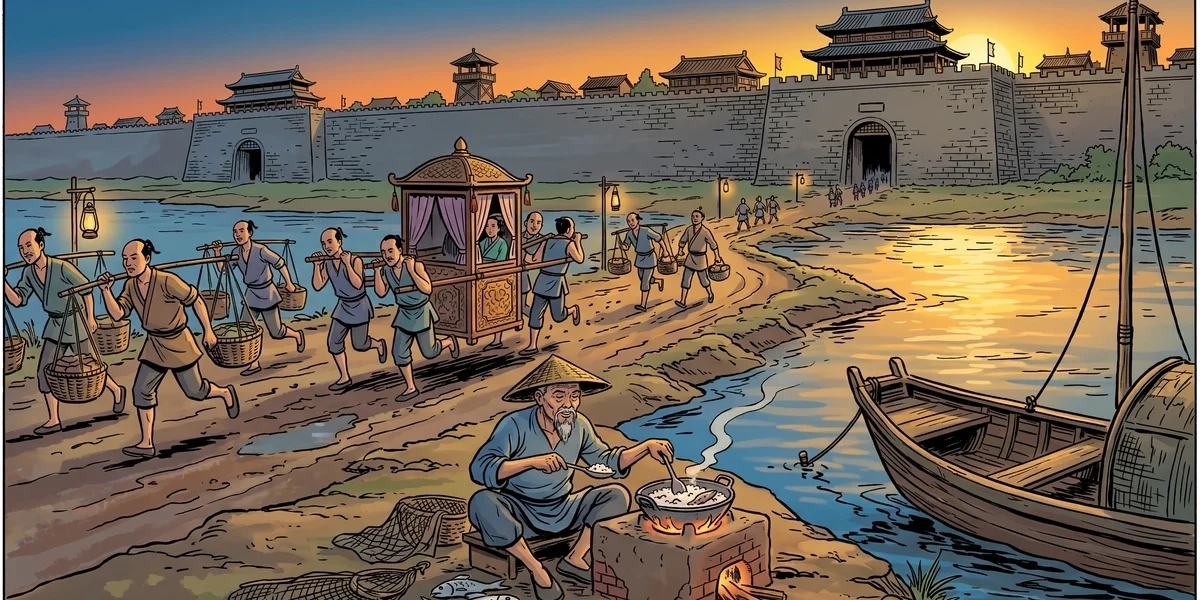
The God Of The City: One evening in the distant past a fisherman anchored his boat near the bank of a stream which flowed close by a great city, whose walls
Origin & Tradition
“The God of the City” centres on one of the most distinctive institutions in Chinese popular religion: the Cheng Huang (城隘, City God), the divine magistrate appointed to protect and govern the spiritual life of each Chinese city, town, and district. The Cheng Huang tradition is documented from at least the Tang dynasty (618–907 CE) and reached its full institutional elaboration during the Ming dynasty (1368–1644), when the Hongwu Emperor formally incorporated the City God into the state religious system, assigning each city a divine official with a rank corresponding to the city’s administrative grade. The story — preserved in oral tradition and recorded in collections such as Richard Wilhelm’s Chinesische Volksmärchen (1914) — reflects the Chinese religious imagination’s most characteristic achievement: the organisation of the divine world as a perfect mirror of the earthly bureaucratic state, with gods holding official posts, receiving promotions and demotions, filing reports, and being held accountable for the welfare of their jurisdictions in precisely the way that imperial officials were held accountable for the districts they governed.
Part I — The Appointment of a Divine Magistrate
The story typically begins with the death of a morally exemplary individual — an upright magistrate, a devoted official, or simply a person of exceptional virtue who served their community faithfully throughout a long life. The death is not an ending but a transition: the celestial administration, which has observed this person’s earthly career with the same careful attention it gives to all mortal lives, has a vacancy in the divine bureaucracy and a newly available candidate of proven qualification. The deceased is summoned before the appropriate celestial official — often a divine messenger sent by the Jade Emperor (玉皇, Yu Huang) or the Court of Hell (地府, Di Fu) — and offered the post of City God for the district where he served and died.
This appointment is not simply an honour; it is a continuation of duty by other means. The City God is responsible for the spiritual welfare of every person within his jurisdiction — protecting the living from malevolent spirits, ensuring that the dead are properly processed through the underworld bureaucracy, maintaining the moral order of the community by keeping a record of every resident’s virtues and transgressions, and reporting this record to higher divine authorities at regular intervals (typically on the first and fifteenth of each lunar month). The Cheng Huang’s temple in the city — the Cheng Huang Miao (城隘廌) — serves as his divine office, and the worshippers who burn incense and present petitions there are, in the logic of the system, citizens filing requests with their local government.
Part II — The Divine Bureaucracy in Action
The story’s central action typically involves the new City God encountering a problem within his jurisdiction that tests the limits of his divine authority and the quality of his celestial judgment. A malevolent spirit has taken up residence in the district and refuses to leave; a grievous injustice has been committed that earthly courts have failed to redress; an epidemic threatens the community and the City God must intercede with higher authorities to obtain relief. The City God must navigate these challenges using the same combination of judicial authority, political skill, and moral persuasion that he employed as a mortal official — the difference being that his jurisdiction now extends to the supernatural as well as the social, and his superiors are the divine hierarchy rather than the imperial court.
This bureaucratic action is depicted with careful attention to procedure. The City God does not simply wave his hand and expel the demon; he issues summonses, conducts hearings, consults precedents, files reports. He is a magistrate, not a magician, and his power operates through legitimate process rather than arbitrary fiat — exactly as mortal magistrates’ power was supposed to operate. When he needs authority beyond his own rank — when the problem requires intervention at a level above the city — he submits a memorial (zou, 奉) upward through the divine hierarchy, as a mortal official would submit a memorial to the throne. The divine administration responds with the same combination of bureaucratic delay and eventual decisive action that the earthly administration was known for.
This procedural elaboration is not merely comic or satirical, though it is sometimes both. It encodes a serious theological claim: that the divine world operates according to the same principles of legitimate authority, accountability, and due process that should govern the earthly world. The celestial bureaucracy is not the corrupt or arbitrary shadow of imperial administration — it is its idealised form, the version that operates without venality, without factional politics, without the distortions introduced by human weakness. The City God story is, among other things, a fantasy of good government: this is how justice would work if the people responsible for it were genuinely virtuous and genuinely accountable.
Part III — The Cheng Huang and the Architecture of Chinese Popular Religion
The Cheng Huang system represents one of the most elaborate and sociologically rich institutions in the history of human religious organization. At its peak in the Ming dynasty, virtually every city in China — from the imperial capital down to the smallest county seat — had a City God with a temple, an official rank corresponding to the city’s administrative grade, a staff of divine underlings (including the menshen or door gods, the earth god Tu Di Gong, and a court of divine constables analogous to the mortal magistrate’s yamen staff), and a calendar of festivals at which the City God’s palanquin was carried through the streets of his jurisdiction in a divine inspection tour.
These inspection tours (xun jing, 巡小) were among the most important annual ritual events in Chinese urban life. The City God’s procession through every street of the city was simultaneously a religious ritual and a public performance of divine governance: the god was inspecting his jurisdiction, recording the moral condition of each household he passed, and making himself visible and accountable to his citizenry. Citizens who had petitions would present them along the procession route; those who had wrongs to redress would call them out as the palanquin passed. The City God was, in the fullest sense, a responsive public official — one who could be petitioned, thanked, criticised, and even demoted if he failed to protect his city from flood, fire, epidemic, or other disaster.
This accountability extended to the divine hierarchy above. If a city suffered repeated misfortunes, the City God might be formally reported to higher authorities as negligent — his divine rank reduced, his tenure in the position ended, a replacement appointed. The Ming Emperor Zhu Yuanzhang famously demoted the City God of Lake Tai after a storm on the lake nearly killed his soldiers, stripping the god of his ceremonial insignia in a formal imperial decree. The divine and human bureaucracies were, in this moment, genuinely continuous — operating by the same logic of performance review and accountability.
Part IV — Virtue Rewarded Beyond Death
The deepest moral proposition of “The God of the City” is also the most comforting one available in the Chinese cosmological system: virtue accumulates value across the boundary of death. The morally exemplary person who dies unrewarded by earthly fortune — who served faithfully, governed justly, lived honestly, and still found that the earthly system failed to properly recognise or compensate these qualities — can trust that the celestial accounting is more accurate than the earthly one. The divine bureaucracy has a better record-keeping system. It has read the complete file, including the chapters that earthly courts overlooked or suppressed. And on the basis of that complete file, it makes its appointments.
This proposition does not simply console — it provides what might be called a cosmological incentive structure for virtue in conditions of earthly uncertainty. The person who behaves virtuously despite having no guarantee of earthly reward does so not merely from abstract moral commitment but from a rational confidence that the universe is structured to recognise and reward virtue eventually, even if the timeline extends beyond the present lifetime. The City God is the visible proof of this structure: a specific individual who lived virtuously, died without extraordinary earthly reward, and was appointed to divine office on the basis of merit alone. His elevation is evidence — or at least the tradition’s claim to evidence — that the system works.
“He governed his district well, and when he died the district mourned him. But Heaven had been watching all along — and Heaven, unlike the earthly court, never misfiles a record of good service.”
Why This Story Lasted
The Cheng Huang story lasted because the hunger for good government — for officials who are genuinely accountable, genuinely virtuous, and genuinely responsive to the needs of those they govern — is permanent. Every society in every historical period has produced both the experience of bad government and the fantasy of its opposite; the Chinese tradition’s genius was to institutionalise that fantasy in religious form, creating a divine administration that modelled the ideal earthly one and providing worshippers with a mechanism (petitions, ceremonies, festivals) to interact with it.
The story also lasted because it takes death seriously without making it final. The mortal life is not negated by what comes after — it is evaluated and extended. The virtuous magistrate does not cease to govern at death; he is promoted to a larger jurisdiction with better tools. This vision of death as career advancement rather than termination offers a specifically Chinese answer to mortality’s challenge, one that integrates Buddhist ideas of continued existence with Confucian ideas of service and accountability into a theological synthesis unique to the Chinese tradition.
You May Also Like
 Chinese Folk Tales
All Ages
Chinese Folk Tales
All Ages
The Heartless Husband
The Heartless Husband: In olden times Hanchow was the capital of Southern China, and for that reason a great number of beggars had gathered there. These
 Chinese Folk Tales
All Ages
Chinese Folk Tales
All Ages
The Monk Of The Yangtze-Kiang
The Monk Of The Yangtze-Kiang: Buddhism took its rise in southern India, on the island of Ceylon. It was there that the son of a Brahminic king lived, who had
 Chinese Folk Tales
Ages 9-12
Chinese Folk Tales
Ages 9-12
The Maiden Who Was Stolen Away
The Maiden Who Was Stolen Away: In the western portion of the old capital city of Lo Yang there was a ruined cloister, in which stood an enormous pagoda