The Maiden Who Was Stolen Away
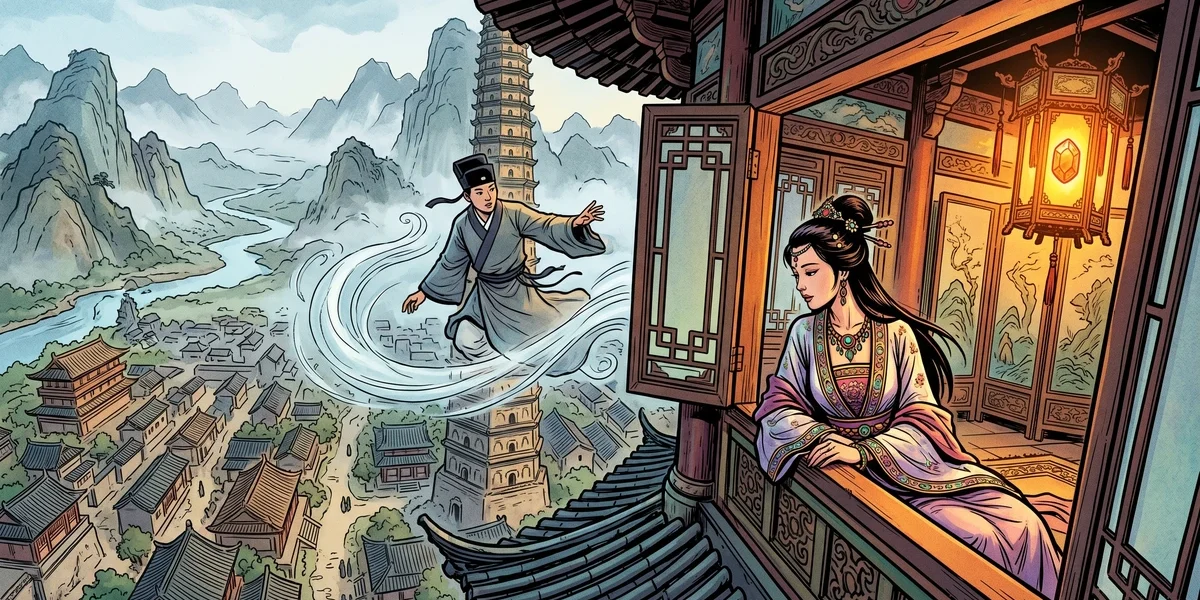
The Maiden Who Was Stolen Away: In the western portion of the old capital city of Lo Yang there was a ruined cloister, in which stood an enormous pagoda
Origin & Tradition
“The Maiden Who Was Stolen Away” belongs to the universal narrative pattern of abduction and rescue — one of the most widely distributed structures in world mythology and folklore, classified by folklorists as the katabasis (κατάβασις) pattern: the hero’s descent into a dangerous or supernatural realm to recover what has been lost or taken. The pattern appears in Greek mythology (Orpheus descending to Hades for Eurydice, Demeter seeking Persephone), Japanese mythology (Izanagi descending to Yomi for Izanami), Mesopotamian epic (Inanna’s descent to the underworld), Scandinavian tradition (Odin’s journey to the well of Mimir), and Hindu mythology (Rama’s rescue of Sita from Lanka). The Chinese telling, preserved in oral tradition and recorded in Richard Wilhelm’s Chinesische Volksmärchen (1914), inflects this universal pattern with specifically Chinese cosmological content: the demon’s realm is understood not as an underworld in the Western sense but as a liminal supernatural space — a pocket of the yao jing (妖精, “demon essence”) world that exists alongside the human world but operates on different principles, accessible only to those with the courage and, often, the spiritual resources to cross its threshold.
Part I — The Abduction and Its Meaning
The stolen maiden is typically characterised by a quality that attracts supernatural attention: exceptional beauty, unusual virtue, or a specific celestial connection that makes her appealing to a being of the spirit world. This is not a random crime but a supernaturally motivated one — the demon who takes her is drawn by something in her specific nature, and the story’s explanation of this attraction carries implicit commentary on the nature of what is most valuable in the human world and therefore most at risk from forces that operate outside of it.
The abduction itself — typically occurring at a moment when the maiden is alone, or transitional (at the boundary between two spaces, at a threshold, at the edge of the known area) — has a structural meaning that goes beyond the specific plot event. The boundary moment is the moment of maximum supernatural vulnerability in Chinese folk cosmology: at the edge of the forest, at the threshold of the house at nightfall, at the junction of two roads, at the moment between sleeping and waking, the boundary between the human and the spirit world is at its thinnest, and what belongs in one realm can slip across into the other. The maiden is taken because she was at such a boundary, and the lesson of the crossing is not merely about physical safety but about the cosmological importance of the boundaries that maintain the proper order of things.
The rescuer — typically the maiden’s husband, betrothed, brother, or devoted admirer — faces a problem that conventional means cannot address. The maiden has been taken into a realm that ordinary human power cannot penetrate. Military force is irrelevant when the enemy’s stronghold exists in a dimension that swords cannot reach. Social authority is useless when the kidnapper is a being who operates outside the human social order and its sanctions. What the rescuer needs is not more power of the ordinary kind but access to a different kind of power altogether — the capacity to cross the boundary that the demon has used, and to navigate the rules of the realm on the other side.
Part II — The Journey and the Threshold
The rescuer’s journey to the demon’s realm follows a consistent pattern across versions. He must first locate the realm — not a geographical destination but a cosmological one, accessible through specific practices, at specific times, or through the assistance of specific guides. A Daoist adept may provide instruction; a divine official may offer a talisman that opens the boundary; or the rescuer may discover, through his own desperation and determination, that the boundary can be crossed by someone willing enough to cross it.
The threshold crossing is the story’s most critical moment. In Chinese cosmological understanding, the boundary between the human realm and the spirit realm is real and has real properties. The person who crosses it in the wrong state — impure, unprepared, without appropriate spiritual protection — is likely to be overwhelmed by what they encounter on the other side. The person who crosses it with genuine dan (膽, gallbladder-courage) and the spiritual clarity that comes from singularity of purpose — someone who is going for one reason and whose attention is entirely on that reason — carries a natural protection that no external talisman can fully substitute for.
Inside the demon’s realm, the rescuer encounters challenges that test not his physical strength but his specific qualities: his faithfulness (which the demon may attempt to undermine by impersonating the maiden, showing false versions of her that might satisfy a less devoted rescuer), his courage (which the demon may attempt to break through escalating supernatural displays), and his orientation (which the demon’s realm may attempt to confuse through spatial and temporal distortions that make it difficult to maintain a clear sense of direction and purpose). The rescuer who maintains all three — faithfulness, courage, and clear orientation — successfully navigates the realm and recovers the maiden.
Part III — Comparative Katabasis and Chinese Inflections
The Chinese abduction-rescue narrative shares its fundamental structure with the global katabasis pattern but differs in several important respects. In the Greek Orpheus story, the descent succeeds until the last moment, when Orpheus’s backward glance — his failure to trust the divine order he had negotiated — destroys the recovery. The Chinese version typically does not feature this tragic reversal; its moral universe is one in which genuine virtue — genuine faithfulness, genuine courage, genuine devotion — is reliably rewarded by cosmic mechanism rather than arbitrarily frustrated at the last moment. The difference reflects a deeper difference in cosmological attitude: Greek tragedy’s comfort with the idea that human endeavour can be frustrated by forces that have nothing to do with the quality of the endeavour; Chinese folk narrative’s insistence on a cosmos that is structured to recognise and reward genuine virtue.
The Japanese Izanagi-Izanami story — where Izanagi’s descent to Yomi to recover his wife Izanami fails because he looks at her in the dark and sees her decomposed form — is similarly structured around a taboo violation that destroys the recovery. The Chinese version is less focused on prohibition and more focused on positive virtue: the rescuer succeeds not by avoiding a specific prohibited action but by maintaining the positive qualities that allow him to navigate the demon’s realm successfully.
The Hindu Rama-Sita narrative, in which Rama must cross the ocean to Lanka (an island-fortress analogous to the demon’s lair) to rescue Sita from Ravana, is structurally the closest parallel to the Chinese tradition: a devoted spouse undertaking an extraordinary journey through hostile supernatural terrain to recover a stolen beloved, with the journey’s success dependent on the quality of the rescuer’s character and the alliances he forms along the way. In both traditions, the rescue is not merely personal but cosmological — a restoration of the proper order of things that has been disrupted by the demon’s transgression.
Part IV — The Return and the Moral of the Journey
The return from the demon’s realm is itself a significant narrative moment. The maiden who has been recovered is not simply retrieved; she has spent time in the spirit world, and that experience has left marks. In some versions, she carries with it knowledge of the supernatural realm that can now benefit the human community — information about the demon’s nature that allows future protection to be established, or wisdom about the boundary between worlds that can be used to keep that boundary secure. In other versions, the time in the demon’s realm has imposed a spiritual contamination that must be ritually cleansed before the maiden can fully re-enter human society. The return is always a re-integration as well as a rescue — a process of restoring the proper relationship between the returned person and the world she has come back to.
The rescuer, too, returns changed. The person who has crossed the threshold of the spirit world, navigated its challenges, and emerged with what he went for has acquired a form of cosmological experience that cannot be obtained any other way. He has demonstrated, in the most demanding possible arena, the qualities that Chinese folk ethics prize most highly: faithfulness under pressure, courage sustained over time, orientation maintained in conditions designed to destroy it. This demonstration is not merely a personal achievement; it is a public statement about the quality of the love that motivated the journey, and the story’s audience receives it as such.
“He crossed into the realm of the spirits to find her, and the spirits’ realm did everything it could to make him forget why he had come. He did not forget. And the love that remembered its purpose in that place, where everything was designed to make forgetting easy, was the love that brought her home.”
Why This Story Lasted
“The Maiden Who Was Stolen Away” lasted because the fear it encodes — that what we most love can be taken from us by forces we cannot control and into realms we cannot follow — is permanent, and because the response it models — the refusal to accept that loss as final, the willingness to pursue into whatever realm the loss has been taken — is among the most emotionally compelling assertions in all of human storytelling. The katabasis narrative endures because it speaks to a desire that every culture shares: the desire to believe that love, if it is genuine enough, can cross any boundary and recover any loss.
The story also lasted because it makes specific claims about what kind of love is capable of this crossing. Not the love that is comfortable, convenient, and unmotivated by cost — that love turns back at the first difficulty, as the large dogs turned back in the hunting dog story. The love that crosses into the spirit world is the love that has been tested by the costs of loving and found that it loves more than it fears the cost. This love — faithful, courageous, and clear about what it is pursuing — is the story’s ultimate subject, and the demon’s realm its most useful arena for revealing what that love actually looks like when all the comfortable options have been removed.
You May Also Like
 Chinese Folk Tales
All Ages
Chinese Folk Tales
All Ages
The God Of The City
The God Of The City: One evening in the distant past a fisherman anchored his boat near the bank of a stream which flowed close by a great city, whose walls
 Chinese Folk Tales
Ages 9-12
Chinese Folk Tales
Ages 9-12
Mulan: The Warrior Maiden and the Price of Duty
Mulan: The Warrior Maiden and the Price of Duty: In the provinces of northern China, where the Great Wall stretched like a stone dragon across mountains and
 Chinese Folk Tales
Ages 6-8
Chinese Folk Tales
Ages 6-8
A Legend Of Confucius
A Legend Of Confucius: When Confucius came to the earth, the Kilin, that strange beast which is the prince of all four-footed animals, and only appears when