The Three Ruling Gods
The Three Ruling Gods: There are three lords: in heaven, and on the earth and in the waters, and they are known as the Three Ruling Gods. They are all
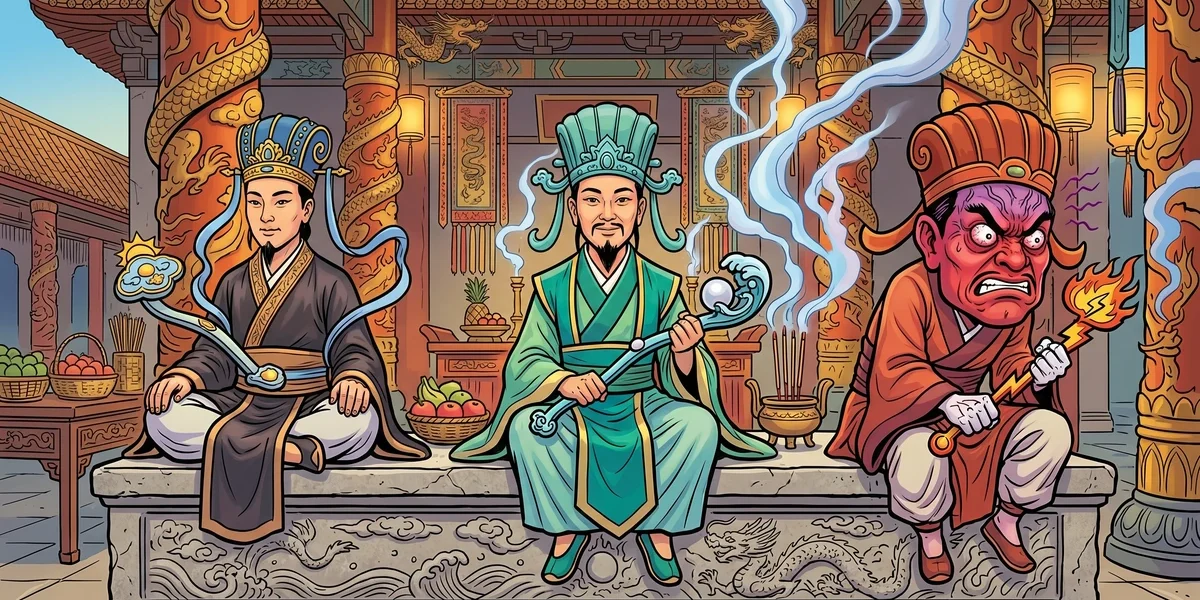
San Guan and the Cosmic Bureaucracy: Heaven, Earth, and Water as Governing Domains
The Three Ruling Gods concerns the San Guan (三官, Three Officials or Three Ruling Gods) — one of the oldest and most persistently venerated groupings in Chinese popular religion. The Three Officials are Tian Guan (天官, Heaven Official), who grants blessings; Di Guan (地官, Earth Official), who forgives sins; and Shui Guan (水官, Water Official), who resolves difficulties. Their feast days — the fifteenth days of the first, seventh, and tenth lunar months — remain among the most widely observed dates in Chinese folk religious practice, and their temples appear throughout China, Taiwan, and Chinese diaspora communities worldwide.
The theological structure of the San Guan tradition reflects the Chinese administrative metaphor for cosmic governance: the universe is organized as a bureaucracy, with different officials responsible for different domains, and proper functioning requires that each domain be governed correctly and that the officials coordinate rather than conflict. This is not a Western-style pantheon of competing deities but a Chinese-style administrative system of complementary functions — a reflection of the deep interpenetration of political theory and religious cosmology that characterizes Chinese civilization from at least the Zhou dynasty onward.
Beat I — The Three Officials and Their Domains
In the cosmology that the San Guan tradition articulates, the three domains they govern — Heaven, Earth, and Water — are understood not as simple physical realms but as dimensions of human experience and moral reality that interpenetrate and mutually condition each other. Heaven is the domain of blessing, destiny, and the consequences of virtue; Earth is the domain of human life, agricultural production, and the moral accounting that sin and merit require; Water is the domain of difficulty, transition, and the resolution of crises that neither Heaven’s blessing nor Earth’s forgiveness can address alone.
The legend’s narrative frame concerns a local dispute that requires the intervention of all three officials to resolve — a structure that dramatizes the theological point about their complementary functions. The dispute is between two neighboring villages sharing a waterway: one upstream, one downstream. The upstream village has constructed a mill that diverts water for its grinding wheels in a way that reduces the downstream village’s irrigation supply during dry seasons. The upstream village argues that it has the right to use what flows through its territory; the downstream village argues that traditional water rights attach to historical usage patterns that predate the mill.
The dispute had been brought before the county magistrate, who had issued a ruling that satisfied neither party and had been appealed through three administrative levels without resolution. In the ordinary course of events it would eventually reach a provincial court where a scholar-official with no local knowledge of the water patterns or the agricultural calendar would issue a binding decision likely to be wrong in some important particular. The two villages, equally exhausted by litigation and by mutual suspicion, had by common if unspoken agreement begun leaving offerings at the local San Guan temple, asking the three officials to take the case that human administrators had proven unable to resolve.
Beat II — The Three Interventions
The legend presents each official’s contribution to the resolution in a distinct register that reflects his domain. Tian Guan’s intervention comes first and operates through what traditional accounts would describe as a turn of fortune: a merchant from a distant city, passing through on trade business, happens to have spent his career managing water allocation disputes in the canal systems of Jiangnan — the most hydraulically sophisticated region of imperial China — and is delayed in the area by a broken axle that takes two days to repair. During those two days, presented to both villages as a neutral party with genuine expertise, he sketches a rotation system for mill operation and irrigation draws that the two villages recognize immediately as workable and fair. He refuses payment, attributes his expertise to a lifetime of watching water behave, and continues on his way. This is Heaven’s blessing: the right person at the right moment, an event inexplicable by simple chance given its precise timing and usefulness.
Di Guan’s contribution is more internal. The headman of the upstream village, in the days following the merchant’s visit, performs the kind of self-examination that the Earth Official’s domain of moral accounting is said to encourage. He reviews, honestly, the history of the dispute and recognizes that the mill construction — which had not been discussed with the downstream village before it began — was not a simple assertion of right but had also been an act of unilateral expansion that he had justified after the fact rather than genuinely considered before it. He does not publicize this recognition — there is no dramatic public confession — but its private acknowledgment shifts his negotiating stance in the rotation discussions from defensive assertion of right to genuine collaboration. Di Guan’s domain is not about confession but about the internal moral work that clears the ground for honest engagement.
Shui Guan’s contribution is practical and ecological: at the spring flood that follows the rotation agreement’s implementation, the changed flow patterns produced by the agreement turn out to flush a silt accumulation that had been silently reducing the downstream channel’s capacity for years. The headman of the downstream village, who had been aware of the siltation but had not connected it to the upstream mill’s altered flow pattern, realizes that the rotation is not merely fair but actively improves the system’s function. Water Official resolves the remaining difficulty — not through miraculous intervention but through the way that water, when allowed to move correctly, resolves its own blockages.
Beat III — San Guan and the Theology of Complementary Governance
The San Guan theological structure encodes a sophisticated understanding of how different kinds of problems require different kinds of solutions. The dispute between the two villages is not simply a legal problem (solvable by correct application of water law), not simply a moral problem (solvable by one party acknowledging wrongdoing), and not simply an engineering problem (solvable by correct design of the rotation system). It is all three simultaneously, and resolving it requires contributions from all three registers.
Tian Guan’s blessing — the chance arrival of the qualified expert — addresses the technical problem. Di Guan’s sin-forgiveness — the upstream headman’s internal moral recalibration — addresses the relational problem. Shui Guan’s difficulty-resolution — the silt-flushing that demonstrates the agreement’s ecological virtue — addresses the systemic problem. Each official’s contribution enables and prepares the ground for the others: without the technical solution, the moral recalibration has nothing to anchor to; without the moral recalibration, the technical solution would have been negotiated in bad faith and produced a rotation that one party would eventually violate; without the systemic resolution, the agreement would have remained perpetually fragile.
This is precisely the theology the San Guan tradition is designed to convey: that the domains of Heaven, Earth, and Water are not separate jurisdictions with clear boundaries but interpenetrating dimensions of a single complex reality. Chinese popular religion’s most persistent insight — consistently affirmed across Buddhist, Daoist, and Confucian streams, despite their many differences — is that problems in the human world are typically multi-dimensional and that mono-causal analysis (this is purely a legal problem, this is purely a spiritual problem, this is purely a technical problem) characteristically fails to resolve them.
Beat IV — The Cosmic Bureaucracy as Model for Human Governance
The San Guan tradition belongs to a broader Chinese tendency to model cosmic order on administrative structure — and, simultaneously, to model administrative structure on cosmic order. The Jade Emperor (Yu Huang, 玉皇) presides over a celestial court organized precisely like the imperial government: ministries, ranked officials, regular reporting cycles, mechanisms for handling petitions, and a system of promotion and demotion based on performance. The Three Officials occupy specific positions within this structure, with defined jurisdictions and accountability relationships.
This administrative modeling of the divine order is not a failure of imagination but a genuine philosophical position: the best model available for understanding how complex systems of governance work is the most sophisticated governance system the culture has produced. In Chinese civilization, that system was the imperial bureaucracy — millennia-refined, extensively theorized, and possessed of genuine sophistication about how to coordinate specialized functions across a vast territory. Projecting this model onto cosmic governance was not naive anthropomorphism but a serious attempt to articulate the organizing principles of a morally structured universe using the best conceptual vocabulary available.
The legend’s resolution — three different interventions from three different officials, each addressing a different dimension of the problem — is thus both a story about a water dispute and a demonstration of how properly functioning governance, at any level, requires the coordination of different kinds of authority and expertise. The county magistrate who had failed to resolve the dispute had tried to apply a single administrative tool (legal ruling) to a problem that required multiple complementary approaches. The San Guan, working through their distinct but coordinated domains, modeled the fuller response.
“Heaven blesses what Earth forgives and Water resolves. No single domain governs alone; the three officials know their own boundaries and honor each other’s work. This is the model for all right administration.”
— Principle of the San Guan veneration tradition
Why This Legend Has Lasted
The Three Ruling Gods endures because it addresses a problem that no governance system has ever fully solved: the tendency to apply single-domain solutions to multi-dimensional problems. Legal systems try to resolve disputes that are also moral and technical problems through legal means alone. Engineering solutions address physical dimensions of crises while leaving relational and moral dimensions unaddressed. Moral admonition calls for individual conscience without providing the technical frameworks within which conscience can produce structural change.
The San Guan tradition’s theological response to this tendency is elegant: it distributes governance across three complementary domains and insists that all three must be active for resolution to occur. This is a counsel not just for cosmic governance but for any human institution facing complex problems — the understanding that blessings, forgiveness, and the resolution of difficulty are distinct operations requiring distinct skills, and that the wisdom to deploy all three in appropriate coordination is the highest form of governance.
San Guan in Chinese Popular Religion
The San Guan (三官, Three Officials) tradition has roots in the earliest layers of Chinese religious practice. The Heavenly Official (天官 Tian Guan), Earth Official (地官 Di Guan), and Water Official (水官 Shui Guan) appear in early Daoist texts and may have pre-Daoist origins in shamanic traditions that treated Heaven, Earth, and Water as the three primary cosmic domains requiring propitiation. Their three feast days — the Upper Yuan (上元, fifteenth of the first lunar month, now Lantern Festival), Middle Yuan (中元, fifteenth of the seventh lunar month, now Ghost Festival or Hungry Ghost Festival), and Lower Yuan (下元, fifteenth of the tenth lunar month) — remain among the most widely observed dates in Chinese folk religious practice. The Middle Yuan festival in particular, when Di Guan is said to assess merit and forgive sins, has developed into the Ghost Festival tradition of making offerings to the ancestors and the wandering dead. San Guan temples are found throughout China, Taiwan, Malaysia, Singapore, and wherever Chinese diaspora communities have maintained folk religious practice. The tradition is not specifically Buddhist or Daoist but belongs to the broad stratum of Chinese popular religion that synthesizes elements from both formal traditions with older indigenous cosmological structures.
You May Also Like
 Chinese Folk Tales
Ages 6-8
Chinese Folk Tales
Ages 6-8
The Three Rhymsters
<p>Three sisters discover that clever words must serve kindness; inner virtue matters more than wit alone.</p>
 Chinese Folk Tales
All Ages
Chinese Folk Tales
All Ages
Sky O’Dawn
Sky O'Dawn: Once upon a time there was a man who took a child to a woman in a certain village, and told her to take care of him. Then he disappeared. And
 Chinese Folk Tales
Ages 9-12
Chinese Folk Tales
Ages 9-12
The God Of War
The God Of War: Guan Di, was really named Guan Yu. At the time when the rebellion of the Yellow Turbans was raging throughout the empire, he, together with two