The Widow Ho
The Widow Ho: One day in the early dawn, a distinguished mandarin was leaving the temple of the City God. It was his duty to visit this temple on the first and
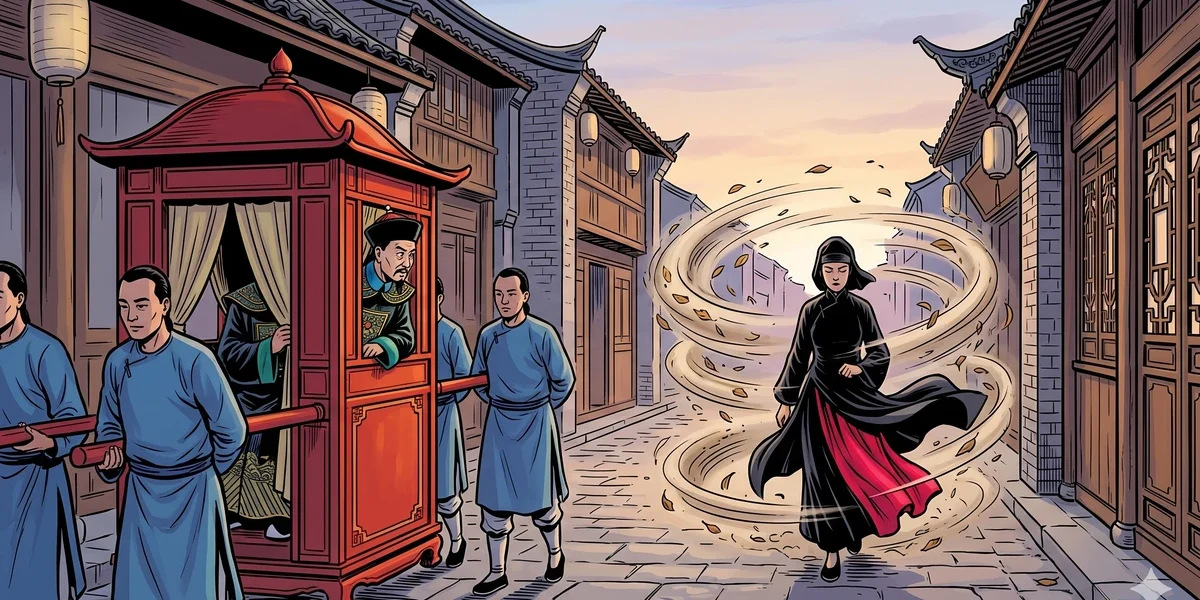
Jie Fu and the Ethics of Widowhood: Strength Without Spectacle in Chinese Moral Literature
The Widow Ho belongs to the extensive Chinese tradition of lie nü (烈女, exemplary women) and jie fu (節婦, women of constancy and integrity) narratives — a literary genre that spans two thousand years of Chinese moral and historical writing, encompassing accounts of widows who maintained their households with dignity, women who refused to remarry under social pressure, mothers who raised children to distinction under conditions of severe privation, and wives who demonstrated moral clarity that exceeded that of the men around them.
The tradition is morally complex in ways that are easy to misread from a modern perspective. The jie fu narratives have sometimes been read as simply enforcing female subjugation — valorizing women’s refusal to remarry as a form of property-like fidelity to the deceased husband. But the most interesting examples in the corpus, including the legend of Widow Ho, reveal something more nuanced: a cultural tradition that genuinely admired female moral courage, recognized women’s practical intelligence and household management as valuable in their own right, and used the figure of the widow who succeeds without male support as a vehicle for examining questions about where genuine strength actually comes from.
Beat I — The Circumstances She Inherits
Ho Meilan was widowed at thirty-one, which in the context of Song dynasty Fujian province was not so young as to make her situation desperate by marriage-market standards but young enough that she faced what Chinese social convention presented as a genuine choice: remarry with her family’s support into a household that would provide material security, or remain in her late husband’s household managing its diminished resources as a widow with children.
Her husband, a merchant who had built a modest but solid textile trading business over fifteen years of careful work, had died of fever during a trading journey — leaving Ho Meilan with three children (the eldest ten, the youngest four), a house that needed repairs, a business whose accounts were partially settled and partially in uncertain arrangements with trading partners he had not had the opportunity to conclude properly, and a mother-in-law whose own age made her a dependent rather than a resource.
The family’s urging to remarry was not malicious; it was pragmatic by the standards of the time. A widow managing a commercial household without male authority was a structural anomaly in Song dynasty commercial culture — her ability to enforce contracts, appear at market without male escort, and maintain the business relationships her husband had cultivated depended on a social tolerance that was not guaranteed. Her own family offered to arrange a second marriage to a prosperous relative who would absorb her children and the household assets in exchange for a comfortable if subordinate position in his established household.
Ho Meilan declined. Her stated reason, preserved in the local gazetteer that eventually recorded her story, was characteristically practical rather than dramatic: she had looked at the accounts, spoken with her husband’s trading partners, assessed the children’s needs and her mother-in-law’s health, and concluded that the household was viable if managed correctly. She was thirty-one, literate, and had worked alongside her husband in the business for fifteen years. She understood the textile trade. She did not understand why she should surrender what she could manage to a stranger who would then own both the management and the credit for it.
Beat II — The Management and the Recognition
What followed was not the legend of a miraculous recovery or supernatural assistance but something more rare in literature: a detailed account of competent management under difficult conditions. Ho Meilan spent the first year settling her husband’s outstanding accounts — some of which required negotiating with trading partners who initially attempted to exploit the ambiguity of a widow’s legal standing. She engaged a local scholar as a formal intermediary for contracts requiring male representation, paying for this service from the household’s limited reserve, and used this arrangement carefully rather than routinely, keeping the expense proportional to the need.
She expanded the textile business in one specific direction that her husband had identified but not developed: supplying embroidered goods to the export trade that moved through Fujian’s coastal ports. This required building relationships with the embroiderers of three neighboring villages — primarily women who worked from their homes and had previously sold through intermediaries at poor rates. Ho Meilan contracted with them directly, eliminating the intermediary margin, which improved their returns and reduced her costs simultaneously. The arrangement produced a trading relationship of unusual stability: the village women trusted her because she dealt honestly; she relied on them because their work was reliable; and the resulting quality control gave her export goods a reputation that more casually assembled competitors could not match.
The eldest son, educated at his mother’s insistence on the same schedule that his late father had maintained despite the household’s reduced circumstances, passed the county examination at seventeen — a success that elevated the family’s social standing in precisely the way that remarriage might have done, but with the crucial difference that the credit for the elevation was unambiguously the family’s own.
The local magistrate, reviewing the household for a routine survey that the county conducted of all widowed householders, noted in his administrative record that Widow Ho’s household was among the most financially sound of the district’s widow-managed establishments and recommended her for official commendation. The commendation, when it arrived, was for two things: the fidelity conventionally attached to a widow who had not remarried, and the practical management that had actually sustained the household. The local gazetteer’s compiler, copying both commendations into the district’s permanent record, added his own note that the second was, in his estimation, the more admirable of the two.
Beat III — Jie Fu and the Social Function of Exemplary Women Narratives
The jie fu (節婦) tradition in Chinese moral literature has a dual character that its critics and defenders have both sometimes simplified. On one reading, these narratives enforce female subordination by valorizing the wife who remains attached to her deceased husband’s household — creating a moral ideal that made remarriage socially costly for women in ways it was not for men, serving the interests of the husband’s family by keeping the widow’s labor and connections within their household rather than transferring them to a new marriage.
This reading is not wrong as a description of how the tradition sometimes functioned. But it misses the way that the most interesting examples in the corpus actually work. Widow Ho’s commendation is explicitly for two things — the conventional fidelity and the practical management — and the gazetteer compiler’s note makes clear that he considers the management the more significant. This is an unusual acknowledgment in a genre that typically emphasizes the symbolic dimension of the widow’s constancy over its practical consequences.
What the tradition of exemplary widow narratives actually preserves, at its best, is something genuinely valuable: an account of female practical intelligence and household management competence in a culture that was systematically inclined to make this competence invisible. Widow Ho’s trading relationships, her decision to contract directly with village embroiderers, her management of her son’s education alongside the business — these are strategic choices that would be unremarkable in an account of a male merchant’s career and are remarkable in her account precisely because the social structure she was operating within made them harder to execute.
The Song dynasty was, paradoxically, both a period of significant expansion in women’s economic participation — particularly in the textile trade, which was substantially organized around female labor — and a period of increasing ideological pressure on widows to remain in their late husbands’ households. Widow Ho’s success navigates this contradiction: she remains in the household, satisfying the ideological expectation, while conducting the kind of active commercial management that the same ideology theoretically reserved for men. The gazetteer compiler who noted that her practical management was the more admirable of her two commendable qualities was registering, in the oblique language available to him, an awareness of this complexity.
Beat IV — The Courage of the Ordinary and Its Long Duration
The legend of Widow Ho is structured around a form of courage that Chinese moral literature has honored but which is less dramatically visible than the courage of a single extraordinary moment: the courage of sustained competent effort under conditions of chronic difficulty, maintained not for a week or a year but across two decades without the prospect of rescue by circumstances or the recognition of public drama.
The Confucian virtue of ren (仁, benevolence/humaneness) in its domestic expression is precisely this: the daily work of caring for those who depend on you, done not with spectacular sacrifice but with consistent attention and genuine competence. Ho Meilan’s care for her mother-in-law, her management of the household economy, her insistence on her eldest son’s education — none of these are individually dramatic. Each is the ordinary expression of someone who has understood what she is responsible for and is doing it correctly, day after day, without the validation of recognition or the relief of rescue.
The Confucian philosopher Mencius distinguished between the courage that shows itself in a single dramatic moment of physical danger and the courage that sustains itself across years of chronic difficulty without the adrenaline of emergency. It is the second kind that the legend of Widow Ho celebrates — the courage of someone who assessed her situation accurately, made a considered decision, and then executed that decision competently across two decades. There is no dramatic scene in this legend; there are twenty years of correct choices in a sequence that eventually produces, quietly and undeniably, a sound household, an educated son, and a legacy in the local record.
“She looked at the accounts, looked at the children, looked at the trade, and decided she could manage it. Then she managed it. This is not a small thing — it is the whole thing.”
— Observation embedded in Chinese jie fu narrative tradition
Why This Legend Has Lasted
The Widow Ho has persisted in local gazetteer tradition and in the popular literature that drew on those records because it honors something that most literary traditions undervalue: the competent management of difficult circumstances over a long period without dramatic incident. Most stories are about crises; this legend is about the years between crises that most people actually live through, and about what it means to live through those years with integrity and practical intelligence rather than merely surviving them.
The figure of the woman who succeeds where the social structure expected her to fail — or to require rescue — has a resonance that transcends its historical context. What the gazetteer compiler understood when he noted that the practical management was the more admirable quality was that the ideological commendation (for fidelity) and the genuine achievement (for competence) pointed in the same direction but derived from different things: the first from following convention, the second from understanding what was actually required and doing it. Ho Meilan did both. The legend records both. The note about which was more admirable is the tradition’s own recognition of where the genuine strength actually lay.
Lie Nü and Jie Fu Traditions in Chinese Historical Writing
The Lie Nü Zhuan (列女傳, Biographies of Exemplary Women), compiled by the Han dynasty scholar Liu Xiang around 18 BCE, established the literary genre of formal accounts of women’s moral exemplarity that continued through the dynastic histories and local gazetteers of subsequent centuries. Every dynastic history included a section on exemplary women; every local gazetteer maintained records of women in the district who had received imperial or provincial commendation for fidelity, filial piety, or management of their households through difficulty. The Song dynasty saw both an expansion of female economic participation (particularly in textile production and trade) and an intensification of the ideological framework around female constancy — the period is associated with the increasing social restriction on widow remarriage that continued through the Ming and Qing dynasties. The tension between women’s actual economic contributions and the ideological framework that simultaneously required their withdrawal from public life is visible in many Song and later gazetteer accounts, where practical economic competence and ideological constancy are commended simultaneously. Modern scholars of Chinese women’s history have used the gazetteer tradition as one of the primary sources for recovering accounts of women’s economic and social activity that was otherwise systematically excluded from the main historical record.
You May Also Like
 Chinese Folk Tales
Ages 9-12
Chinese Folk Tales
Ages 9-12
Dschang Liang
Dschang Liang: was a native of one of those states which had been destroyed by the Emperor Tsin Schi Huang. And Dschang Liang determined to do a deed for his
 Chinese Folk Tales
Ages 6-8
Chinese Folk Tales
Ages 6-8
A Legend Of Confucius
A Legend Of Confucius: When Confucius came to the earth, the Kilin, that strange beast which is the prince of all four-footed animals, and only appears when
 Chinese Folk Tales
Ages 9-12
Chinese Folk Tales
Ages 9-12
The Monkey King’s Journey to the West: Pride and Redemption
The Monkey King's Journey to the West: Pride and Redemption: Before time itself had been properly counted, when the heavens and earth were still learning to