The Magic Cask
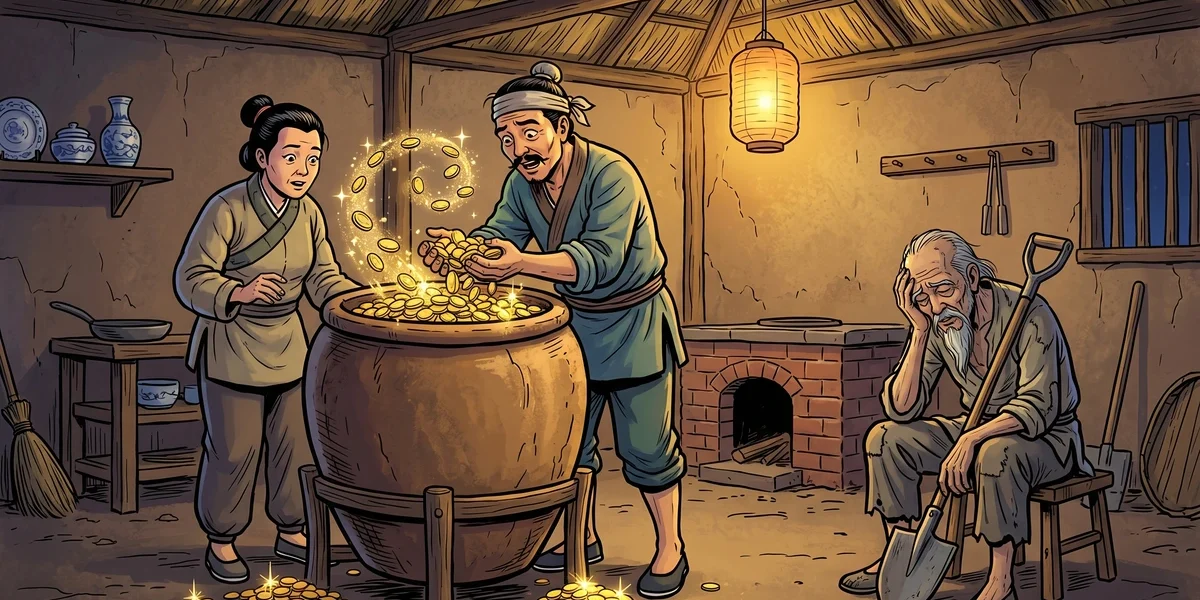
The Magic Cask: Once upon a time there was a man who dug up a big, earthenware cask in his field. So he took it home with him and told his wife to clean it out.
Origin & Tradition
“The Magic Cask” belongs to the Chinese tradition of magical abundance narratives centred on the figure of the inexhaustible wine or spirit vessel — a container whose contents never deplete, whose generative capacity exceeds any natural explanation, and whose presence in a story typically marks both the extraordinary nature of its source and the moral qualities its possession requires. The story appears in Richard Wilhelm’s Chinesische Volksmärchen (1914) and participates in one of Chinese literary and folk culture’s richest symbolic registers: the Daoist and Tang dynasty poetic tradition of sacred wine, in which the liquid dispensed by the immortal’s vessel is understood not merely as a pleasurable beverage but as a symbol — sometimes an actual vehicle — of the liberating alterations in consciousness that the Daoist tradition associates with genuine alignment with the Tao. The Eight Immortals are never far from this tradition: Han Zhongli’s fan, Li Tieguai’s iron crutch-gourd, and Lan Caihe’s flower basket are all magical vessels of various kinds, and the wine that flows among the Eight Immortals at their legendary banquets is understood as a substance that is simultaneously fermented grape or grain and refined cosmic essence — the outward sign of an inward transformation that those who drink it in the right spirit might begin to partake of.
Part I — The Cask and Its Keeper
The magic cask typically comes into the story through a gift or a discovery — a departing immortal who leaves it behind, a hidden room in an old house, a transaction in which what appears to be an ordinary cask turns out to have inexhaustible qualities. The person who first discovers the cask’s nature does so gradually: the cask is drawn from, as one would draw from any cask, and the expected depletion does not occur. A day’s drinking has left it unchanged. A week’s hospitality has made no impression. The wine that fills it — fragrant, clear, of unusual quality — appears to renew itself as fast as it is drawn.
The keeper of the cask faces the same fundamental moral test that all magical abundance stories pose, but with a specifically vinous register: the question of hospitality. The wine in the magic cask is, in the Chinese folk moral framework, implicitly a gift for sharing. Its inexhaustibility suggests that it was designed for generosity — for the sustained, unlimited hospitality that the Confucian and folk moral tradition prized as one of the clearest expressions of genuine virtue. The keeper who understands this — who uses the inexhaustible cask to establish an inexhaustible hospitality, welcoming travellers, sustaining the poor, celebrating every arrival with an appropriate generosity — has grasped the nature of the gift and is using it in accordance with its design.
Part II — The Daoist Wine and the Eight Immortals Tradition
The magic cask connects to one of the most visually and literarily rich traditions in Chinese popular religion: the wine culture of the Eight Immortals (Ba Xian, 八仙). The Eight Immortals are among the most beloved figures in Chinese folk religion — a diverse group of divine beings, each with distinctive attributes and associated magical objects, who are depicted repeatedly in Chinese art in the act of celebrating, journeying, and dispensing the gifts of immortality. Several of their magical objects are vessels of various kinds: Li Tieguai’s iron crutch-gourd (hu lu) contains healing medicines and miraculous substances; Han Zhongli’s fan can revive the dead; Lan Caihe’s flower basket contains the herbs of immortality.
The wine that appears repeatedly in images of the Eight Immortals is not ordinary wine. The most famous image of the tradition — the Ba Xian Guo Hai (八仙過海, “Eight Immortals Crossing the Sea”) — shows the eight crossing the water each on their own magical object, in various states of festive intoxication, dispensing the gifts of their objects to those they encounter. The wine they carry and share is the wine of immortality — not in the literal sense of an elixir that prevents physical death (that is a different substance) but in the symbolic sense of the liberating vitality that comes from genuine alignment with the cosmic order. To drink the wine of the immortals is to participate, for a moment, in their quality of being — in the de (德, potency/virtue) that makes them what they are.
The Tang dynasty poets — particularly Li Bai (李白, 701–762 CE), the “Immortal Poet” (Shi Xian, 詩仙) — developed this symbolism into one of Chinese literature’s most productive tropes. Li Bai’s wine poetry is ostensibly about the pleasures of drinking, but its deeper register is consistently metaphysical: the wine-drunk state is used as a figure for the sage’s release from conventional constraints, the liberation from petty social calculation and status-anxiety that allows genuine encounter with the world as it actually is. “Heaven and earth are but a tavern,” Li Bai wrote; “and time is but the wine.” In this frame, the magic cask that never empties is not simply an unusual supply problem but a figure for the inexhaustible generative capacity of the Tao — the cosmic source that offers without depleting, that gives without calculation, that sustains hospitality without reference to a bottom that will eventually be reached.
Part III — Sacred Intoxication and Daoist Liberation
The concept of sacred intoxication — the idea that a certain kind of altered state can function as a vehicle for genuine spiritual insight — appears across many traditions but has a specifically Daoist inflection in Chinese culture. The Zhuangzi (莊子), the founding text of Daoist philosophy, uses the image of the drunk man who falls from a carriage without injury as a figure for the sage’s natural ease and imperviousness to harm: the drunk man is relaxed, without resistance, fully present in his condition without anticipation or resistance, and the fall that would injure a tense and calculating person slides off him. This is “drunk like the Tao” — not chemically impaired but ontologically relaxed, freed from the defensive structures that make ordinary people simultaneously more self-protective and more vulnerable.
The wine of the magic cask, in this symbolic register, is not an intoxicant in the pejorative sense but a release: a substance that, for those who receive it in the right spirit, loosens the grip of the categories, judgments, and defensive calculations that prevent genuine encounter with other people and with the world. The household that maintains a magic cask of inexhaustible wine and practises unlimited hospitality is, in folk narrative terms, enacting this Daoist loosening at the social level: the barriers between host and guest, between established member and newcomer, between the prosperous and the destitute, are dissolved in the warmth of freely shared wine, and the social encounter that results is truer and more human than what the carefully maintained social distinctions of ordinary life permit.
This social dimension connects the magic cask story to a specifically Chinese form of hospitality ethics that has deep roots in the classical tradition. The Zhou Li (周禮, “Rites of Zhou”) includes elaborate prescriptions for the provision of wine at official ceremonial occasions, grounded in the understanding that the sharing of wine was not merely pleasurable but cosmologically significant — a ritual enactment of the proper relationships between all parties, a moment when the social order was both celebrated and, in the best instances, temporarily transcended.
Part IV — The Moral of the Inexhaustible Vessel
The magic cask story’s moral differs from the golden canister story’s (P-427) in a significant way. The golden canister tested the possessor’s relationship with sufficiency — whether they could recognise when enough was enough. The magic cask tests something adjacent but distinct: the possessor’s relationship with generosity — whether they understand that abundance is for sharing and that the correct response to inexhaustible provision is inexhaustible hospitality.
The person who seizes the magic cask and attempts to sell its contents — to commercialise the inexhaustible gift, turning what was meant for sharing into a source of personal revenue — typically discovers that the cask’s inexhaustibility is conditional on the generosity of its use. Attempt to charge for what was given freely, and the cask begins to deplete. Attempt to hoard the wine against future shortages, and it sours. The inexhaustibility is not an intrinsic property of the cask but a consequence of the relationship between the cask’s abundance and the keeper’s generosity — the two in alignment produce an ongoing miracle; either in isolation produces an ordinary barrel of wine that will, eventually, run dry.
This is a subtle but important moral proposition: that the miraculous is not a property of objects but a property of relationships. The magic cask is not magic in itself; it is magic in the hands of someone who understands what it is for and uses it accordingly. This proposition extends beyond magical casks to every form of unusual capacity or resource: the gift, the talent, the opportunity, the position of authority — all of these have a magic in them that is conditional on the quality of the relationship the holder maintains with their purpose.
“He drew from it every day and shared what he drew, and every morning it was full again — not because the cask was magic, but because the giving was. When he finally tried to keep some back, he discovered that keeping and giving could not coexist in the same vessel, and learned what he should have understood from the beginning: the cask was only as inexhaustible as he was generous.”
Why This Story Lasted
“The Magic Cask” lasted because its central claim — that miraculous abundance and genuine generosity are not merely compatible but structurally identical, that the inexhaustible and the unconditionally shared are the same thing — is one of the most counter-intuitive and therefore most worth repeating propositions in any culture’s ethical repertoire. The ordinary economic intuition says that sharing depletes what you have; the magic cask story says that sharing is the condition under which depletion becomes impossible. This is not economics but it is, the story insists, a deeper truth about how genuine abundance actually works — a truth that every tradition that has celebrated generosity as a way of life has discovered in its own way.
The story also lasted because wine is one of the most social of all substances — one of the things that human beings have, throughout history, most reliably shared in the act of gathering together, and one whose sharing has always carried a symbolic charge that goes beyond the liquid itself. The magic cask that never empties when shared is an image of the social bond at its most generous: the communal meal that always has room for one more, the fire that warms without being divided, the story that loses nothing by being retold. These are the things that maintain human community across time, and the magic cask is their symbol.
You May Also Like
 Chinese Folk Tales
Ages 9-12
Chinese Folk Tales
Ages 9-12
The Ghost Who Was Foiled
The Ghost Who Was Foiled: There are ghosts of many kinds, but the ghosts of those who have hung themselves are the worst. Such ghosts are always coaxing other
 Chinese Folk Tales
All Ages
Chinese Folk Tales
All Ages
The Disowned Princess
The Disowned Princess: At the time that the Tang dynasty was reigning there lived a man named Liu I, who had failed to pass his examinations for the doctorate.
 Chinese Folk Tales
All Ages
Chinese Folk Tales
All Ages
Black Arts
Black Arts: The wild people who dwell in the South-West are masters of many black arts. They often lure men of the Middle Kingdom to their country by promising