King Mu Of Dschou
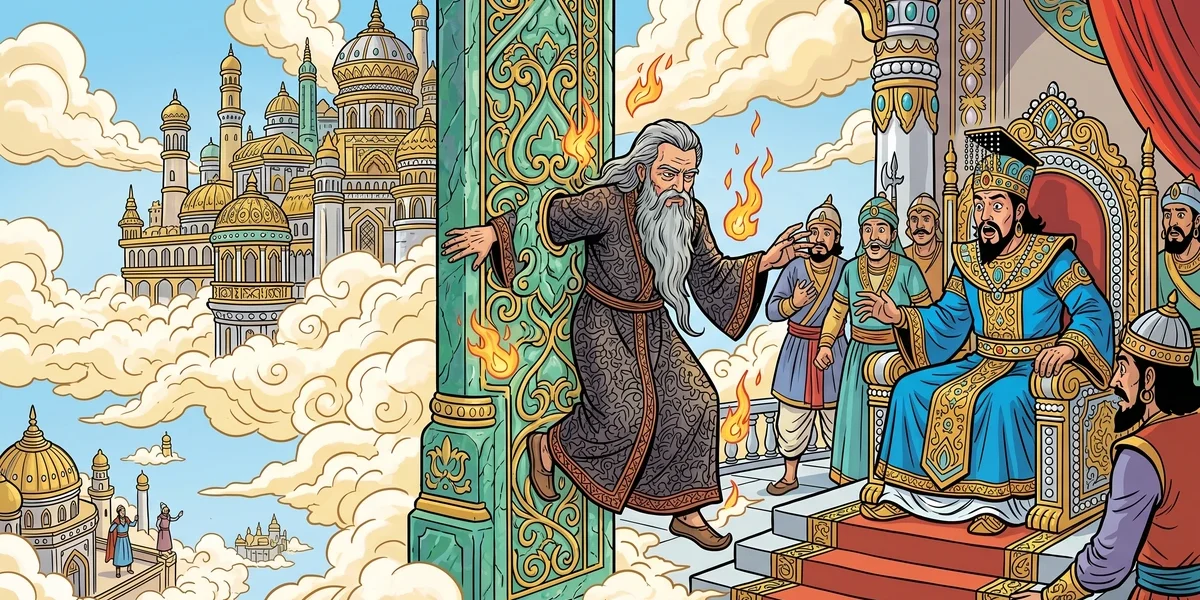
King Mu Of Dschou: In the days of King Mu of Dschou a magician came out of the uttermost West, who could walk through water and fire, and pass through metal
Origin and Tradition
King Mu of Dschou — the romanisation following the German sinologist Richard Wilhelm’s influential translation tradition — preserves the legendary cycle surrounding Zhou Mu Wang (周穆王), the fifth king of the Western Zhou dynasty (traditionally r. 976–922 BCE), whose reign became the setting for one of the most elaborate mythological journey narratives in the Chinese literary tradition. The primary source for King Mu’s legendary travels is the Mu Tianzi Zhuan (穆天子傳 — Account of the Son of Heaven Mu), a text discovered among the Ji Commandery tomb manuscripts in 279 CE and representing one of the oldest extended prose narratives in the Chinese literary record. Supplementary material appears in the Shan Hai Jing, the Liezi, and the great Daoist philosophical tradition that found in King Mu’s journeys a paradigm for the sovereign’s spiritual quest.
The story belongs to the youxian (遊仙 — roaming immortals) literary tradition — narratives describing journeys to the realms of divine beings, celestial courts, and paradisiacal landscapes that lie beyond the ordinary boundaries of human geography. As both historical legend and cosmological myth, the King Mu cycle served multiple functions in Chinese literary culture: as political mythology affirming the Zhou king’s cosmic mandate, as proto-geographical imagination of the western regions beyond China’s known borders, and as a meditation on the relationship between sovereign power and the divine order that legitimises it.
The Narrative: A King Journeys to the Western Paradise
King Mu, possessed of divine horses of legendary speed — the Eight Steeds (八駿, Ba Jun), each with a name evoking a miraculous quality of movement — sets out westward from his capital with a company of attendants and the skilled charioteer Zao Fu (造父). The journey takes him through a series of landscapes of increasing strangeness and wonder: across the mountains at the edge of the known world, through territories inhabited by peoples of fabulous custom and appearance, and finally to the far western paradise of Kun Lun (崑崙), the mythological mountain that served as the axis of the Chinese cosmos, where the Queen Mother of the West (西王母, Xi Wang Mu) holds her divine court.
The encounter between King Mu and Xi Wang Mu is the legend’s emotional and cosmological centre. Xi Wang Mu — in her early mythological form a powerful, sometimes fearsome goddess associated with pestilence, punishment, and the secrets of immortality — receives the Zhou king at Jade Pool (瑤池, Yao Chi), a paradisiacal lake on the slopes of Kun Lun. The two exchange songs, poems, and pledges of return; the king hunts in the divine preserve, feasts in the goddess’s garden, and is shown or gifted with emblems of cosmic sovereignty and immortal longevity. His sojourn in the western paradise represents the fullest possible expression of the Zhou king’s claim to cosmic authority: the Son of Heaven (天子, Tianzi) meeting the Queen of Heaven in her own domain.
Xi Wang Mu: From Ancient Goddess to Daoist Queen of Immortality
The Queen Mother of the West (西王母, Xi Wang Mu) underwent one of the most dramatic transformations in Chinese religious history: from a fearsome proto-deity in the Shan Hai Jing — described as having a human face, tiger’s teeth, and a leopard’s tail, controlling plague and divine punishment — to the serene Daoist queen of a western paradise where immortality peaches ripen every three thousand years and celestial fairies feast in jade pavilions. This transformation, substantially completed by the Han dynasty, reflects the broader development of Daoist religious culture, which systematised earlier mythological traditions into a coherent theology of immortality, cultivation, and cosmic order.
In the King Mu legend, Xi Wang Mu appears in her transitional form: already the mistress of a paradisiacal western realm, already associated with gifts of longevity and cosmic knowledge, but still retaining something of her ancient wildness and power. The king’s meeting with her is not simply a royal visit to a friendly court; it is a cosmological encounter between the human ruler who claims divine mandate and the divine power that can confirm or withhold that mandate. The gifts and songs exchanged at Jade Pool are, in this reading, the ritual confirmation of the Zhou king’s cosmic legitimacy — a legitimacy that flows ultimately not from military conquest but from divine recognition.
“White clouds float in the sky; hills and mountains rise from the earth. The road between them is eight thousand li; yet between heaven and earth, all is one.”
— Song attributed to Xi Wang Mu at Jade Pool, from the Mu Tianzi Zhuan
The Eight Steeds and the Axis of the Cosmos: Sacred Geography in the King Mu Legend
The Eight Steeds (八駿, Ba Jun) that carry King Mu westward are not merely fast horses; they are cosmic vehicles whose names — “Crimson Shadow,” “Jade Wheel,” “Bright Light,” “Dawn Racer,” “Flying Yellow,” “Night Light,” “Whirlwind,” “Sky-Strider” — map the full range of celestial movement and natural force. To ride the Eight Steeds is to command the cosmic order itself; King Mu’s journey westward is simultaneously a journey across physical geography and across the structure of the cosmos. The charioteer Zao Fu’s skill in managing these divine animals represents the disciplined human art of channelling cosmic power without being destroyed by it.
Kun Lun, the destination of the journey, occupied the centre of Chinese cosmological imagination as the mountain that connects heaven and earth — the axis mundi around which the cosmos is organised. To reach Kun Lun is to reach the point where the human world and the divine order most directly intersect, and it is here, at this cosmic centre approached from the east by a journey representing the king’s movement through all the stages of human civilisation and beyond, that the encounter with Xi Wang Mu takes place. The sacred geography of the legend is not decorative but structural: every landmark on King Mu’s route maps a stage in his movement from the human world toward the divine.
Why This Story Endured
The King Mu legend endured because it gave concrete narrative form to some of the deepest concerns of Chinese imperial culture: the cosmic legitimacy of royal authority, the possibility of human access to divine power and immortality, and the nature of the relationship between the human sovereign and the divine order he claimed to represent. As the youxian literary tradition developed in later Chinese poetry and fiction — most magnificently in the Tang dynasty verse of Li Bai and Du Fu, who used journeys to celestial realms as vehicles for reflections on political exile, spiritual aspiration, and the transience of earthly glory — the King Mu cycle provided the foundational template.
The legend also preserved something rare in Chinese literary tradition: a narrative in which a historical ruler is shown as genuinely seeking divine encounter not for political advantage but for the experience of transcendence itself. Whatever the historical King Mu may or may not have done, the legendary figure who rides his eight divine horses to the western mountain to sing songs with the Queen of Heaven at the Jade Pool represents the Chinese imagination at its most expansive — reaching beyond the boundaries of the known world, the known cosmos, and the known limits of human sovereignty toward something larger, wilder, and more radiant than ordinary life can contain.
You May Also Like
 Chinese Folk Tales
All Ages
Chinese Folk Tales
All Ages
The Spirits Of The Yellow River
The Spirits Of The Yellow River: are called Dai Wang Great King. For many hundreds of years past the river inspectors had continued to report that all sorts of
 Chinese Folk Tales
All Ages
Chinese Folk Tales
All Ages
Rose Of Evening
Rose Of Evening: On the fifth day of the fifth month the festival of the Dragon Junk is held along the Yangtze-kiang. A dragon is hollowed out of wood, painted
 Chinese Folk Tales
Ages 6-8
Chinese Folk Tales
Ages 6-8
Why Dog And Cat Are Enemies
Why Dog and Cat Are Enemies: An Ancient Tale of Betrayal and Heartbreak In the time when animals could speak to one another just as humans do, there...