The Flower-Elves
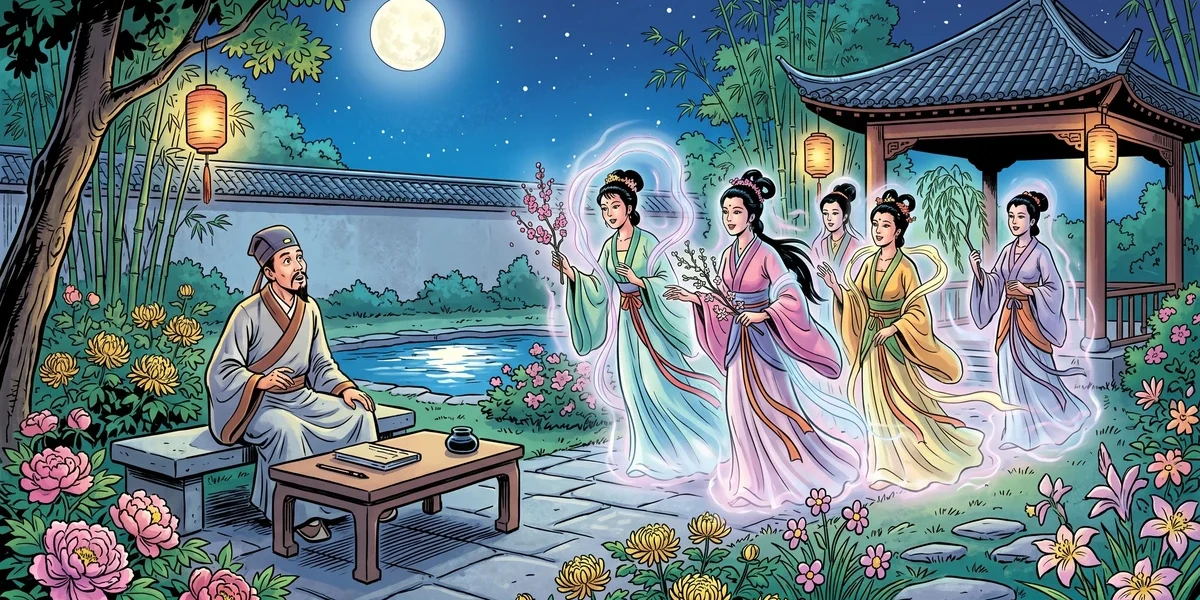
A retired scholar's sincere spiritual cultivation attracted flower-elves from celestial realms, proving inner development creates transcendent connection.
Origin & Tradition
“The Flower-Elves” belongs to the vast Chinese tradition of hua jing (花精, “flower essence-spirits”) — the animist conviction that plants of exceptional beauty or age accumulate jing (精, vital essence) until they achieve consciousness and can assume human form. The story appears in Richard Wilhelm’s landmark anthology Chinesische Volksmärchen (1914), translated into English as The Chinese Fairy Book, which drew on centuries of written and oral tradition. Its closest literary cousins are found in Pu Songling’s monumental Liaozhai Zhiyi (聰齊志異, “Strange Stories from a Chinese Studio,” c. 1740), where flower maidens, peony immortals, and chrysanthemum spirits regularly cross the boundary between the botanical and the human. The hua jing tradition is inseparable from Chinese literati garden culture: the scholar’s garden (wenren yuan, 文人園) was understood not merely as an aesthetic retreat but as a charged liminal space where the boundaries between natural and supernatural, visible and invisible, became permeable. To cultivate a garden with genuine care was, in Chinese folk cosmology, to earn the attention of its resident spirits.
Part I — The Garden That Breathes
A gentle scholar tends his garden with extraordinary devotion. Where other men hire labourers to water, prune, and fertilise by rote, he moves among his plants as if greeting old friends — whispering encouragement, clearing away the beetle and the aphid with patient fingers, sheltering tender stems before the night frost arrives. His peonies blush crimson in spring, his chrysanthemums hold gold long into autumn, and the plum at the garden’s corner flowers even in the bite of the coldest month. Neighbours remark that his garden seems almost to breathe — that the colours there run deeper, the scent carries further, the blossoms last longer than any natural season should allow. The scholar accepts these observations with quiet pleasure but does not explain them, for he himself does not know the reason. He simply loves the flowers, and that, it turns out, is reason enough.
One evening at dusk, sitting beside his lantern as moths drift through the honeysuckle, he sees a movement at the base of his largest peony: a flicker of light no bigger than a firefly, but warm and golden rather than cold and blue. He holds his breath. A second flicker answers it from the chrysanthemum bed. Then a third from the orchid shelf, a fourth from the hanging wisteria. Within moments the whole garden is alive with tiny luminous figures — no taller than a man’s thumb — moving between the blossoms with the purposeful grace of a palace court going about its evening business. The flower-elves have emerged.
Part II — Guests at the Miniature Court
The scholar does not cry out, does not reach for a lamp to examine them more closely, does not attempt to catch one in a jar. He remains perfectly still, breathing slowly, understanding instinctively that the wrong gesture will shatter this vision like a reflection in a disturbed pool. The elves, for their part, are not oblivious to him — they know he is there. Their calm is itself an act of trust: after so many months of his careful tending, they have concluded that this human is safe. What follows is less a dramatic encounter than a gradual, tentative diplomacy between two realms.
The elf who inhabits the great peony is their apparent queen: robed in layered petals of deep crimson and rose, her hair wound with stamens of gold. She leads a formal procession across a broad leaf as if it were a banquet dais, and the others — chrysanthemum-spirits in amber and ochre, orchid-spirits in pale violet, jasmine-spirits in white so pure it seems to generate its own light — arrange themselves in the order proper to their flower’s seasonal rank. The scholar, watching this, recognises something: the elves are enacting the same ritual courtesies, the same careful hierarchies of li (砃, propriety), that govern a well-ordered human household. Their garden is not chaos but cosmos, structured and dignified, governed by the same principles that Confucius observed in the movement of the stars.
Over subsequent evenings the scholar and the flower-elves arrive at an understanding. He leaves out offerings: a few drops of pure spring water in a thimble-sized cup, a scattering of sesame seeds, a twist of incense so thin its smoke is barely visible. They accept these graciously and, in return, leave gifts at his doorstep before dawn — drops of distilled flower-nectar that sharpen the mind when tasted, a pinch of pollen dust that, stirred into ink, makes his calligraphy flow with uncharacteristic ease. The exchange is wordless, meticulous, reciprocal: the exact logic of proper gift culture (li shang wang lai, 礼尚往來 — “propriety values mutual giving”) enacted across the boundary between species.
Part III — What the Jing Reveals
The Chinese concept of jing (精) is one of the three fundamental vital constituents alongside qi (气, vital breath) and shen (神, spirit). In Daoist physiology, jing is the densest and most material of the three — the concentrated, refined substance from which life is built. Ordinary plants possess jing as a latent potential; it is only through sustained exposure to qi (particularly the cyclic influx of solar, lunar, and seasonal energies), and through the focused attention of a cultivated human mind, that plant jing ripens into consciousness. The scholar’s garden, therefore, is not just well-watered soil — it is a practice: his daily mindful attention functions as a kind of alchemical catalyst, accelerating the refinement of the flowers’ jing until it crosses the threshold into sentience.
This is why the hua jing tradition consistently features scholars and hermit-gardeners as the humans who encounter flower spirits, rather than merchants or warriors. Flower spirits emerge not to the powerful but to the refined — to those who have themselves cultivated their own jing through study, aesthetic practice, and the disciplined quieting of coarse desire. The scholar’s virtue (德, de) creates a resonance with the flowers’ developing virtue, and the two realms draw together like harmonically tuned strings. This is an epistemology as much as a cosmology: the story teaches that the quality of one’s attention determines what one is capable of perceiving. Coarser eyes would see only flowers and insects; the scholar’s cultivated sensitivity sees the court beneath the petals.
The five-phase (wu xing, 五行) cosmology further enriches the tale. The peony, as queen, corresponds to Fire (火) and the south — the phase of maximum yang, summer heat, heart-energy, and the colour red. The chrysanthemum maps to Metal (金) and the west — autumn, contraction, the lung, and the colour white (or gold). The orchid maps to Wood (木) and the east — spring’s first unfurling, the liver, creativity. The jasmine, fragrant and white, bridges Metal and Water. The plum aligns with Water (水) and the north — winter, stillness, latency, the kidneys, dark endurance. Together the assembled flower-elves constitute a living wu xing mandala, a complete cosmological system convened in the scholar’s garden. His cultivation of all five has, unknowingly, brought the Five Phases into harmonic balance — and the appearance of the spirits is the garden’s announcement that balance has been achieved.
Part IV — The Moral of Miniature Things
“The Flower-Elves” articulates a moral that runs counter to the heroic registers of most folklore. No dragon is slain, no kingdom rescued, no monster outwitted. The story’s entire drama is the drama of attention — of choosing to look carefully at small things rather than scanning the horizon for large ones. The scholar’s reward is not gold or power but perception: he is admitted into a world that has always existed alongside his own, invisible only because most humans lack the patience to earn admission.
This connects to a broader current in Chinese aesthetics known as wei (微, “the subtle” or “the minute”) — a sensitivity to small-scale phenomena that the Daoist tradition regards as the truest register of reality. Laozi’s Tao Te Ching counsels attending to what is soft and yielding rather than hard and forceful; Zhuangzi’s philosophy celebrates the wisdom of small creatures as a rebuke to human presumption. The flower-elves embody this wei epistemology perfectly: they are tiny, quiet, seasonal, and morally transparent — and it is precisely their smallness that makes them wise.
For contemporary readers, the story carries an ecological resonance that would have been implicit rather than explicit for its original audiences. The scholar’s stance toward his garden — attentive, reciprocal, unhurried, non-exploitative — is exactly the relational posture that ecological ethics now advocates as a corrective to industrial nature-as-resource thinking. The flower-elves are not resources; they are neighbours. The garden is not property; it is a community. To tend it well is to participate in a network of mutual obligation that extends beyond the human.
“The spirits of the flowers rewarded the scholar not because he was powerful, but because he was gentle; not because he demanded, but because he gave; not because he searched, but because he waited — and in waiting, he had already arrived.”
Why This Story Lasted
The hua jing story persists across Chinese literary and oral tradition because it satisfies a deep cultural hunger: the hunger to believe that beauty is not indifferent. That the peony, which asks nothing and gives everything to any eye that pauses before it, might in some ultimate sense know when it is truly appreciated — and respond in kind. In a cosmos governed by gan ying (感應, “stimulus and response”) — the principle that sincere inner states generate corresponding outer manifestations — it would be cosmologically wrong for devoted care to go entirely unrewarded. The flower-elves are the universe’s answer to devoted attention, materialised in miniature.
The story also survives because it solves the problem of scale. The grandest Chinese folk narratives — the Journey to the West, the Eight Immortals, the Dragon Kings — operate at cosmic dimensions. “The Flower-Elves” offers the same metaphysical architecture — the same spirit world, the same qi energetics, the same cosmic reciprocity — compressed into the compass of a garden wall. It democratises wonder: one does not need a pilgrim’s thousand-mile journey to encounter the extraordinary. One needs only a patch of earth, a watering can, and the patience to be still at dusk.
You May Also Like
 Chinese Folk Tales
Ages 6-8
Chinese Folk Tales
Ages 6-8
Fox-Fire
A Japanese folklore tale about the mysterious fire created by fox-spirits that lures travelers astray.
 Chinese Folk Tales
All Ages
Chinese Folk Tales
All Ages
The Widow Ho
The Widow Ho: One day in the early dawn, a distinguished mandarin was leaving the temple of the City God. It was his duty to visit this temple on the first and
 Chinese Folk Tales
All Ages
Chinese Folk Tales
All Ages
Notscha
Notscha: The oldest daughter of the Ruler of Heaven had married the great general Li Dsing. Her sons were named Gintscha, Mutscha and Notscha. But when Notscha