How Three Heroes Came By Their Deaths Because Of Two Peaches
How Three Heroes Came By Their Deaths Because Of Two Peaches: At the beginning of his reign Duke Ging of Tsi loved to draw heroes about him. Among those whom
Origin and Tradition
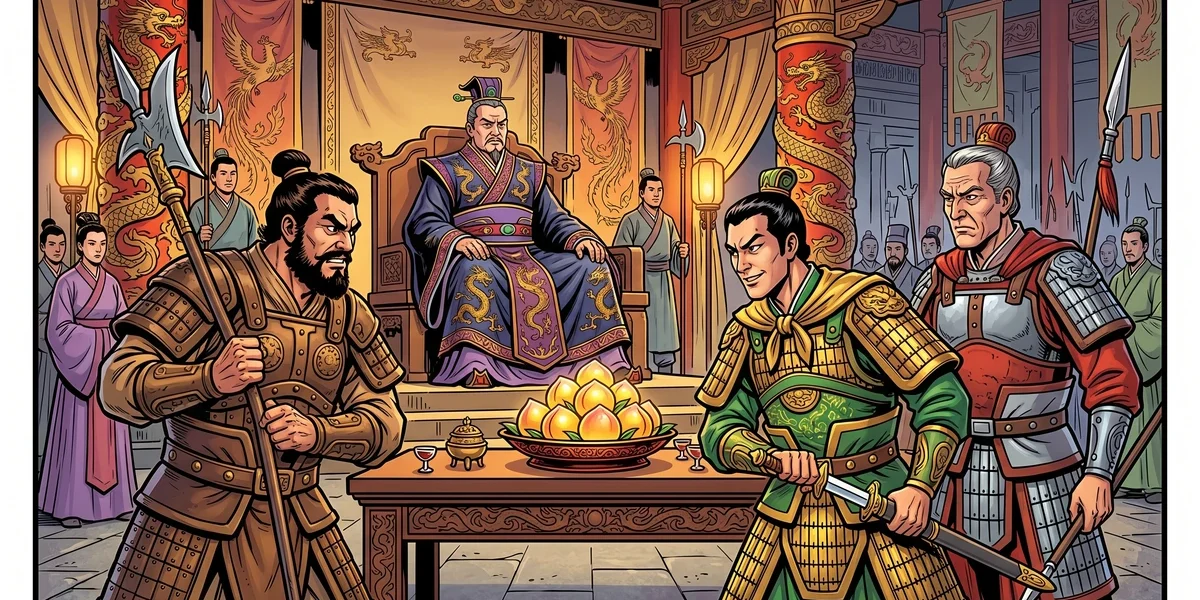
How Three Heroes Came by Their Deaths Because of Two Peaches is the folk narrative tradition of the celebrated Chinese political legend known as Er Tao Sha San Shi (二桃殺三士 — Two Peaches Kill Three Heroes), one of the most celebrated examples of moulüe (謀略 — strategic scheming) in the Chinese historical imagination. The story originates in the Spring and Autumn period (c. 6th century BCE) and centres on Yan Ying (晏嬰, also known as Yanzi), the brilliant and diminutive chancellor of the state of Qi, and his stratagem for neutralising three dangerously powerful military heroes who threatened the stability of the state.
The episode is preserved in the Yanzi Chunqiu (晏子春秋 — Spring and Autumn Annals of Yanzi), a text dedicated to the wise sayings and diplomatic exploits of Yan Ying, and is referenced in the Shi Ji and numerous later collections. It became one of the canonical examples in Chinese political philosophy of how the scholar-statesman (wenchen 文臣) could overcome the martial hero (wujiang 武將) through intelligence rather than force — a paradigm with deep implications for the Confucian understanding of the proper relationship between civil and military authority in the state.
The Narrative: Honour as a Weapon
The three heroes — Gong Sun Jie (公孫接), Tian Kai Jiang (田開疆), and Gu Ye Zi (古冶子) — were the mightiest warriors in the service of Duke Jing of Qi. Each was a figure of legendary prowess: one had slain a tiger barehanded, one had turned the tide of a great battle single-handedly, one had dragged a great serpent from the depths of a river while it sought to overturn the duke’s boat. Their military achievements were genuine and their loyalty to Qi was real; but their arrogance had grown to match their fame, and Yan Ying perceived that their contempt for civil authority and their habit of treating the state as the stage for their personal glory posed a long-term danger that their usefulness could not justify.
The chancellor’s solution was characteristically elegant. He persuaded Duke Jing to present two peaches — symbols of honour and divine favour in Chinese court culture — to whichever of the three had performed the greatest service to the state, with each hero to judge his own merit and take a peach accordingly. The stratagem worked through the internal logic of military honour: each warrior, confronted with the opportunity to claim pre-eminence over his peers, was compelled by his own sense of glory to declare the magnitude of his achievements. But with only two peaches for three claimants, the arithmetic of honour was fatal. The hero who could not claim a peach had implicitly conceded his own inferiority; the hero who had taken a peach might later feel he had done so at the cost of a companion’s dignity. The warriors, trapped by their own pride in a logic they could not escape, fell to quarrelling — and then, one by one, to ritual suicide, each unwilling to live with the diminishment that the peach competition had imposed.
Moral Architecture: Wen Versus Wu — The Supremacy of Civil Wisdom
The story’s political philosophy is grounded in the foundational Chinese tension between wen (文 — civil/literary culture, wisdom, the arts of peace) and wu (武 — military power, martial skill, the arts of war). Chinese political philosophy from Confucius onward maintained that while military power was necessary, it was inherently subordinate to the civil virtue of the ruler and his advisers: the sword must serve the brush, not the reverse. Yan Ying’s stratagem is the perfect embodiment of this principle — the small, scholarly chancellor eliminates three giant warriors without drawing a weapon, using nothing but psychological insight and a pair of fruit.
The moral is double-edged in the way characteristic of the finest Chinese didactic stories. On one level, Yan Ying is admired: his cleverness protects the state from the instability that arrogant military heroes inevitably create. On another level, the tale invites reflection on the tragedy of the three heroes themselves — men of genuine courage and achievement whose destruction was rooted not in wickedness but in an excess of the very quality, military honour, that made them valuable. Chinese commentators across the centuries have divided on whether Yan Ying’s stratagem was admirable statecraft or a morally troubling manipulation; this ambiguity is part of what has kept the story alive and generative as a subject of ethical reflection.
“The strategist who masters men’s hearts defeats armies without raising a sword; the warrior who cannot master his own pride is already defeated.”
— Chinese maxim in the moulüe (strategic scheming) tradition
The Peach as Symbol: Divine Favour, Merit, and the Politics of Honour
The peach (桃, táo) occupies a specific and powerful symbolic position in Chinese culture that Yan Ying’s stratagem exploits to devastating effect. In Chinese mythology and folk religion, the peach is associated with immortality (the Peach Garden of the Queen Mother of the West, Xi Wang Mu, produces peaches of immortality that ripen every three thousand years), with divine favour, and with the recognition of exceptional virtue. To receive a peach from the duke’s hand was not merely a pleasant gift but a statement about one’s standing in the cosmic as well as political order — an assertion of pre-eminence among peers.
This symbolic weight is what makes the competition tragic rather than merely absurd. When Yan Ying arranges for two peaches to be awarded to the most meritorious, he is not setting up a trivial contest over fruit; he is triggering a competition for the most fundamental form of recognition available to a warrior in Chinese court culture — the official, public, divinely-endorsed acknowledgment that one’s service has been the greatest. No warrior of genuine pride can simply decline to participate, and no warrior who fails to secure a peach can easily live with the public implication of that failure. The peaches are weapons precisely because they are so much more than peaches.
Why This Story Endured
The Two Peaches legend endured because it captured, with memorable precision, several truths that Chinese political and moral culture returned to repeatedly across the centuries. It demonstrated the power of psychological intelligence over physical force — a principle that the Confucian tradition elevated into a political philosophy. It illustrated the danger of military arrogance unchecked by civil authority — a concern that recurred with every dynastic transition in Chinese history. And it preserved the ambivalence at the heart of the warrior’s ethos: the same qualities of pride, honour, and refusal of humiliation that made the three heroes great also made them vulnerable to manipulation and ultimately led to their destruction.
The story became a touchstone for Chinese political writing on the relationship between strategy and virtue, and is still referenced in contemporary discussions of political leadership and the management of difficult personalities. Yan Ying himself — small, unprepossessing, and devastatingly intelligent — became one of the iconic figures of Chinese political wisdom, a demonstration that the greatest power in the state belongs not to the strongest arm but to the clearest mind. How Three Heroes Came by Their Deaths Because of Two Peaches remains alive because every generation encounters the collision between military pride and civil authority, and must decide which it will allow to govern.
You May Also Like
 Chinese Folk Tales
Ages 9-12
Chinese Folk Tales
Ages 9-12
The Legend of the White Snake: Love Beyond Form and Fear
The Legend of the White Snake: Love Beyond Form and Fear: In the misty valleys of ancient China, where dragons still whispered through bamboo groves and
 Chinese Folk Tales
Ages 6-8
Chinese Folk Tales
Ages 6-8
The Fox And The Raven
The Fox And The Raven: The fox knows how to flatter, and how to play many cunning tricks. Once upon a time he saw a raven, who alighted on a tree with a piece
 Chinese Folk Tales
Ages 9-12
Chinese Folk Tales
Ages 9-12
The Maiden Who Was Stolen Away
The Maiden Who Was Stolen Away: In the western portion of the old capital city of Lo Yang there was a ruined cloister, in which stood an enormous pagoda