Hong Kil Tong
Hong Kil Tong: OR, THE ADVENTURES OF AN ABUSED BOY. During the reign of the third king in Korea there lived a noble of high rank and noted family, by name Hong.
The Man Who Could Not Call His Father Father
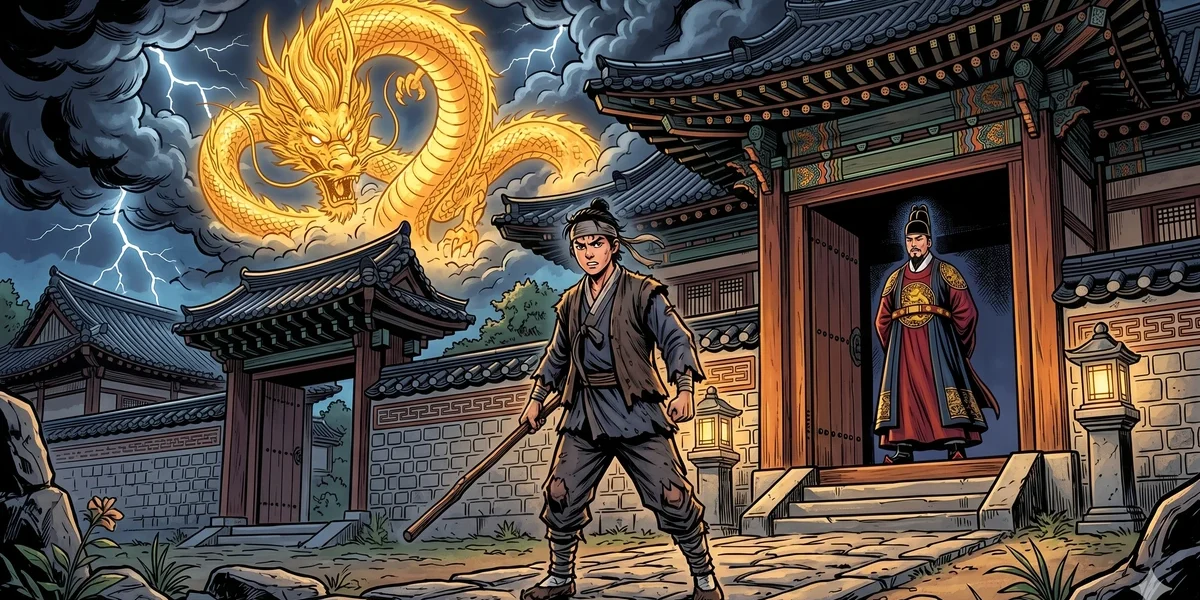
There is a prohibition at the heart of the Hong Kil-dong story that strikes every Korean reader with peculiar force. Hong Kil-dong — brilliant, physically magnificent, morally serious — cannot call his father abeoji (father) or his elder brother hyeong (older brother). These are not merely terms of address. In Confucian Korea they are declarations of relational identity, of belonging, of one’s place in the social fabric. To be barred from them is to be barred from social existence itself, regardless of what one actually is. Hong Kil-dong is the son of Minister Hong. He knows it, his father knows it, the household knows it. But because his mother was a concubine rather than a primary wife, Joseon law classified him as seo-eol (서얼) — a secondary-line child — and stripped him of the social language for his own family.
This is where the tale begins: not with adventure or magic, but with a naming problem so severe it becomes a social wound. Everything that follows — the magic, the banditry, the island kingdom — is in some sense Hong Kil-dong’s sustained attempt to resolve it.
Beat I — The Seo-Eol System and Its Structural Cruelty
The Joseon Dynasty inherited and systematised a rigid hierarchy of social categories. At its upper tier stood the yangban — the aristocratic scholar-official class — who monopolised the civil and military examinations that opened the door to official careers. But within the yangban world, a further distinction operated: children of primary wives held full yangban status, while children of concubines or secondary wives were designated seo-eol and barred from sitting the examinations entirely. They could not hold significant office, could not address their fathers or elder half-siblings by the familial honorifics that denoted full kinship, and were expected to accept this diminishment without complaint as a condition of their existence.
The cruelty of this system was not lost on Heo Gyun, the scholar-official credited with writing Hong Gildong Jeon — the earliest Korean prose novel in the vernacular hangul script. Heo Gyun himself had complex relationships with the Joseon order and was eventually executed for his alleged involvement in a conspiracy. His Hong Kil-dong is transparently a vehicle for critique: a figure of superlative ability who masters the martial arts, reads the Book of Changes to its depths, and demonstrates every quality the Confucian tradition claimed to value — and who is denied the social recognition those qualities were supposed to generate because the system had decided his mother’s status mattered more than his own.
Hong Kil-dong’s initial response is not rebellion but grief. He mourns, quietly and privately, the names he cannot use. This grief is the story’s moral centre: the sorrow of a person who is real, who has genuine relationships, who possesses real virtues, but whose social world refuses to name any of it correctly.
Beat II — The Road to Hwalbin-Dang
Unable to advance through legitimate channels, Hong Kil-dong eventually leaves the household and enters the wider world. His supernatural abilities — drawn from his mastery of the Book of Changes and attributed in the narrative to the intensity of his learning — allow him to create magical duplicates of himself, to fly, to summon storms, and to move invisibly. He joins a band of outlaws and, through the sheer force of his character and capability, becomes their leader.
He names his outlaw organisation Hwalbin-dang — the “Society for Relieving the Poor” — and establishes a strict code: rob only corrupt officials and local tyrants who have accumulated wealth through exploitation; distribute everything taken to the farmers and villagers who were its true producers; never harm innocent people. The Hwalbin-dang operates not as random brigandage but as a parallel justice system, redistributing wealth according to a moral logic the official system had abandoned.
The authorities, unsurprisingly, hunt him. But Hong Kil-dong’s ability to create multiple simultaneous versions of himself across different provinces simultaneously makes him impossible to catch — an eight-directional Hong Kil-dong appears in every corner of the kingdom at once, each confounding local officials. This magical detail functions as social commentary: a system that refuses to acknowledge the reality of a person cannot locate him within its own framework either. Hong Kil-dong becomes literally uncatchable because he has already been rendered socially invisible by the seo-eol designation.
Beat III — Jeong-Myeong and the Demand for Correct Naming
The Confucian philosophical tradition that underpinned Joseon governance included the principle of jeong-myeong (정명) — the Rectification of Names, articulated by Confucius in the Analects as the foundational political act. For Confucius, correct governance required that names match realities: a ruler who does not rule as a ruler should is not truly a ruler; a father who does not act as a father should is not truly a father; social order depends on the alignment of designations with actual qualities and relationships. When names and realities diverge, social fabric frays.
Hong Kil-dong’s story is, among other things, a devastating application of jeong-myeong logic to the seo-eol system itself. Hong Kil-dong IS a loyal son — his grief at being unable to name his father correctly is the grief of genuine filial piety, not its absence. He IS a capable official in the making — his administration of Hwalbin-dang is more just than the provincial governance around him. He IS a man of virtue by every Confucian metric. The system that denies him these names is the one in violation of jeong-myeong, not Hong Kil-dong. His outlaw career is in this sense not a rejection of Confucian order but a demonstration of where that order has failed its own principles.
The narrative makes this explicit in a remarkable scene: Hong Kil-dong ultimately demands of the king not wealth or pardon but a single official appointment — the position of byeongjo panseo (Minister of War) — so that he can be addressed by his proper social title for even one day. Once granted this nominal recognition, he departs the kingdom forever. The ask is not material but semiotic: give me my correct name, acknowledge the alignment between what I am and what I am called, and I will trouble you no more. The king’s eventual compliance is the story’s nearest approach to justice.
Beat IV — Yuldo Island and the New Naming
Hong Kil-dong does not remain to reform the kingdom that failed him. He takes his followers — other social outcasts, other seo-eol, others for whom the official naming system had no adequate category — and sails to the island of Yuldo, where he establishes his own kingdom. There he becomes king by his actual qualities: his leadership, his vision, his justice, his capacity to protect and provide. The new kingdom names things correctly from the start.
This ending is not escapism but structural critique. Hong Kil-dong does not believe Joseon can be reformed from within — its naming systems are too entrenched, its aristocratic interests too consolidated. The only resolution available is a new space with new rules, where birth status does not determine social designation and where virtue, demonstrated and lived, constitutes the only relevant credential. Yuldo is utopia not as fantasy but as the logical conclusion of jeong-myeong taken seriously: a world organised around the alignment of name and reality.
Hong Kil-dong has continued to speak to Korean audiences across four centuries because his predicament is recognisably human: the experience of possessing genuine qualities that one’s social context refuses to name or acknowledge. The particular vehicle — seo-eol status in Joseon — is historically specific, but the structure it describes — arbitrary categorical exclusion overriding demonstrated reality — recurs in every society and era. Hong Kil-dong’s response — grief, then resistance, then the construction of an alternative space where correct naming becomes possible — remains one of Korean literature’s most enduring moral templates.
“If you cannot call your father father in the land of your birth, you must build a land where fathers are known by their fathering.” — Traditional Korean gloss on the Hong Kil-dong legend
The story of Hong Kil-dong endures because it refuses the consolation of individual triumph. Hong Kil-dong does not defeat the seo-eol system or shame it into reform. He simply leaves — taking with him all the ability and loyalty and justice the system refused to incorporate — and builds elsewhere. The Joseon kingdom that remains is poorer for his departure, and the narrative knows it. What lasts, the story suggests, is not the unjust system but the memory of what it wasted: a man who could not call his father father, and who built a world where such cruelties would have no jurisdiction.
Frequently Asked Questions
What is the moral of Hong Kil Tong?
The story’s central moral is that a social system which denies recognition to genuine virtue on the basis of arbitrary birth status violates its own professed principles and forfeits its claim to order. Hong Kil-dong does not rebel against Confucian values — he embodies them more fully than the system does. His outlaw career is a corrective to institutional hypocrisy, and his departure to build a just kingdom elsewhere is a verdict on a society unwilling to name things correctly.
What happens in Hong Kil Tong?
Hong Kil-dong, the extraordinarily gifted son of a Joseon-era nobleman, is classified as seo-eol (secondary-line) because his mother was a concubine. Barred from the examinations, official careers, and even the familial honorifics that acknowledge kinship, he eventually leaves home, joins outlaws, and becomes the leader of Hwalbin-dang — a righteous bandit organisation that redistributes wealth from corrupt officials to the poor. Using magical abilities, he evades capture across the kingdom. He ultimately demands and receives a single day’s nominal appointment as Minister of War (his correct name acknowledged at last), then departs with his followers to establish his own just kingdom on Yuldo Island, where he rules as king.
What is the seo-eol system and why does it matter to the story?
The seo-eol (서얼) designation was a Joseon-era classification applied to children born of concubines or secondary wives of yangban men. Such children were excluded from the civil examinations, barred from significant official positions, and forbidden from using the familial honorifics that denoted full kinship with their fathers and half-siblings. The system was justified as maintaining the integrity of the primary-wife lineage but in practice wasted enormous talent and generated deep social resentment. It is central to the Hong Kil-dong story because his entire predicament — and his extraordinary response — flows from this single categorical exclusion.
What does the story say about justice and legitimate authority?
The story proposes that legitimate authority derives from actual virtue and just conduct rather than from birth status or official appointment. Hong Kil-dong’s Hwalbin-dang is more genuinely just in its redistribution than the official provincial governance it raids. His Yuldo kingdom is more authentically ordered than the Joseon kingdom he leaves. The narrative thus reverses the conventional Confucian equation: the outlaw is the true Confucian, and the official order is the one in violation of the principles it claims to uphold.
How has Hong Kil-dong influenced Korean culture?
Hong Kil-dong has become one of the most enduring archetypes in Korean cultural memory, consistently invoked whenever discussions of social exclusion, institutional hypocrisy, or the gap between stated and actual justice arise. The character has inspired dozens of films, television dramas, and novels across the 20th and 21st centuries. His name functions in Korean political discourse as a shorthand for the righteous outsider who exposes systemic injustice through action rather than argument. The novel itself is significant as an early example of Korean vernacular literary fiction and as a rare document of explicit social critique from within the Joseon scholarly class.
You May Also Like
 Korean Folk Tales
Ages 6-8
Korean Folk Tales
Ages 6-8
The Awful Little Goblin
The Awful Little Goblin: There was an occasion for a celebration in the home of a nobleman of Seoul, whereupon a feast, to which were invited all the family
 Korean Folk Tales
All Ages
Korean Folk Tales
All Ages
Hyung Bo And Nahl Bo
Hyung Bo And Nahl Bo: OR, THE SWALLOW-KING’S REWARDS. In the province of Chullado, in Southern Korea, lived two brothers. One was very rich, the other very
 Korean Folk Tales
Ages 6-8
Korean Folk Tales
Ages 6-8
The Brave Magistrate
A brave magistrate catches a thief who steals from homes. By showing courage and compassion, he discovers the thief's sad story.