The Snake’s Revenge
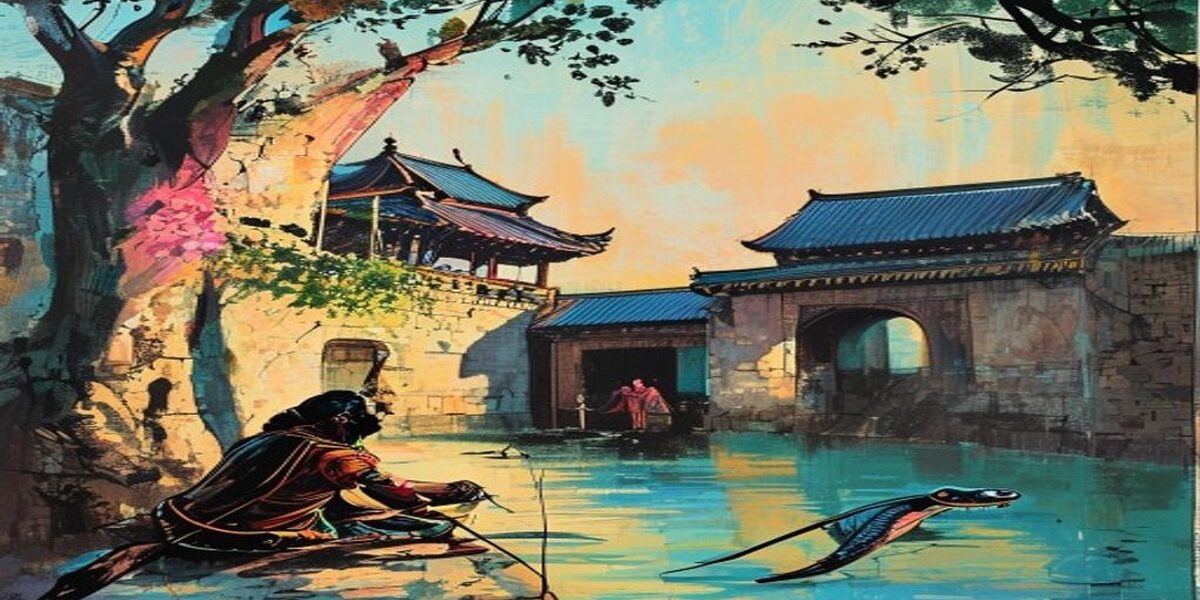
The Snake's Revenge: There lived in ancient days an archer, whose home was near the Water Gate of Seoul. He was a man of great strength and famous for his
Origin & Tradition
“The Snake’s Revenge” belongs to the rich Korean tradition of eombi iyagi (업비 이야기, household guardian stories)—narratives centred on the supernatural beings that Korean folk tradition understood to inhabit and protect specific households. The household guardian snake (eombi, 업비, or eomnyeo, 업녀, depending on regional tradition) was a specific type of spiritual presence: typically an old, large snake that had taken up residence in the inner room, beneath the foundation, or in the storage space of a house and whose continued presence was understood to be inseparable from the household’s continued good fortune. Such snakes were not merely tolerated; they were respected with specific observances: food offerings placed in the areas they frequented, the prohibition on killing or harming them, and the practice of addressing them with courtesy when encountered. The belief was not that the snake was merely an animal that happened to live in the house; it was that the snake was the physical manifestation of a household protective spirit (seonangsin, 성황신, or one of the many localized household spirits of Korean shamanic cosmology) and that its wellbeing was directly linked to the household’s wellbeing. Stories about the snake’s revenge emerged from this belief system to explore what happens when a household, through ignorance, carelessness, or aggressive household management, destroys the presence it had been unknowingly depending on.
Beat I — The Guardian Unrecognized
A new member arrives in the household—typically a young bride, a visiting relative from outside the region, or a newly prosperous household head who has absorbed enough official Confucian skepticism about folk belief to dismiss what his neighbors take for granted. She or he discovers the snake in the inner room or the storage space and reacts with the response that their background has taught them is appropriate: alarm, disgust, and immediate action to remove or destroy the intruder. The neighbors, learning of this, respond with the specific alarm of people who understand what is about to be lost but cannot quickly communicate the depth of the tradition to someone who has not been raised within it.
The snake—old, slow, clearly long resident in this specific space—does not flee with the alertness of a wild snake. It moves with a dignity that the attentive observer would recognise as the movement of something that understands its own position in this space and does not fear ordinary human presence. This quality of movement is itself a traditional sign: wild snakes flee; household guardian snakes do not. The person who destroys it is, in the story’s economy, destroying something that had already marked itself as different from ordinary wildlife if only they had known what to look for.
Beat II — The Consequences
The snake’s revenge is not a supernatural assault; it is the withdrawal of protection and the natural consequences of that withdrawal. In the weeks and months following the guardian’s destruction, things go wrong in the household with a persistence that goes beyond ordinary bad luck. The food stores begin to diminish through spoilage and vermin in ways that they did not before; the grain that the household had reliably maintained now develops problems with pests. Commercial dealings that had proceeded smoothly begin to encounter difficulties. Illness appears in the household with unusual frequency. Relationships within the extended family become strained. None of these things are individually inexplicable; each has an ordinary cause. But their combination and their timing—all beginning after the snake’s death, concentrated in the specific domains that household protection was supposed to cover—is the story’s demonstration that the protection was real.
The revenge is thus the most philosophically precise form of revenge available: not punishment inflicted from outside but the natural experience of a world from which a specific layer of protection has been removed. The household is not being attacked; it is simply experiencing the unprotected condition that it was already in before the snake arrived, and that it had forgotten was possible because the protection had been so long-established that it felt like the natural state of affairs. The snake’s revenge is the revelation that the natural state of affairs was never quite as natural as it seemed.
Beat III — Eombi and the Ecology of Household Protection
The Korean folk cosmological understanding of the household guardian snake (eombi) rests on a premise that the more rationalist Confucian tradition found difficult to accommodate: that specific physical presences in specific locations are the manifestation of spiritual protections whose reality is demonstrated by their effects rather than by any mechanism that rational analysis can specify. The eombi tradition is not asking its practitioners to believe in a magical snake; it is asking them to observe that households where old snakes are respectfully maintained tend to fare better than those where they are destroyed, and to interpret this observation through the cosmological framework that makes it intelligible: the snake is a guardian, its wellbeing is linked to the household’s wellbeing, and harming it breaks a protection that was real even if its mechanism was invisible.
This is a sophisticated empirical position rather than naive superstition. The observation that old snakes in a household’s storage spaces tend to reduce rodent populations, which tend to protect grain stores, which tend to correlate with household prosperity, can be stated in entirely naturalistic terms. The folk tradition’s choice to state it in spiritual terms is not an error but an interpretive framework that connects the specific observation to a broader cosmological understanding of the relationship between the human household and the forces that sustain it. The eombi tradition encoded, in narrative and ritual form, a practical knowledge about household ecology that the Confucian tradition’s official skepticism about folk belief often worked to destroy—with the consequences that the snake’s revenge stories dramatise.
The folk tradition’s insistence that the snake be treated with courtesy—addressed politely, offered food, never harmed—is thus simultaneously a spiritual practice and an ecological management strategy: it ensures that the animal whose presence benefits the household is retained rather than expelled, and the spiritual framing provides the motivational structure to maintain the practice even when individual encounters with a large snake in a storage space might naturally trigger the opposite impulse. The story of the snake’s revenge is the consequence of the protective framing failing to hold against the immediate reaction.
Beat IV — The Recognition and Its Costs
The household eventually recognises what it has lost. A shaman consulted about the persistent misfortunes identifies the guardian snake’s destruction as the source of the household’s troubles—not through supernatural revelation but through the pattern: a specific set of problems beginning at a specific time after a specific event. Propitiation is attempted: rituals performed for the snake’s spirit, apologies made in the appropriate ceremonial form, the conditions of the household restored so that a new guardian might eventually be attracted. The misfortunes gradually ease, not because the original guardian has been restored—it cannot be—but because the household has re-established the basic conditions of respectful cohabitation with the forces that sustain it.
The tale’s moral is sobering without being cruel: we live within protections we did not build and do not fully understand, and the discovery that these protections were real typically comes at the moment of their destruction. The household that kills its guardian snake learns, in the misfortunes that follow, the precise shape of what it had been protected from—learning it negatively, through the experience of its absence, which is the most expensive form of education available. The snake’s revenge is not vindictive; it is simply the world showing the household what it actually contains when protection is removed.
“You will know the guardian when it is gone; the proof of its presence is always written in the shape of the troubles that follow its absence.”
— Korean folk saying associated with the eombi (household guardian snake) tradition
Why This Story Has Lasted
“The Snake’s Revenge” endures because it addresses a universally recognizable experience: the discovery, too late, that something one dismissed or destroyed was providing a protection one had not known to value. The household guardian snake is a specific cultural form of a universal human situation—the infrastructure of wellbeing that is invisible precisely because it is functioning, and that becomes visible precisely when it stops. The story’s revenge is the most honest form of revenge in folklore: not punishment but revelation. The misfortunes that follow the snake’s death are not what the snake does to the household; they are what the household’s world actually is without the snake’s presence. That distinction is the story’s most durable observation.
The Eombi Tradition and Household Guardian Snakes in Korea
The eombi (업비) or eom (업) tradition in Korean folk religious practice held that specific households were inhabited by guardian spirits that took the form of snakes, weasels, or occasionally other animals. The snake guardian was most widespread and most elaborately theorised: old snakes found in the inner rooms, under the foundation, or in the storage areas of a house were understood to be the physical manifestation of the household’s protective spirit, whose presence was linked to the household’s good fortune in food production, commercial success, and family health. Ritual provisions for the eombi included food offerings placed in the areas the snake frequented, verbal acknowledgments when the snake was encountered, and strict prohibitions on harming it. Regional variation was extensive—different areas of Korea maintained different specific practices—but the core belief was consistent across the peninsula. The eombi tradition was officially discouraged by Confucian administrations throughout the Joseon dynasty as superstitious practice incompatible with rational governance, but it persisted in folk practice precisely because the household ecology observation that it encoded was accurate: snakes in storage areas reduce rodent populations, protecting grain stores and household food security, and the communities that maintained respectful cohabitation with these snakes observed real benefits even if they explained them in spiritual terms.
Frequently Asked Questions
- What is the moral of “The Snake’s Revenge”?
- That we live within protections we did not build and do not fully understand, and that the proof of their reality is typically written in the misfortunes that follow their destruction. The household guardian snake’s revenge is not punishment inflicted from outside but the natural experience of an unprotected condition that had been forgotten because protection had been so long-established that it felt like the natural state of affairs.
- What happens in “The Snake’s Revenge”?
- A new member of a household, unfamiliar with the eombi tradition, discovers and kills the old snake that has been living in the storage area as a household guardian. In the weeks and months following, food stores diminish through vermin and spoilage, commercial dealings encounter difficulties, illness increases in the household, and family relationships become strained. A shaman identifies the snake’s destruction as the source of the household’s troubles; propitiation rituals are performed; conditions gradually ease as the household re-establishes the conditions for protective cohabitation.
- What is an eombi in Korean folk tradition?
- An eombi (업비) is a household guardian spirit in Korean folk religious practice that typically manifests as a snake resident in the household’s storage areas or inner rooms. The snake is understood to be the physical manifestation of a protective spiritual presence whose wellbeing is directly linked to the household’s wellbeing. Households maintained specific ritual provisions for the eombi including food offerings and prohibitions on harm, understanding that the guardian’s continued presence was inseparable from the household’s continued good fortune.
- Is the snake’s revenge supernatural?
- In the story’s logic, the revenge is the withdrawal of protection rather than an active supernatural assault. The misfortunes that follow the snake’s death are the household’s experience of an unprotected condition—the natural state of affairs without the guardian’s presence—rather than punishment actively inflicted by an angry spirit. This is philosophically precise: the revenge reveals what was real by removing it, rather than adding something new. The distinction matters because it makes the story’s moral about recognition rather than retribution.
- Why did Confucian officials discourage the eombi tradition?
- Official Joseon Confucianism regarded folk religious practices like the eombi tradition as superstition incompatible with rational governance and the proper ordering of social life according to classical principles. The belief that a snake in the storage area was a spiritual guardian requiring ritual observance was, from the Confucian perspective, a confusion of natural and supernatural categories that proper education should dissolve. The persistence of the tradition despite official disapproval reflected the practical accuracy of its underlying ecological observation: communities that maintained respectful cohabitation with storage-area snakes genuinely had fewer rodent problems and correspondingly more reliable food stores.
You May Also Like
 Korean Folk Tales
Ages 6-8
Korean Folk Tales
Ages 6-8
The Fearless Captain
The Fearless Captain: There was formerly a soldier, Yee Man-ji of Yong-nam, a strong and muscular fellow, and brave as a lion. He had green eyes and a terrible
 Korean Folk Tales
Ages 9-12
Korean Folk Tales
Ages 9-12
The Literary Man Of Imsil
The Literary Man Of Imsil: [The calling of spirits is one of the powers supposed to be possessed by disciples of the Old Philosopher (Taoists), who reach a
 Korean Folk Tales
Ages 9-12
Korean Folk Tales
Ages 9-12
The Temple To The God Of War
The Temple To The God Of War: When he was a child a blind fortune-teller came and cast his future, saying, “This boy will be very great indeed.” At seven years