1003+ Stories from Ancient India — Free to Read! Explore all stories →

The Man Who Became A Pig

The Man Who Became A Pig: [Kim Yu was the son of a country magistrate who graduated with literary honours in 1596. In 1623 he was one of the faithful courtiers

The Man Who Became A Pig - Cover - Amar Chitra Katha Style
Ad Space (header)

Origin & Tradition

“The Man Who Became a Pig” belongs to the Korean tradition of byeonsin iyagi (변신 이야기, transformation stories)—narratives in which human characters undergo metamorphosis into animal form as a consequence of their dominant character qualities, their karmic accumulations, or their encounters with supernatural agents of justice. The tradition draws simultaneously on Buddhist concepts of animal rebirth as karmic consequence, Korean shamanic cosmology’s understanding of animal spirits as embodiments of specific qualities, and the folk moral instinct that connects character to outward form. The pig (dwaeji, 돼지) in Korean symbolic tradition occupies a position that is paradoxically positive and negative: dreams of pigs (dwaeji kkum, 돼지 꿈) are considered auspicious, associated with wealth and abundance; but the pig as a character type is associated with the qualities that excessive pursuit of wealth and abundance produces—greed, sensory indulgence, lack of discrimination, the prioritisation of physical appetite over every other consideration. The man who becomes a pig has not been given pig qualities by the transformation; the transformation has given visible form to pig qualities he was already expressing through his human life.

Beat I — The Man Before the Transformation

The man of the story is prosperous and not entirely without social virtues—he is generous at feasts, entertaining company, known for his enjoyment of food and drink in ways that make him a popular host. His household is well-fed and his business is successful. His community regards him with the particular affection that attaches to people who are reliably pleasant to spend time with and who share their abundance freely with guests.

What the community either does not see or has chosen not to name is the nature of his calculation. His generosity at feasts is real, but it is the generosity of a man who enjoys the social warmth that feast-giving produces and who has discovered that being known as a generous host is commercially advantageous as well as personally pleasurable. His pleasantness is also real, but it is the pleasantness of a man whose primary orientation is toward his own comfort and whose social relationships are valued exactly in proportion to the comfort and advantage they provide. When circumstances require him to act at personal cost for someone else’s benefit—to absorb a loss rather than pass it to a weaker party, to maintain a commitment that has become inconvenient, to share when sharing means going without—his pleasant sociability develops sudden complications. He is not cruel; he is simply, at his core, oriented toward his own appetite and comfort in a way that human social convention usually allows him to mask.

Beat II — The Transformation

The mechanism of transformation varies across versions of the story: a Buddhist monk whose alms request the man declines with an excuse that everyone present understands to be false; a shaman’s curse activated by a specific act of calculated self-interest disguised as generosity; a spirit’s direct intervention after a long period of observation. The common element is not the mechanism but the moment: the transformation happens at the instant when the man’s actual orientation—appetite over everything, comfort over obligation—is expressed in a form so clear that it cannot be explained away even by himself.

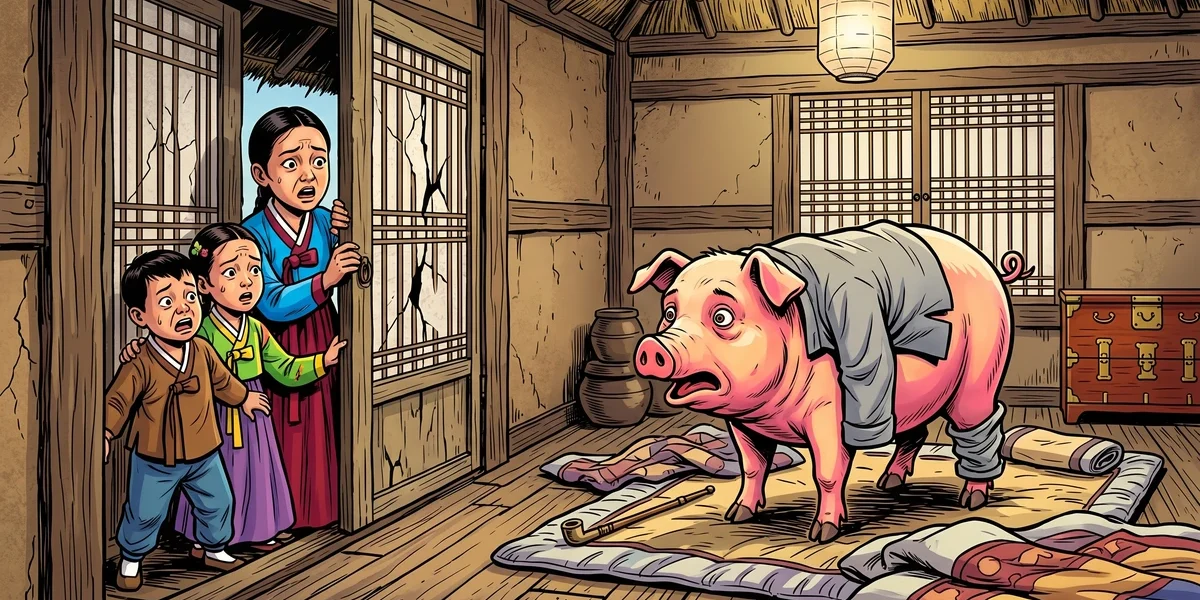
The transformation is not painful in the narrative’s telling; it is described with a quality almost of completion, as though the man has finally arrived at the form that his way of being in the world was always moving toward. His human body becomes a pig’s body. His human voice becomes a pig’s grunt. His human social intelligence—which was considerable and which he deployed skillfully in service of his appetites—becomes the pig’s straightforward and undisguised focus on the trough. The transformation has removed the social equipment that allowed him to pursue pig-goals through human means. What remains is the goal itself, now expressed without mediation.

His family recognises him. This is the story’s most pointed observation: those who live with him most closely are not surprised. They grieve, but they are not shocked. They had known, in the way that families know things about each other that are never quite articulated, what was underneath. The transformation has confirmed rather than revealed something they had been quietly aware of for some time.

Beat III — Byeonsin as Karmic Revelation

Korean Buddhist folk cosmology treats animal rebirth not as arbitrary punishment but as ontological accuracy: each animal form embodies a specific pattern of consciousness and orientation, and the soul that has been living according to that pattern in human form is assigned the form that matches its actual mode of being. The pig’s consciousness is organised around physical sensation—food, warmth, comfort—with a corresponding reduction of capacity for the kinds of discrimination, delayed gratification, and orientation toward others that human consciousness is supposed to develop. A human consciousness that has been functioning on pig-logic—treating social relationships as means to sensory ends, consistently choosing immediate appetite over longer-term obligation, failing to develop the specifically human capacity for genuine concern for others—has not been living a human life in any meaningful sense. It has been living a pig life in human form.

The transformation in this reading is not punitive but clarifying: it removes the gap between form and substance that the man had maintained throughout his human life. The gap was never a neutral condition; it was a form of deception—of his community, who extended to him the social trust that human form implies, and of himself, who was able to believe his own self-presentation as a generous, pleasant, sociable person because his human intelligence could generate narratives that explained each self-serving act as something else. The pig has no capacity for such narratives. The pig simply wants what it wants and pursues it directly. In removing the narrative capacity, the transformation removes the self-deception, and what remains is exactly what was always there.

The story engages a question that Korean Buddhist thought took seriously: what is the relationship between our social performance and our actual character? If the performance is sustained long enough and skillfully enough, can it become the character? Or does character remain what it was underneath, and social performance merely a mask of varying thickness? The man who became a pig answers this question in the pessimistic direction: decades of pleasant social performance did not change the underlying orientation. The pig was always there.

Beat IV — The Moral and Its Reach

Whether the man reverts to human form depends on the version: some tellings allow a path back through genuine changed behaviour in pig form, demonstrating that the pig-consciousness can be transformed from within; others maintain the pig form as the story’s final image, not as cruel finality but as honest accounting. The versions that allow reversion are more doctrinally Buddhist in their optimism about the possibility of genuine change. The versions that do not are more honest about the difficulty of changing a fundamental orientation rather than a surface behaviour.

What all versions share is the story’s primary moral statement: the gap between social presentation and actual character is not stable. It requires continuous maintenance through the deployment of intelligence, social skill, and self-narrative, and it is always at risk of collapse at the moments when the actual orientation is required to express itself without mediation. The man’s transformation happens at exactly such a moment: the gap collapsed, and what was underneath became visible. The story’s audience is invited to ask, in the privacy of their own reflection, what their own gap contains and whether they would be comfortable with its sudden closure.

“The body eventually comes to match the life; the only question is whether the matching happens before death or after.”
— Korean Buddhist folk saying, associated with byeonsin narrative tradition

Why This Story Has Lasted

“The Man Who Became a Pig” endures because it makes visible a process that everyone suspects is real: the gradual coalescence of character around its dominant orientation, regardless of what social performance overlays it. The man’s pleasantness was real; his generosity was real; his sociability was real. But they were all in service of pig-logic, and the story insists that what a capacity serves matters as much as whether the capacity exists. Intelligence, social skill, and generosity used primarily in service of one’s own appetite and comfort are not the same virtues as intelligence, social skill, and generosity used in genuine orientation toward others. The story makes this distinction with unusual clarity by waiting for the moment when the mask drops and then showing what was always behind it.

Animal Transformation in Korean Buddhist Folk Narrative

The Korean Buddhist folk narrative tradition treats human-to-animal transformation as ontological revelation rather than arbitrary punishment, drawing on the Buddhist doctrine of rebirth according to karmic accumulation. Each of the six realms of existence in Buddhist cosmology corresponds to a dominant mode of consciousness: the animal realm is characterized by the dominance of sensory drive and the relative absence of reflective capacity. A human being who has been living in an animal mode—driven primarily by appetite, comfort, and immediate sensation rather than by the distinctively human capacities for reflection, delayed gratification, and genuine concern for others—has accumulated the karmic pattern that corresponds to animal rebirth. The pig specifically, in Korean and broader East Asian Buddhist iconography, represents the first of the Three Poisons (sam-dok, 삼독, 三毒)—greed or delusion—alongside the snake (hatred) and the rooster (ignorance). Stories in which characters become pigs engage this iconographic tradition, using the pig form to make visible the quality of consciousness that karma theory identifies as the cause of that particular rebirth.

Frequently Asked Questions

What is the moral of “The Man Who Became a Pig”?
That transformation into an animal does not impose a new nature but reveals the nature already present beneath social performance. The man who becomes a pig was already living according to pig-logic—oriented primarily toward appetite, comfort, and sensory satisfaction—and the transformation removes the human intelligence and social skill that allowed him to pursue those goals while presenting himself as a generous and pleasant person. What remains after the transformation is what was always actually operating.
What happens in “The Man Who Became a Pig”?
A prosperous and socially pleasant man who is secretly oriented primarily toward his own appetite and comfort undergoes transformation into a pig at the moment when his actual nature is expressed without the usual mediating social performance. His family recognizes him and is not entirely surprised. The transformation removes his capacity for self-narrative and social management, leaving only the appetite-focused orientation that was always underneath. Depending on the version, he either remains a pig or finds a path back through genuine change.
What does the pig symbolize in Korean folk tradition?
The pig in Korean folk culture carries a dual symbolism: pig dreams (dwaeji kkum, 돼지 꿈) are auspicious, associated with wealth and abundance, reflecting the pig’s association with prosperity. But as a character type, the pig represents the qualities that unlimited pursuit of abundance produces: greed, sensory indulgence, lack of discrimination, and the prioritisation of physical appetite over relational and ethical considerations. In Korean Buddhist iconography, the pig is associated with the first of the Three Poisons: greed or delusion.
How does Korean Buddhist thought explain animal transformation?
Korean Buddhist folk theology treats rebirth in animal form as karmic accuracy rather than punishment: each realm of existence corresponds to a dominant mode of consciousness, and a being is reborn in the realm that matches the consciousness pattern it has been developing. A human who has been living in an animal mode of consciousness—driven primarily by appetite and sensation rather than by reflection and genuine concern for others—has accumulated the karmic pattern that corresponds to animal rebirth. The form matches the actual mode of being rather than the claimed or performed one.
Why does the man’s family recognize him?
Because they lived with him most closely and knew, in the way families know things that are never quite articulated, what was underneath the social pleasantness. The transformation confirms rather than reveals something they were already aware of. This is the story’s most pointed observation: the gap between social presentation and actual character is maintained primarily for the benefit of those who interact with us occasionally and at social distance; those closest to us often see through it, even if courtesy and affection prevent them from naming what they see.
Ad Space (in-content)
Ad Space (after-content)

Get a New Story Every Week!

Join thousands of parents and teachers who receive our hand-picked folk tales every Friday. Stories with morals your kids will love.

Free forever. No spam. Unsubscribe anytime.