Longka, The Dancing Girl
After Eastern Ocean islanders learn of Korea's wealth, they seek to possess Longka, a dancing girl whose virtue and wisdom keep her steadfast against all temptation.
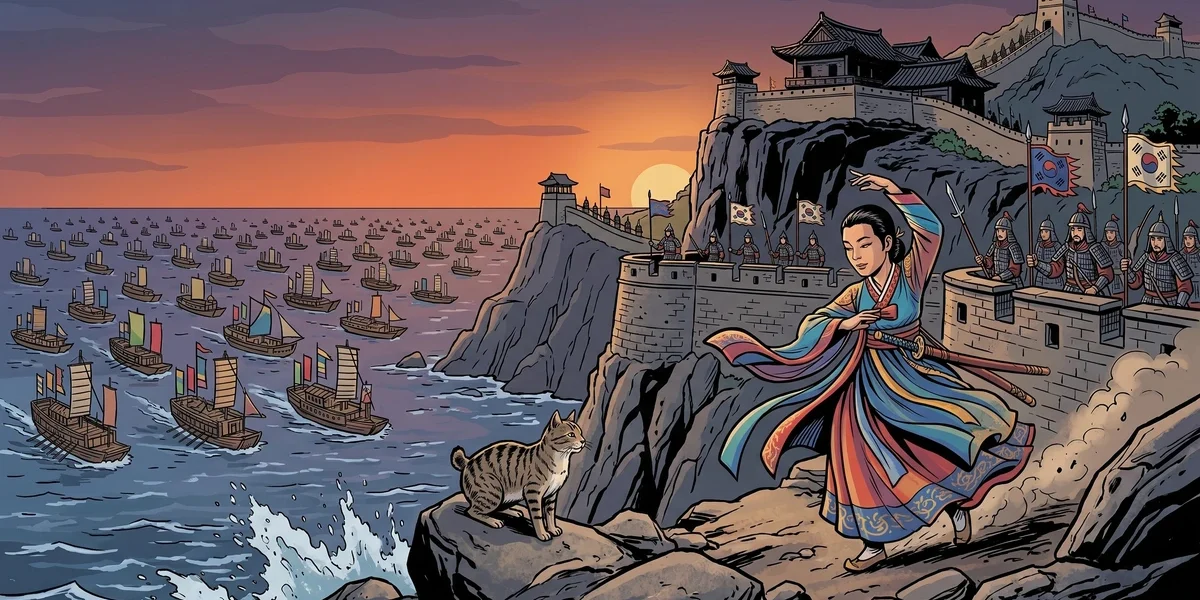
The Girl Whose Dance Was a Wound Turned Inside Out
In Joseon Korea, the gisaeng (기생) occupied one of the most paradoxical social positions in the kingdom’s rigid hierarchy. Classified as cheonmin — the lowest stratum of a society structured by Neo-Confucian status categories — they were nonetheless trained in the arts that Joseon’s cultivated classes most prized: poetry, calligraphy, music, and dance. They served at official banquets, entertained visiting dignitaries, and were sometimes the most educated women in their provinces, at a time when education for women of higher status was restricted to private domestic instruction. Their social degradation was absolute. Their cultural achievement was, in certain cases, equally absolute. The contradiction between these two facts was never resolved by Joseon’s institutions; it was simply maintained, generating in the women who lived within it a particular intensity of experience that Korean folk tradition recognised as the source of their art’s distinctive power.
Longka was a gisaeng, and her story is a study in what that combination of social position and artistic mastery produces in a person, and in what that person’s art can do for those who witness it.
Beat I — Longka’s Formation and What the Dance Required
Longka had been placed in the gisaeng system as a child — the standard path of entry for those born into families already registered in the institution’s hereditary rolls. She learned music, poetry, the elaborate formalities of entertainment at official occasions, and above all dance. By her twenties she had become known in her provincial town as a dancer of unusual force — not merely technically accomplished, which many gisaeng were, but possessed of a quality in her performance that left audiences unsettled in a way they found difficult to name.
Her teacher, an older gisaeng who had spent forty years in the profession, told Longka early in her training that the Korean traditional dances she was learning were not decorative exercises. They were forms for holding and moving through large human experiences — grief, longing, the movement between sorrow and acceptance — that had nowhere else to go. A dancer who had not herself felt these things could produce technically correct movement but could not produce the real thing. The real thing required that the dancer know, in her body and her history, what the form was designed to carry.
Longka’s history was not short of material. The gisaeng life concentrated experiences that other women were protected from: the exhaustion of sustained performance, the compulsory amiability masking complex inner states, the social contempt that coexisted with social demand, and the particular loneliness of a person whose role required intimate emotional engagement with others while the social order denied her the reciprocal intimate relationships that might have sustained her. This accumulated experience — this density of unresolved feeling — was what her teacher called han (한), and what she called the raw material of genuine art.
Beat II — The Performance That Changed the Banquet Hall
The story turns on a single performance at an official banquet attended by the provincial governor and his guests. Longka was called to dance, as she had been called hundreds of times before to similar occasions. The expected dance was a celebratory one — a formal acknowledgement of the occasion’s official joy. Longka began the dance correctly. But something shifted partway through — not visibly, not through any departure from the form’s established movements, but in the quality of what the movements carried.
The guests, initially inattentive in the way of people at official entertainments, fell silent. Then still. The dance Longka was performing was, technically, a celebration. What was being communicated through it was something that contained celebration but was larger than it — something that held sorrow and endurance and the fragile persistence of beauty within conditions that constantly threatened to extinguish it. It was the dance of a person who knew exactly what it cost to be present in that hall in that role on that evening, and who had transformed that knowledge into the movement of her body.
When it ended, the hall was silent for a long moment. Then the governor wept — not from grief at anything personal, but from the particular effect that great art produces in those who receive it: the sense of having been shown something true about human experience that they had been carrying without being able to name it. Several guests wept alongside him. The official occasion had been interrupted by something too real for its own framing to contain.
The governor afterward sought out Longka and asked her what she had been thinking during the dance. She told him she had been thinking about nothing specific — she had been inside the form, letting it carry what it was built to carry. He asked her how she had learned to do this. She told him: by having enough to carry that the form had something real to work with.
Beat III — Han and Its Aesthetic Transformation
Longka’s story articulates a theory of artistic power that Korean tradition developed most fully through its most marginalised performers. Han — the accumulated weight of grief, resentment, and thwarted longing — is not in itself art. It is raw suffering. But Korean aesthetic tradition, shaped by both shamanic practice and the experience of communities who had endured centuries of foreign invasion, political instability, and social oppression, understood that han could be transformed by the right formal container into something that did not eliminate the suffering but alchemised it into a communicable truth.
The transformation is what Korean tradition calls han-puri — the untying or releasing of han — and it is the mechanism through which the mudang’s ritual ceremony works. But Longka’s dance operates through the same mechanism by different means. The mudang releases han through invocation, cloth-passing, and communal ceremony. The dancer releases it through the formal structure of the dance, which becomes a vessel for the accumulation and its movement toward resolution. Both are acts of making the han communicable — allowing it to move through a shared form so that it can dissipate into the shared space rather than remaining locked inside a single person.
This theory of art helps explain the paradox of the gisaeng’s cultural position: the social oppression that generated their han was also the condition that made their art possible in the specific form it took. A person without Longka’s history could not have produced Longka’s dance — not because suffering is necessary for art in general, but because these particular dances, in this particular tradition, were forms designed to carry and release precisely the kind of accumulated han that Longka’s life had given her in full measure. The tradition and the biography were matched. The result was a performance that could do something for its audience that technically accomplished but emotionally thinner work could not.
Korean folk tradition recognised this dynamic and encoded it in the biographies of legendary gisaeng and performing artists: the distinctive power of the greatest performances was consistently attributed not to technical mastery alone but to the depth of experience the performer brought to the form. Experience here meant specifically han-laden experience — the weight of a life lived at the intersection of beauty and hardship, of intimate knowledge of human emotion and systematic social exclusion from its most sustaining expressions.
Beat IV — Longka’s Legacy and What Art Owes Its Sources
Longka grew old in the gisaeng system, never achieving the official recognition that her art deserved by any standard the culture actually valued. She was never elevated from the cheonmin category; the social order that had shaped her was not moved to acknowledge the contradiction in its own values. What she left was her students — younger gisaeng to whom she transmitted not only the technical forms of the dances but the understanding of what those forms required from the person inside them.
She told them that the dance was not about performance. It was about truth-telling by means that were available to a person in their position. A gisaeng could not write a memorial to the throne. She could not hold office or shape policy. She could not speak in the public venues where Joseon’s official conversations happened. But she could dance in a way that made the men who held all those powers feel, for the duration of the dance, what the world actually was for a person whose experience was never otherwise consulted. This was not nothing. In some circumstances it was the only form of truth-telling the social order permitted, and therefore the most important one available.
“The dance that makes the magistrate weep is worth more than the petition he ignores. Both speak of the same wound; only one reaches him.” — Korean gisaeng proverb
Longka’s story has survived in Korean oral tradition because it names something about the relationship between suffering, form, and communication that remains true well beyond its specific historical context. The principle that the most powerful art is often produced by those whose social position has given them the most to carry, and that the formal structures of a tradition serve as containers for precisely that accumulation — this insight transcends the gisaeng system that produced Longka while remaining grounded in the specificity of her experience. She could not have danced what she danced anywhere else, or with any other life. The dance required her history. Her history, passed through the dance, became something others could receive and be changed by. The transformation is the art. The art is the han-puri. The han-puri is why the governor wept.
Frequently Asked Questions
What is the moral of Longka, The Dancing Girl?
The story’s moral is that great art — particularly in traditions designed to carry and release collective emotional weight — requires the artist to have genuinely experienced what the form is built to hold. Longka’s dance is powerful precisely because her social position has given her an accumulation of han that fills the dance’s formal structure with authentic weight. The moral extends to a recognition of the social conditions that generated that han: a society that creates the suffering from which its most powerful art springs, while refusing to acknowledge the contradiction, is engaged in a form of moral evasion that the art itself quietly exposes.
What happens in Longka, The Dancing Girl?
Longka is a gisaeng — a trained entertainer of the lowest social stratum in Joseon Korea — whose dance has been recognised from her training years as possessing unusual power beyond technical accomplishment. At a provincial governor’s banquet, she performs a celebratory dance that shifts, within its formal structure, into something that carries the full weight of her accumulated han. The inattentive official audience falls silent, then moved to tears — including the governor himself. Asked afterward what she had been thinking during the dance, she explains that she had simply let the form carry what it was built to carry. Her later years are spent transmitting this understanding to younger students.
What is a gisaeng in Korean history?
Gisaeng were registered female entertainers in the Joseon period, required by their classification as cheonmin (lowest social class) to perform at official functions, yet trained to high levels in the arts most valued by Joseon’s cultivated classes. The contradiction between their artistic excellence and their social degradation was a persistent feature of the institution. Some gisaeng achieved significant cultural renown — the historical gisaeng Hwang Jini is still celebrated as a poet — while the institution as a whole represented a systematic exploitation of women’s artistic and social labour. The gisaeng tradition contributed significantly to the transmission of Korean classical performance arts.
How does han function in Korean artistic traditions?
Han (한) in Korean artistic tradition functions as both the emotional raw material and the intended object of transformation in certain performance genres. The concept holds that accumulated grief, resentment, and thwarted longing — particularly when it is collective or historically generated rather than purely personal — can be gathered into formal artistic structures (dance, song, pansori performance) and released in a way that is communally therapeutic rather than merely individually expressive. This process, called han-puri, parallels the shamanic gut ceremony’s function of releasing ancestral han. The performers who have accumulated the most han through their lives and social positions are understood to have the most potent artistic material to work with.
How does Longka’s story relate to broader Korean artistic philosophy?
Longka’s story exemplifies a recurring Korean aesthetic principle: that the most powerful art emerges at the intersection of formal mastery and deep lived experience, particularly experience marked by han. This principle appears across Korean artistic traditions — in the pansori singer’s cultivation of a voice made rough and resonant by years of demanding practice and emotional experience, in the salpuri dancer’s embodiment of the desire to be free of accumulated burden, in the mourning songs that serve simultaneously as grief expression and communal release. The tradition recognises that form without experience produces technique, while experience without form produces mere suffering; the combination produces art capable of moving those who witness it toward something like catharsis.
You May Also Like
 Korean Folk Tales
All Ages
Korean Folk Tales
All Ages
The Plucky Maiden
The Plucky Maiden: We are told in the Yol-ryok Keui-sul that when Han was a boy he had for protector and friend a tiger, who used to accompany him as a dog
 Korean Folk Tales
Ages 6-8
Korean Folk Tales
Ages 6-8
The Propitious Magpie
The Propitious Magpie: People say that when the magpie builds its nest directly south of a home that the master of the house will be promoted in office.
 Korean Folk Tales
Ages 6-8
Korean Folk Tales
Ages 6-8
A Story Of The Fox
A Story of the Fox: Ancient Wisdom About Cleverness and Magic In the ancient lands of Asia, storytellers have always known something special about foxes. These