The Magic Invasion Of Seoul
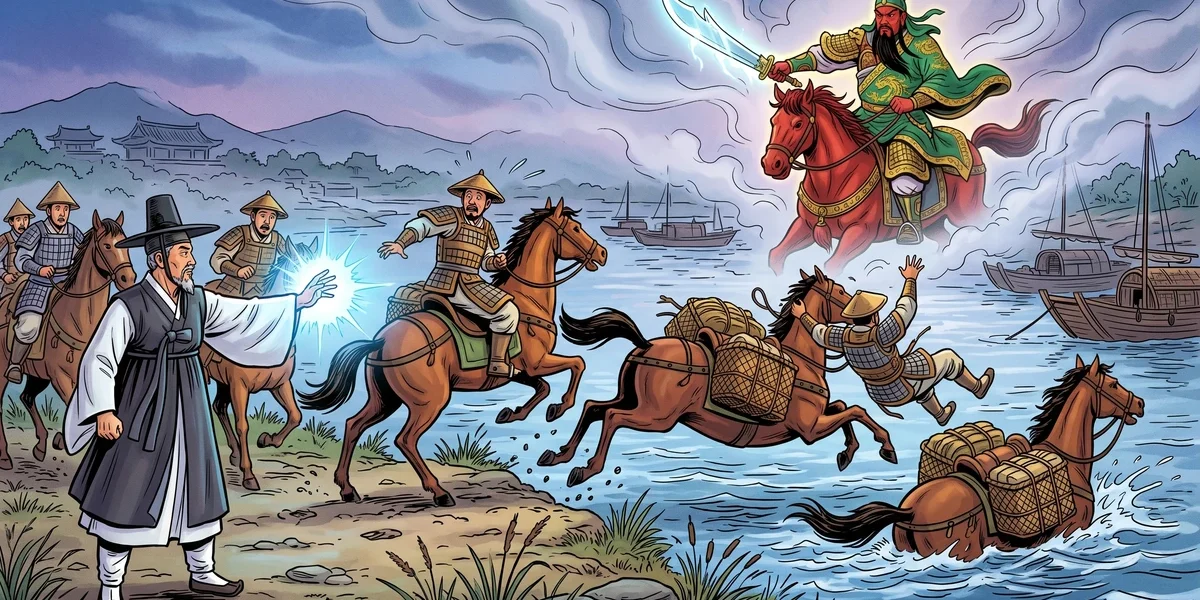
The Magic Invasion Of Seoul: A gentleman of Seoul was one day crossing the Han River in a boat. In the crossing, he nodded for a moment, fell asleep and
Origin & Tradition
“The Magic Invasion of Seoul” belongs to the Korean tradition of sulbeop iyagi (술법 이야기, magical arts stories)—narratives centred on practitioners of sulbeop (술법, 術法), the magical-technical arts that included divination, geomantic manipulation, spiritual combat, and the direction of supernatural forces. These stories sit at the intersection of Korean shamanic cosmology, Taoist magical practice, and Buddhist protective ritual, and they frequently stage a confrontation between a practitioner using magical power for destructive or self-serving ends and a practitioner using it in service of a legitimate social order. Seoul—Hanyang (한양) during the Joseon dynasty (1392–1897)—was both the political and the spiritual capital of the kingdom: its location had been selected through elaborate pungsu (풍수, geomancy) analysis to concentrate auspicious energies, its founding was accompanied by major ritual protection, and its spatial organisation reflected the cosmological principles that were supposed to underpin legitimate governance. A magical attack on Seoul was therefore not merely a military or political threat; it was a theological proposition: a claim that the city’s spiritual protections could be overcome, and by implication that the mandate underlying its political authority was not as secure as the court maintained.
Beat I — The Invasion Announced
A figure of formidable magical reputation arrives at the borders of the capital—accounts vary on whether he is foreign or a Korean renegade practitioner, and the ambiguity is meaningful: both possibilities were threatening in different ways. He announces his intention not subtly but publicly, sending word to the court that he intends to demonstrate his power by rendering the city spiritually inert: disrupting its pungsu configuration, neutralising its protective spirits, and establishing his own spiritual authority over the space. His stated motivation varies across versions of the story—personal grievance against the king, ambition for recognition, a philosophical argument that the court’s claimed mandate is spiritually hollow—but the structural challenge is consistent: he is testing the proposition that technical magical power, applied with sufficient skill, can override the spiritual protections of a legitimately governed capital.
The court is genuinely alarmed. The king’s advisors include Confucian scholars who are officially skeptical of magical arts and Buddhist monks who maintain the capital’s ritual defenses, and neither group has clear authority to handle the specific kind of threat being announced. The Confucian approach—dismiss the announcement as superstition and maintain confident governance—is theoretically correct but practically risky: if the invader’s power is real, confident dismissal leaves the city undefended. The Buddhist approach—intensive protective ritual—requires a practitioner of sufficient power to match the invader.
Beat II — The Defender Found
The practitioner who steps forward to defend the capital is not a court official but a reclusive figure from the mountains—characteristically, in Korean folk narrative, the person with the power to handle an extraordinary threat is not found within the institutions designed to handle ordinary threats. He is either a Buddhist monk of exceptional practice, a Taoist hermit, or a dogyeong (도경, adept in the Way) whose cultivation has brought him abilities that institutional practitioners cannot match. His willingness to enter the capital to serve as its defender is itself a moral statement: he has no personal stake in the political order, which makes his defense of it a choice rather than an obligation, and choice made freely on behalf of a just cause carries more spiritual force than obligation performed under institutional pressure.
The confrontation between the defender and the invader unfolds across the capital’s geomantically significant sites: at the four guardian gates, at the central mountain—Bugaksan (북악산, the northern mountain that anchors the city’s pungsu configuration)—and along the axis that connects the palace to the southern gate. The battle is not fought with weapons but with the manipulation of spiritual forces: the invader attempts to redirect the city’s energy flows and neutralise its protective presences; the defender restores and reinforces them. The combat is invisible to ordinary eyes but its effects are felt: at points where the invader gains ground, residents report unease, livestock behave erratically, and the ordinary harmonious operation of the city’s social life becomes strained.
Beat III — Cheonmyeong and the Limits of Magical Power
The theological proposition that “The Magic Invasion of Seoul” explores through narrative is one that Korean political cosmology had to engage seriously: can raw technical magical power override the spiritual authority that legitimate governance is supposed to embody? The concept of cheonmyeong (천명, 天命, Heaven’s mandate)—the principle that the right to rule is conferred by Heaven on those whose moral quality warrants it and withdrawn when it does not—was the foundation of Joseon dynastic legitimacy. If the mandate was real and operative, then the capital’s spiritual defenses were not merely artificial ritual constructions but expressions of an actual cosmic alignment that an individual practitioner’s skill could not simply override.
The story’s resolution tests this proposition directly. The defender’s advantage over the invader is not that his individual skill is superior—the narrative typically acknowledges that the invader is formidable—but that he is fighting with the spiritual backing of a legitimately ordered space. The city’s pungsu configuration, properly maintained, is not passive; it actively assists those who defend it in accordance with the principles that organized it. The defender is not so much winning a power contest as facilitating the city’s own self-defense: he provides the skilled human agency through which the accumulated spiritual protections of a correctly established capital can express themselves against an external threat. The invader, however technically skilled, is fighting against the grain of cosmic order; the defender is fighting with it.
This is not a trivial theological claim. It means that the moral quality of the governance the capital represents matters to the outcome of the magical confrontation: a capital of a deeply corrupt regime would not be spiritually backed in the same way, and its defender would fight without the same reserves. The story implicitly evaluates the Joseon political order not through administrative analysis but through the outcome of a magical battle—a characteristically Korean way of making a political argument that would be dangerous to make directly.
Beat IV — The Repulse and Its Meaning
The invader is repulsed not destroyed—a nuance that matters. He withdraws rather than is eliminated, which preserves the story’s theological precision: the capital’s defenses have demonstrated their effectiveness, but they have not demonstrated that all magical challenge to political order can be permanently neutralised. The defender returns to his mountain retreat. The court offers him honors that he declines, which confirms his status as someone who acted from principle rather than ambition—a person who accepts institutional rewards is implicitly working within the institutional framework; a person who declines them has demonstrated that their motivation is independent of institutional validation.
The city returns to its ordinary operation, but residents who were sensitive to the spiritual disturbance during the invasion are aware that something has been resolved rather than merely ended. The capital has been tested and has held. This is not a permanent guarantee—the mandate can be lost, the pungsu can deteriorate, the practitioners who maintain the spiritual defenses can age and not be replaced. But for this encounter, in this place, at this time, the proposition has been demonstrated: a legitimately governed capital, properly maintained and actively defended by a practitioner acting on principle, can withstand a direct magical assault by a technically formidable individual operating without moral backing from the cosmic order.
“The wall that Heaven has approved cannot be breached by one who lacks Heaven’s approval, however skilled the siege; the city’s stones know who defends them rightly.”
— Korean protective ritual saying, associated with the Joseon-era capital defense tradition
Why This Story Has Lasted
“The Magic Invasion of Seoul” endures because it stages a question that every society must answer in some form: what is the relationship between power and legitimacy? The story’s answer is that they are different things and that legitimacy, when genuine, provides access to reserves of support that raw power alone cannot generate. The magical invader has power; the defender has power plus the backing of a cosmic order that recognizes the justice of what he is defending. This is not a comfortable answer—it requires that the governance being defended actually be just, which the story leaves as an open question that the audience is invited to evaluate against their knowledge of their own political situation—but it is a serious one, and its narrative encoding in the form of a magical battle makes the argument accessible to audiences who would not follow it in philosophical form.
Seoul’s Pungsu Configuration and Spiritual Defense
The site of Seoul was selected by the geomancer Muhak (무학, 1327–1405) for its pungsu (풍수, 風水) configuration: surrounded on three sides by mountains that provide spiritual protection according to the four directional guardian principles (sasin, 사신, 四神), with the Han River to the south providing the water element required for auspicious energy accumulation. The founding of the Joseon capital was accompanied by the construction of four guardian gates aligned with the cardinal directions, a central axis connecting the palace to the southern gate, and a series of protective shrines and Buddhist temples that maintained the city’s spiritual defenses. The practitioner tradition that maintained these defenses combined Buddhist protective ritual, Taoist geomantic technique, and elements of Korean shamanic cosmology. Stories about magical threats to Seoul engaged this entire framework, testing whether the accumulated spiritual infrastructure of a century or more of careful ritual maintenance could hold against external assault.
Frequently Asked Questions
- What is the moral of “The Magic Invasion of Seoul”?
- That legitimate political authority, when genuine and properly maintained, has spiritual backing that raw magical power alone cannot override. The defender fighting on behalf of a just order draws on reserves that the technically skilled invader, operating without cosmic sanction, cannot access. Power and legitimacy are different kinds of force, and where they meet, legitimacy carries a reserve that individual skill cannot generate.
- What happens in “The Magic Invasion of Seoul”?
- A practitioner of formidable magical skill announces his intention to spiritually disable the capital by disrupting its geomantic configuration and neutralizing its protective forces. A reclusive practitioner from the mountains volunteers to defend the city. The two engage in a spiritual confrontation across the capital’s geomantically significant sites. The invader is repulsed but not destroyed; the defender returns to his mountain retreat, declining the court’s offered honors.
- What is sulbeop in Korean folk tradition?
- Sulbeop (술법, 術法) refers to the magical-technical arts in Korean folk tradition, encompassing divination, geomantic manipulation, spiritual combat, talismanic practice, and the direction of supernatural forces. Practitioners were associated with various traditions: Taoist hermits, Buddhist monks of exceptional cultivation, and hybrid figures who combined elements of shamanic, Buddhist, and Taoist practice. Sulbeop practitioners appeared in folk narrative both as threats and as protectors, depending on whether their power was deployed in service of or against the social and cosmic order.
- Why is Seoul particularly significant as the target of a magical invasion?
- Seoul (Hanyang) was selected as the Joseon capital through elaborate geomantic analysis and established with extensive ritual protections. It was both the political and spiritual center of the kingdom, its location and spatial organization reflecting the cosmological principles that were supposed to underpin legitimate governance. A magical attack on Seoul was therefore simultaneously a military-political threat and a theological challenge: a claim that the city’s spiritual protections were insufficient, implying that the mandate underlying its political authority was not as cosmically secure as the court maintained.
- What is the significance of the defender declining the court’s honors?
- In Korean folk narrative, a practitioner who declines institutional reward after serving the state demonstrates that their motivation was independent of institutional validation. This independence is itself a form of moral authority: it confirms that the practitioner acted from principle rather than ambition, which reinforces the story’s proposition that their effectiveness derived from alignment with a cosmic order rather than from institutional backing. A person working within the institutional framework would accept its rewards; a person whose authority is cosmic in origin has no need to.
You May Also Like
 Korean Folk Tales
All Ages
Korean Folk Tales
All Ages
Ta-Hong
Ta-Hong: [Sim Heui-su studied as a young man at the feet of No Su-sin, who was sent as an exile to a distant island in the sea. Thither he followed his master
 Korean Folk Tales
Ages 6-8
Korean Folk Tales
Ages 6-8
The Propitious Magpie
The Propitious Magpie: People say that when the magpie builds its nest directly south of a home that the master of the house will be promoted in office.
 Korean Folk Tales
Ages 9-12
Korean Folk Tales
Ages 9-12
The Story of Chunhyang
The Story of Chunhyang: In the province of Jeolla, during the reign of the Joseon Dynasty, there lived a nobleman’s son named Lee Mong-ryong. He was of noble