The Old Man Who Became A Fish
The Old Man Who Became A Fish: Some years ago a noted official became the magistrate of Ko-song County. On a certain day a guest called on him to pay his
Origin & Tradition
“The Old Man Who Became a Fish” belongs to a distinctive register within Korean transformation narrative that differs significantly from stories of punitive animal metamorphosis. Where tales like “The Man Who Became a Pig” use transformation to reveal a character’s hidden dominant fault, this narrative tradition uses transformation to express the culmination of genuine spiritual development: the form the protagonist assumes at the story’s end is not the exposure of what was always underneath but the flowering of what was slowly cultivated across a lifetime. The fish (mulgogi, 물고기) in Korean folk and Taoist-influenced cosmology carries a specific cluster of meanings: freedom of movement through an alien medium, the capacity to navigate depths that other beings cannot enter, the principle of yielding embodied in water itself, and the longevity associated with the carp (iri, 잉어) that in Korean and Chinese tradition represents perseverance and transformation. An old man who becomes a fish has not been punished or corrected; he has arrived at the form that his manner of living in the world was always approaching.
Beat I — The Old Man’s Manner of Living
The old man of the story is not a hero in any conventional sense. He has not won battles, accumulated wealth, or achieved examination success. He has lived a long, quiet life in a village beside a river, working as a fisherman—not a prosperous one, but a sufficient one. His manner of fishing is described with care: he does not take more than he needs, he releases the young fish without being asked, he knows the river well enough to find fish without disturbing the sections where spawning is occurring, and he speaks of the river in terms that his neighbors find slightly odd—as though it were a living being with its own preferences and its own timetable, which ought to be respected rather than exploited.
His manner of living on land reflects the same quality. When disputes arise in the village, he is the person who finds the path that allows both parties to withdraw with face intact—not because he is clever at manipulation but because he genuinely does not mind taking the lower position himself, which creates room for everyone else to be slightly less defended. He has never, in anyone’s memory, insisted on his own position with the urgency that most people bring to disagreements. This is sometimes mistaken for weakness; his neighbors have occasionally taken advantage of it. He has not seemed to mind. Over decades, the quality of his non-contention has become recognizable as something different from weakness: it is the settled confidence of someone who does not need victory in the way that insecure people need it.
Beat II — The Transformation
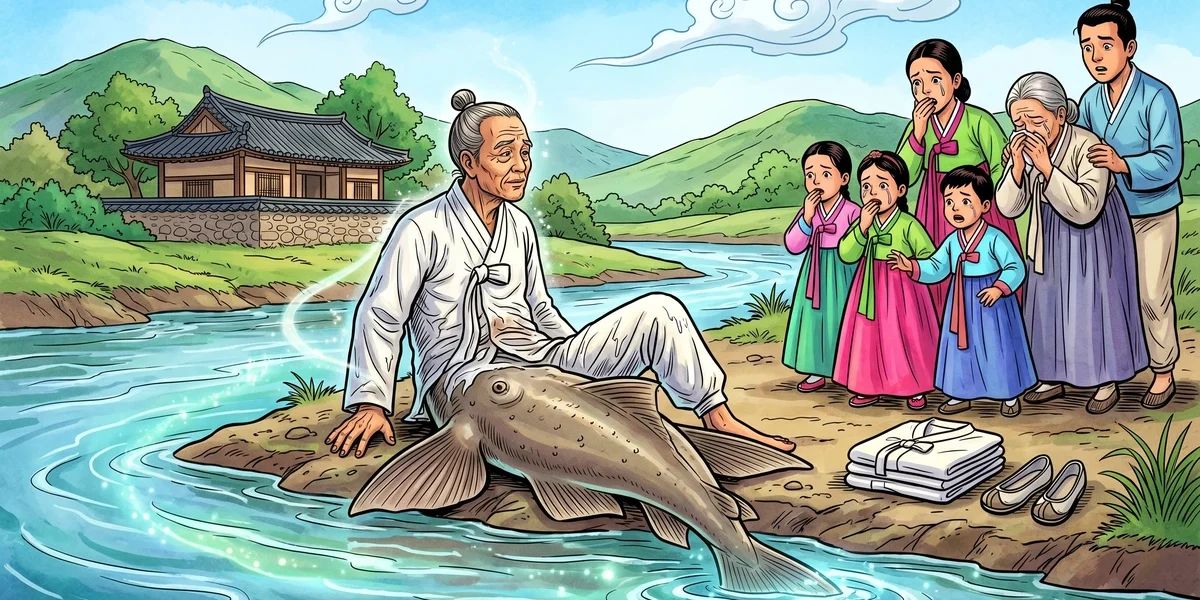
The transformation is not dramatic. One morning in late autumn, the old man goes to the river at his usual time and does not return. His family searches. They find his net folded neatly at the riverbank, his shoes placed beside it with the care of someone who has left things in order. In the water near the bank, a large old carp moves with the unhurried ease of a creature that has been in this particular section of the river for a very long time. The carp does not flee when the family approaches; it simply holds its position in the current, looking at them with the patient regard that the old man’s look in his final years had come to resemble.
A local monk, consulted by the grieving family, offers an interpretation that the story presents without endorsement but also without dismissal: the old man has been practicing, in his particular way, the water principle—sucheon (수천, water heaven), the understanding that the highest virtue resembles water, which benefits all things without contending, which occupies the low places that others disdain, and which in doing so becomes the most powerful force in the world. A lifetime of practicing this principle in human form had, the monk suggests, brought the old man to the threshold of the form that embodies it most completely. He has not been taken by the river; he has become it, in the measure available to any individual consciousness.
Beat III — Su and the Taoist Water Principle in Korean Folk Thought
The water principle that the old fisherman embodies connects Korean folk narrative to a strand of thought that entered Korean culture through Chinese Taoist transmission and was thoroughly domesticated into the folk religious synthesis that characterised popular Korean cosmology by the Joseon period. The core text is the Tao Te Ching’s (도덕경) eighth chapter: “The highest good is like water. Water benefits all things and does not contend. It occupies the place that people disdain, and in this it is close to the Tao.” This passage—known in Korean Taoist-influenced thought as the su-deok (수덕, water virtue) principle—describes a mode of being that uses no force, assumes no high position, and yet achieves what force and position cannot: the penetration of every available space, the nourishment of everything it touches, and the capacity to wear down the hardest stone simply by flowing consistently around it.
The old fisherman has been practicing su-deok without knowing its name. His manner of fishing reflects it: he knows the river well enough to find fish without imposing on it, which means his understanding runs with the river’s nature rather than against it. His manner in the village reflects it: he takes the lower position naturally, which drains the urgency from other people’s positions and allows conflicts to resolve without requiring anyone to lose. His lifetime of non-contention is not the weakness it sometimes appeared to be; it is the systematic practice of a principle that Korean folk tradition—through the synthesis of Taoist water philosophy, Buddhist non-attachment, and indigenous Korean respect for natural forces—recognized as the highest form of practical wisdom.
The fish form, in this reading, is not metaphor but logic: the creature that lives entirely in water, that moves by yielding to current while also shaping it, that navigates the depths without any of the equipment that land creatures bring to their environments, is the form that su-deok fully embodied would naturally take. The old man has not been given a fish’s nature; he has developed a nature for which the fish is the most accurate form. The transformation reveals not a hidden character (as in the pig story) but a developed one.
Beat IV — The Moral and Its Reach
The family, after the monk’s explanation, does not quite know how to grieve. Their father is gone but the old carp is still present in the river, still holding its position in the current with the unhurried ease that characterised the old man in his final years. They begin to visit the river the way they visited him: not urgently, but as a regular quiet practice, sitting on the bank and feeling the presence that the water now holds. The transformation has changed the nature of the relationship but not ended it; it has moved it from the domain of human social interaction to the domain of the river itself, which is simultaneously more and less accessible.
The tale’s moral does not promise that living as the old man lived will produce a fish transformation for anyone who tries it. It makes a more modest and more interesting claim: that a lifetime of genuine practice of the water principle produces a person who is, by the end, genuinely different from the person who has spent a lifetime insisting on their own position, accumulating victories, and occupying high places. What they become is something the story can only gesture at through the image of the old carp in the river, which is simultaneously ordinary (just a fish in a river) and extraordinary (a fish in a river that holds the presence of a life wisely lived).
“He who learns to live like water does not need to go anywhere; the river comes to him, and eventually he goes to the river, and there is no difference between the two.”
— Korean Taoist-folk saying, associated with riverside seonbi (scholar-recluse) tradition
Why This Story Has Lasted
“The Old Man Who Became a Fish” endures because it offers a vision of what a life organized around yielding rather than forcing might actually culminate in—not failure, not obscurity as the world measures them, but a different kind of completion. The old man has not achieved the things that Joseon society formally valued: examination success, official position, accumulated wealth, lasting family reputation. He has achieved something that Joseon folk culture recognized as equally real: a quality of being in the world that has no enemies because it contends with nothing, that finds nourishment everywhere because it takes the lower place, and that persists long after the noisier achievements of his contemporaries have dissolved. The fish in the river is a gentle and permanent argument for the water principle.
Fish Symbolism and the Water Principle in Korean Culture
The carp (iri, 잉어, 鯉魚) occupies a position of particular significance in Korean symbolic tradition, shared with Chinese culture: carp that swim upstream and leap the waterfall become dragons, a metaphor for the perseverance and transformation associated with examination success and worldly achievement. But the carp at rest—holding its position in the current with effortless ease—represents a different and equally recognized virtue: the capacity to maintain one’s essential nature without effort, in harmony with the medium one inhabits. Korean Taoist-influenced folk thought (seon* tradition, 仙, not to be confused with Zen Buddhism) valued the water principle as the highest practical wisdom, citing the Tao Te Ching’s identification of water as the closest approximation to the Tao available in the material world. The old man’s fish transformation is the folk narrative expression of this identification: a life organized around the water principle eventually assumes the form that embodies it most completely.
Frequently Asked Questions
- What is the moral of “The Old Man Who Became a Fish”?
- That a lifetime of genuine practice of the water principle—yielding rather than forcing, occupying the low place rather than the high, flowing around obstacles rather than breaking them—produces a person who is, by the end, genuinely different in kind from those who spent the same time insisting on their positions. The fish transformation is not punishment or fantasy but the natural culmination of a life that was always moving toward the form that most completely expresses the wisdom it had developed.
- What happens in “The Old Man Who Became a Fish”?
- An old fisherman who has spent his life practicing a quiet, non-contentious manner of living—taking only what he needs, occupying the lower position in disputes, moving with the river’s nature rather than against it—disappears from the riverbank one morning, leaving his net and shoes neatly arranged. A large old carp appears in the river near where he fished, holding its position with the unhurried ease that characterized the old man in his final years. A monk explains the transformation as the culmination of a lifetime’s practice of the water principle. The family begins visiting the river as they visited him.
- What is the “water principle” (su-deok) in Korean Taoist thought?
- Su-deok (수덕, water virtue) is drawn from the Tao Te Ching’s description of water as the highest good: it benefits all things without contending, occupies the low places others disdain, and in doing so becomes the most powerful force in the world. In Korean folk Taoist synthesis, this principle was understood as a practical life orientation: yielding where others force, taking the lower position where others insist on the higher, finding nourishment in the humble and the overlooked rather than competing for the conspicuous and the valued.
- How does this transformation differ from the pig transformation in related Korean stories?
- The pig transformation reveals a character’s hidden dominant fault—it exposes what was always underneath the social mask and makes the inside visible as the outside. The fish transformation reveals a character’s developed virtue—it expresses what has been slowly cultivated across a lifetime and gives it its most complete form. Both are transformations that make character visible in physical form, but one is revelation of what was always present and the other is culmination of what was gradually developed. The direction of the narrative is opposite: downward into the flaw (pig) and upward into the attainment (fish).
- What role does the river play in the story?
- The river is simultaneously the old man’s workplace, his spiritual environment, and his ultimate destination. His lifetime of fishing has been simultaneously a practical livelihood and an extended education in the water principle: the river has been teaching him, through decades of patient attention to its nature, what yielding, flowing, and finding the low place actually look like in practice. The transformation into the river’s fish is the logical conclusion of this education: having spent a lifetime learning from the river, he becomes part of it in the most complete way available.
You May Also Like
 Korean Folk Tales
Ages 6-8
Korean Folk Tales
Ages 6-8
The Soldier Of Kang-Wha
The Soldier Of Kang-Wha: [The East says that the air is full of invisible constituents that, once taken in hand and controlled, will take on various forms of
 Korean Folk Tales
All Ages
Korean Folk Tales
All Ages
The Sky Bridge Of Birds
The Sky Bridge Of Birds: No bird is more common in Korea than the magpie. They are numbered by millions. Every day in the year, except the seventh day of the
 Korean Folk Tales
Ages 6-8
Korean Folk Tales
Ages 6-8
Whom The King Honours
Whom The King Honours: Kings and rulers throughout history have understood that true power rests not merely on laws and force, but on the hearts and loyalty of