Hong’s Experiences In Hades
Hong's Experiences In Hades: Hong Nai-pom was a military graduate who was born in the year A.D. 1561, and lived in the city of Pyeng-yang. He passed his
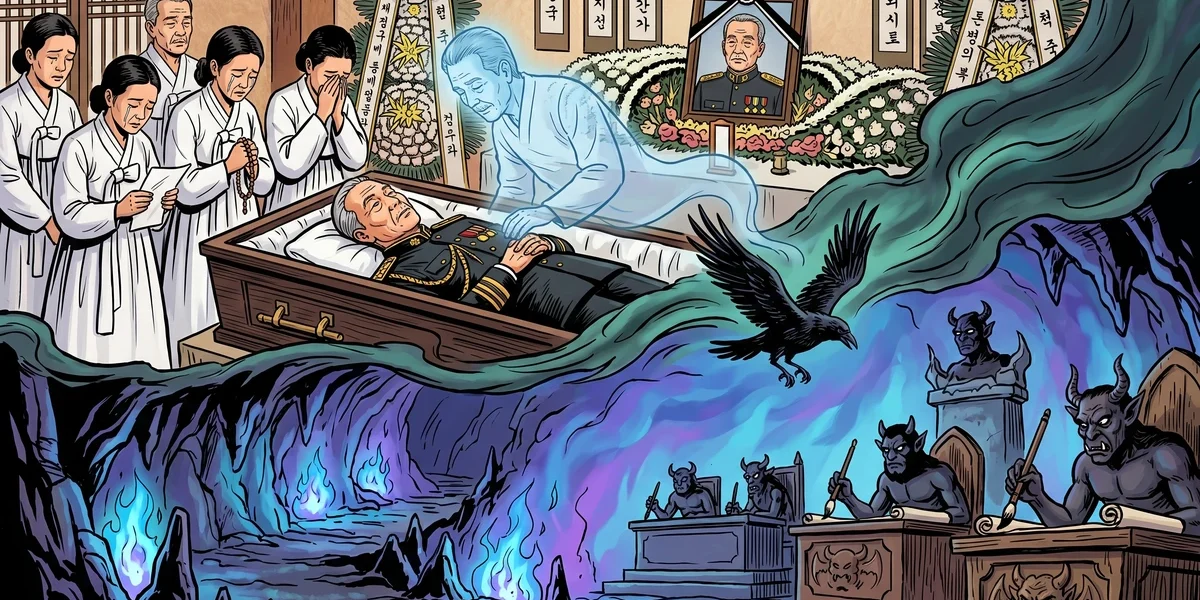
The Ledger That Does Not Lie
Among the most distinctive genres in Korean folk literature is the jeoseung-yagi — the underworld story — in which a living person, through death-like illness or spiritual displacement, descends into jeoseung (저승), the Korean realm of the dead, and returns with knowledge unavailable to those who have not crossed the threshold. These narratives share a common architecture: the traveller witnesses the court of Yeomra-daewang (염라대왕), the great king of the dead, where every life is examined against a meticulous record and assigned its appropriate outcome. What the traveller observes, invariably, is that this accounting system runs on entirely different values than the visible prestige hierarchy of the living world.
The story of Hong’s experiences in hades belongs to this tradition. Hong — a man of some standing in his community, accustomed to the deference that education and status commanded in Joseon society — finds himself transported, through severe illness, into jeoseung. What he witnesses there reorganises everything he understood about moral worth.
Beat I — Arrival at the Hall of Reckoning
Hong’s passage into jeoseung follows the classic Korean pattern: he is brought not by his own will but by official summons, conducted by spirit-messengers who carry the orders of Yeomra-daewang. The underworld he enters is not chaos or fire but a bureaucratic apparatus — organised, systematic, and relentlessly thorough. There are halls for different categories of the dead, officials who consult ledgers, scribes who have recorded every act of every life with a precision no earthly archive could match.
The ledger is the central symbol. Korean underworld tradition, shaped by the convergence of indigenous shamanic belief with Buddhist and Taoist afterlife cosmologies introduced from China, imagined the dead’s moral record as a literal document maintained from birth. Nothing escapes it: not the small cruelties muttered under the breath, not the generosity performed only when observed, not the patient kindness extended in private to those who could offer nothing in return. The ledger records the actual moral texture of a life rather than its public reputation.
Hong, standing in line with other recently dead souls, watches as case after case is called. He had expected the proceedings to reflect something like the Joseon order he knew — officials and scholars accorded weight, their accumulated prestige and learning carrying influence even here. What he sees instead begins to unsettle him.
Beat II — The Inversions Hong Witnesses
A prominent magistrate is called first. In life this man had commanded public respect, dispensed justice from an elevated bench, and been the subject of commemorative steles erected in his district. The ledger that Yeomra-daewang’s officials consult tells a different story: the magistrate had accepted bribes in a land dispute, had allowed a false witness to go unchallenged because the true testimony would have embarrassed a powerful friend, and had habitually humiliated servants in private in ways that never became public knowledge. His public career as a dispenser of justice is weighed against his private conduct as a man, and the private conduct is heavier. He is assigned accordingly.
A woman of no particular public distinction is called next. In life she had been a farmer’s wife — anonymous in the social registers that tracked Joseon prestige, remembered by no stele, cited in no official document. The ledger reveals a different accounting: she had fed wandering monks during three consecutive droughts when her own family ate less, had taken in two orphaned children of a neighbour who died of fever, and had never once spoken unkindly to her mother-in-law despite sustained provocation across thirty years. Yeomra-daewang’s court notes each entry with care. She is assigned accordingly — and her destination is considerably more comfortable than the magistrate’s.
Hong watches more cases. A renowned scholar whose commentaries on the classics circulated across the kingdom: the ledger notes a lifetime of intellectual achievement but also a pattern of using that achievement as a shield against accountability — a scholar who treated his actual human relationships with less care than he lavished on ancient texts. A market vendor of no education: the ledger notes small daily acts of fairness — correct measure, honest weight, the occasional extra given to a customer who was clearly hungry — maintained without drama across forty years of commercial life. The pattern that emerges is consistent. The jeoseung accounting system is indifferent to status, indifferent to reputation, indifferent to public achievement except insofar as achievement was used to help or harm actual people. It cares about the texture of daily conduct: how one treated those who could not retaliate, how one behaved when no one of consequence was watching.
Beat III — The Logic of Jeoseung Accounting
The inversions Hong witnesses follow a coherent logic that the narrative is at pains to articulate. Joseon society organised its prestige hierarchy around visible markers: examination success, official appointment, scholarly reputation, noble lineage. These markers conferred honour publicly and shaped how a person’s life was evaluated by contemporaries. The problem the jeoseung narrative exposes is that these markers are proxies for virtue rather than virtue itself, and imperfect proxies at that. Examination success measures a certain kind of disciplined intellectual capacity; it says nothing about whether that capacity was deployed with care for others or in service of one’s own advancement. Official appointment creates the opportunity to exercise power justly or unjustly; the appointment itself is morally neutral.
Yeomra-daewang’s ledger bypasses the proxies and examines the underlying reality. This is why domestic virtues — patience with difficult family members, kindness to servants, honesty in private transactions — weigh so heavily in jeoseung accounting. These are precisely the virtues that Joseon’s public prestige system did not measure and could not reward. A man could be publicly honoured and privately monstrous. The public honour would not transfer to jeoseung. The private monstrous conduct would be there in the ledger, in full.
The Korean underworld story differs from similar traditions in other cultures in its emphasis on the mundane and domestic. Chinese underworld narratives often feature spectacular punishments keyed to specific sins — the vivid torments of the Ten Kings of Hell. Japanese ghost-narrative traditions tend to focus on unresolved emotional attachments. Korean jeoseung stories are more bureaucratic and more interested in the aggregate of ordinary conduct. The question is not “did you commit a great sin?” but “across the ten thousand small decisions of daily life, did you lean toward generosity or toward cruelty, toward honesty or toward convenience?”
Beat IV — Hong’s Return and What He Carries Back
Hong is eventually informed that his summons was an error — it is not yet his time — and he is returned to his body and his life. He recovers from his illness to find himself in possession of knowledge that changes his daily conduct permanently. He becomes less interested in the markers of public prestige that previously organised his ambitions, and more attentive to the texture of his private behaviour. How he speaks to his servants. Whether he gives fair measure in small transactions. Whether he is patient in the moments when no one of consequence is observing him.
His neighbours find him changed — quieter, less concerned with ceremony, unexpectedly generous in small ways. When asked what happened to him during his illness, Hong tells what he saw. The story becomes a teaching, passed from household to household: that the reckoning comes, that it is meticulous, and that it is conducted on entirely different terms than the visible prestige system of the living world.
The story’s moral force derives from this return. Hong does not emerge enlightened in an abstract spiritual sense; he emerges with a corrected set of priorities grounded in observed evidence. He has seen the ledger. He knows what it records. The knowledge is not mystical but practical: the underworld has showed him, with bureaucratic precision, exactly which of his daily choices will matter at the final accounting.
“Yeomra-daewang does not read commemorative steles. He reads the ledger that was kept while no one was watching.” — Korean folk saying
The lasting power of the Hong story lies in its democratic moral vision. The jeoseung accounting system is the great leveller: it cannot be influenced by status, bribed by prestige, or confused by reputation. It operates on evidence that is not available to the living world’s evaluative systems but is, in retrospect, the most important evidence there is — the evidence of how a person actually treated other people across the thousand unremarked moments of an ordinary life. The story asks its listeners to imagine themselves before that ledger and to consider, honestly, what it would say. The answer to that question is the story’s real lesson.
Frequently Asked Questions
What is the moral of Hong’s Experiences In Hades?
The moral is that the moral accounting of the afterlife operates on entirely different criteria than the prestige hierarchies of the living world. The jeoseung ledger weights private kindness, domestic honesty, and daily generosity — virtues invisible to Joseon’s public reputation system — far above official achievement or scholarly renown achieved without corresponding private virtue. To live well, in the story’s terms, means attending to the small unrewarded acts of care rather than to the visible markers of status.
What happens in Hong’s Experiences In Hades?
Hong, a man of some social standing, is transported through severe illness into jeoseung, the Korean underworld. He witnesses the court of Yeomra-daewang, where the lives of the recently dead are examined against meticulous ledgers. He watches prominent magistrates and scholars fare poorly when their private conduct is weighed, while humble farmers’ wives and market vendors whose private lives were characterised by sustained small generosities fare well. Informed that his summons was an error, Hong is returned to life transformed: less interested in public prestige, more attentive to the daily texture of his private behaviour.
What is jeoseung in Korean belief?
Jeoseung (저승) is the Korean term for the realm of the dead — the afterlife domain through which souls pass after death and in which their lives are judged. It is presided over by Yeomra-daewang (the king of the underworld, adapted from the Indian-Chinese tradition of Yama/Yanluo). Korean jeoseung tradition imagines it as a bureaucratic apparatus with courts, officials, and ledgers, heavily shaped by Buddhist karma concepts but retaining indigenous shamanic elements. It is distinct from any simple conception of heaven or hell, functioning more as a moral accounting system than a place of eternal reward or punishment.
Why do Korean underworld stories emphasise domestic and private virtue?
Korean underworld narratives consistently weight domestic and private virtues — patience, small generosities, honesty in private transactions — because these are precisely what the living world’s prestige system cannot see or reward. Public reputation in Joseon was built through examination success, official appointment, and scholarly recognition — none of which required, or even measured, how one behaved in the unobserved moments of domestic life. The jeoseung ledger compensates for this blind spot by recording exactly what public systems miss. The emphasis is also a form of social critique: it suggests that Joseon’s visible hierarchy is a poor guide to actual moral worth.
How does this story compare to other Asian underworld narratives?
Korean jeoseung stories share the bureaucratic afterlife court framework with Chinese underworld narratives (the Ten Kings of Hell) but differ in emphasis: Chinese versions often feature vivid, specific torments keyed to particular sins, while Korean versions are more interested in the aggregate of ordinary conduct across a lifetime. Japanese underworld themes in literature tend toward unresolved attachment and emotional haunting rather than formal accounting. Indian traditions emphasise karma as accumulated across multiple lifetimes rather than a single life’s ledger. Korean jeoseung accounting is distinctive in its attention to the mundane, the domestic, and the unrewarded — the moral texture of daily life rather than its dramatic peaks.
You May Also Like
 Korean Folk Tales
All Ages
Korean Folk Tales
All Ages
The Great Stone Fire Eater
The Great Stone Fire Eater: Ages ago, there lived a great Fire Spirit inside of a mountain to the southwest of Seoul, the capital of Korea. He was always
 Korean Folk Tales
All Ages
Korean Folk Tales
All Ages
The Voice Of The Bell
The Voice Of The Bell: When Tai Jo, the great general and first King of Korea, founded a new dynasty, he moved the capital near the great river Han and
 Korean Folk Tales
All Ages
Korean Folk Tales
All Ages
Old Timber Top
In Kang Wen, River Meadow province, forest fairies and Old Timber Top teach that greed and the desire to conquer nature lead only to loss and destruction.