The King Of The Sparrows
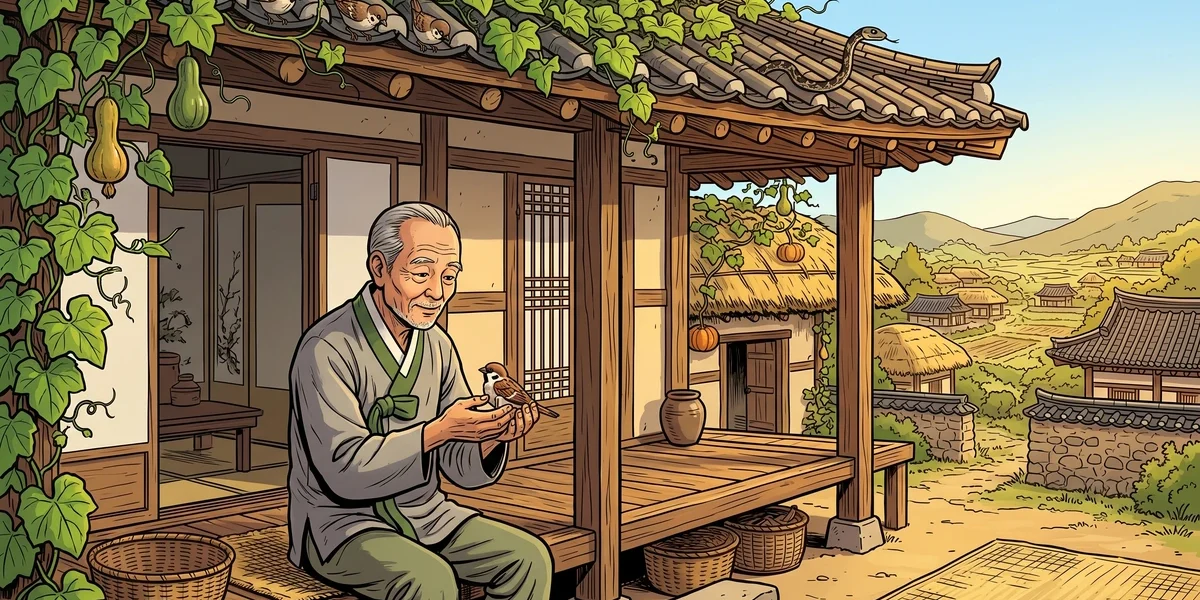
The King Of The Sparrows: The Korean children are awakened every morning by the twittering of the sparrows. These little birds build their nests among the
Origin & Tradition
“The King of the Sparrows” belongs to the extensive corpus of Korean animal fables in which the social and political life of bird communities mirrors, with comic or instructive distortion, the concerns of human communities. The sparrow (chamsae, 참새) occupies a specific symbolic position in Korean folk culture: it is the common bird par excellence, associated with village life, communal chatter, and the ordinary texture of agricultural existence. Unlike the crane (hak, 학), which represents scholarly longevity and aristocratic refinement, or the magpie (kkachi, 까치), which represents good news and auspicious communication, the sparrow represents the undifferentiated mass of ordinary people going about ordinary business. A story about the selection of a sparrow king is therefore necessarily a story about leadership among equals—the specific challenge of identifying genuine capacity for governance within a community where no member possesses the obvious external markers of distinction that make leadership recognition easy in hierarchical systems. The story asks a question that human communities perpetually face: when everyone looks roughly the same, how do you find the one who should lead?
Beat I — The Problem of Selection
The sparrow community is large, busy, and contentious. Decisions must be made about where the flock forages, how it responds to predators, and how disputes over nesting sites and food access are adjudicated. Without some recognized authority, the community’s energy goes into internal argument rather than external survival, and internal argument in the presence of hawks is a fatal luxury. The sparrows convene to select a king.
The difficulty is immediately apparent: every sparrow looks like every other sparrow. There are no obvious candidates. One elder sparrow proposes selection by age, but several sparrows of roughly equal age present themselves and cannot agree on precedence. Another proposes selection by size, but the size differences among adult sparrows are negligible and measurement produces only more argument. A third proposes selection by voice—the one who chirps most vigorously should lead—and this proposal produces the most argument of all, since every sparrow is confident in the vigor of its own voice and the inadequacy of everyone else’s. By evening, the community is more contentious than when it started, and still without a leader.
Beat II — The Test of Willingness
An old sparrow who has been listening from a branch above the assembly descends and offers a different approach. The community faces a specific and immediate problem: a cat has been stalking the flock’s primary foraging ground for three days, taking a sparrow each morning before the flock fully wakes and organises a response. The solution is known to everyone—a sparrow must fly close enough to the cat at dawn to sound the alarm before the cat strikes, giving the flock time to scatter. This is dangerous: it requires flying within the cat’s reach before the cat has committed to a strike, and the alarm-sparrow’s escape is not guaranteed. Everyone knows this needs to be done. No one has volunteered.
The old sparrow proposes that the king of the sparrows be whichever sparrow volunteers to serve as alarm-bird the next three mornings. Not whichever sparrow is most impressive or most vocal, but whichever sparrow is willing to absorb the community’s risk so that the rest can forage safely. The assembly goes quiet. Then one sparrow—smallish, not particularly distinguished in appearance or voice—steps forward and says it will do it.
The next three mornings, that sparrow positions itself near the cat’s approach point before dawn. Twice it sounds the alarm in time and escapes. On the third morning, the cat changes its approach and the sparrow barely escapes, losing a tail feather in the attempt. On the fourth morning, the cat does not come; apparently the alarm pattern has made this foraging ground too costly. The community forages in peace. When they gather that evening, there is no debate about who should be king.
Beat III — Service as the Basis of Democratic Authority
Korean folk political thought, particularly in the tradition of the minyo (민요, folk song) and minsok (민속, folk custom) that expressed the values of the agricultural commoner class rather than the Confucian elite, developed a distinctive conception of leadership authority that differed importantly from the hierarchical model of the official class. In the Confucian model, authority derived from education, examination success, and the moral cultivation associated with the gunza (君子) ideal—qualities that were, in practice, strongly correlated with hereditary social position. In folk tradition, authority derived from service: specifically, from the willingness to absorb costs and risks that the community as a whole needed absorbed but that no individual wanted to absorb alone.
This is the principle the old sparrow articulates and the alarm-sparrow demonstrates. The community’s need for an alarm-bird is genuine and urgent. The benefit of having it performed goes to everyone. The cost of performing it falls on one. The person who voluntarily accepts that asymmetry—who takes individual risk in exchange for collective benefit—has already performed the defining function of leadership before any title is conferred. The title of king is not what makes the alarm-sparrow a leader; the alarm-sparrow becomes a leader through the act of stepping forward, and the title is simply the community’s recognition of what has already occurred.
This conception of leadership-as-service rather than leadership-as-status is not unique to Korean folk tradition—it appears across cultures—but the Korean version has a specific emphasis on the moment of voluntary cost-absorption as the decisive event. The selection criterion is not what the candidate claims to be able to do for the community; it is what the candidate actually does when the community needs it done and no one else is doing it. Claim is easy; action under cost is the only reliable evidence of genuine commitment.
Beat IV — The Moral and Its Reach
The newly recognized king of the sparrows continues to perform alarm-bird duty for several seasons, eventually training younger sparrows to take turns at the role. The community stabilises around this function: it is understood that the king is the sparrow currently performing the most dangerous necessary service, and that any sparrow who takes on that service is thereby performing the function of a king regardless of whether a formal assembly has confirmed the title. Leadership has been detached from title and re-attached to action.
The tale’s moral operates at two levels. The obvious level is about the nature of genuine leadership: it is service, not status, and it is demonstrated through voluntary acceptance of disproportionate cost rather than through impressive performance in safe conditions. The subtler level is about how communities of equals should organise their selection processes: not by measuring beauty, voice, or size—all of which generate argument without resolution—but by identifying the specific costly service the community needs performed and watching to see who performs it. This is a selection criterion that cannot be gamed by the clever or the self-promoting, because it requires actual performance rather than the management of appearance.
“The sparrow who warned the flock while the cat was still watching did not ask to be called king; the flock simply found itself following a sparrow who was already where a king should be.”
— Korean proverb associated with chamsae (sparrow) folk narratives
Why This Story Has Lasted
“The King of the Sparrows” endures because it offers a genuinely useful answer to one of the most persistent practical problems of community life: how to identify leadership capacity that is not correlated with physical dominance, inherited status, or rhetorical skill. All three of those easily observable proxies for leadership quality are unreliable—history is full of dominant, high-status, eloquent leaders who were disastrous—and the story’s folk wisdom offers a more reliable criterion that is also harder to fake: watch who steps forward when the cost is real and no one else is moving. The sparrow community’s solution to the cat problem is both a survival strategy and a selection mechanism, and the convergence of those two functions is the story’s structural elegance.
Korean Sparrow Symbolism and Animal Fable Tradition
The sparrow (chamsae, 참새) in Korean folk culture carries rich associations with communal life, agricultural rhythms, and the social world of ordinary people. Sparrow behavior—their constant chattering, their communal foraging, their quarrelsome nesting habits—made them natural subjects for fables about community governance. The Korean animal fable tradition, overlapping with the pansori (판소리) vocal narrative tradition and the talchum (탈춤) mask dance theater, used animal communities as satirical mirrors for human social arrangements, frequently targeting the gap between claimed authority and genuine service. The sparrow fable tradition in particular tended toward democratic rather than hierarchical resolutions: in a community of birds who are all essentially equal, claims based on superiority of kind were inherently comic, and the resolution that the flock found naturally compelling was almost always based on demonstrated service rather than asserted distinction.
Frequently Asked Questions
- What is the moral of “The King of the Sparrows”?
- That genuine leadership among equals is not conferred by obvious markers of distinction but earned through voluntary acceptance of the community’s necessary costs. The sparrow who steps forward to serve as alarm-bird—absorbing individual risk so the community can forage safely—is already performing the function of a leader. The title follows the action; it does not create the quality.
- What happens in “The King of the Sparrows”?
- A sparrow community struggles to select a king because no selection criterion based on appearance, age, or voice can resolve their argument. An old sparrow proposes a different criterion: whoever is willing to serve as alarm-bird near the cat that has been taking sparrows each morning shall be king. One small, undistinguished sparrow volunteers, performs the dangerous service successfully for three mornings (losing a tail feather on the third), and drives the cat away. The community recognizes this sparrow as their king without further debate.
- What does the sparrow represent in Korean folk culture?
- The sparrow (chamsae, 참새) represents the ordinary commoner—the undifferentiated member of the agricultural village community whose life is shaped by communal rhythms and shared concerns rather than individual distinction. Unlike prestige birds such as the crane or the phoenix, the sparrow has no elevated symbolic associations; it is simply the most familiar bird of ordinary village life, which makes it the natural vehicle for stories about the governance of communities of equals.
- Why does the old sparrow’s criterion work when others fail?
- Because it is not a measurement but a test. Criteria based on age, size, or vocal vigor require comparison and produce argument because comparison involves subjective judgment. The alarm-bird criterion requires performance under genuine cost, which is self-selecting: only someone who actually intends to do the work will volunteer, and only someone who actually does the work will demonstrate the quality the title is meant to recognize. It eliminates the gap between claim and performance that made all the other criteria argumentative.
- How does this story relate to Korean concepts of communal obligation?
- Korean agricultural village culture developed a strong ethic of communal mutual obligation expressed in practices such as dure (두레, collective farm labor) and gye (계, rotating credit associations). These institutions rested on the premise that community survival required individuals to absorb costs and provide labor that benefited the group as a whole. The alarm-sparrow’s willingness to face the cat on behalf of the flock enacts this ethic in its most demanding form: not collective labor-sharing but individual risk-absorption for collective benefit, which is the most stringent test of community commitment that Korean folk culture recognized.
You May Also Like
 Korean Folk Tales
All Ages
Korean Folk Tales
All Ages
Old Timber Top
In Kang Wen, River Meadow province, forest fairies and Old Timber Top teach that greed and the desire to conquer nature lead only to loss and destruction.
 Korean Folk Tales
Ages 6-8
Korean Folk Tales
Ages 6-8
The Resourceful Wife
The Resourceful Wife: In the last year of Yon-san terrible evils were abroad among the people. Such wickedness as the world had never seen before was ’s quick
 Korean Folk Tales
Ages 9-12
Korean Folk Tales
Ages 9-12
A Visit From The Shades
A Visit From The Shades: (The story of meeting his mother’s ghost is reported to be of this man.) Choi Yu-won matriculated in 1579 and graduated in 1602