Hyung Bo And Nahl Bo
Hyung Bo And Nahl Bo: OR, THE SWALLOW-KING’S REWARDS. In the province of Chullado, in Southern Korea, lived two brothers. One was very rich, the other very

Two Brothers and the Question of Why
The tale of Heungbu and Nolbu — known across Korea as one of the pansori classics and beloved in virtually every village storytelling tradition — appears at first glance to be a simple story about a good younger brother and a greedy elder brother, their encounters with a grateful swallow, and the very different contents of the gourds the swallow’s seed produces for each of them. But the story’s moral precision is considerably greater than this summary suggests. It hinges on a distinction that Korean folk tradition understood as fundamental: the difference between an act performed from genuine feeling and an act performed to obtain an outcome.
When Heungbu splints the swallow’s broken leg, he is not calculating reward. He is moved. The action flows from sunjong (순정) — pure or uncalculated feeling — and from the broader disposition of jeong (정), the deep relational warmth that Korean culture identifies as the foundation of genuine human connection. When Nolbu later breaks a swallow’s leg specifically to recreate the conditions that produced Heungbu’s reward, he performs an act that resembles Heungbu’s in every external particular. The natural world, the story insists, is not deceived. The gourd knows why the leg was broken.
Beat I — The Brothers and What Divided Them
Heungbu and Nolbu are the sons of a once-prosperous family. Their father’s death leaves the estate in the control of Nolbu, the elder brother, who exercises that control through hoarding and exclusion. He drives Heungbu — gentle, feckless, surrounded by hungry children — from the family compound without inheritance or support. Heungbu’s poverty is genuine and grinding. He tries and fails at various livelihoods. His household skirts starvation.
The difference between the brothers is not framed in the narrative as a difference in intelligence or social status. Nolbu is clever; he manages the estate shrewdly. The difference is motivational and dispositional. Nolbu relates to the world primarily through calculation — what can be extracted, retained, used. Heungbu relates to the world through feeling — what draws his care, what moves his sympathy, what he cannot leave unattended when it is suffering. This difference in orientation is established before the swallow appears. It is the precondition for everything that follows.
In versions of the pansori “Heungbuga” — the operatic form in which this story was also performed — Heungbu’s goodness is depicted not as strategic virtue but as something almost involuntary. He cannot help feeding a beggar when he has little himself. He cannot help feeling distress at a suffering creature. His generosity is not a calculated investment in moral credit; it is his nature, operating before deliberation.
Beat II — The Swallow and the Gourd
One spring day a swallow falls from her nest, her leg broken. Heungbu finds her, feels the characteristic pull of his nature, and splints the leg with careful strips of cloth. The swallow recovers and departs south for the winter. The following spring she returns, carrying a single gourd seed. Heungbu plants it. The vine that grows from it produces enormous gourds that, when cut open, yield not vegetable matter but wealth: rice, cloth, gold, carpenters and tools who build Heungbu a fine house. Heungbu’s poverty ends, suddenly and completely, through the operation of what the story presents as natural gratitude working through a natural medium.
When Nolbu hears of this — and the news of Heungbu’s transformed circumstances travels quickly — his response is not wonder but calculation. He identifies the operative sequence: swallow with broken leg, splint, departure, seed, gourd, wealth. He replicates the sequence deliberately: he catches a swallow and breaks its leg, splints it, releases it. He waits. The swallow returns with a seed. Nolbu plants it with considerable anticipation.
The gourds that grow from Nolbu’s vine are also enormous. But when he splits them open, what emerges is not wealth but punishment calibrated to his offences: a torrent of muddy water, crowds of debt collectors presenting bills he cannot pay, demons who destroy his compound, supernatural forces that reduce him to precisely the destitution he had inflicted on Heungbu. The external sequence was identical. The internal reality was entirely different. The gourd, in the story’s moral logic, reads both.
Beat III — Sunjong and the Limits of Mimicry
The distinction the Heungbu-Nolbu story draws between genuine compassion and its imitation connects to a deep current in Korean moral thinking. The concept of sunjong — pure, uncalculated feeling — and the related concept of seong (성, sincerity or authenticity) hold that the moral quality of an act is inseparable from the motivational state that produces it. An act of care performed from genuine concern is a different kind of act, at the level of its moral reality, than the same action performed as a strategy for obtaining reward. They may be externally indistinguishable. They are internally — and cosmically — distinct.
This position has significant implications for the story’s moral logic. Nolbu’s error is not that he performed an action similar to Heungbu’s. His error is that his action was, in its actual nature, a different kind of action entirely. He did not help a wounded creature; he created a wounded creature in order to obtain access to a mechanism he had observed producing wealth. The form was that of compassion. The substance was instrumental violence. When the gourd responds differently to each brother, it is not violating any principle of fairness; it is responding to the actual nature of what each man did.
Korean folk tradition embeds this distinction in numerous stories: the grateful animal who returns a favour and the impostor who tries to replicate the favour-earning situation through deliberate staging. In each case the natural world — whether represented by animal, spirit, or gourd — reads through the surface to the motivational substrate. This represents a folk-philosophical position about the nature of virtue: it cannot be performed successfully without being actual. The performance without the actuality is detectable, eventually, by the world through which one moves.
The sibling structure of the narrative adds another layer. Nolbu’s original wrong — driving Heungbu from the family compound — is a violation of the elder sibling’s duty of care. In Confucian family ethics, the elder brother’s obligation to the younger is not merely a social convention but a moral relationship constitutive of both their identities. Nolbu’s violation of this relationship established his motivational character long before the swallow appeared. The swallow episode is in one sense just the most recent and most legible instance of a character already formed.
Beat IV — Restoration and What It Means
The story’s resolution moves beyond simple retribution. Heungbu, despite receiving the punishment Nolbu’s gourds inflict, does not abandon his brother. He shares his own recovered wealth with the ruined Nolbu, extending the same uncalculated generosity that characterises all his dealings. This final gesture completes the story’s moral argument: sunjong is not a strategy that Heungbu deploys when it seems advantageous. It is his consistent orientation, exercised even toward someone who has wronged him profoundly. The consistency is what makes it genuine.
Heungbu and Nolbu remain the most recognisable sibling archetypes in Korean folk culture — referenced in proverbs, deployed in daily speech as character types, and revisited repeatedly in contemporary fiction and drama. The story’s longevity rests not on the magic of gourds but on the accuracy of its psychological portrait: the particular quality of calculative intelligence that mistakes the form of virtue for its substance, and the particular quality of genuine feeling that cannot quite help being what it is even when it would be strategically advantageous to be otherwise. These are recognisable human types in every era, and the story’s verdict on them is consistent and clear.
“The swallow knows why you healed her. She has always known. The gourd she brings you knows too.” — Korean folk saying on Heungbu and Nolbu
The lasting lesson of Hyung Bo and Nahl Bo is not that kindness is rewarded — though in the story it is. It is that the natural and moral order responds to what is actually present in an act rather than to its outward form. Genuine compassion and the strategic performance of compassion may look identical from the outside. They produce different gourds. Korean folk wisdom, in this story, proposes that the world is ultimately discerning enough to tell the difference — and that building one’s life on the assumption that mimicry is sufficient is the most expensive mistake a person can make.
Frequently Asked Questions
What is the moral of Hyung Bo And Nahl Bo?
The story’s central moral is that the natural and cosmic order responds to the genuine motivational state behind an act, not its external form. Heungbu’s compassionate care for the swallow flows from genuine feeling; Nolbu’s imitation of that care is an instrumental strategy for obtaining reward. The different contents of their gourds represent the world’s ability to distinguish between these two fundamentally different kinds of action. Genuine virtue cannot be successfully mimicked; the mimicry eventually reveals itself through its consequences.
What happens in Hyung Bo And Nahl Bo?
Generous Heungbu is driven from the family home by his greedy elder brother Nolbu with no inheritance. Poverty-stricken, Heungbu finds and heals a swallow with a broken leg. The swallow returns the following spring with a gourd seed; Heungbu’s gourd yields treasure and transforms his fortunes. Nolbu, learning of this, deliberately breaks a swallow’s leg to recreate the sequence. His gourd also grows enormous — but its contents punish him with debts, demons, and destruction, reducing him to the destitution he inflicted on Heungbu. Heungbu, true to his character, shares his wealth with his ruined brother.
What does the swallow represent in this story?
The swallow in Korean folk tradition is an auspicious bird associated with spring, renewal, and the carrying of fortune between the human and natural worlds. In the Heungbu-Nolbu story she functions as the mediating figure between human moral conduct and cosmic response: the agent through whom genuine compassion is recognised and rewarded, and through whom calculated cruelty is exposed and corrected. Her ability to return with a seed that produces different results for different brothers encodes the story’s central claim: that the natural world is morally discerning, not merely mechanically responsive to surface behaviour.
Why is this story told through siblings rather than unrelated characters?
The sibling relationship intensifies the moral contrast by setting it against a background of shared origin and obligatory kinship. Nolbu and Heungbu had the same father, the same household, the same inheritance. Their divergent characters are therefore not explainable by circumstance — they reflect genuine dispositional difference. The elder-younger sibling dynamic also engages Confucian ethics directly: Nolbu’s original wrong is a violation of the elder brother’s duty of care, establishing his moral character before the swallow appears. His later imitative action confirms rather than reveals a character already formed by the prior betrayal.
How has the Heungbu-Nolbu story influenced Korean culture?
Heungbu and Nolbu are among the most widely recognisable character archetypes in Korean cultural memory, functioning in daily speech as shorthand for generous-natured and grasping-calculating personality types respectively. The story exists in oral folk tale, literary pansori opera, children’s picture book, animated film, and television drama forms. Its emotional range — from comedy in Nolbu’s pompous greed to pathos in Heungbu’s dignity amid poverty — has made it resilient across changing media and audiences. Contemporary Korean literature and social commentary continue to invoke Heungbu-Nolbu as a frame for discussions of inequality, fraternal obligation, and the relationship between character and fortune.
You May Also Like
 Korean Folk Tales
Ages 6-8
Korean Folk Tales
Ages 6-8
The Resourceful Wife
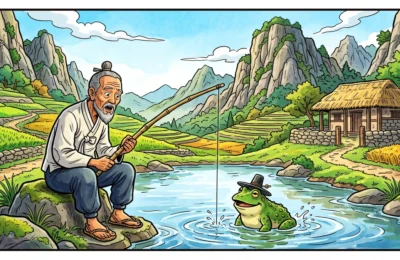
The Resourceful Wife: In the last year of Yon-san terrible evils were abroad among the people. Such wickedness as the world had never seen before was ’s quick
 Korean Folk Tales
All Ages
Korean Folk Tales
All Ages
A Frog For A Husband
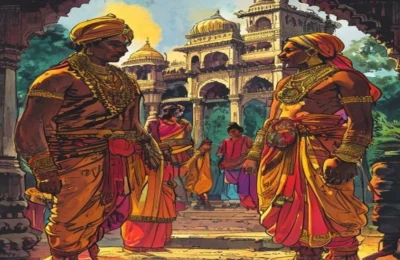
A Frog For A Husband: Off in a valley among very stony mountains, lived an old farmer named Pak We and his wife. His land was poor and he had to toil from
 Korean Folk Tales
Ages 6-8
Korean Folk Tales
Ages 6-8
The Tiger and the Dried Persimmon: Courage Found in Unexpected Places
The Tiger and the Dried Persimmon: Courage Found in Unexpected Places - a folk tale retold for young readers with a clear moral, simple words, and the...