The Unmannerly Tiger
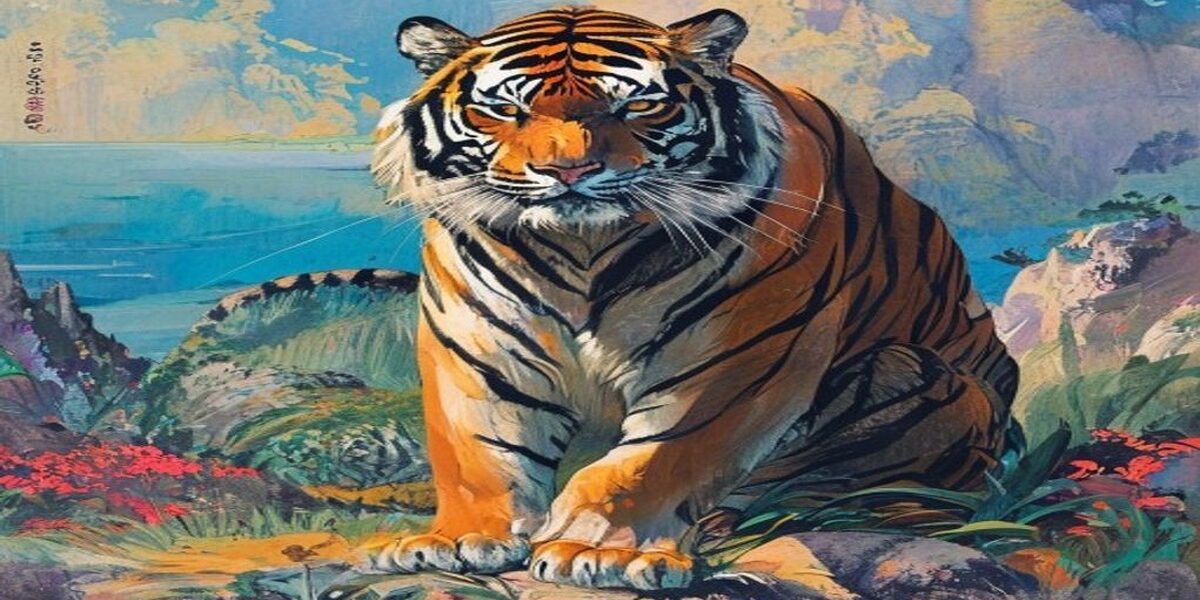
The Unmannerly Tiger: Mountain Uncle” was the name given by the villagers to a splendid striped tiger that lived among the highlands of Kang Wen, the long
Origin & Tradition
The tiger (호랑이, horangi) occupies a position in Korean folk culture without close parallel: simultaneously the most feared predator in the Korean mountain landscape and a figure of deep spiritual ambivalence — associated with mountain deities, shamanic power, and the raw force of nature that both threatens and protects human communities. Korean folk tales involving tigers are among the most numerous and varied in the entire corpus, ranging from cautionary tales about nature’s violence to comic tales where the tiger’s elemental directness makes it the inadvertent critic of human social hypocrisy. “The Unmannerly Tiger” belongs to the latter tradition: tales in which the tiger’s refusal to observe social convention produces, through friction against human custom, a form of folk wisdom that more polished narrators cannot deliver. These stories were particularly prevalent in rural mountain communities of the Gyeonggi and Gangwon highland regions.
Beat I — The Tiger Who Would Not Bow
The tiger came down from the mountain at the season of the ancestral rites, when proper ceremony was at its most elaborate and the village’s social hierarchies were being most visibly performed: senior households receiving deference from junior ones, the educated from the unlettered, the wealthy from those dependent on their continued goodwill. The accumulated propriety of a community performing itself for itself was at its most concentrated.
The tiger did not bow. In Korean social life, the formal greeting — its depth calibrated precisely to relative status, its timing governed by elaborate convention — was not merely courtesy but a statement of social reality. To not bow was to refuse to participate in the system by which the village constituted itself as a social order. The tiger’s failure was therefore not a simple lapse of manners but a structural challenge: the presence of a being that the system of courtesy had no way to incorporate.
The headman confronted the tiger with the formal language of Confucian reproof. He cited the principles of appropriate conduct, the obligations that all beings sharing a space incurred toward one another, the importance of maintaining the forms through which community cohesion was expressed. The tiger listened with an expression witnesses later described, with the imprecision of people trying to describe something without adequate category, as polite attention. Then the tiger said what it thought.
Beat II — What the Tiger Saw
The tiger did not speak in the elaborate hedged language that Korean social convention required — language that softened every observation through layers of deference until the original perception was barely legible. The tiger spoke in the mode of mountain reality, where the question was always simply: what is true?
The tiger observed that the headman’s elaborate ceremony for the ancestors was conducted with great attention to form and very little apparent connection to any actual memory of the ancestors themselves — that the ritual gestures were being performed not as communication with the dead but as performance for the living, specifically for the assembled community whose assessment of the headman’s piety was bound up with his social position. The tiger noted that the man seated in the lowest position at the ceremony — a distant relative of no current economic significance — had wept during the ancestral invocation in a way that suggested genuine grief, while the men in the highest positions maintained the controlled composure of people managing impressions rather than feeling loss.
The tiger then said it had eaten a man from this village the previous year — a man traveling alone through the mountain pass at nightfall — and that the man had, in the moment before the tiger caught him, been speaking to himself about things he could not say to anyone in the village: his resentment of his older brother, his fear that he had wasted his life in deference to people who would never reciprocate, his private conviction that the village’s elaborate social structure served the people at its top far more than anyone below. The tiger reported this not as confession or apology but as information — as what it had observed of what was true beneath the village’s polished social presentation.
Beat III — The Tiger as Critique of Excessive Ye
Korean Confucian tradition placed ye (예, 禮 — ritual propriety, courtesy, ceremony) among the highest human virtues, the external form through which benevolence and righteousness were made socially operative. This is a genuine insight: forms of conduct matter because they structure the space within which people interact without constant renegotiation. But Korean folk tradition also generated narratives that examined what happens when ye becomes detached from the inner states it was meant to express — when courtesy becomes performance, ceremony becomes display, propriety becomes a tool of social control rather than genuine mutual respect.
The tiger, who has no stake in the social arrangements that ye sustains, functions as the diagnostic instrument for this detachment. The tiger’s unmannerliness is not random but specifically the refusal to participate in social fictions, exposing the gap between the village’s presentation of itself through elaborate courtesy and the actual internal states of the people performing it. In Korean folk philosophical terms, the tiger sees sogimi (속이미, inner true nature) where social convention creates only outward surface.
The headman’s fury at the tiger’s unmannerliness is fury at having the gap between form and reality made visible. His investment in proper ceremony has depended on the community’s collective agreement to treat performance as if it were the thing — to treat elaborate courtesy as if it were genuine regard, ancestral rites as if they were genuine communication with the dead, hierarchy as if it reflected genuine differences in wisdom rather than differences in inherited advantage. The tiger’s refusal to participate in this agreement does not destroy it, but it reveals it as an agreement rather than a fact.
Beat IV — The Moral and Its Endurance
The story does not end with the tiger being punished or reformed. This is crucial. In traditions where transgressive figures ultimately submit to social norms, the social system is affirmed as ultimately correct. The Korean tiger tales of this critical variety do not do this. The tiger withdraws back to the mountain, unimproved and unrepentant, taking its particular quality of perception with it. The village returns to its elaborate ceremony. The gap between form and reality closes back over.
What the tiger leaves behind is not a reformed social order but a memory of having been seen. The man who had wept genuinely at the ancestral rites — sitting in the lowest position, invisible to the village’s formal attention — finds after the tiger’s visit that he is looked at differently, his grief having been named by a witness who had no reason to name it except that it was true. This is the small adjustment the story permits: not transformation of the social structure, but momentary visibility for what the structure normally obscures.
The moral was not a call for abandoning social ceremony — Korean communities understood what social cohesion required. The moral was more targeted: that the forms of ye should periodically be evaluated against the internal states they purport to express, that the person sitting in the lowest position weeping is sometimes the most honest person in the room, and that the capacity to see this — tiger-sight, perception of inner nature without social convention’s distortion — was wisdom that human beings needed to cultivate even if they could not exercise it with the tiger’s complete indifference to social consequence.
“The tiger does not bow, but he does not lie. Which is more respectful — the bow that hides contempt or the directness that makes contempt impossible to hide?”
— Korean folk saying associated with the tiger parable tradition
Why This Story Lasted
Tiger tales of the critical social variety persisted because they provided safe cover for observations that the social system made dangerous to express directly. The tiger could say what the peasant could not say to the magistrate, what the daughter-in-law could not say to the mother-in-law, what the younger son could not say to the household head. By routing these observations through the mouth of a creature that operated outside human social convention, the tale tradition gave communities a way to hear uncomfortable truths without having to assign them to any human speaker who would then be held socially accountable. The tiger’s unreformability — its refusal to ultimately bow and apologize — was the guarantee that the truths it delivered remained in view rather than being buried under compensating contrition.
The Tiger in Korean Folk Culture
No animal occupies more space in Korean folk imagination than the tiger. As the apex predator of the Korean mountain landscape until its effective extinction on the peninsula in the early twentieth century, the tiger was simultaneously a real danger to rural communities and a figure of mythological significance — associated with the mountain deity (산신, sanshin), with shamanic protective power, and with the elemental force that civilization required but could not contain. The tiger’s folk personality in Korean tales is notably complex: sometimes terrifying, sometimes comedic, sometimes wise, always direct in a way that human characters cannot afford to be. The tradition of comic tiger tales — in which the tiger’s complete indifference to human social convention produces instructive effects — is one of the richest in the entire Korean narrative corpus.
Frequently Asked Questions
What is the central moral of “The Unmannerly Tiger”?
The tale teaches that the forms of ritual courtesy (ye) should periodically be evaluated against the internal states they are meant to express, and that the capacity to perceive inner truth without the distortion of social convention — tiger-sight — is a form of wisdom that human beings need to cultivate. The tiger’s unmannerliness is not mere rudeness but a diagnostic instrument that reveals the gap between social performance and genuine regard.
What happens in the story?
A tiger descends from the mountain during the village’s ancestral rites and refuses to bow to the headman. When reproved for improper conduct, the tiger describes what it has actually observed: that the elaborate ceremony is performed for social display rather than genuine ancestral memory, that the man weeping in the lowest position is more honestly connected to the rite than the composed men in the highest positions, and that a village man it had eaten the previous year had spoken, alone in the mountain pass, of resentments and truths the village’s social structure made unsayable within it.
What does sogimi mean and how does it relate to the tiger’s perception?
Sogimi (속이미) refers to the authentic inner nature that lies beneath social presentation — the genuine internal state that elaborate courtesy is both meant to express and, in practice, often conceals. The tiger perceives sogimi directly and reports it without social filtering. Its unmannerliness is specifically the refusal to participate in the collective agreement to treat social performance as if it were inner reality.
Why doesn’t the tiger get punished at the story’s end?
The tale belongs to a tradition of Korean tiger narratives that do not reform or punish the tiger but allow it to return to the mountain unimproved and unrepentant. This unreformability is essential: if the tiger ultimately bowed and apologized, the social system would be affirmed as ultimately correct and the truths it delivered would be buried under compensating contrition. The tiger’s refusal to submit guarantees that its observations remain in view, unretracted.
How does this story relate to Korean attitudes toward social hierarchy?
Korean folk tradition maintained a complex relationship with the Confucian social hierarchy it officially endorsed — generating alongside the official tradition a body of counter-narratives that examined what happened when courtesy became performance and ceremony became social control. The tiger tale tradition was one of the primary vehicles for this critical examination, using the tiger’s natural indifference to human social structure to voice observations that the structure itself made impossible to voice from within. The tale does not advocate for the abolition of hierarchy but for its periodic honest evaluation.
You May Also Like
 Korean Folk Tales
Ages 9-12
Korean Folk Tales
Ages 9-12
The King Of Yom-Na (Hell)
The King Of Yom-Na (Hell): [Pak Chom was one of the Royal Censors, and died in the Japanese War of 1592.] In Yon-nan County, Whang-hai Province, there was a
 Korean Folk Tales
All Ages
Korean Folk Tales
All Ages
The Woodman And The Mountain Fairies
The Woodman And The Mountain Fairies: Over a half thousand years ago there lived in a northern village, near Ping Yang, a wood-cutter named Keel Wee. He owned
 Korean Folk Tales
Ages 9-12
Korean Folk Tales
Ages 9-12
A Bridegroom For Miss Mole
A Bridegroom For Miss Mole: By the river Kingin stands the great stone image, or Miryek, that was cut out of the solid rock ages ago. Its base lies far beneath