Nails in the Fence: An Inspirational Moral Story for Kids
Read the Nails in the Fence story for kids (ages 6+). A boy learns that angry words leave holes—like nails in a fence—even after he says sorry. Moral + FAQ.
Intro
“Nails in the Fence” is a short modern moral parable: a boy with a quick temper, a bag of nails, a wooden fence, and a father who lets the timber teach what lectures cannot. It is short enough for bedtime and clear enough for classroom SEL. The English form that circulates today grew out of late nineteenth- and twentieth-century children’s and temperance readers (later popularised in self-help primers); it is not a traditional Indian folk tale. We keep it here because its lesson—restrain anger (krodha) before speech scars the people you love—matches older South Asian teachings found in the Tirukkuṟaḷ, the Dhammapada, and the Hitopadeśa.
Recommended ages: 6 and up · Read time: about 10 minutes · Tradition: Modern Anglo-American moral parable (honest Modern Moral framing—not ethnographic Indian folk)
Story
Beat I — The Boy With The Quick Tongue
There was once a boy whose temper went off like a starter’s pistol. A toy that would not fit, a younger sister in his chair, a friend’s ball lost in the wrong hedge, a grocer slow with change—anything could set him off. What left his mouth then was not a small tired grumble but a hot flash of speech that left the listener hurting under the skin.
He was not a bad boy. He could be patient with the kitten on his lap and gentle with his grandmother’s hand. But the sharp words came faster than the kindness, and faster than his thinking, and by the time he heard himself it was already too late.
His mother tried first. She talked about manners. She had him write apologies. She kept a jar on the kitchen window where he was meant to drop a coin every time he spoke sharply, hoping the slow fill would teach a slow lesson. The jar filled fast. The lesson did not arrive. Friends began to look away on the lane. His sister learned to flinch. Teachers sent careful notes home.
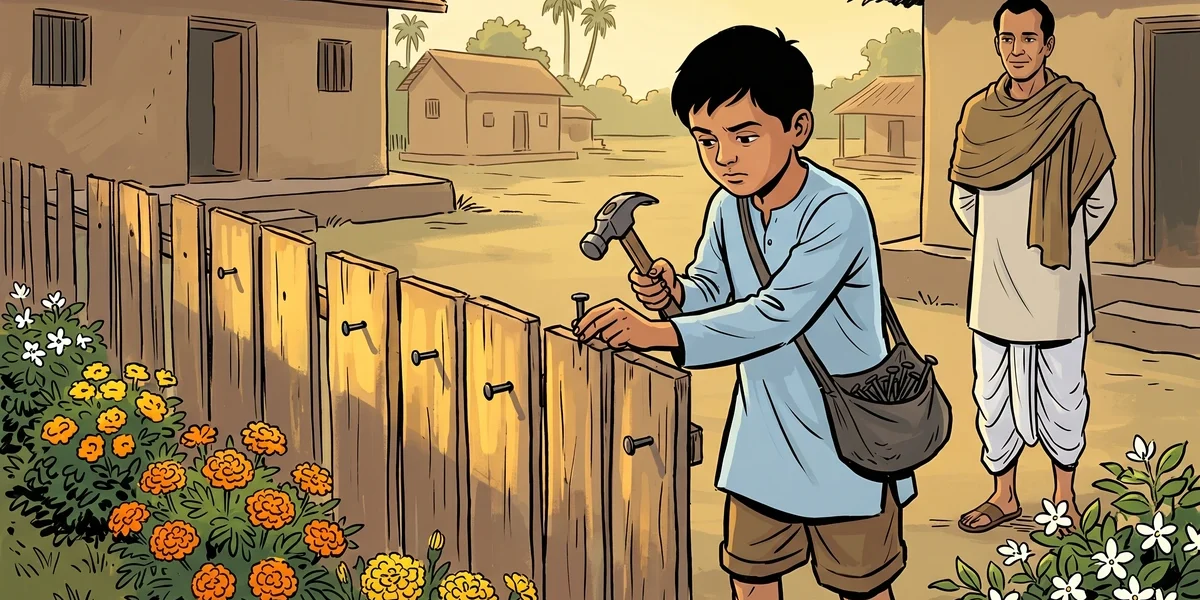
Neighbours, with the long memory small communities keep, left a little space around him at the festival and at Sunday cricket. It was his father who thought of the fence. He was a quiet man who had spent his working life with timber—a carpenter’s son with his own father’s tools—and what he said that morning sounded almost like a joke. He put a small canvas bag of iron nails into the boy’s hand and a hammer on the verandah step.
“When you feel the temper rise,” he said, “do not say the word. Walk to the back fence and drive a nail into the wood. One nail, every time, for every word you wanted to throw. We will see what comes of it.”
Beat II — The Hammer And The Plank
On the first day the boy hammered thirty-seven nails. He kept count because the hammer was heavy and his arm grew tired, and counting gave the work a shape. By supper his shoulder ached and the back fence bristled with cold iron in the soft afternoon light. He fell asleep with the smell of timber and metal still on his palms.
On the second day he drove twenty-eight. On the third, nineteen. By the end of the first week the bag was light enough to lift with one hand. He had begun, without quite noticing, a small calculation: Is this worth the walk? Worth the swing? Worth another scar in the wood? Most of the time, when he stopped to ask, the answer was no. The temper still rose—temper does not vanish because we have noticed it—but now it had to argue against the dull walk and the dull pull of the hammer, and most of the time the temper lost.
One evening, several weeks later, the boy came to the kitchen door and said, very quietly, that he had not put a single nail into the fence that day. The father did not smile. He nodded the way a craftsman nods at work going right.
“Good. Now, tomorrow, you will start to take them out. One nail for every day you do not speak in anger. Pull them slowly. Do not break the heads.”
Beat III — The Slow Withdrawal
Pulling nails from seasoned timber is harder than driving them in. The wood, having closed around the iron, does not let go easily. The claw must be set just so, and the lever must be slow, or the head shears off and the iron stays buried. The boy learned this on the first afternoon, and again when a stubborn nail snapped at the surface and left its body sealed inside the plank where no tool could reach.
He kept at it. A nail a day became, on quiet weeks, two or three; on hard weeks, one pulled with both hands and a knee against the fence. The bag at his side—once full, then empty, now filling again—became a kind of inverted hourglass: a measure not of time spent in anger but of time spent in repair. By the last summer of his boyhood the bag was almost full again, and the back fence stood in the evening light as it had at the start: weathered planks, no iron in sight, wood the colour of old honey.
Almost. A few broken heads and buried bodies remained—perhaps four or five. And all along the planks were the small round holes the nails had left. The wood had not closed over them. Wood does not heal the way skin does. The holes were dark, neat, and permanent, and when the late sun came in low each one caught a small shadow and threw it onto the next plank.
Beat IV — The Holes That Stay
The father came into the garden that evening and stood beside his son for a long time without speaking. Then he asked, in the same quiet voice that had given the first instruction, “Tell me what you see.”
“The fence,” the boy said. He waited. Then: “The fence, but with holes.”
“Yes,” the father said. “Look at it well. You drove the nails in when you were angry. You have pulled most of them out. The fence is standing again. But the holes are there, and they will be there when you are a grown man, and when you are an old man, and when this fence has been pulled down and the planks burned for firewood. The wood remembers. Your friends, your sister, your mother, the grocer at the end of the lane—they are made of softer stuff than wood. The words you drove into them have left holes too. You can ask their forgiveness; you can do them kindness for the rest of your life; you can love them better than you knew how before. But the holes will be there. That is the price the angry tongue pays. Remember it.”
The boy said nothing for a long time. The back fence stood in the cooling air. Behind them the kitchen window glowed, and his mother’s voice called the family in to supper. He walked up the path beside his father very slowly and did not let go of the older man’s hand until they reached the verandah step.
Moral of the Story
Angry words are like nails in a fence: you can pull the nails out and say sorry, but the holes stay. Think before you speak when you are angry.
Cross-Tradition Note
The same teaching appears across older South Asian moral literature:
- Tirukkuṟaḷ (adhigaram on renouncing anger): restraining the anger another’s anger raises in you is the true fruit of learning (sense of kural 305).
- Dhammapada 222 (Kodha-vagga): one who restrains rising anger as one would a runaway chariot is the true charioteer; others merely hold the reins.
- Hitopadeśa (nīti line on krodha): anger is the first enemy that lives inside the body; no fire equals anger.
These Tamil, Pali, and Sanskrit lines say what the father says at the fence: the wound of the angry word outlives the anger that made it. That is why this modern Western exemplum sits honestly beside South Asian anger-restraint teaching—without claiming ethnographic Indian folk origin.
Provenance: The English form is dated to late-19th- and 20th-century American children’s, Sunday-school, and temperance readers, with late-20th-century popularisation through self-help primers. Folklorists treat it as a modern exemplum, not a strict ATU tale-type.