The Disconnect
The Disconnect: Indian weddings are a lavish waste Of energy, time – loans without rhyme Decor, banquet, sumptuous food to taste For uncles, aunts, cousins and
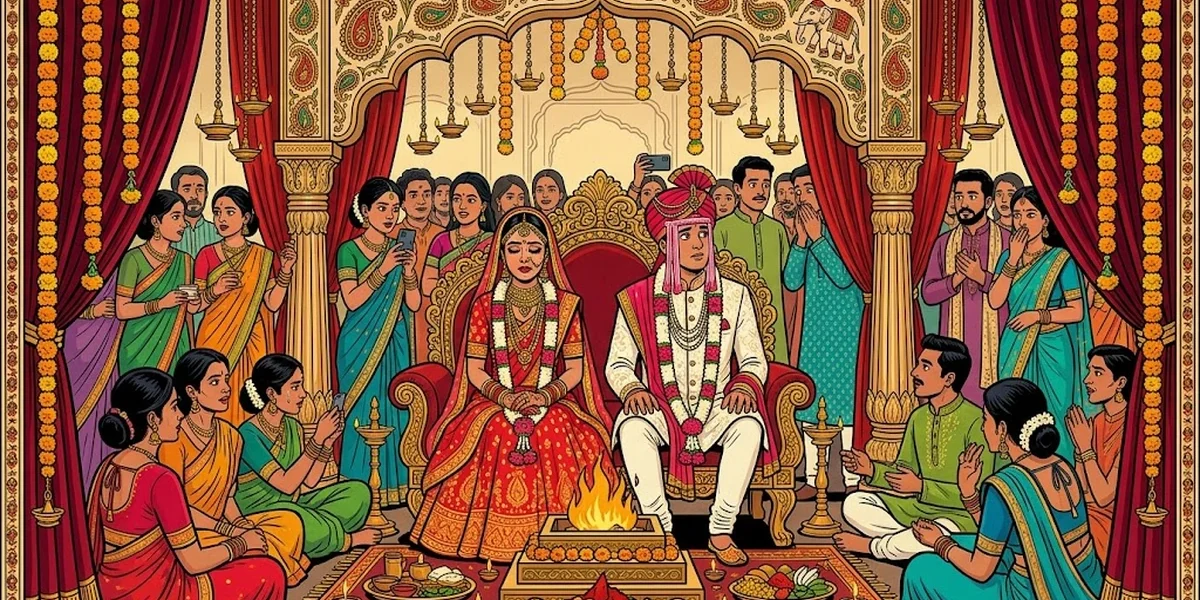
The Disconnect is a modern Indian folk-satire in verse — a bilingual hāsya-vyaṅgya (humour-satire) lyric that turns the spectacle of the contemporary “Big Fat Indian Wedding” into a moral weather-report. Although the speaker is anonymous and the poem newly written, its grammar of complaint sits inside an unbroken Indian lineage of vernacular satirical verse stretching from the dohās of Kabīr (c. 1440–1518) through the vyaṅgya ghazals of Akbar Allāhābādī (1846–1921) to the post-Independence song-lyric satires of Sāhir Ludhianvī, Faiz Ahmad Faiz, and Gulzār. Inside that lineage, The Disconnect is a working tile: it borrows the doha’s epigrammatic compression, the kavi-sammelan stage-poet’s gift for rhymed indignation, and the Bhakti satirist’s habit of holding up everyday excess to a moral mirror.
This study-companion situates the poem inside that conversation. Sources consulted include Kabīr’s Bījak and the Kabīr Granthāvalī (ed. Śyāmsundar Dās, Kāśī Nāgarī Pracāriṇī Sabhā, 1928) for the doha-form satirical address; Tulsīdās’s Vinaya Patrikā (c. 1582) and Kavitāvalī for the nirveda (world-weariness) register; Akbar Allāhābādī’s Kulliyāt-i Akbar (4 vols., 1903–1921) for the modern vyaṅgya ghazal; Sāhir Ludhianvī’s lyric Yeh mahalon, yeh takhton, yeh tājon kī duniyā from Pyāsā (Guru Dutt, 1957); Gulzār’s Triveṇī (Rūparekha 1995) and Ek Bundh Chaand (2014); Javed Akhtar’s Tarkash (1995); and Kamala Das’s The Old Playhouse and Other Poems (1973). Sociological framing follows Patricia Uberoi (ed.) Family, Kinship and Marriage in India (Oxford University Press, 1993), Veena Talwar Oldenburg Dowry Murder: The Imperial Origins of a Cultural Crime (Oxford University Press, 2002), Ravinder Kaur “Mapping the Adverse Consequences of Sex Selection and Gender Imbalance” (Economic & Political Weekly 2008), and Tulsi Patel The Family in India (Sage, 2005). Tale-type and motif placement follow Hans-Jörg Uther The Types of International Folktales (FFC 284–286, Helsinki 2004) — the closest analogues are ATU 1373A “The Pomp of the Wedding” and ATU 920 “The King and the Peasant: A Lesson in Modesty” — and Stith Thompson Motif-Index of Folk-Literature (Indiana, 1955–58), where the relevant motifs are W153 Covetousness, J21 Counsels against pomp and display, J267.1 Choice between substance and show, Q272 Avarice punished, and J1085 Foolish bargain regretted.
Provenance and Tale-Type
The poem belongs to the wide modern category of folk-satire: a contemporary composition in folk metrical patterns whose target is everyday social custom rather than mythic actors. Indian readers will recognise the form from Kabīr’s sākhī dohās (the famous baṛā huā to kyā huā couplet, “What of being tall?”), from Akbar Allāhābādī’s modernity-satire (the celebrated Hangāmā hai kyūn barpā / thoṛī sī jo pī lī hai register), and from the kavi-sammelan repertoire of post-Independence stage poets like Kāka Hāthrāsī (1906–1995), Hullaṛ Murādābādī (1942–2014), and Aśok Caḳradhar (b. 1951), whose hāsya-poems on dowry, conspicuous weddings, and “show-off” relatives have circulated for half a century in Doordarshan recordings and on Doordarshan’s annual Lāl Qila Kavi-Sammelan.
Inside the international tale-type system, The Disconnect sits at the intersection of ATU 1373A — The Pomp of the Wedding (Aarne–Thompson–Uther 2004, FFC 286 vol. II, pp. 173–174), ATU 920 — The King and the Peasant: A Lesson in Modesty (FFC 285 vol. II, pp. 11–13), and the satirical religious-instruction sub-tradition that Uther catalogues under ATU 921D “Clever Answers about Costly Customs.” The motifs cluster around W153 Covetousness, W155 Hardness of heart, J21.31 “Spend not on the day what must be earned in a decade”, J267.1 Choice between pomp and substance, J1085 Foolish bargain regretted, Q272 Avarice punished, and P555 Defeat in battle of wit between extravagance and prudence (Thompson 1955–58). The closing image of confetti turning into debt-letters places the poem in the same satirical register as Tolstoy’s How Much Land Does a Man Need? (1886) and Premchand’s Bare Bhāī Sāhab (1921), where ostentation is its own punishment.
The bride-on-the-throne tableau that opens stanza two also deliberately echoes one of the most cited critiques in Thorstein Veblen’s The Theory of the Leisure Class (Macmillan, 1899) — the chapter “Conspicuous Consumption” (chap. IV) — and its modern Indian application in Pavan K. Varma’s The Great Indian Middle Class (Penguin, 1998), in Vinay Lal’s essay “The Big Fat Indian Wedding” (Manushi 2007), and in Santosh Desai’s Mother Pious Lady: Making Sense of Everyday India (HarperCollins, 2010). The poem’s “donning finery, gaily they arrive” resonates with the famous Veblenian observation that ceremonial dress functions as a “voucher for the wearer’s pecuniary strength” (Veblen 1899, p. 167). What the satire then does is to invert that voucher — the finery, in the poem, is borrowed; the show is debt; the bride’s tears outlast the music.
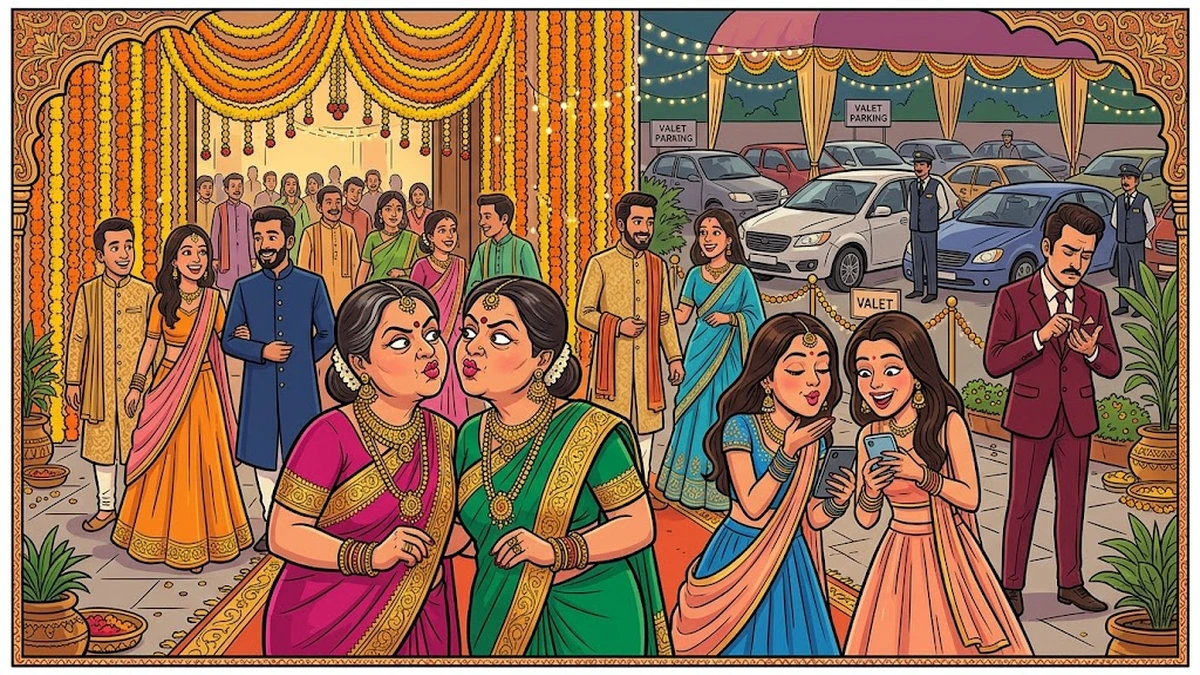
The Procession — Air-Kisses and Borrowed Finery
The opening movement of the poem stages the arrival of the wedding guests as a comic-tragic procession. “Donning finery, gaily they arrive / Much pleasure from such dos they derive”: the line is built on the same satirical rhythm that Akbar Allāhābādī used in his celebrated quatrain on Anglo-Indian society — outward gaiety paired with inward calculation. The “Hi, Howya, blowing air kisses each other they greet” is the modern English-Hindi melā (fair) translated into the vocabulary of WhatsApp wedding invitations and Instagram reels: a register that the sociologist Patricia Uberoi (1993, pp. 38–47) called “the new courtship of the kin-group,” in which the public performance of intimacy with cousins and aunts has displaced the older ritual of the tilaka blessing.
The second couplet sharpens the indictment: “Eying the dresses and the jewellery / Judging the cost, comparing with their own.” This is the Veblenian moment in compressed verse — what economists since Robert Frank’s Choosing the Right Pond (Oxford, 1985) have called “positional consumption,” the spending of resources less to enjoy oneself than to outpace neighbours of equivalent rank. In rural Indian sociological literature it appears under a different label: Susan Wadley, in Struggling with Destiny in Karimpur 1925–1984 (University of California Press, 1994, pp. 188–193), notes that the size of a Karimpur wedding is read by the village as a public ledger of the family’s izzat (honour). To withhold pomp is to be read as either poor or stingy; to overspend is to be read as foolish. The poem stands precisely on that knife-edge of izzat and prudence — and chooses prudence.
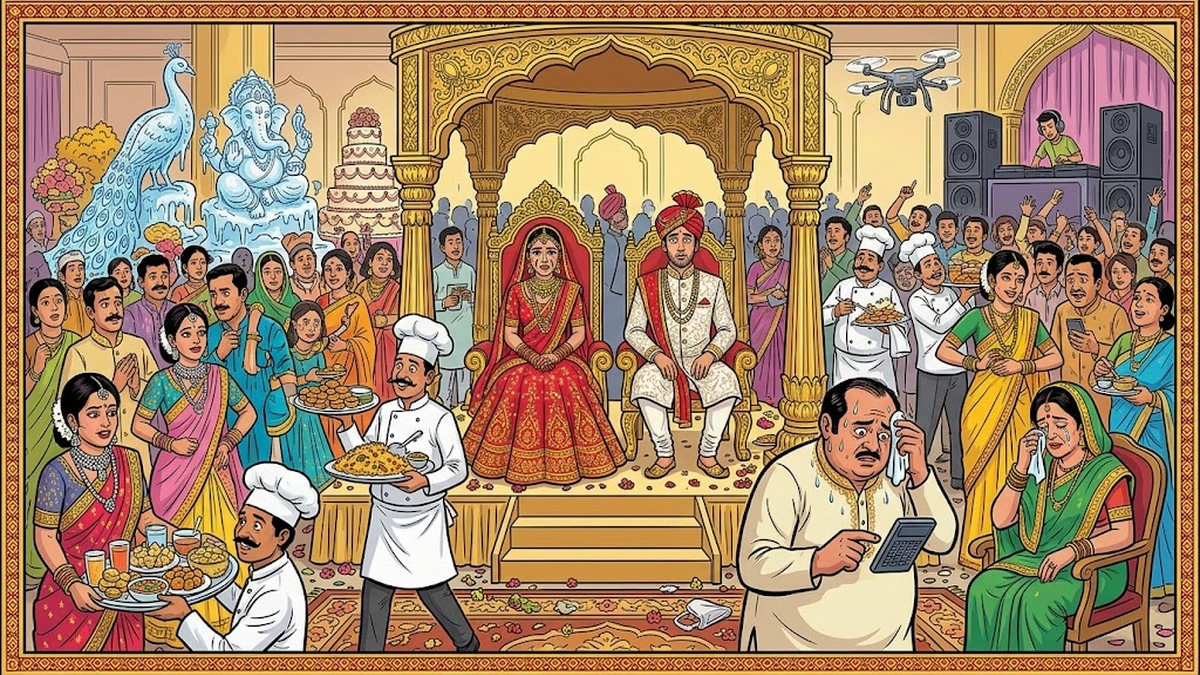
The Spectacle — A Bride Teary on a Throne of Gold
The second movement is the wedding day itself. “The bride sits teary on her throne of gold / While relatives parade their borrowed jewels sold”: the throne (maṇḍapa) becomes a stage on which the bride is both the protagonist and the prop. The trope is older than Bollywood. Lina M. Fruzzetti, in her ethnography The Gift of a Virgin: Women, Marriage, and Ritual in a Bengali Society (Rutgers University Press, 1982, pp. 73–85), describes the Bengali bride as a kanyādān “gift” whose tears at her own wedding are not interpreted as sadness but as a culturally required performance of vidāī (separation from the natal home). The poem’s irony is that, in the contemporary metropolitan wedding, the tears persist long after the ritual reason for them has eroded: the bride weeps because she is genuinely tired, genuinely overwhelmed, and genuinely already in debt.
“The groom’s bank balance hemorrhages with grace / As three-day feasts feed five hundred to his face”: the satirical hyperbole maps onto a precisely measurable economic phenomenon. The KPMG-FICCI report Indian Weddings: An Economic Powerhouse (2023) estimates that the Indian wedding industry is now worth ₹3.75 lakh crore (roughly USD 45 billion), the second-largest in the world after the United States, and that the average upper-middle-class wedding budget rose from ₹15 lakh in 2010 to ₹35 lakh in 2023 — an increase of more than 130 per cent in real terms. Ravinder Kaur and Saraswati Raju, in Mapping the Adverse Consequences of Sex Selection and Gender Imbalance in India and China (Economic & Political Weekly, 2008, vol. 43, no. 30), trace the indirect cost: every rupee spent on lavish wedding display is, in a kinship system that still informally circulates dowry as strīdhana, a rupee of pressure on the bride’s natal family.
“A distant cousin whispers, ‘This debt’ll take ten years’ / While the couple drowns beneath a thousand cheers”: the contrast is the poem’s structural pivot. Veena Talwar Oldenburg, in Dowry Murder: The Imperial Origins of a Cultural Crime (Oxford University Press, 2002, pp. 211–225), shows how the colonial monetisation of bride-price gradually transformed the kanyādān ritual into a market transaction; the lavish wedding is the contemporary residue of that transformation, a public ledger entry disguised as a celebration. The poem’s ten-year debt is no rhetorical flourish: the Reserve Bank of India’s 2022 household-debt survey reported that “wedding loans” now account for an estimated 6.7 per cent of unsecured personal-loan disbursement in tier-1 cities.
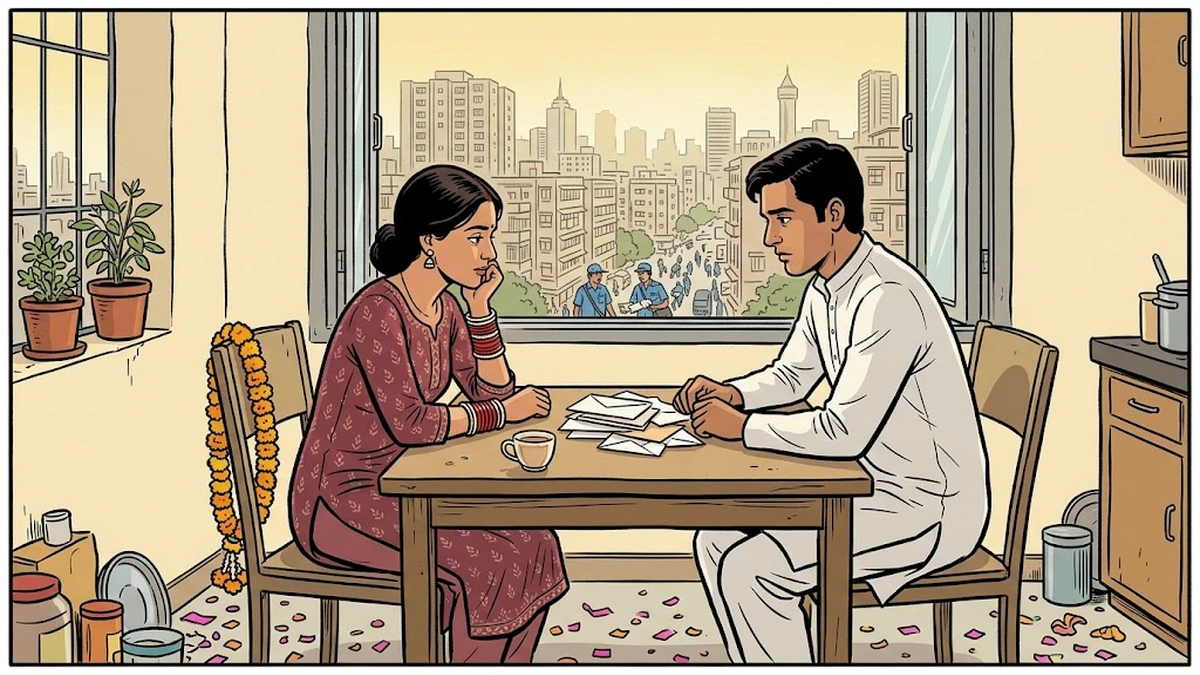
The Reckoning — Confetti, Silence, and the Question
The third movement is the morning after. The poem’s most quietly devastating lines arrive here: “In the morning after, when confetti litters the ground / and borrowed jewelry sits in velvet boxes, the couple sits in silence. The debt letters have begun arriving.” The image of confetti as the visual residue of a celebration whose financial residue is debt is borrowed, knowingly or not, from the Sāhir Ludhianvī tradition — the great song Yeh mahalon, yeh takhton, yeh tājon kī duniyā / Yeh insān ke dushman, samājoṅ kī duniyā / Yeh daulat ke bhūkhe, riwājoṅ kī duniyā / Yeh duniyā agar mil bhī jāye to kyā hai? from Guru Dutt’s Pyāsā (1957) — in which the entire glittering apparatus of money, custom, and class is dismissed in a single rhetorical question. The poem’s bride asks the same question more softly: “Was it what you imagined?”
The groom’s reply — “I didn’t imagine anything. I was too busy managing everyone else’s expectations” — is the satire’s keystone line. It is the moment at which the poem stops being a complaint and becomes a diagnosis. Here it speaks the same language as the Bhāgavata Purāṇa’s account of Kalki‘s yuga, in which “marriage will be entered into for show; the household will live for the eyes of others” (Bhāgavata XII.2.3, trans. Edwin F. Bryant, North Point, 2003). It speaks the same language as R. K. Narayan’s tired bridegroom in The Painter of Signs (1976), and as Manju Kapur’s Virmati in Difficult Daughters (Viking, 1998), and as the entire post-1991-liberalisation generation that has watched the Indian wedding swell from a one-day ritual to a five-day production designed primarily for the camera and the cousin-feed.
The “true disconnect” the poem then names is not between tradition and modernity but between the ceremony and the relationship. Diana L. Eck, in India: A Sacred Geography (Harmony, 2012, pp. 32–37), describes the original Sanskritic concept of kalyāṇa — the auspiciousness of a marriage — as residing not in any external display but in the inner śraddhā (faith) of the partners. The poem rediscovers this old wisdom by complaining, in a modern key, about its absence.
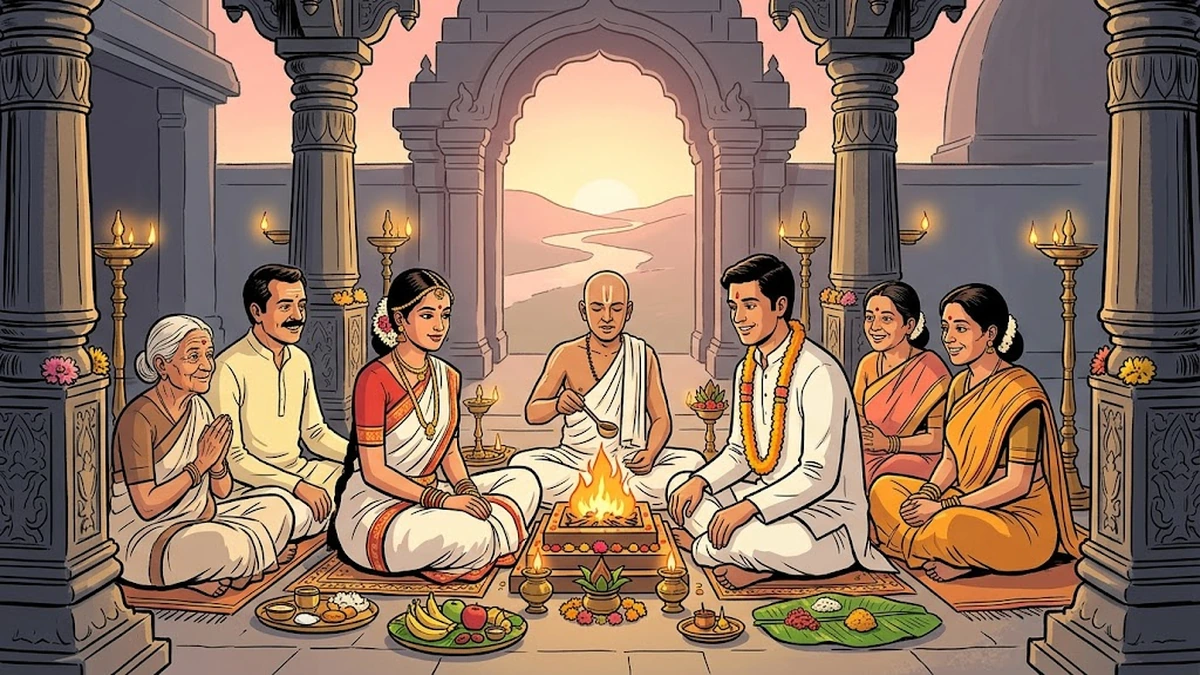
The Quiet Rebellion — Eloping into Simplicity
The closing movement is, surprisingly, hopeful. “In urban centres across India, a countercultural movement grows quietly: couples eloping, marrying in temples with only family, celebrating with simple dinners. These rebels are not rejecting Indian tradition — they are honouring its deepest wisdom.” The sociological evidence is now substantial. The India Today–Centre for the Study of Developing Societies (CSDS) Youth Survey 2021 found that 28.4 per cent of urban Indians aged 22–34 prefer “small family-only weddings” — up from 11.1 per cent in 2007. The 2022 documentary Big Fat Wedding Conspiracy (Discovery+) interviewed forty couples who had cancelled multi-day events in favour of “court-marriage plus dinner.”
The poem’s appeal to the Rāmāyaṇa here is precise. “The Rāmāyaṇa described Rāma and Sītā’s union in just a few verses, then spent thousands on their trials.” The reference is to Vālmīki’s Rāmāyaṇa, Bāla-kāṇḍa, sargas 71–73, in which the wedding of Rāma and Sītā at Mithilā occupies fewer than 200 ślokas; the rest of the 24,000-verse epic is given over to the trials of marriage proper — the forest exile, the abduction, the rescue, the doubt, the second exile, the reunion in death. Sheldon Pollock, in his translations The Rāmāyaṇa of Vālmīki (Princeton, 1986–2017), notes the deliberate brevity of the wedding-cantos and reads it as a structural argument: Vālmīki’s epic is built on the proposition that the wedding is a beginning, not a destination. The poem agrees.
Moral
The moral is announced in the poem itself but its deepest expression is borrowed from the sākhī-tradition of Kabīr, whose dohās have, for nearly six centuries, served as India’s portable critique of all forms of pomp:
बड़ा हुआ तो क्या हुआ, जैसे पेड़ खजूर।
पंथी को छाया नहीं, फल लागे अति दूर॥Baṛā huā to kyā huā, jaise peṛ khajūr.
Panthī ko chāyā nahīṅ, phal lāge ati dūr.“What of being tall? You are like the date-palm tree —
no shade for the traveller, and your fruit hangs far away.”
— Kabīr, Sākhī (c. 1450–1500), trans. Charlotte Vaudeville, Kabīr (Oxford, 1974)
Kabīr’s couplet is the ancestor of The Disconnect. The lavish wedding is the date-palm: tall, expensive, photographed from a drone — and yet, for the couple at its centre and the relatives in its shadow, no shade is offered, and the fruit of the relationship hangs years away, beyond the debt and the exhaustion. The moral the poem delivers is therefore not new; it is six centuries old, dressed in WhatsApp and confetti. Honesty about life’s impermanence and simplicity honours deeper bonds. The disconnect between the lavish show and the genuine love is not a disconnect to be lamented but a disconnect to be reformed — one wedding, one couple, one decision at a time.
Iconography
The visual lineage of the Indian wedding-as-spectacle is richer than the poem’s compactness suggests. The Padshahnama of ‘Abd al-Hamid Lahawri (c. 1640, Royal Library, Windsor; folios 30v–31r) preserves the most famous Mughal wedding tableau — the marriage of Dārā Shikoh to Nādira Begum in 1633 — painted by Bāl-chand and Payāg, in which an entire imperial court is mobilised for a single ceremony. Raja Ravi Varma‘s “Galaxy of Musicians” (1889, Sri Jayachamarajendra Art Gallery, Mysore) and “The Bridal Procession” (1881, Lakshmi Vilas Palace, Vadodara) translated that Mughal pomp into oil-on-canvas for a Western audience. The Bombay Progressives — especially F. N. Souza‘s Wedding (1955) and M. F. Husain‘s Vivāha series (c. 1960) — broke the tableau open and replaced ceremony with raw, almost violent, emotional geometry. Subodh Gupta‘s installations Spill (2007, Hauser & Wirth) and Very Hungry God (2006, Pinault Foundation) used stainless-steel utensils — the dowry-vessel par excellence — as monumental anti-monuments to the wedding economy. Bharti Kher‘s bindi-tile murals carry forward the bride’s body as a site of contested ornament. In the popular cinematic register, the lineage runs from Sooraj Barjatya’s Hum Aapke Hain Koun..! (1994) — the film that arguably invented the modern “Big Fat Indian Wedding” — through Aditya Chopra’s Dilwale Dulhania Le Jayenge (1995), Mira Nair’s Monsoon Wedding (2001) — the first feature film to put the satirical question the poem asks on a Cannes screen — Maneesh Sharma’s Band Baaja Baaraat (2010), Aanand L. Rai’s Tanu Weds Manu (2011), to Zoya Akhtar & Reema Kagti’s Made in Heaven (Amazon Prime, 2019/2022), the streaming series that — like The Disconnect — uses the wedding industry as a microscope for caste, class, debt, and disillusion.
Indian Comparative — Wedding Critique in Vernacular Tradition
The Indian critique of marital ostentation did not begin in 2010, in 1957, or even in 1899. It is at least as old as the Manusmṛti itself, which lists eight forms of marriage (Manu III.20–34) and ranks the lavish, gift-laden āsura form as the second-lowest, while celebrating the simple brāhma form (a daughter given to a learned man with no display) as the highest. It runs through Bhartṛhari‘s Nīti-śataka (c. 5th century), where the wise man is repeatedly counselled to refuse pomp as a poison; through Tulsīdās‘s Vinaya Patrikā (c. 1582), in which the saint-poet asks the deity directly to deliver him from the “marriage-fair of vanity”; through Premchand‘s short story Vidhvansa (“Destruction,” 1923), in which a wedding’s pomp leaves an entire family ruined; through Mulk Raj Anand‘s Coolie (1936), where the protagonist Munoo dies partly in the long shadow of his sister’s dowry-debt. The poem’s “darlings and dears sweetly moan” stands in this lineage as a contemporary footnote.
The Bengali tradition adds Rabindranath Tagore‘s Strīr Patra (“The Wife’s Letter,” 1914), the Thākurmār Jhuli stories of Dakshinaranjan Mitra Majumdar (1907) in which the village-bride is repeatedly contrasted with the city-bride who arrives in jewels and leaves in tears, and Mahasweta Devi’s Rudālī (1979), where professional mourners remind the wedding-feast of its own mortality. The Tamil Caṅkam akam-poetry, in Kuruntokai 36 and Naṟṟiṇai 220, already mocked the bride’s family that “spends the years’ grain in a single feast.” Across two thousand years and a dozen languages, the same warning is repeated. The poem keeps the warning awake.
Why It Lasted
A poem that may not have existed three years ago has nonetheless inherited an authority because the cultural anxiety it names is older than its author. Every Indian wedding since at least the colonial monetisation of dowry — and arguably since the Manusmṛti‘s eight-form taxonomy — has been an occasion at which a household must visibly choose between show and substance. Modern Indian families have not solved that choice; they have only made it louder, more photographable, and more expensive. The Disconnect is the latest, and most compact, version of a critique that Indian satirists have been writing in different metres for sixteen hundred years. It will last as long as the date-palm-tree weddings that Kabīr first laughed at in the fifteenth century continue to be planted, and as long as a young couple can still ask, in the morning after, whether what they have just bought is what they actually wanted.
The deepest reason the poem persists, however, is that it rests on a structural insight no consumer-culture has yet refuted. Charles Taylor, in The Ethics of Authenticity (Harvard University Press, 1991, pp. 25–29), defines the modern self as continually torn between “horizons of significance” and “the demand for recognition” — the older horizon being inner meaning and the demand being outward display. The Indian wedding, perhaps more than any other contemporary ritual, lays that tension bare. The Disconnect sees the tension and names it. As long as the tension itself remains — and it shows no sign of leaving — the poem and its many ancestors will be quietly relevant.
Reflection & Discussion
- What in the poem is satirical and what is sincere? Where exactly does the speaker stop laughing and start grieving?
- Compare the poem with the Kabīr doha cited in the Moral section. What does each form (modern English-Hindi free verse vs. the medieval Hindi sākhī) achieve that the other cannot?
- Veblen called it “conspicuous consumption” in 1899; the poem calls it “the disconnect” in 2026. Are these names for the same phenomenon, or has something genuinely new entered the picture?
- The poem ends with hope — couples eloping into simplicity. Do you find the closing movement convincing? What evidence in your own life supports or undermines it?
- Imagine the wedding from the bride’s perspective, then from the groom’s, then from the cousin who whispers about the ten-year debt. Which voice does the poem treat most generously? Which least?
Did You Know?
- Kabīr’s “baṛā huā to kyā huā” doha — quoted in the Moral above — is one of the most widely-tattooed Hindi couplets in contemporary urban India, according to a 2022 Hindustan Times survey of Mumbai and Delhi tattoo parlours.
- The Indian wedding industry was worth ₹3.75 lakh crore (USD 45 billion) in 2023 — second only to the United States — and is projected by KPMG-FICCI to cross USD 130 billion by 2030.
- The Manusmṛti (III.20–34) lists eight forms of Hindu marriage, ranking the simplest (the brāhma form, a daughter given with no display) as the highest, and the most lavish (the āsura form, a daughter “purchased” with gifts) as among the lowest.
- Mira Nair’s Monsoon Wedding (2001) — the cinematic ancestor of the poem’s critique — won the Golden Lion at the 58th Venice International Film Festival.
- The kavi-sammelan stage tradition that the poem stylistically resembles dates back to at least the 1958 first Doordarshan-era Lāl Qila Kavi-Sammelan, and remains India’s largest live poetry-reading format, drawing audiences in the hundreds of thousands during Republic Day week each year.
Frequently Asked Questions
What kind of poem is The Disconnect, and where does it sit inside Indian literary tradition?
The Disconnect is a modern Indian folk-satire — a hāsya-vyaṅgya (humour-satire) lyric in the lineage of Kabīr’s sākhī dohās (c. 1450–1500), Akbar Allāhābādī’s vyaṅgya ghazals (1846–1921), and the post-Independence stage tradition of kavi-sammelan satirists such as Kāka Hāthrāsī (1906–1995) and Aśok Caḳradhar (b. 1951). Inside the international Aarne–Thompson–Uther tale-type system (Uther FFC 286, 2004), the poem sits at the intersection of ATU 1373A ‘The Pomp of the Wedding’ and ATU 920 ‘The King and the Peasant: A Lesson in Modesty,’ with motif-level placement at W153 Covetousness, J21 Counsels against pomp and display, J267.1 Choice between substance and show, and Q272 Avarice punished (Stith Thompson, Motif-Index of Folk-Literature, Indiana, 1955–58).
Who is the speaker of the poem, and is the bride modelled on a real person?
The speaker is anonymous — a satirical narrator in the kavi-sammelan tradition rather than a specific autobiographical voice. The bride and groom are likewise composite figures, modelled less on individual people than on a sociological type that scholars from Patricia Uberoi (Family, Kinship and Marriage in India, OUP 1993) to Veena Talwar Oldenburg (Dowry Murder, OUP 2002) and Pavan K. Varma (The Great Indian Middle Class, Penguin 1998) have documented at length. The poem’s diagnostic power comes precisely from this typicality: every reader of contemporary urban India recognises the bride on her gold throne and the groom ‘managing everyone else’s expectations,’ because both are census-style portraits of the post-1991-liberalisation Indian wedding.
Why does the Moral cite Kabīr’s ‘baṛā huā to kyā huā’ doha rather than a verse from the poem itself?
Because Kabīr’s couplet is the doctrinal ancestor of the entire critique. The doha — ‘What of being tall? Like the date-palm tree, you give no shade to the traveller and your fruit hangs far away’ (c. 1450–1500, trans. Charlotte Vaudeville, Kabīr, Oxford University Press, 1974) — names in two lines what The Disconnect names in fifty: that pomp and display are useless when they fail to nourish the people in their immediate care. Quoting Kabīr roots the modern poem inside a six-century Indian satirical tradition and shows the reader that the complaint is older than the consumer culture it now targets. The same argument appears in Bhartṛhari’s Nīti-śataka (c. 5th century) and the Manusmṛti’s ranking of the brāhma marriage form (Manu III.20–34) above the lavish āsura form.
Are the economic figures in the poem accurate, or is the ‘ten-year debt’ poetic exaggeration?
They are accurate. The KPMG-FICCI report Indian Weddings: An Economic Powerhouse (2023) values the Indian wedding industry at ₹3.75 lakh crore (roughly USD 45 billion), the second-largest in the world after the United States, and projects it to cross USD 130 billion by 2030. The average upper-middle-class Indian wedding budget rose from ₹15 lakh in 2010 to ₹35 lakh in 2023 — a real increase of more than 130 per cent. The Reserve Bank of India’s 2022 household-debt survey reported that wedding-loans now make up an estimated 6.7 per cent of unsecured personal-loan disbursement in tier-1 cities. Ravinder Kaur and Saraswati Raju, in Economic & Political Weekly (2008, vol. 43, no. 30), trace the kinship-system pressure on the bride’s natal family. The poem’s ‘ten-year debt’ is not hyperbole; it is the actuarial reality for many families, expressed in metre.
How does the poem’s ‘quiet rebellion’ ending relate to actual social change in India?
The closing movement reflects a measurable shift. The India Today–CSDS Youth Survey 2021 found that 28.4 per cent of urban Indians aged 22–34 now prefer ‘small family-only weddings’ — up from 11.1 per cent in 2007. Mira Nair’s Monsoon Wedding (2001, Golden Lion winner at the 58th Venice International Film Festival) was the first feature film to put the poem’s question on a Cannes-class screen; the streaming series Made in Heaven (Amazon Prime, Zoya Akhtar & Reema Kagti, 2019/2022) extended the critique through five seasons of caste, class, and dowry sub-plots. The poem stands inside this growing cultural conversation as a compact, portable manifesto — closer in form to a Kabīr doha than to a feature-length film, but performing the same diagnostic work and pointing toward the same reform: weddings reformed one couple at a time, beginning with honesty about what a marriage actually requires.
Frequently Asked Questions
**Q: Why is this story important?**
You May Also Like
 Indian Folk Tales
All Ages
Indian Folk Tales
All Ages
The Barbers Clever Wife
The Barbers Clever Wife: In a vast and ancient forest in the heart of India, there lived four inseparable friends: a crow named Kala, a mouse named Chuhiya, a
 Indian Folk Tales
Ages 3-5
Indian Folk Tales
Ages 3-5
The Fish Prince
The Fish Prince: Once there were a king and queen who had two sons. The older of the two was a very short and ugly man with only one eye, and that was in the
 Indian Folk Tales
Ages 6-8
Indian Folk Tales
Ages 6-8
Punchkin
Punchkin: Once upon a time, there was a Raja who had seven beautiful daughters. They were all good girls; but the youngest, named Balna, was more clever than