The Story of the Brahmins Who Put Life Into the Lion
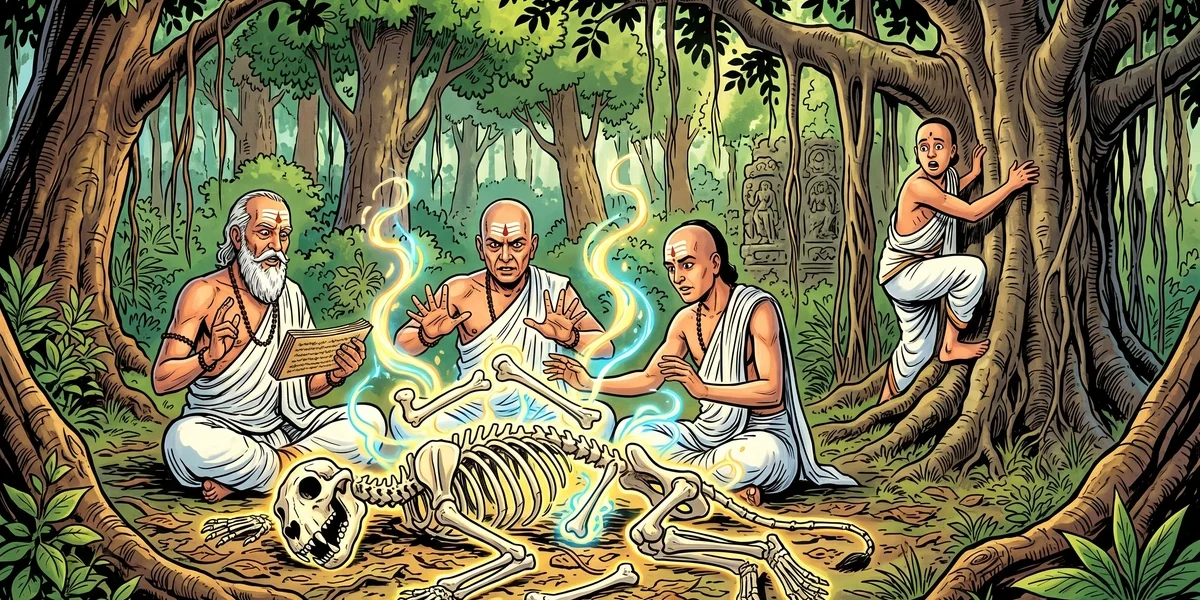
The Story of the Brahmins Who Put Life Into the Lion: In a certain town, there lived f3our sons of Brahrn ins. They were great friends. Three of them werevery
Origin & Canonical Placement
“The Story of the Brahmins Who Put Life Into the Lion” is one of the Panchatantra’s sharpest and most frequently cited fables, encoding a distinction of the first importance: the difference between shastra-buddhi (scholarly or technical intelligence) and loka-buddhi (worldly or practical wisdom). The tale belongs to Vishnu Sharma’s Pancatantra (c. 300 BCE–300 CE) and is preserved in the Hitopadesha and numerous regional Sanskrit collections. It belongs thematically to Book V: Aparikshitakaraka (“Ill-considered Action”), specifically to the subset of tales that document the catastrophic consequences of applying technical expertise without practical judgment — of knowing how to do something without considering whether doing it is wise.
“Shastra-pandityam kim kurute yah loke naiva veda kimchit.”
“What use is mastery of texts to one who understands nothing of the actual world?”
— Panchatantra maxim, Book V
Beat I — Four Scholars, One Dangerous Idea
Four Brahmin scholars were travelling together through a forest. Three of them had spent their lives in deep study of Sanskrit texts and had mastered the most advanced sciences of their age: one was a master of the science of reconstructing a living creature from its bones; the second possessed the knowledge to clothe such a skeleton with flesh and blood; the third could breathe life into a fully reconstituted body. All three were celebrated scholars whose technical mastery was beyond question.
The fourth companion was not a scholar in the formal sense. He had studied less, read fewer texts, and could not match the others in any examination of classical knowledge. But he had something the others lacked: what the Panchatantra calls loka-buddhi — the intelligence of the world, the practical capacity to read a situation and foresee its likely consequences. The three scholars tolerated his company but did not regard him as an equal; he tolerated their condescension with the equanimity of a man who knows his own value even when others do not.
Deep in the forest they came upon the bones of a lion — the skeleton complete, gleaming in the undergrowth. The three scholars looked at each other with the quiet excitement of professionals who have found an ideal opportunity to demonstrate their mastery. They agreed at once: here was the perfect test case for their combined skills. They would reconstruct the lion entirely and breathe life into it.
Beat II — The Warning and the Tree
The fourth scholar immediately raised his hand. “Wait,” he said. “Those are the bones of a lion. If we restore this creature to life, it will kill us.” The three scholars looked at him with the patient tolerance they reserved for the practically minded. “We have not spent our lives mastering these sciences in order to be afraid of using them,” one of them said. “This is a matter of scholarly integrity. We will demonstrate what we know.”
The fourth scholar recognised that argument was futile. He said: “Then allow me a moment to climb this tree before you complete the work.” This was agreed — they were not unkind men, merely obtuse ones — and the fourth scholar climbed to a high branch and watched from safety. The three scholars worked through their sequence with admirable precision: skeleton clothed with flesh and blood, blood warmed to life, breath breathed into the restored body. The lion opened its eyes, assessed its situation, and killed all three scholars before any of them had time to regret their decision.
The fourth scholar descended from the tree when it was safe and continued his journey, arriving eventually at his destination, where he lived out his life in reasonable prosperity, never having mastered the resurrection of the dead but never having been eaten by anything he had resurrected either.
Beat III — The Analysis: The Hierarchy of Intelligence
The Panchatantra’s analysis of this tale is among the most explicit in the entire corpus. The three scholars are not presented as foolish or incompetent — their mastery is genuine and their technical achievement (reconstructing a lion from bones) is extraordinary. What they lack is the entirely separate capacity to think past the technical question (“can we do this?”) to the practical question (“should we do this, and what will happen if we do?”). These are different questions, they require different kinds of knowledge, and neither automatically implies the other.
The fourth scholar possesses none of the technical knowledge but all of the practical knowledge. He cannot reconstruct a lion from bones, but he knows that a restored lion will kill people who stand near it — a fact so obvious from the perspective of loka-buddhi that it scarcely needs stating, but which the three scholars’ framework of formal knowledge has no category to accommodate. Their mastery of the “how” has crowded out all consideration of the “what then.”
Kautilya’s Arthashastra addresses this hierarchy directly in its classification of types of ministers and advisors. The highest category — the amatya of the first rank — must possess both technical mastery and practical wisdom: the capacity to conceive and execute a strategy and the capacity to foresee its consequences in the actual world of competing interests and unpredictable actors. A minister who possesses only technical mastery — who can construct a plan but cannot anticipate its real-world consequences — is less valuable and more dangerous than a less learned minister who has developed genuine worldly judgment.
Beat IV — Moral Dimension & Enduring Relevance
The story’s moral is an affirmation of the value of practical wisdom as a distinct and essential form of intelligence, not a lesser or more vulgar alternative to formal learning. The Panchatantra tradition consistently refuses to rank formal learning above practical judgment; indeed, in the stories where the two conflict, practical judgment regularly saves lives while formal learning gets people killed. This is not anti-intellectualism — the text is itself a product of deep learning and celebrates intelligence in all its forms — but it is a pointed insistence that shastra-buddhi without loka-buddhi is incomplete and potentially catastrophic.
For contemporary organisations and individuals, the distinction between technical expertise and practical wisdom is among the most consequential in professional life. Technical experts who cannot think past the question of what is technically possible to the question of what is practically wise create risks that their organisations did not bargain for. The discipline of asking “what will actually happen if we do this?” — not “what should happen according to our model?” but “what will the actual world, with all its unpredictability, produce in response to this action?” — is precisely the discipline of loka-buddhi that the fourth scholar embodies.
Moral: Technical mastery without practical wisdom is incomplete and dangerous; knowing how to do something is worthless without the judgment to know whether doing it is wise.
Why This Story Has Lasted 2,000 Years
The four scholars and their lion have endured as one of the world’s most precise images of expertise without wisdom because the distinction they embody — between knowing how and knowing whether — is permanent and perennial. Every era produces scholars who are brilliant within the categories their training has given them and blind to everything outside those categories. Every era also produces the fourth scholar: the practically minded person who may not be able to pass the formal examination but who is the only one who notices that the lion, when restored, will eat everyone present. The Panchatantra’s contribution is to make this distinction visible with such comic and dramatic clarity that having heard the story once, the reader recognises both types immediately whenever they encounter them in the world.
About the Panchatantra
The Panchatantra (“Five Treatises”) was composed in Sanskrit by the scholar Vishnu Sharma around 300 BCE–300 CE as a niti-shastra — a guide to wise conduct and statecraft — framed as animal fables for the instruction of young princes. Its five books cover the dissolution of allies, the winning of allies, war and peace, the dangers of naivety, and the hazards of rashness. The text spread westward through Pahlavi and Arabic translations to become the most widely translated secular book of the ancient world after the Bible.
You May Also Like
 Panchatantra Stories
Ages 9-12
Panchatantra Stories
Ages 9-12
The Musical Donkey: A Panchatantra Fable
The Panchatantra's hard-edged little fable of Uddhata — the "haughty" washerman's donkey — who feasts on stolen cucumbers under the moon, mistakes his longing for talent, and brays the song that brings the farmers running with sticks. The story is found in Book V of the Panchatantra (Aparīkṣitakāraka, "Ill-Considered Action"), and it is one of Vishnu Sharma's quietest and most devastating lessons: a donkey called Raised On High is going to be brought low, and the only question is how.
 Panchatantra Stories
Ages 9-12
Panchatantra Stories
Ages 9-12
The Four Treasure-Seekers
Read 'The Four Treasure-Seekers' — a classic Panchatantra story about moral lessons about greed. The Four Treasure-Seekers is a beloved Panchatantra tal...
 Panchatantra Stories
Ages 9-12
Panchatantra Stories
Ages 9-12
A Three-in-One Story
Some Panchatantra tales are simple. A Three-in-One Story is not. It is a tale that hides three little stories inside one bigger story — and each of the three teaches the same surprising lesson: even the wisest grown-ups become foolish when love asks them to be. King Nanda neighs like a horse for his queen, his prime minister Vararuchi shaves his head for his wife, and a third nested tale shows how this folly travels far beyond the palace walls.