The Story of the Cobra and the Crow
The Story of the Cobra and the Crow: Somewhere in the country, under a banyan tree, therelived a pair of crows, husband and wife. Now, wheneverthe female

The Story of the Cobra and the Crow
Source: Panchatantra, Book III — Kakolukiyam (Of Crows and Owls), attributed to the sage Vishnu Sharma, composed c. 300 BCE–300 CE; this redaction follows the Sanskrit Tantrakhyayika recension and Patrick Olivelle’s critical translation (Oxford University Press, 2006).
बलया न शक्यं यस् नेतुश्च्यं ब््ह्रुश्च्यं साधायतेःः
A pair of crows have built their nest in a great tree at whose base lives a cobra that devours their eggs and chicks every season. The male crow despairs; direct confrontation is impossible. The female crow formulates a plan that converts the king’s servants into unwitting executioners of the cobra, using a stolen necklace as the instrument and the cobra’s own den as the trap. This is the Panchatantra’s most celebrated example of upaya — indirect means — and one of its clearest demonstrations that the weak can defeat the strong by redirecting the power of a third party.
Part I: The Annual Loss
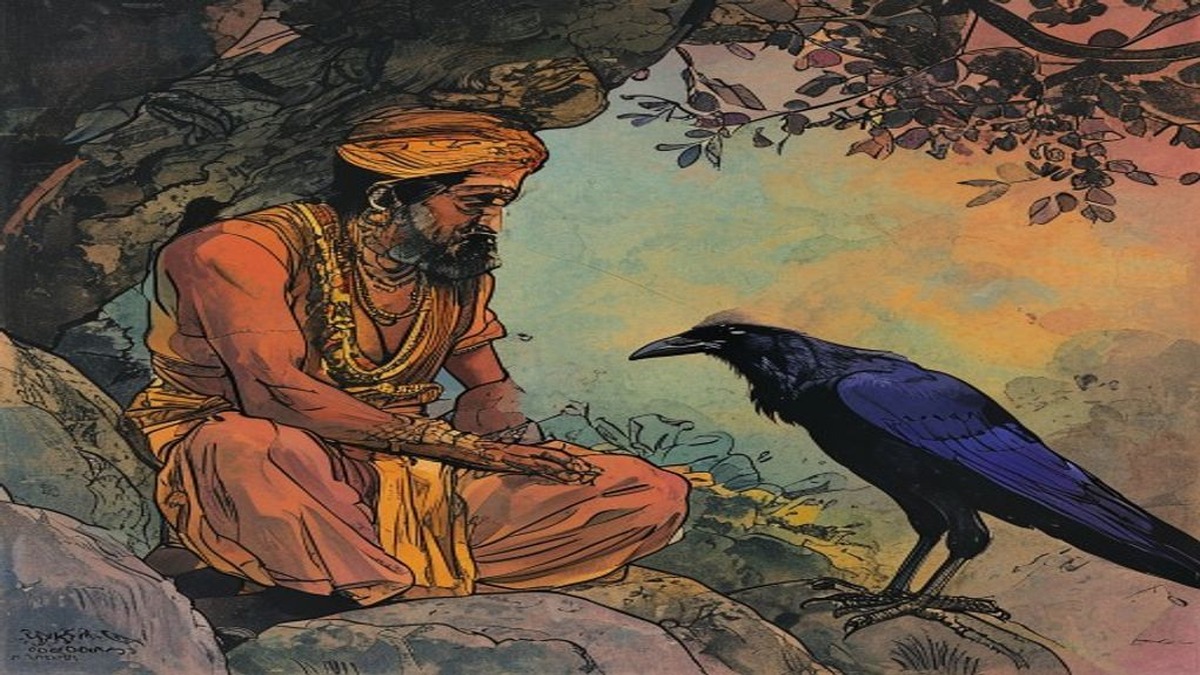
In the forest bordering the city of Pataliputra there stood a great banyan tree whose crown sheltered a colony of birds. Among them was a pair of crows — the male Samhitartha, steady and sorrowful; the female Chaturika, sharp-eyed and always calculating. They had nested in the high branches for five years. In each of those five years, a cobra named Nagadushtaha, who occupied a hollow at the base of the tree, had eaten their eggs or their chicks.
The cobra was large, old, and entirely beyond the crows’ capacity to harm directly. Samhitartha had attacked him on two occasions and had retreated both times with injuries. The cobra did not particularly want to harm the crows; he simply found their nest a convenient source of food that required no effort on his part. The crows’ suffering was, to him, a side-effect of efficient eating.
After the fifth year’s loss, Samhitartha sat in the high branches and went through the list of options available to him. He could relocate the nest — but the cobra ranged widely and would find them. He could seek allies among the other birds — but no bird in the colony was large enough to challenge the cobra. He could appeal to the mongoose families in the adjacent grassland — but they were territorial and owed him nothing.
Chaturika listened to this inventory and then said: “We do not need to defeat the cobra ourselves. We need to arrange for someone else to defeat him. Someone who has the power we lack and a reason to use it that we can create.”
She spent the afternoon at the edge of the royal bathing tank, watching the princess and her attendants take their daily bath.

Part II: The Necklace
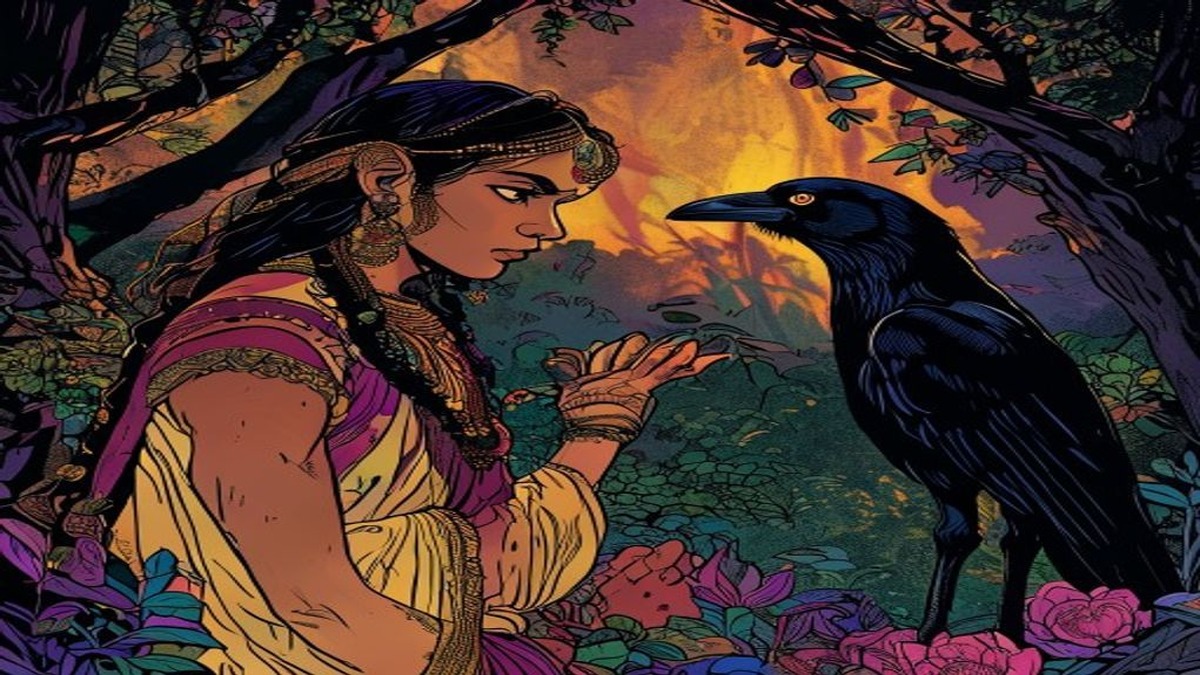
The princess’s bathing ritual followed a consistent pattern. She removed her jewellery and placed it on a flat stone at the tank’s edge before entering the water. Her attendants arranged themselves at a respectful distance. The golden necklace — heavy, distinctive, immediately recognisable as royal property — sat on the stone unattended for approximately the duration of a crow’s swift flight from a nearby tree.
Chaturika timed it with the precision of an animal who had spent the afternoon studying the pattern. She swept down, took the necklace in her beak, and flew not away from the bathing tank but toward the tree — slowly, deliberately, making herself visible to the attendants who had begun shouting the moment the necklace disappeared.
The attendants gave chase. This was the point of the exercise: Chaturika needed them following her, not simply reporting the theft. She flew at a pace they could maintain — fast enough to stay ahead, slow enough that they could see her — and led them directly to the base of the great banyan tree. There she dropped the necklace into the cobra’s hollow.
The attendants arrived at the hollow. They could see the gleam of gold inside it. They called for the servants who had the equipment for this kind of retrieval — long sticks, fire, the implements used for removing dangerous animals from palace grounds. By the time the senior servants arrived, the situation had the clean logic of an instruction: the necklace was in the snake’s hole; the snake must be removed to retrieve the necklace; the necklace belonged to the princess.
Nagadushtaha was killed by the king’s servants within the hour, his hollow cleared, the necklace retrieved, and the matter recorded in the palace accounts as an incident at the royal bathing tank. No one noted that the crow who had taken the necklace was the same crow who nested in the branches above the hole. No one had reason to.

Part III: The Mechanics of Indirect Power
Vishnu Sharma’s analysis of this tale is the most technically detailed in the Panchatantra’s treatment of upaya (indirect means). He identifies four elements that Chaturika assembled correctly:
First, she identified a power that exceeded the cobra’s — in this case, the king’s servants, who had the numbers, equipment, and legal authority to deal with a dangerous animal. The weak party’s first task is always to find a power it can redirect rather than a power it can match.
Second, she created a motivation for that power to act — the stolen necklace. The servants had no intrinsic reason to deal with the cobra; the necklace gave them one. The motivation had to be proportionate to the required action: a minor irritant would not have produced a lethal response. A golden necklace belonging to the princess produced exactly the lethal response required.
Third, she delivered the motivation directly to the location of the target. Dropping the necklace into the cobra’s hollow was the stroke of precision that converted the servants’ general anger into a specific, located action. Without this step, they might have searched widely and found nothing; the specific location of the necklace produced a specific, terminal response.
Fourth — and this is Vishnu Sharma’s most admiring observation — she remained invisible throughout. The servants saw a crow, but not a crow with a strategy; they saw a thief who happened to drop stolen goods in an inconvenient place. The intelligence behind the sequence was never apparent to its instruments, because a strategy that is understood by its instruments can be countered. A strategy that appears to be coincidence cannot.
Part IV: What the Story Teaches
Samhitartha, watching from the high branches as the servants cleared the cobra’s hollow, said something the Panchatantra records with unusual warmth: “I would have died attacking that cobra in my own name. You killed him with someone else’s power and his own greed kept us alive.” He was not quite right — it was not the cobra’s greed but the servants’ legitimate interest in recovering royal property — but his broader point was accurate: Chaturika had understood that the question was not “how do we defeat this cobra?” but “how do we arrange for this cobra to be defeated?” The two questions have very different answer sets.
The story’s moral is the most repeated in the Panchatantra’s Book III: intelligence consistently defeats strength when the intelligent party refuses to accept the contest on the strength party’s terms. Chaturika did not make the cobra smaller or herself larger; she changed the contest entirely, introducing a third party that the cobra had no way to anticipate and no way to counter.
Vishnu Sharma closes with a formulation that has been quoted in Sanskrit statecraft literature for two thousand years: “The crow that fights the cobra with its beak dies. The crow that makes the cobra fight the king’s guards lives. The difference between these two crows is not courage but imagination.”
Frequently Asked Questions
What is the moral of The Story of the Cobra and the Crow?
The story teaches that the fundamental cognitive move of effective strategy is to change the question. Samhitartha asks 'how do I fight the cobra?' — which has no good answer for a crow. Chaturika asks 'how do I arrange for the cobra to be fought?' — which has many good answers. Intelligence defeats strength not by making the weak stronger but by refusing to accept the contest on the strong party's terms, and redirecting a third party's power to do the necessary work.
Which book of the Panchatantra does this story come from?
The story comes from Book III, Kakolukiyam (Of Crows and Owls), which is the Panchatantra's book most focused on statecraft and indirect means. The book's title itself signals its concern: the relationship between crows (associated with intelligence and strategy) and owls (associated with strength and direct confrontation) is the book's recurring metaphor for the relationship between cunning and force.
What are the four elements of Chaturika's plan?
Vishnu Sharma identifies four components: first, identifying a power that exceeds the enemy's (the king's servants); second, creating a motivation for that power to act (the stolen necklace); third, delivering the motivation directly to the target location (dropping the necklace into the cobra's hollow); and fourth, remaining invisible throughout so the strategy cannot be anticipated or countered. The last element is the most admired — a strategy understood by its instruments can be countered; one that appears to be coincidence cannot.
Is this story found in other world traditions?
Yes. The folktale type — a small creature defeating a large one by provoking a third powerful party to act — is classified as ATU 56 in the Aarne-Thompson-Uther Index and appears in indigenous traditions across Africa, East Asia, and the Americas. The Panchatantra's version is notable among all variants for its technical specificity: Chaturika's plan is explained analytically rather than simply celebrated, making it one of the oldest surviving strategy tutorials in world literature.
Why doesn't Chaturika simply appeal to the king's servants directly?
A direct appeal — 'please kill the cobra that eats our eggs' — would require the servants to act on behalf of a crow, which gives them no compelling reason to do so and no authority to act on palace grounds. By stealing the necklace and dropping it in the cobra's hole, Chaturika converts the servants' legitimate interest in recovering royal property into an action that terminally resolves her own problem. They act for their own reasons, not as her agents, which means the action is both more powerful and more certain than any appeal could have been.
You May Also Like
 Panchatantra Stories
Ages 9-12
Panchatantra Stories
Ages 9-12
The Story of the Blue Jackal
The Panchatantra's brilliant tale of Caṇḍarava — the "Fierce Howler" jackal — who tumbles into a vat of indigo dye and walks out a king of the jungle. The story is found in Book I of the Panchatantra (Mitrabheda, "The Separation of Friends"), and it is one of Vishnu Sharma's most quietly devastating lessons: disguise is not transformation, and the test of who you are is not how you look on a calm day, but what comes out of you on the night when you forget you are pretending.
 Panchatantra Stories
Ages 6-8
Panchatantra Stories
Ages 6-8
The Foolish Sage And The Jackal
The Foolish Sage And The Jackal: In a monastery far away from human habitation lived a saint called Deva Sarma. He amassed a lot of wealth by selling clothes
 Panchatantra Stories
Ages 9-12
Panchatantra Stories
Ages 9-12
The Story of the Merchant’s Son
The Story of the Merchant's Son: Do your best but leave it to destiny.” Sagardatta was a merchant who had a handsome young son. One day, he observed that his