The Three Rhymsters
<p>Three sisters discover that clever words must serve kindness; inner virtue matters more than wit alone.</p>
Shi and the Poet’s Oblique Power: Verse, Wit, and Survival in the Chinese Court
The Three Rhymsters belongs to the tradition of Chinese shi hua (詩話, “remarks on poetry”) and anecdotal literature concerning poets who used verse as a tool of social navigation — a genre that encompasses some of the most celebrated episodes in Chinese literary history and reflects the unique role that poetry played in Chinese civilization as simultaneously an aesthetic form, an official competency, and a vehicle for political speech that could not be made directly.
In the Chinese imperial system, from the Tang dynasty through the Qing, poetic ability was a fundamental component of literati culture and official qualification. The ke ju (科舉, civil examination) system required the composition of regulated verse as a core competency; officials were expected to exchange poems at official occasions; and the ability to compose a poem quickly, elegantly, and with appropriate allusion was among the most visible demonstrations of cultivation and intelligence. This centrality of poetry to official life created a distinctive social situation: verse was the medium through which dangerous things could sometimes be said obliquely that would be fatal if said directly.
Beat I — Three Men Before a Difficult Magistrate
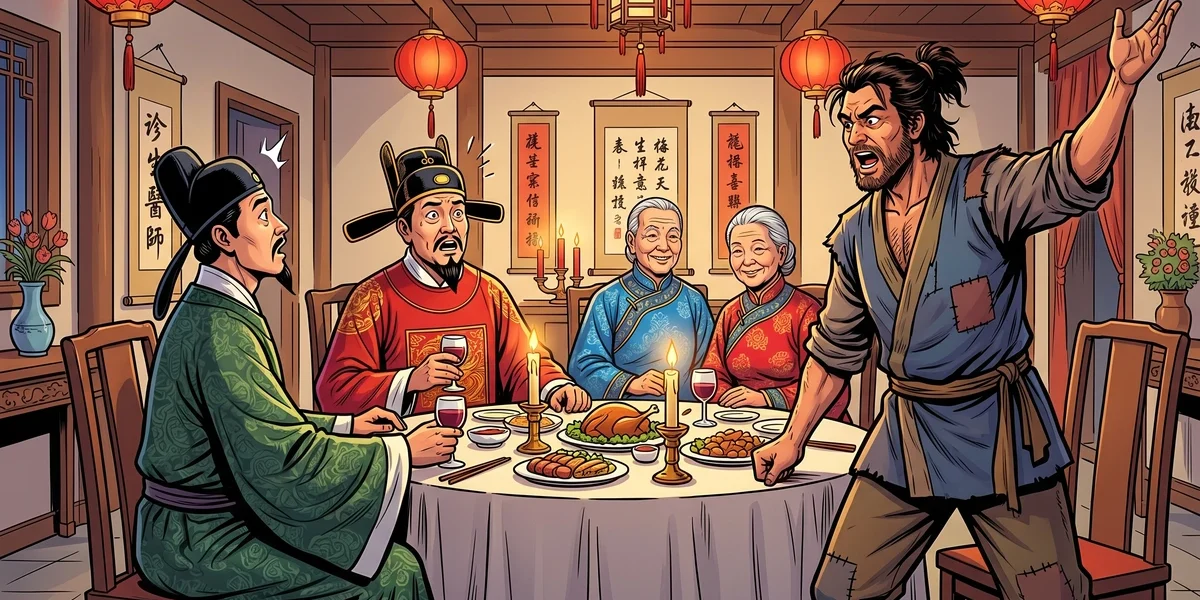
During the Tang dynasty, in a prefecture whose magistrate was known for irascibility, rigid application of law, and a particular dislike of petitioners who wasted his time, three men found themselves simultaneously brought before the court on charges that each privately believed were disproportionate to their actual offenses. The first was a merchant accused of short-measuring grain sales. The second was a teacher accused of accepting improper gifts from students’ families. The third was a traveling entertainer accused of performing unlicensed at a market.
The magistrate, who had had a difficult morning with a complex inheritance dispute and was in no mood for patience, announced that he would deal with all three cases at once and that he would hear each man speak — but only in verse. He was, as it happened, a man of genuine literary cultivation who found that requiring verse of petitioners served a dual function: it saved time (most petitioners, having no ability in verse, quickly admitted their cases and accepted their fines rather than attempt the humiliation of bad poetry) and occasionally produced something interesting when a genuinely talented person appeared before him.
The three men looked at each other with the shared understanding of people who have been assigned an arbitrary challenge and must either rise to it or suffer the consequences. The merchant spoke first, since his case had been called first. He was not, by his own assessment, a poet. But he had spent forty years in the market and had a market trader’s practical understanding of what his audience needed to hear and how to make it land.
Beat II — The Three Verses and Their Work
The merchant’s verse addressed the grain-measuring charge with the particular directness of a man who has nothing to lose by honesty and nothing to gain by evasion. He composed something roughly approximating a quatrain that acknowledged the short measure (claiming it was the result of a faulty scale he had since replaced), pointed to his forty years of trading without previous complaint, and ended with an image of an honest scale balancing the claims of buyer and seller as justice required. It was not elegant verse. But it was honest, and the final image landed with a clarity that more polished work might have obscured. The magistrate, who recognized the honesty, assessed a modest fine and moved on.
The teacher presented a more delicate problem. He had in fact received a gift from a student’s family — a quantity of rice sufficient to be technically classified as improper — but he had received it during a period when his own household was in genuine difficulty following a flood that had destroyed his garden. The accusation was technically correct. The context changed its moral character substantially. A direct statement of the context risked appearing to be making excuses; a denial of the fact risked appearing dishonest.
The teacher’s verse navigated this by making the rice itself the poem’s subject — describing it in terms drawn from classical agricultural poetry, the long Chinese tradition of celebrating the labor of the farmer and the value of the grain that labor produced, placing the gift in a lineage of such gifts across Chinese history and thus making it, through literary allusion, something more dignified than a bribe and something more legible as genuine human generosity in difficult circumstances. The magistrate, who recognized the classical allusions and appreciated both the scholarship and the delicacy, dismissed the charge with a written note that the boundary between appropriate gratitude and improper gift required context for correct interpretation.
The entertainer was the third and most difficult case. An unlicensed performance was a straightforward administrative violation, and the magistrate had a genuine bureaucratic interest in maintaining licensing systems — they generated revenue and provided some measure of quality control. The entertainer was also, as it happened, the most genuinely talented of the three as a composer of verse, which created both an opportunity and a risk: a poem too good might irritate the magistrate by outperforming his own compositions; a poem too clever might appear to be making fun of the court.
The entertainer composed a verse that placed himself in the ancient tradition of itinerant performers who had carried music and story through China’s great agricultural festivals since before the dynasties — a tradition that the Tang court, with its sophisticated interest in popular art forms, genuinely valued. He made the licensing system itself the foil: a regulation designed for permanent establishments could not have anticipated a performer who played only where invited, who charged nothing but accepted what was offered, who had no fixed venue and therefore could not be licensed in the way fixed venues were licensed. The verse ended with a couplet suggesting that the spirit of the regulation — quality assurance — was better served by the magistrate’s own hearing of his performance today than by any license a distant administrator might issue. The magistrate laughed — the desired response — and dismissed the charge on condition that the entertainer perform at the next official banquet.
Beat III — Shi as Political Technology
The three rhymsters’ performances illustrate what Chinese literary scholarship has extensively documented: the function of verse as a medium that allows speech that direct prose would not permit. This is not merely a matter of aesthetic decoration or linguistic indirection; it reflects a genuine social function that poetry has served in Chinese civilization across millennia.
The mechanism operates through several simultaneous channels. Classical allusion places a speaker’s current situation within a larger historical and literary context that can reframe its moral valence — the teacher’s rice-as-agricultural-gift is not a mere rationalization but a genuinely different framing that literary tradition makes available. Formal constraint (the requirement to compose in a recognized form with correct rhythm and rhyme) demonstrates cultivation and intelligence, which in a system where cultivation and intelligence are among the primary legitimating qualities of authority, serves as a form of social credential. And the aesthetic pleasure of a well-composed verse creates a momentary experience of goodwill in the audience that can shift the emotional atmosphere of a hearing before any argument has been made.
The Tang dynasty in particular was a period when these functions were at their most explicit. The Tang court produced some of the greatest poetry in the Chinese tradition — Li Bai, Du Fu, Wang Wei — and the intersection of poetic practice with official life was tighter than in any other period. Officials were expected to compose at official occasions, poems circulated as the primary medium of communication between literati friends separated by official postings, and the ability to compose an appropriate verse quickly was among the most visible forms of cultural competence. In this context, a magistrate who required verse of petitioners was not being eccentric; he was applying the standard medium of official discourse to an administrative context.
Beat IV — Wit, Beauty, and the Ethics of Oblique Speech
The deeper question that the legend raises — and which it does not fully answer, leaving the ambiguity as productive tension — is whether the use of verse to navigate administrative power is honorable or merely clever. The entertainer’s final couplet, which makes the magistrate laugh and achieves the desired dismissal, is genuinely witty and the observation about the regulation’s scope is genuinely valid. But it also works because it flatters the magistrate by making him the measure of quality — a flattery he knows is flattery and accepts anyway because it is elegant.
This is the zone that Chinese literary ethics has debated since at least the Warring States period: when oblique speech that serves truth is not distinguishable from oblique speech that serves convenience. The tradition’s resolution tends to be pragmatic: verse that achieves a just outcome through indirection is preferable to direct speech that achieves an unjust outcome through confrontation with power that cannot be moved by direct speech. Du Fu’s political poetry — which criticized the Tang court’s failures of governance through verse that was simultaneously unmistakably critical and aesthetically beyond reproach — is the canonical example of this principle applied at the highest level.
The three rhymsters are a folk-level version of the same principle. The merchant’s honest quatrain, the teacher’s classical reframing, the entertainer’s witty couplet — each uses the available medium as precisely as the speaker’s skill allows to serve a just outcome in a system where direct speech would have been less effective. The legend presents this not as dishonesty but as literary competence applied to practical life — the understanding that form and content are not separate, and that in a civilization organized around literary culture, mastery of form is itself a form of ethical practice.
“Say the difficult thing beautifully and the official who would have refused it harshly finds himself agreeing before he has understood why. This is not deception — it is the ancient use of the right form for the right moment.”
— Principle embedded in Tang dynasty anecdotal literature about poets and officials
Why This Legend Has Lasted
The Three Rhymsters endures because it captures something true about the relationship between aesthetic form and social power. In any culture that places high value on a particular artistic or rhetorical tradition, mastery of that tradition confers access to forms of influence that are unavailable to those who lack it — and this creates an implicit argument for literacy, cultivation, and the willingness to engage seriously with the forms that a given culture treats as its highest expression.
The legend also affirms something that might otherwise seem merely elitist: that the ability to speak beautifully and precisely is a genuine competency that serves real social functions. The three men who compose verse before the magistrate are not engaged in merely ornamental activity; they are using the most powerful available tool to navigate a situation in which direct speech would have been less effective and less just. This is the oldest argument for the liberal arts: not that beauty is its own justification, but that the capacity for beautiful speech is simultaneously the capacity for precise thought, and that precise thought serves justice in ways that mere assertion cannot.
Poetry in Tang Dynasty Official Culture
The Tang dynasty (618–907 CE) represents the period of poetry’s most complete integration with Chinese official life. The imperial examination system required composition of regulated verse (lü shi, 律詩, eight-line poems with strict tonal and rhyme requirements) as a core competency. Officials were expected to exchange poems at all significant social and official occasions; the inability to compose appropriately was a genuine social disqualification. The great poets of the era — Li Bai (李白), Du Fu (杜甫), Wang Wei (王維), Bai Juyi (白居易) — all held official positions at various points in their careers, and much of their poetry engages directly with official life, political failure, and the experience of serving in a complex bureaucratic system. Bai Juyi in particular was famous for writing poems explicitly as political instruments — his Xin Yuefu (新樂府, New Music Bureau Poems) deliberately used popular folk forms to carry political criticism to audiences beyond the court. The tradition of poetry as political technology was sufficiently well established by the Tang that magistrates requiring verse of petitioners, anecdotes of poems that saved lives or careers, and collections of clever verses exchanged at official confrontations were all recognized genres of literary anecdote with their own established conventions.
You May Also Like
 Chinese Folk Tales
All Ages
Chinese Folk Tales
All Ages
Kwang-Jui And The God Of The River
Kwang-Jui And The God Of The River: China is a land where the great masses of the people have to toil and struggle incessantly in order to obtain even the bare
 Chinese Folk Tales
Ages 9-12
Chinese Folk Tales
Ages 9-12
The Lady Of The Moon
The Lady Of The Moon: In the days of the Emperor Yau lived a prince by the name of Hou I, who was a mighty hero and a good archer. Once ten suns rose together
 Chinese Folk Tales
Ages 9-12
Chinese Folk Tales
Ages 9-12
The Three Evils
The Three Evils: Once upon a time, in the old days, there lived a young man by the name of Dschou Tschu. He was of more than ordinary strength, and no one