The Fire-God
The Fire-God. Kids-friendly retelling with setting, characters, moral, and a lesson for today.
Origin and Tradition
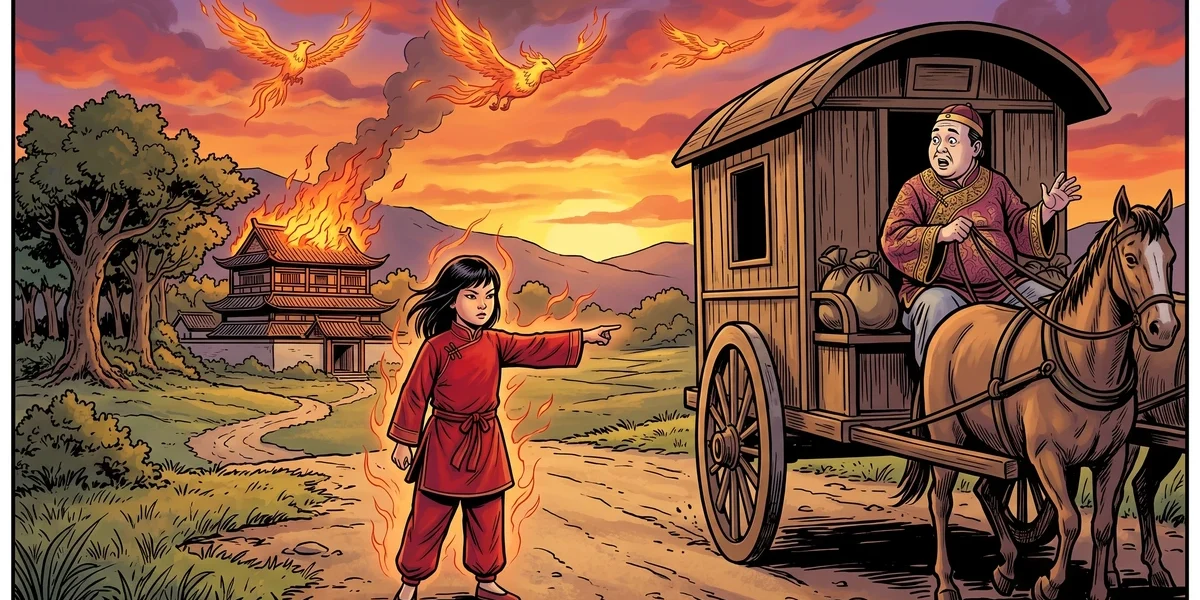
The Fire-God draws on the mythology of Zhu Rong (祝融), one of the oldest and most cosmologically significant deities in the Chinese religious imagination — the divine sovereign of fire and the south, one of the Five Di (五帝 — Five Thearch-Gods) who governed the primordial world before the establishment of human civilisation, and a figure whose mythology preserves some of the most ancient layers of Chinese cosmological thinking. Zhu Rong’s myth is inseparable from his great cosmic adversary, Gong Gong (共工), the Water God of the north, and from the catastrophic conflict between them — one of the foundational mythological events that shaped the world as Chinese tradition understood it.
The story belongs to the group of Chinese primordial myths that scholars of Chinese mythology, particularly Anne Birrell and K. C. Chang, have identified as theomachies (divine wars) — accounts of conflicts between cosmic powers whose battles reshape the physical structure of the world as a consequence of their struggle. Unlike the morally straightforward divine wars of some other traditions, Chinese theomachies tend toward cosmological complexity: neither combatant is simply evil, and the outcome — a damaged but still functioning world — reflects the Chinese cosmological understanding that the universe operates through the dynamic tension between opposing forces rather than the triumph of one over the other.
Zhu Rong: Fire, Summer, and the South
Zhu Rong (祝融 — the name is sometimes interpreted as “invoking the brilliant” or “summoning the luminous”) governs the south and the element of fire within the Chinese five-phase cosmological system. Fire, in Chinese cosmology, is the most yang of the five elemental phases — the energy of summer heat, of the midday sun, of outward expansion and visible brilliance. Zhu Rong’s attributes reflect this cosmic role: he is depicted as a figure of blazing, luminous power, his body wreathed in fire, his presence generating the warmth that sustains life and the heat that can destroy it. In the Shan Hai Jing he is described as the minister of the southern region, ruling the great southern seas and the lands of summer heat.
The Fire God’s mythology intersects with the history of Chinese civilization in a specific and important way: Zhu Rong is credited in some traditions with teaching humanity the use of fire — the technology that more than any other separated human existence from the existence of animals and made possible the cooking, forging, ceramics, and warmth management that are the foundations of material culture. In this capacity he parallels the Greek Prometheus, the Vedic Agni, and other fire-bringer deities whose gift of fire to humanity represents the beginning of civilized life. The Fire God is thus simultaneously a cosmic power and a cultural benefactor — the divine source of humanity’s most transformative technological possession.
Gong Gong and the Great Collision: Fire Meets Water
Gong Gong (共工 — Water God, associated with the north and the flooding waters of rivers) is Zhu Rong’s cosmic opposite and adversary. The conflict between them is one of the most dramatic episodes in Chinese primordial mythology: Gong Gong, described as a serpentine being of enormous power, enters into conflict with Zhu Rong over dominion of the world — whether the primordial epoch’s cosmic governance should be held by fire or water, by the yang south or the yin north. Their battle shakes the cosmos; fire and water collide with the force of two fundamental principles of the universe pressing against each other at maximum intensity.
Gong Gong loses the battle — but his response to defeat is one of the most cosmologically consequential events in Chinese mythology. In his rage at losing, he crashes headfirst into Buzhou Mountain (不周山 — the Pillar That Does Not Surround, one of the mountains that support the dome of heaven), breaking it and causing the sky to tilt toward the northwest and the earth to tilt toward the southeast. This is the mythological explanation for several observed features of the Chinese world: the sky appears lower in the northwest than the southeast; rivers flow toward the southeast; the North Star appears to have shifted from its original zenith position. The cosmological damage of the Gong Gong collision was repaired by the great goddess Nuwa (女媧), who smelted five-coloured stones to patch the hole in the sky.
“When fire and water meet without mediation, both are consumed in the collision — and the world bears the marks of their violence in its very tilt and the direction of its rivers.”
— Chinese commentary on the Zhu Rong/Gong Gong cosmological conflict
Fire in Chinese Religion and Ritual: From Cosmic Power to Household Practice
The Fire God’s cosmic mythology stands behind a rich tradition of fire-related ritual practice in Chinese popular religion. The kitchen hearth — the most fundamental source of fire in any traditional household — was presided over by the Zao Jun (灶君 — God of the Stove or Hearth God), a deity who, while distinct from the cosmological Zhu Rong, participates in the same understanding of fire as a sacred power requiring proper management and propitiation. The Hearth God’s annual report to the Jade Emperor, already mentioned in connection with the karmic retribution tradition, was the domestic-scale expression of the same cosmic principle that Zhu Rong embodies at the universal scale: fire mediates between earth and heaven, between the human and the divine, reporting to the celestial authority on the quality of human conduct.
The ritual burning of paper offerings — ghost money, paper replicas of worldly goods, written petitions — in Chinese popular religious practice also draws on the Fire God mythology’s understanding of fire as the medium of communication between the human and divine realms: what is burned crosses the boundary between worlds, reaching the celestial courts or the underworld as material offerings transformed by fire into the appropriate spiritual currency. Fire’s power to transform matter — turning the solid into the gaseous, the opaque into light, the dense into dispersal — is precisely its cosmological function: it is the force of transformation itself, the agent through which things change their state and cross the boundaries between categories.
Why This Story Endured
The Fire God mythology endured because fire itself endures as one of the most fundamentally ambivalent phenomena in human experience: simultaneously the source of warmth, light, cooked food, and technological possibility, and the agent of destruction, disaster, and death. No human culture that has lived with fire — which is to say, all human cultures — can remain neutral about it; all invest it with religious significance, treating it as something that must be managed, propitiated, and properly related to rather than simply used as a neutral tool. The Chinese Fire God mythology gives this universal human ambivalence about fire its most cosmologically elaborate expression — placing fire at the centre of a universe whose very shape (tilted, river-draining southeastward) is the residue of a divine battle between fire and water.
The collision between Zhu Rong and Gong Gong also endured because it encodes a sophisticated cosmological insight: that the great opposing forces of the universe — fire and water, yang and yin, the southern heat and the northern cold — are not simply enemies to be resolved but necessary tensions whose proper management sustains the cosmos, and whose catastrophic collision when either exceeds its proper domain leaves marks that persist in the very structure of the physical world. The Fire God’s story is thus not simply a myth about a divine battle but a cosmological teaching about the structure of reality and the consequences of imbalance.
You May Also Like
 Chinese Folk Tales
Ages 9-12
Chinese Folk Tales
Ages 9-12
The Sorcerer Of The White Lotus Lodge
The Sorcerer Of The White Lotus Lodge: Once upon a time there was a sorcerer who belonged to the White Lotus Lodge. He knew how to deceive the multitude with
 Chinese Folk Tales
Ages 9-12
Chinese Folk Tales
Ages 9-12
How Molo Stole The Lovely Rose-Red
How Molo Stole The Lovely Rose-Red: At the time when the Tang dynasty reigned over the Middle Kingdom, there were master swordsmen of various kinds. Those who
 Chinese Folk Tales
Ages 9-12
Chinese Folk Tales
Ages 9-12
The Legend of the White Snake: Love Beyond Form and Fear
The Legend of the White Snake: Love Beyond Form and Fear: In the misty valleys of ancient China, where dragons still whispered through bamboo groves and