How The River-God’s Wedding Was Broken Off
How The River-God's Wedding Was Broken Off - a folk tale retold for young readers with a clear moral, simple words, and the warmth of a bedtime story from...
Origin and Tradition
How the River-God’s Wedding Was Broken Off is one of the most celebrated political legends of ancient China, rooted in the historical career of Ximen Bao (西門豹), the Legalist-influenced administrator who governed Ye county in the state of Wei during the Warring States period (c. 422 BCE). The story is preserved in the Shi Ji (史記 — Records of the Grand Historian) of Sima Qian, the Zhan Guo Ce (Stratagems of the Warring States), and numerous regional folk collections, each transmission layer adding detail while preserving the essential confrontation between rational governance and the corrupt exploitation of popular religion. As a folk tale, it circulated far beyond its historical origins, becoming a paradigmatic story about the duty of the virtuous official to protect the people against those who abuse religious authority for personal gain.
The River God in question is He Bo (河伯 — Lord of the River), the deity of the Yellow River, one of the oldest and most powerful figures in the Chinese religious imagination. He Bo appears in the Shan Hai Jing and in the great Chu elegies of Qu Yuan, where he is described as a powerful and demanding figure requiring ritual propitiation from the communities living along the Yellow River’s turbulent banks. The practice of sending brides to the river — human sacrifice dressed as divine marriage — had deep roots in ancient Chinese river cult practice, but by the Warring States period, such practices had been captured and institutionalised by local priestly and official elites who extracted massive tribute from rural communities under religious sanction.
The Narrative: A Governor Confronts Sacred Exploitation
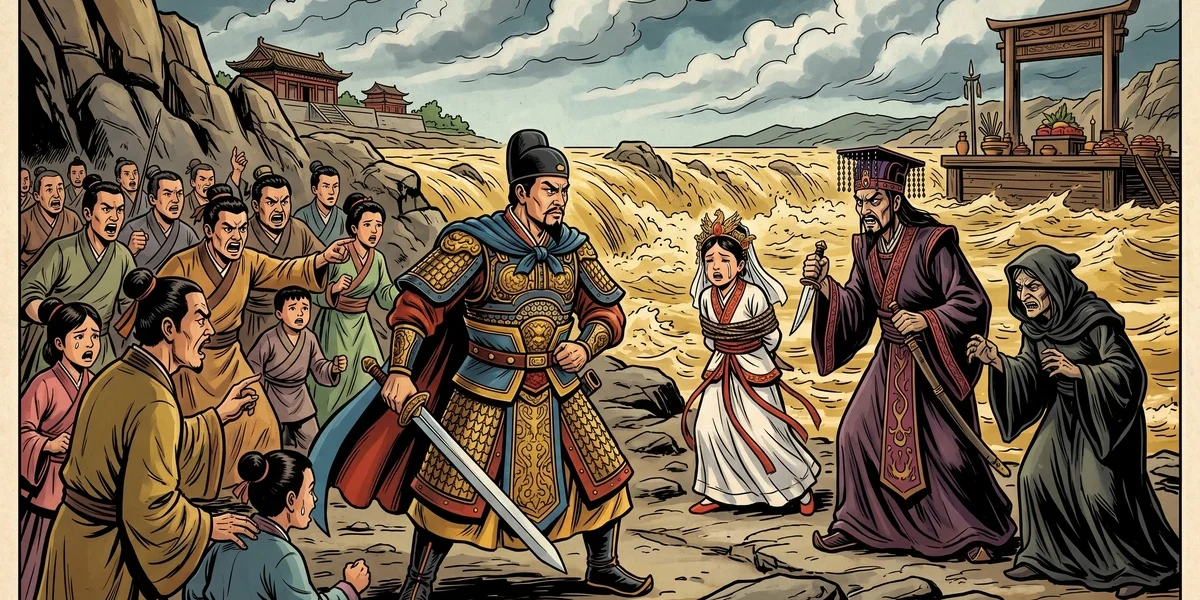
When Ximen Bao arrives to govern Ye, he discovers that the county has been systematically impoverished by an annual ritual: a young woman, selected from the families of the poor, is designated as the “bride” of He Bo, adorned at enormous communal expense, and drowned in the Yellow River. The ceremony is administered by a triumvirate of corrupt operators — the chief sorcerer (wu zhu), the local elders who profit from the tribute collection, and the wealthy families who ensure their own daughters are never selected. Year after year, the poorest families are compelled to give up daughters and funds; those who resist are warned that the River God’s anger will bring flood and catastrophe.
Ximen Bao attends the next ceremony in his capacity as governor. He examines the bride, expresses concern that she is insufficiently beautiful to please so great a deity, and proposes that the sorcerer swim out to the River God’s court to explain the delay and arrange a suitable replacement. When the sorcerer hesitates, Ximen Bao has him thrown into the river. The same fate meets several of the collaborating elders who are sent after him to “hurry the negotiations.” After a suitable pause, Ximen Bao observes pleasantly that the River God appears to be detaining his messengers, and suggests the remaining officials wait patiently on the bank. The ceremony is never held again.
Moral Architecture: Legitimate and Illegitimate Sacred Authority
The story’s moral genius lies in its refusal of simple secularism. Ximen Bao does not deny He Bo or mock the river cult; he uses the internal logic of the religious system against its corrupt operators. If the River God is powerful enough to demand a human bride, he is powerful enough to receive the sorcerer as a messenger. If the ritual is legitimate, those who administer it should be willing to participate in it personally. The corrupt operators are exposed not by rationalist scepticism but by their own unwillingness to submit to the religious obligations they impose on others.
This rhetorical strategy reflects the Chinese tradition of zhengming (正名 — rectification of names), the Confucian insistence that things be called by their true nature and that social roles carry genuine obligations. The sorcerer claims the authority of religious office; Ximen Bao holds him to the actual implications of that claim. In doing so, the governor enacts the Confucian principle that legitimate authority — whether sacred or political — must be grounded in genuine service to the people, not in the manipulation of people’s beliefs for private gain.
“The official who truly serves the people does not wait for heaven to correct what humans have corrupted — he acts, and heaven confirms his action.”
— Chinese proverb in the Ximen Bao tradition
The River God He Bo: Sacred Geography and Political Religion
He Bo’s religious significance in pre-Han China was considerable. The Yellow River (黄河, Huang He) was simultaneously the source of the North China Plain’s agricultural fertility and its greatest periodic destroyer, its floods capable of obliterating entire communities with no warning. In this context, the propitiation of the River God was not mere superstition but a response to a genuine and terrifying natural force that the ancient Chinese had no technological means to control. The bride-gift ritual encoded this relationship between human vulnerability and divine power in its most extreme form: the offering of a human life to the river’s demand.
By the Warring States period, however, the state-building project of competing kingdoms required the rationalisation and reform of local religion — the replacement of chaotic, locally-administered ritual with standardised state cult practice that served political rather than merely propitiatory functions. Ximen Bao’s action can be read in this context as a Legalist administrative intervention: the governor does not abolish the river cult but severs its connection to exploitative local operators, redirecting the community’s resources toward irrigation projects that actually addressed the flood problem He Bo was supposed to manage. The story thus contains a political programme as well as a moral lesson.
Why This Story Endured
The story of Ximen Bao and the River God’s wedding has endured for over two millennia because it addresses a perennial dimension of social life: the exploitation of popular religious belief by those with access to sacred authority. Every generation in every culture has encountered figures who claim divine sanction for practices that conveniently enrich themselves at the expense of those they claim to serve. The story provides a model for how to confront such exploitation — not through crude scepticism that alienates the believing community, but through the precise, pointed use of the exploiter’s own logic to expose the gap between claimed sanctity and actual behaviour.
Chinese folk tradition preserved this story not merely as historical record but as a manual of righteous governance, a demonstration of how the virtuous official fulfils the Confucian obligation to protect the people (保民, bao min). In the folk memory, Ximen Bao becomes a model administrator — wise, courageous, strategically brilliant, and genuinely concerned with the welfare of those in his care. The story’s continuing resonance, across Chinese literary culture from Sima Qian to contemporary retellings, confirms that the problem it addresses — sacred authority misused for private gain — remains permanently, universally recognisable.
You May Also Like
 Chinese Folk Tales
All Ages
Chinese Folk Tales
All Ages
The God Of The City
The God Of The City: One evening in the distant past a fisherman anchored his boat near the bank of a stream which flowed close by a great city, whose walls
 Chinese Folk Tales
Ages 9-12
Chinese Folk Tales
Ages 9-12
Pearl From Beneath The Chin Of A Black Dragon
Pearl From Beneath The Chin Of A Black Dragon - a folk tale retold for young readers with a clear moral, simple words, and the warmth of a bedtime story...
 Chinese Folk Tales
Ages 6-8
Chinese Folk Tales
Ages 6-8
The Three Rhymsters
<p>Three sisters discover that clever words must serve kindness; inner virtue matters more than wit alone.</p>