The Spirits Of The Yellow River
The Spirits Of The Yellow River: are called Dai Wang Great King. For many hundreds of years past the river inspectors had continued to report that all sorts of

He Bo and the Divine Ecology of China’s River of Sorrows
The Spirits Of The Yellow River engages one of the oldest and most complex figures in Chinese mythology: He Bo (河伯, Lord of the River), the deity of the Yellow River — the Huang He (黃河) — whose veneration predates written Chinese history and whose moral and spiritual significance is inseparable from the river’s central role in the formation of Chinese civilization. No body of water in Chinese culture carries more accumulated meaning: the Yellow River is simultaneously the cradle of Chinese civilization, the source of catastrophic floods that shaped Chinese statecraft for five thousand years, and a living presence whose moods and behaviors were understood as reflecting both cosmic conditions and the quality of human governance along its banks.
He Bo appears in the Shan Hai Jing (山海經), in the poetry of Qu Yuan’s Chu Ci (楚辭, Songs of Chu, 3rd century BCE), in the historical records of river sacrifices maintained by successive dynasties, and in the famous account by Si Maqian of the brutal practice of “marrying” young women to the river god — a practice that the administrator Ximen Bao famously abolished in the Warring States period by throwing the officiating priests into the river when they claimed the bride was not beautiful enough. The Yellow River’s divine ecology is thus inseparable from the history of human attempts to both honor and reform the relationship between communities and the great natural force that determined their survival.
Beat I — What Lives in the Yellow Water
The Yellow River takes its name from the extraordinary sediment load it carries — the fine loess soil of the Chinese interior highlands that the river picks up across its 5,464-kilometer journey from the Tibetan plateau to the Bohai Sea. The water is genuinely, opaquely yellow for much of its middle and lower course, and this characteristic color — so unlike the blue-green clarity of rivers in other traditions — gave the river a particular visual identity that Chinese culture encoded as something between sacred and ominous. The yellow color spoke simultaneously of the fertility deposited onto the North China Plain and the destructive power of floods carrying enormous quantities of this same soil.
The spirits that traditional accounts place in the Yellow River reflect this dual character. He Bo himself is typically depicted as a pale figure in white and blue robes, riding two dragons through the yellow water — a figure of controlled power over a force that is inherently difficult to control. Around him the tradition places a population of lesser river spirits: the shui gui (水鬼, water ghosts) of the drowned, who are said to seek substitutes among the living before they can move on; the jiao (蛟, river dragons) who inhabit the deep channels and emerge during floods; and the spirits of those who died heroically in flood-control efforts, who are sometimes understood to continue their work in a spiritual register.
A specific legend in the broader Yellow River spirit tradition concerns a ferryman named Lao Jiang who operated a crossing near Mengjin — the ancient ford where the river was historically narrow enough to cross but still treacherous. Lao Jiang had worked this crossing for forty years and had developed a relationship with the river that went beyond mere professional competence. He knew the river’s moods: the particular quality of light on the water that preceded a sudden rise, the sound changes in the current that meant sand was shifting dangerously in the channel, the way the yellow water changed texture before a wall of flood water came down from the upstream gorges.
Beat II — The Night of the River Council
On a night in late summer — when the river’s annual flood cycle was near its peak and the current was running fast and brown with mountain runoff — Lao Jiang could not sleep. He sat at the river’s edge watching the water, as he had done on many such nights. Toward midnight he became aware that the usual sounds of the river — the slap and pull of current against bank, the distant roar of rapids upstream — had changed. The water was still and silent in a way it never was, as if listening.
In the stillness he heard voices. Not the voices of the drowned — which the river tradition warned were a danger, voices that could draw the unwary into the water — but something different: a formal, deliberate exchange that had the quality of a council in session. He could not make out individual words, but he understood, in the way that forty years of conversation with a river teaches understanding, that the river spirits were discussing something that concerned the communities downstream.
At dawn the voices stopped. The river resumed its normal conversation with its banks. Lao Jiang, acting on a certainty he could not have explained in rational terms, crossed the river immediately and walked upstream to find the village headman of the settlement on the far bank. He told the headman that the river was going to flood beyond the normal seasonal high mark within three days and that the lower fields and the cluster of houses nearest the bank needed to be evacuated.
The headman, who knew Lao Jiang’s forty-year record of accurate river reading, ordered the evacuation without demanding an explanation he understood Lao Jiang could not fully provide. The flood came on the second day — not the third — and was the largest in thirty years. The lower fields were destroyed; the houses nearest the bank collapsed into the new channel. No one died. The tradition records that Lao Jiang, who had already crossed back to his own bank before the flood peak, felt the river push against his hull with something that seemed, in his experience, like gratitude for the warning having been passed along.
Beat III — He Bo, Hydraulic Civilization, and the Politics of River Deity
The Yellow River’s spiritual tradition is unique among world river deity traditions in its explicit entanglement with state power and hydraulic engineering. The Chinese state’s relationship with the Yellow River flood control has been described by scholars as one of the defining challenges of Chinese governance — “the hydraulic state” hypothesis proposes that the organizational demands of coordinating large-scale flood control along the Yellow River was itself a driver of the centralized administrative structures that characterize Chinese political history.
He Bo’s tradition reflects this entanglement. The river god is not simply a nature deity to be propitiated with offerings; he is understood as a cosmic administrator responsible for the river’s behavior in the same way that human officials are responsible for the behavior of their jurisdictions. When the river floods catastrophically, the tradition’s response is not only religious (increased offerings, prayers, processions) but also quasi-bureaucratic: the emperor may issue a formal reprimand to He Bo, recorded in official documents, holding the river deity accountable for the damage.
This is not naivety about causation — the same administrative tradition that issued reprimands to river deities also maintained sophisticated engineering bureaus employing thousands of workers on flood control infrastructure. The dual approach reflects the Chinese administrative understanding that physical and ritual measures operate in different registers and that neither alone is sufficient: the levees matter and the relationship with the river’s spiritual dimension matters, because effective governance of a force as powerful as the Yellow River requires engagement at every level of the reality it inhabits.
The practice of “marrying” young women to He Bo — abolished by Ximen Bao’s famous intervention — represents the extreme end of a propitiation logic that the mainstream tradition consistently tried to reform. Qu Yuan’s great poem He Bo in the Chu Ci treats the river deity with reverent beauty rather than fearful appeasement, imagining him as a being of extraordinary power but also of aesthetic sensitivity and genuine connection to the human world. This literary tradition — river deity as partner rather than monster — reflects the reformed relationship that Chinese civilization progressively developed with its great river across millennia.
Beat IV — The Yellow River as Archive of Chinese Civilization
The deepest dimension of the Yellow River spirit tradition is its function as an archive — a living record of everything Chinese civilization has experienced in relationship with this particular body of water across five thousand years of continuous habitation. The river has flooded approximately 1,600 times in recorded history, changed its course dramatically 26 times, and shifted its mouth between north and south of the Shandong Peninsula nine times. Every one of those catastrophic events is encoded somewhere in the tradition: in flood control mythology, in the stories of heroic administrators who managed crisis years, in the temple inscriptions that record specific floods with their death tolls, in the ghost traditions of the drowned that cluster along particular bends in the river.
Lao Jiang’s ability to read the river’s mood and hear what he hears as a council of spirits is, at one level, the accumulated product of this entire tradition distilled into a single person’s forty-year practice. He is not hearing anything supernatural; he is hearing what a man who has given forty years of careful attention to a river can hear: the sub-audible signals in the water’s movement and sound that indicate coming flood conditions. The tradition’s genius is to encode this practical knowledge in spiritual language — to treat Lao Jiang’s expertise as a form of intimacy with the river’s spirit, because that is precisely what it is.
The Yellow River does not merely run through Chinese civilization; in a meaningful sense it is Chinese civilization — the force that shaped the agriculture, the governance, the hydraulic engineering, the flood mythology, the river deity traditions, the great migrations triggered by catastrophic floods, and the long patient work of communities rebuilding after each inundation. To know the spirits of the Yellow River is to know something of what five thousand years of living beside a terrible and generous force has made of the people who stayed.
“The river remembers everything that has happened on its banks. To listen to the river carefully enough is to hear the whole history of the people who have lived beside it.”
— Principle of Yellow River spirit veneration tradition, North China
Why This Legend Has Lasted
The Spirits Of The Yellow River persists because it holds together the river’s full complexity: its practical terror and its cultural centrality, its destructive power and its agricultural gift, its spiritual presence and its engineering challenge. Lao Jiang’s night of listening at the river’s edge — hearing what cannot quite be explained and acting on what cannot quite be justified — is the legend’s image of what mature relationship with a great natural force looks like: not domination, not submission, but the kind of careful, long-practiced attention that eventually crosses the threshold from observation into something that feels like communication.
The Yellow River remains one of the most hydrologically challenging rivers on earth — its sediment load, its tendency to build up its own bed above the level of surrounding terrain, its catastrophic potential — and Chinese civilization has lived beside this challenge for five thousand years without either completely mastering it or being destroyed by it. The tradition of He Bo and the river spirits is part of what has made that coexistence possible: a cultural framework that treats the river as a participant in the human project, requiring relationship rather than mere management, attention rather than mere engineering, honoring rather than mere exploitation.
He Bo and the History of Yellow River Veneration
He Bo (河伯, Lord of the River) is one of the oldest named deities in Chinese religious tradition, with attestations in oracle bone inscriptions from the Shang dynasty (approximately 1600–1046 BCE). He appears in the Chu Ci poetry as a figure of beauty and power, imagined riding dragons through the river’s depths. The practice of annual sacrificial offerings to He Bo — including, in some periods and regions, the drowning of young women as “brides” — is documented in historical sources and was the subject of reforming action by officials throughout Chinese history, most famously Ximen Bao (西門豹) of the Wei state in the 4th century BCE, who forced the local priests into the river, effectively ending the practice in his jurisdiction. The Yellow River has flooded catastrophically approximately 1,600 times in recorded history, with the 1931 flood being the deadliest natural disaster of the 20th century (estimated 850,000–4 million deaths). Modern hydraulic management of the river, including the Sanmenxia and Xiaolangdi dams, has substantially reduced flood risk but has not eliminated the river’s role as a central cultural and spiritual reference in Chinese civilization.
You May Also Like
 Chinese Folk Tales
Ages 6-8
Chinese Folk Tales
Ages 6-8
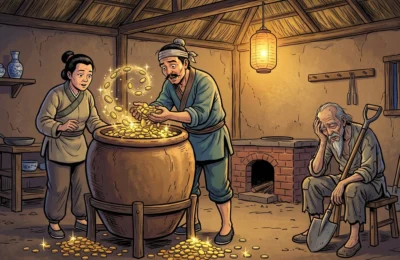
The Magic Cask
The Magic Cask: Once upon a time there was a man who dug up a big, earthenware cask in his field. So he took it home with him and told his wife to clean it out.
 Chinese Folk Tales
All Ages
Chinese Folk Tales
All Ages
The Disowned Princess
The Disowned Princess: At the time that the Tang dynasty was reigning there lived a man named Liu I, who had failed to pass his examinations for the doctorate.
 Chinese Folk Tales
All Ages
Chinese Folk Tales
All Ages
The Tragedy Of The Yin Family
The Tragedy Of The Yin Family: In a certain district in one of the central provinces of China, there lived a man of the name of Yin. He was possessed of