How the Five Ancients Became Men
Five elemental Ancients shape heaven and earth from chaos, make plants, beasts, and people, and crown the White Jade Ruler as the highest god.
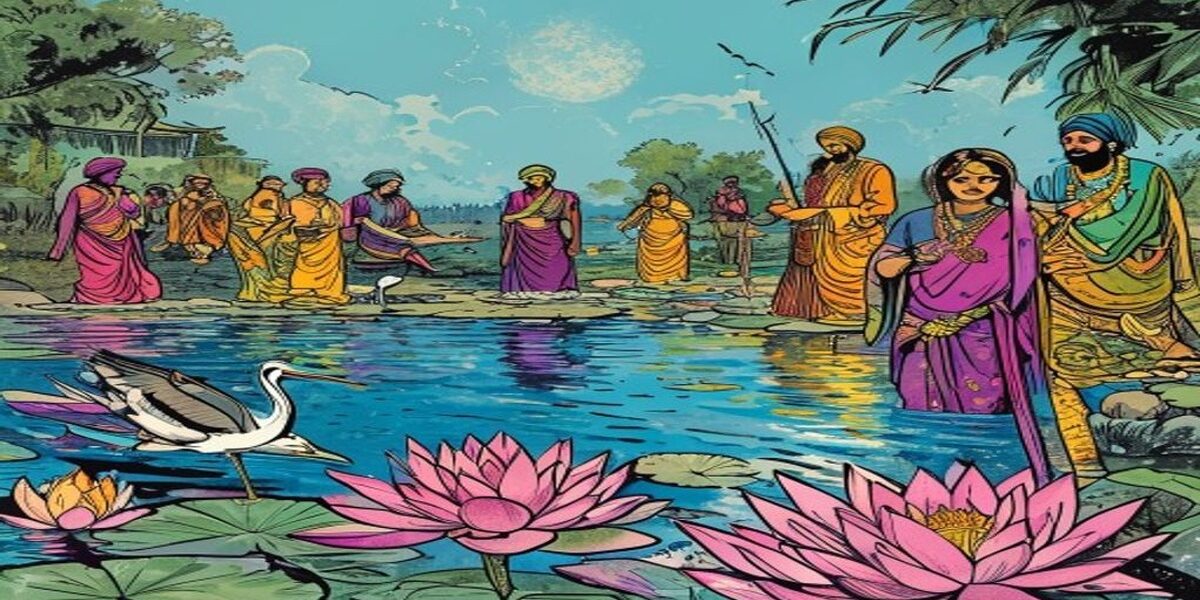
In this creation legend, before heaven and earth had been pulled apart, there was nothing but a huge ball of watery mist called chaos. Out of it the spirits of the five elemental powers took form, and these became the five Ancients.
The first was the Yellow Ancient, ruler of earth. The second was the Red Lord, ruler of fire. The third was the Dark Lord, ruler of water. The fourth was the Wood Prince, ruler of wood. The fifth was the Mother of Metals, who governed all metals.
Together the five Ancients set their first, deepest spirit-force moving. Water and earth sank; the sky floated up; the ground grew solid far below. They let the waters run together into rivers and seas, and hills and plains rose into view. So heaven opened and earth was divided from it, and there were sun and moon and all the stars, and wind, clouds, rain, and dew.
The Yellow Ancient set the purest power of the earth turning in a circle and mixed in the workings of fire and water. From this sprang grasses and trees, birds and four-footed beasts, snakes and insects, fish and turtles. The Wood Prince and the Mother of Metals joined light with darkness, and so they made human beings, men and women. Little by little, the world took shape.
In those days there was one called the True Prince of the Jasper Castle, who had won mastery of magic through long practice. The five Ancients asked him to reign as the highest god. He lived above the thirty-three heavens in the Jasper Castle, built of white jade with gates of gold. Before his throne stood the stewards of the twenty-eight houses of the moon, the gods of thunder, the gods of the Great Bear, and a band of harmful gods whose power brought evil and death. All of them helped him govern the countless peoples under heaven and hand out life and death, good luck and bad. The tale calls the Lord of the Jasper Castle the Great God, the White Jade Ruler.
Their work done, the five Ancients stepped back and lived on in quiet purity. The Red Lord lives in the South as the god of fire. The Dark Lord lives in the North, mighty master of the dark polar skies, in a castle of liquid crystal; in a later age he sent Confucius down to earth as a saint, which is why Confucius is called the Son of Crystal. The Wood Prince lives in the East. People honor him as the Green Lord; he watches over the birth of every creature, the power of spring lives in him, and he is the god of love. The Mother of Metals lives in the West beside the Jasper Sea. She is also called the Queen-Mother of the West; she leads the dances of the fairies and watches over change and growth.
The Yellow Ancient lives in the middle, and he is always travelling through the world to rescue and help anyone in trouble. On his first visit to earth he was the Yellow Lord, who taught people all kinds of skills. In his old age he grasped the meaning of the world on the Ethereal Mount and flew up to the shining sun. Under the Dschou dynasty he was born again as Li Oerl, and since his hair and beard were white at birth, he was called Laotsze, the “Old Child.” He wrote the book of “Meaning and Life” and spread its teaching across the world, and he is honored as the head of Taoism. When the Han dynasty began, he came once more as the Old Man of the River, Ho Schang Gung, and spread the teaching of Tao so widely that Taoism flourished greatly. The tale associates these teachings with the Yellow Ancient.
There is also a saying: “First Laotsze was, then the heavens were.” Within this legend, the saying identifies Laotsze with the Yellow Ancient of the earliest days.
About this story
This creation legend is the first of the “Legends of the Gods” in Richard Wilhelm’s The Chinese Fairy Book, translated by Frederick H. Martens (Stokes, 1921). Wilhelm notes that he gives it in the version told among ordinary people, in which the five elemental spirits—earth, fire, water, wood, and metal—are woven into a story of how the world began.
His note adds that the White Jade Ruler, Yu Huang Di, is rendered by this edition as a familiar name for “the good lord,” that “White Jade” simply expresses his dignity, and that he is the highest of thirty-three Yu Huangs. Wilhelm compares him to the Indian god Indra, whose heaven also has thirty-three halls.
Read the original: Richard Wilhelm, The Chinese Fairy Book (Project Gutenberg)
Best for ages 9–12 — a creation myth packed with gods, directions, and big ideas.
Reading the story closely
The story has two organizing patterns. First the five powers work together to separate and populate the world; then they take distinct places—center, south, north, east and west. The Yellow Ancient differs again by returning in several human forms, linking creation with the later transmission of teaching.
Draw a five-point map and label each Ancient’s direction, material and activity. Use a second line to follow the Yellow Ancient’s appearances. This separates a spatial pattern from a sequence through time and helps explain why the ending returns to the figure introduced first. These relationships belong to this telling; they should not stand for every Chinese creation tradition.
Talk about it
- Which five powers do the five Ancients rule?
- Where does each Ancient live after the world is made?
- Why does the story connect the Yellow Ancient with Laotsze?
You may also like
- Laotsze — the full legend of the Old Child
- The Creation of the World from Ymir’s Body — a Norse story of how the world began
- The Fire-God — the Red Lord of the South in another Wilhelm legend
Frequently Asked Questions
Who are the five Ancients?
Who did the Ancients crown as the highest god?
How is the Yellow Ancient linked to Laotsze?
You May Also Like
 Chinese Folk Tales
Kwang-Jui and the God of the River
A scholar who frees a captured fish is murdered by a boatman who steals his post, but the River God keeps him safe until his son brings justice.
 Chinese Folk Tales
Ages 9-12
Chinese Folk Tales
Ages 9-12
How Molo Stole the Lovely Rose-Red
A young man cannot read a palace girl’s secret finger signs, but his old servant Molo, a flying sword hero, can, and rescues her over ten walls.
 Chinese Folk Tales
The Frog Princess
Sia's marriage to a frog-princess is broken repeatedly by his abuse; the tale ends with a reconciliation whose terms invite scrutiny.