Rose Of Evening
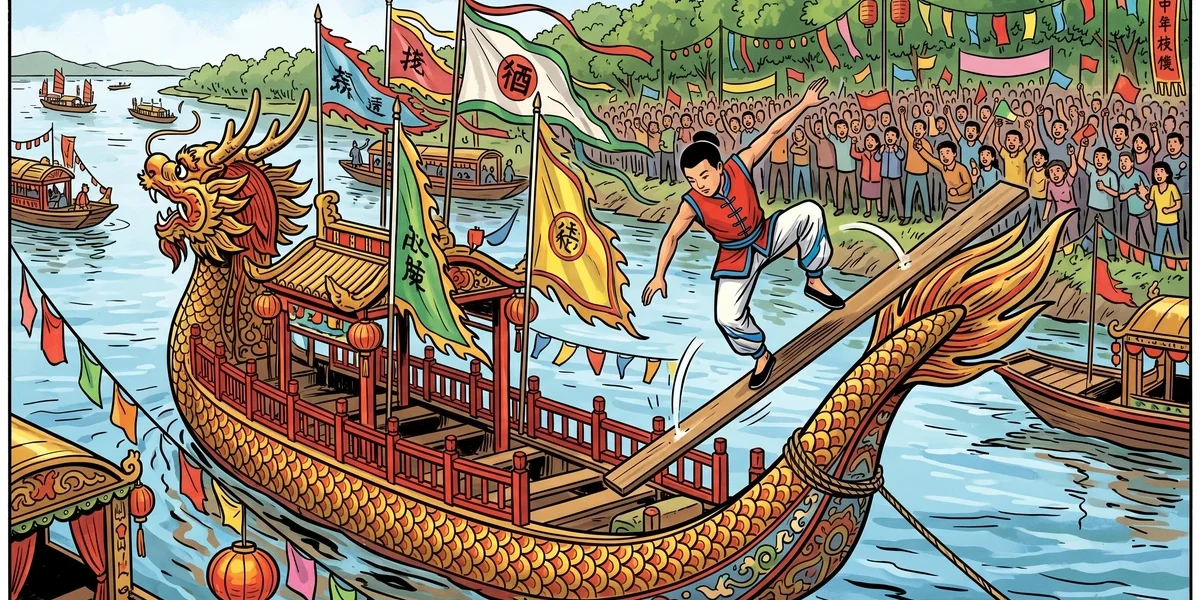
Rose Of Evening: On the fifth day of the fifth month the festival of the Dragon Junk is held along the Yangtze-kiang. A dragon is hollowed out of wood, painted
Origin and Tradition
Rose of Evening belongs to the hua jing (花精 — flower spirit) or hua xian (花仙 — flower immortal) tradition of Chinese folk narrative — the vast body of tales in which flowers, trees, and plants achieve sufficient spiritual concentration through long years of existence to manifest as beautiful women who move between the natural world and the human realm. This tradition, elaborated most gorgeously in Pu Songling’s Liaozhai Zhiyi and the later novel Jinghua Yuan (鏡花緣 — Flowers in the Mirror), rests on the fundamental Chinese cosmological conviction that any natural phenomenon — mineral, vegetable, or animal — that accumulates sufficient ling qi (靈氣 — spiritual essence or numinous energy) over time will eventually develop consciousness and the ability to take human form.
The “Evening” aspect of the Rose of Evening title situates this story within a specific and symbolically rich temporal zone: the Chinese poetic and mythological tradition of huang hun (黄昏 — dusk/twilight), the transitional hour between day and night that Chinese literary culture associated with heightened emotional intensity, the thinning of boundaries between the human and spirit worlds, and the emergence of beauty that ordinary daylight conceals. The great Tang dynasty poets — Du Fu, Li Bai, Wang Wei — returned obsessively to dusk as the hour of philosophical reflection and spiritual encounter; in folk narrative, it is the hour when spirits are most easily perceived and when the flower spirits’ beauty, enhanced by the soft quality of evening light, is at its most overwhelming.
The Narrative: A Spirit Born from Twilight Colour
The Rose of Evening is a spirit born from years of absorbing the particular quality of light that falls on rose blossoms at dusk — the deep, saturated crimson that the setting sun draws from petals that have been gathering light all day and now release it in concentrated form as day dissolves into night. She is, in the truest sense, a creature of the threshold: neither fully of the day nor fully of the night, neither human nor quite spirit, her beauty partaking of the transient quality of the dusk itself — present, intensely, for a brief period before dissolving into darkness.
She appears to a solitary young man — a scholar, an artist, or a lonely young person living apart from the usual social structures — who encounters her at the garden’s edge in the evening hours. Unlike the fox spirits of other tales, whose appearances are strategic and whose relationships with humans are complex moral negotiations, the Rose of Evening comes simply: drawn to the quality of perception in someone who has learned to be still enough at dusk to notice what the evening reveals. Their encounters unfold in the hours of threshold light, disappearing when full dark comes, and the young man must learn whether he can love what can only be met in the in-between — what cannot be owned, domesticated, or brought fully into the daylit world without losing what makes it extraordinary.
Flower Spirits in Chinese Literature: Ling Qi, Cultivation, and the Right to Human Form
The metaphysical framework underlying the flower spirit tradition is the Chinese doctrine of ling qi (靈氣 — numinous/spiritual energy), which held that all natural phenomena possess an inherent energy or spiritual vitality that can be cultivated, concentrated, and developed over time. Plants that survive for exceptionally long periods, or that grow in locations of concentrated natural energy (near dragon veins, sacred mountains, or confluences of yin and yang forces), accumulate sufficient ling qi to cross the threshold between plant consciousness and the capacity for human experience and human form.
This capacity for threshold-crossing was not unlimited: the flower spirit typically cannot sustain human form indefinitely, cannot survive in environments hostile to her plant nature, and is bound by the seasonal and daily rhythms of her botanical origin. The rose spirit’s evening hours correspond to the rose’s own peak moment of fragrant intensity; the plum blossom spirit (a figure of parallel importance in Chinese literature) appears only in the cold months when the plum blooms against snow. These constraints are not limitations in a negative sense but expressions of the spirit’s essential nature: she is most fully herself in the conditions that correspond to her botanical being, and the human who loves her must learn to love precisely this conditioned, seasonal, bounded beauty rather than demanding an unconditional presence she cannot give.
“She comes when the day grows quiet and the garden holds its breath; she cannot stay when the lamps are lit and the world grows loud again — but she was here, and the fragrance remains.”
— Chinese flower spirit romance tradition
Twilight as Liminal Sacred Space: Huang Hun in Chinese Cosmology
The temporal setting of the Rose of Evening story — dusk, the threshold between day and night — carries specific cosmological significance in Chinese thought that enriches every detail of the narrative. Huang hun (黃昏 — literally “yellow dusk”) is the hour when yin (陰) energy begins its ascent as yang recedes: the hour of transition between the male, solar, active principle and the female, lunar, receptive principle. Flower spirits, associated with beauty, fragrance, emotional depth, and the capacity for transformation, are quintessentially yin entities; dusk is the hour of their greatest power precisely because it is the hour of yin’s emergence.
The association of dusk with spiritual permeability — the sense that the normal boundaries between human and non-human worlds grow thin at the transition between day and night — is found across Chinese folk belief and is documented in the institutional guidelines of Daoist ritual practice, which often scheduled the most spiritually significant ceremonies for twilight or dawn (the two threshold hours of the day). The Rose of Evening’s appearances at dusk are thus not merely atmospheric but cosmologically precise: she emerges at the moment when the world’s spiritual architecture makes encounter between human and spirit consciousness most possible, and she retreats when that architecture reasserts its ordinary daylight configuration.
The Ethics of Loving What Cannot Stay
The Rose of Evening narrative, like the finest of its genre, is ultimately a meditation on what it means to love something that is beautiful precisely because of its transience and its refusal of permanent possession. Chinese literary culture had a deeply developed aesthetic of meihua de shunshi (美花的瞬時 — the instantaneous beauty of flowers), most fully articulated in the Buddhist-inflected observation that the cherry blossom’s beauty is inseparable from its falling, the plum’s fragrance inseparable from its blooming in cold and solitude. The flower spirit embodies this aesthetic made personal: she is not a woman who happens to be associated with flowers but the spirit of floral beauty itself — present, brilliant, fragrant, gone.
The young man who loves the Rose of Evening must choose between two modes of relationship: the grasping love that demands permanence and is destroyed by its own demand (he cannot keep her past dawn without losing her forever), and the open-handed love that receives each evening encounter as complete in itself — a love that finds in the quality of each brief meeting everything that matters, without requiring it to extend beyond its natural limit. This ethical choice, dramatised through the magical framework of the flower spirit encounter, addresses something permanently relevant in human experience: the difficulty of loving the beautiful and transient without either clinging destructively or refusing to love at all.
Why This Story Endured
The flower spirit romance tradition — and the Rose of Evening narrative within it — endured because it gave form to one of the most persistent human experiences: the encounter with a beauty so arresting that it seems to offer access to another order of reality, but that cannot be sustained indefinitely in ordinary life without losing the very quality that made it extraordinary. Chinese literary culture’s long meditation on this experience, expressed through the flower spirit framework, produced some of the most beautiful prose in the tradition and continues to find resonance in contemporary Chinese literature and art. The Rose of Evening is beautiful precisely because she is of the evening: it is her nature to come with the dusk and depart with the dark, and the human heart that can receive this — without rage at the limit, without desperate grasping — finds in the encounter something that permanent possession could never have provided.
You May Also Like
 Chinese Folk Tales
All Ages
Chinese Folk Tales
All Ages
The Fairy Bonze
The Fairy Bonze: In a certain well-known and populous city in one of the north-western provinces of China, there once resided a man of the name of Meng. Greed
 Chinese Folk Tales
Ages 9-12
Chinese Folk Tales
Ages 9-12
The Girl With The Horse’s Head Or The Silkworm Goddess
The Girl With The Horse's Head Or The Silkworm Goddess: In the dim ages of the past there once was an old man who went on a journey. No one remained at home
 Chinese Folk Tales
Ages 6-8
Chinese Folk Tales
Ages 6-8
The Spirit Of The Wu-Lian Mountain
The Spirit Of The Wu-Lian Mountain - a folk tale retold for young readers with a clear moral, simple words, and the warmth of a bedtime story from long ago.