Home (far) away from home!!!
The famous Efik folk tale from southern Nigeria — Sun and Moon were old friends with the great Water, and they built a house big enough to welcome him in. But Water brought every fish and every wave with him, and the friends had to learn that some friendships are honored best across a great distance. A West African pourquoi tale, first written down in English by Elphinstone Dayrell in 1910 — and the gentle origin of why the Sun and Moon live in the sky.
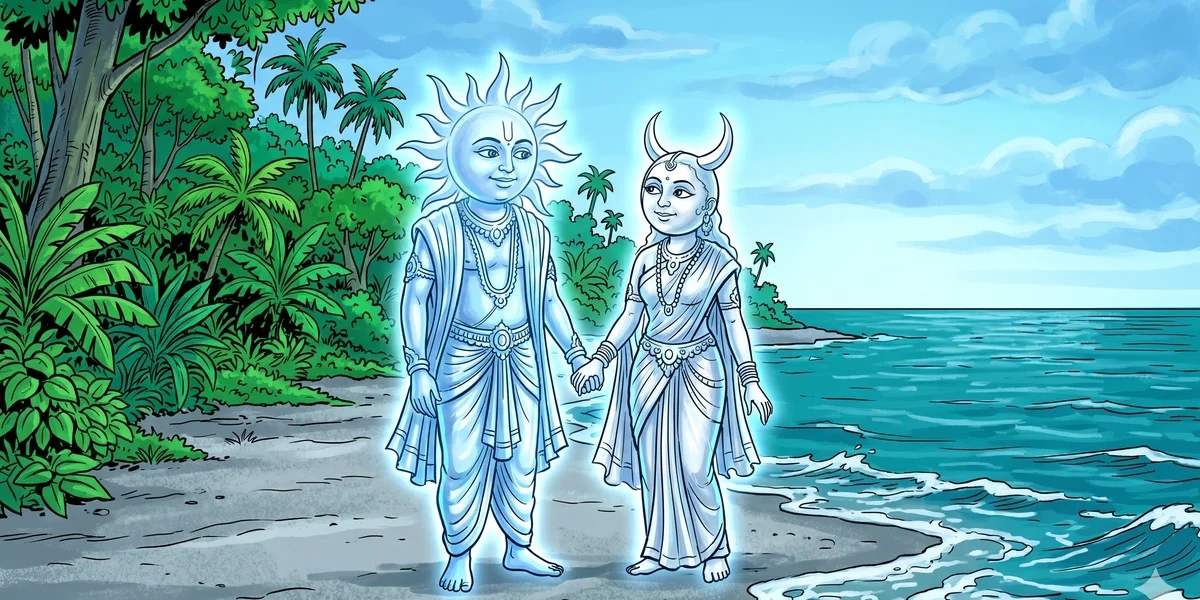
It begins, as so many of the oldest stories do, with a question from a child. “Mom, why are the Sun and the Moon always up in the sky? Won’t they ever come down?” There is no clean scientific answer that satisfies a five-year-old at bedtime, and so I did what mothers and fathers and grandmothers have done for thousands of years when faced with that particular kind of question. I told her a story.
The story I told her is not mine. It is far older than me — older than the country I live in, older than the language I speak. It travelled across an ocean to reach my daughter’s pillow that night, having been told and retold for centuries by the Efik people of southern Nigeria, on the banks of the Cross River, before it was ever written down. It is one of the most beautiful “why” stories in the human library, and it answers that bedtime question in a way no science textbook can.
Where this story really comes from
This is not, as some retellings claim, a story from the Panchatantra. The Panchatantra has its own great library of beast-fables, but the tale of the Sun, the Moon, and the Sea belongs to a different and equally ancient tradition — the oral folk literature of the Efik and Ibibio peoples of the Calabar region in what is now Cross River State, southeastern Nigeria. It was first written down in English in 1910 by Elphinstone Dayrell, a colonial officer who collected the stories he heard from Efik storytellers and published them as Folk Stories from Southern Nigeria, West Africa. His version of this tale opened the book — it was the first story in his collection, and it has been anthologized in children’s books and folklore studies in dozens of languages ever since.
The story you are about to read is a faithful retelling of that ancient Efik original, with one small softening for younger listeners: in Dayrell’s version the Sun and the Moon are husband and wife who lived together on the earth. In most modern children’s retellings — including this one — they are described as twins or siblings, which fits a bedtime story for small children better. Either way, the bones of the tale are the same, and the wisdom inside it is the same too.
Act One — Three friends, one of whom never visits
Long ago, when the world was younger and stranger than it is now, the Sun and the Moon lived on the earth. They were the closest of friends. Wherever the Sun went, the Moon went too. They walked the long roads of the earth together, ate from the same dish, and sat each evening on a great pale rock by the edge of the sea, watching the day end and the night begin.
And the third in their small circle of friendship was Water. Water lived at the shore, in the great cool curving stretch of ocean and river and pool that wrapped around the edge of the earth. Every day the Sun and the Moon came down to visit Water. They sat on the cool grey sand and talked of small things and large things, the way close friends do, and the day passed gently.
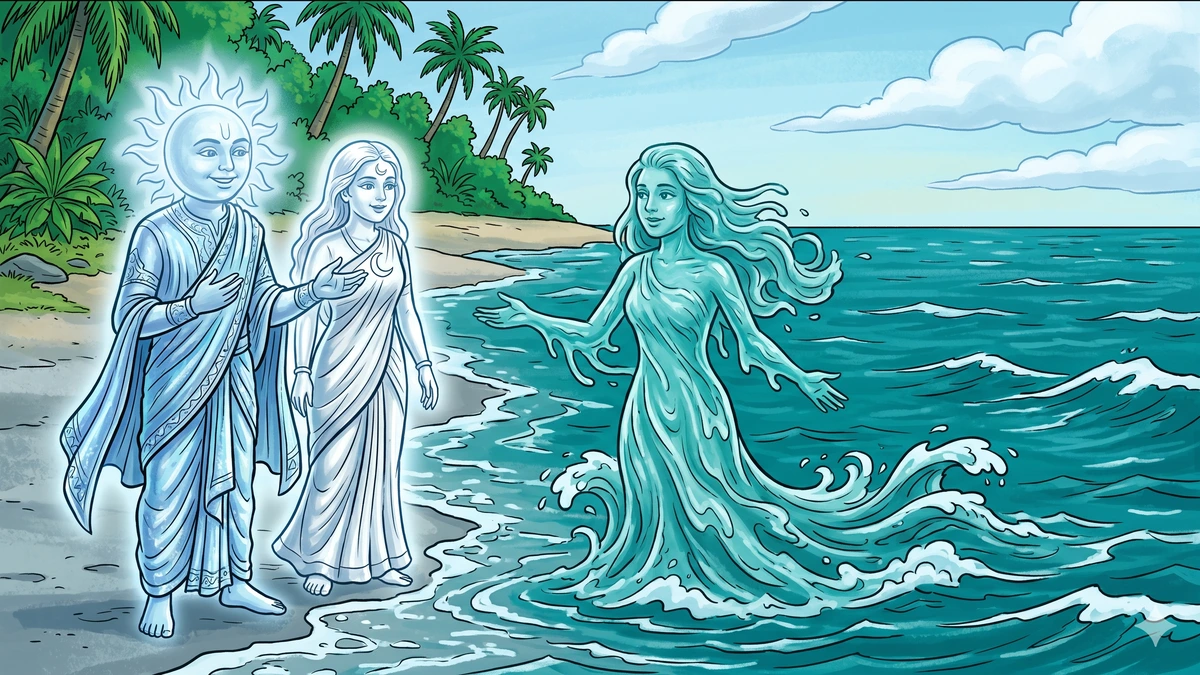
But the Sun, who was the more curious of the two siblings, began to notice something strange. No matter how often he and the Moon came to visit Water, Water never came to visit them. Months passed. Years passed. The Sun and the Moon’s small house at the edge of the forest stood empty of guests, while their feet wore a deep path down to the sea.
One evening, as the three of them sat together at the shore, the Sun could hold the question no longer. “My friend,” he said gently, “the Moon and I come to see you every day. We love these visits. But you never come to us. Have we said something that hurt you? Are we no longer welcome friends? Why is it that you never visit our home?”
Water was quiet for a long time. Then he said, “It is not that I do not love you, my brother and sister. I love you both. The truth is more practical than that. I cannot come alone. I have many, many friends — far more than you can imagine — and they come everywhere with me. If I were to come to your house and bring my friends, your small house would not hold us. We would crowd it, and break it, and ruin it. That is why I have stayed away. I would rather see you here, where there is room for everyone, than risk breaking the home you love.”
Act Two — A bigger house
The Sun thought about this for a long time. Then his face grew bright and certain. “If we build a bigger house,” he said — “a much bigger house, big enough for you and all your friends — would you come? Would you finally visit us?”
Water smiled gently. “Yes, of course. If your house is big enough for all of us, I will come. Nothing would make me happier than to sit at your table for a change, instead of always you at mine.”
And so the Sun and the Moon went home that night and began the largest building project anyone in that part of the world had ever seen. They cut tall trees from the forest, careful to plant new saplings for every one they took. They dug clay from the riverbanks and shaped it into bricks. They cut stones from the hillside and lifted them into walls. They worked from one full moon to the next, and then to the next, and then to the next. The Sun’s hands grew steady and strong. The Moon learned the patient art of laying a roof beam straight. Their old small house disappeared into the new one, swallowed up by the rising walls of a building so vast that travellers from distant villages came to stand and gape at it.
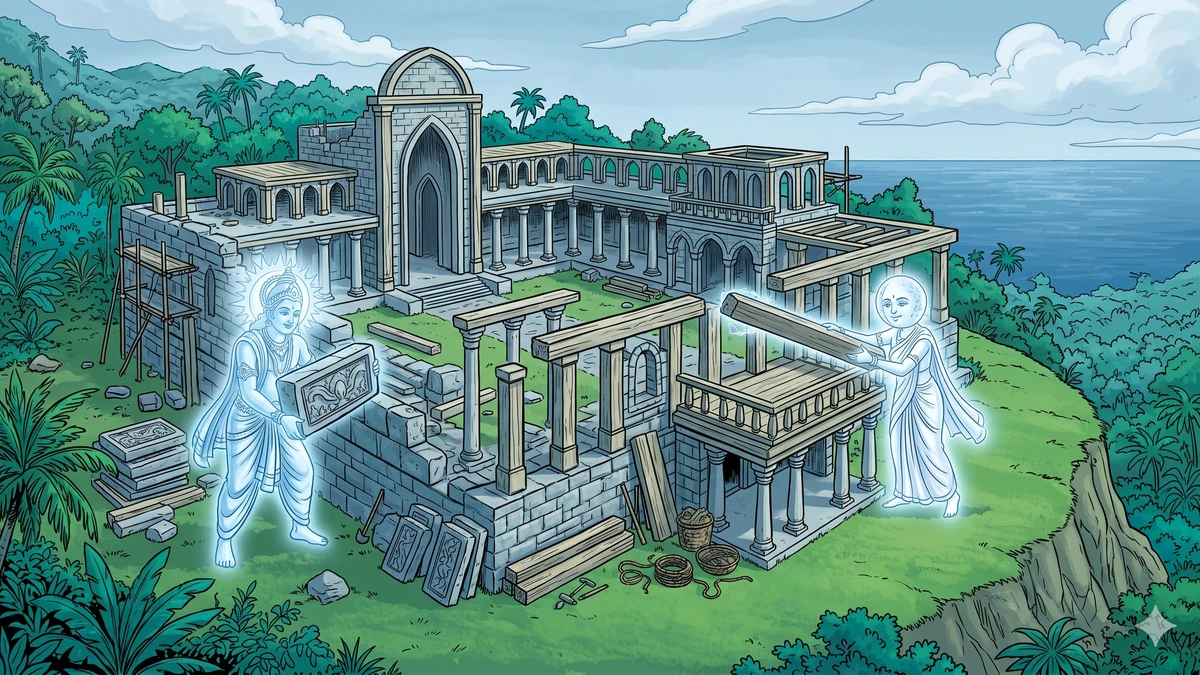
For a long time, the Sun and the Moon were so busy building that they almost forgot to visit Water. Days went by. Then weeks. The path to the shore grew thin and overgrown. Water waited patiently at the edge of the sea. He understood. Some friendships are quiet for a season because the friends are doing the work that friendship has asked of them.
At last the great house was finished. Its roof was so high that birds flew below it. Its rooms stretched out in every direction. The Sun and the Moon stood in the doorway and looked at what they had made, and then they looked at each other, and they smiled. “Now,” said the Sun, “we will invite our friend at last.”
Act Three — Water comes to call
The Moon swept the floors. The Sun decorated the great hall with garlands of forest flowers in white and pale blue. They prepared sweet things to eat and laid out cups of cool fresh river water. Then they went down to the shore, hand in hand, to invite Water home.
“Our friend,” said the Sun, bowing politely, “the house is ready. It is bigger than any house has ever been. Come, please come, and bring all your friends with you. There is room for everyone.”
Water laughed, and the laugh of Water sounded like a thousand small bells. “Then I will come,” he said, “and I will come tomorrow at first light.”
The Sun and the Moon went home that night so happy they could barely sleep.
The next morning they stood by the great open door of their new house, watching the path that led down to the sea. And here came Water — sliding gently up the path, bright and clear, lapping politely at the doorstep. “Can we come in?” Water asked.
“Oh yes!” said the Sun. “Please, you are most welcome.”
The poor Sun did not look outside the doorway to see what waited beyond Water. If he had, he might have paused.
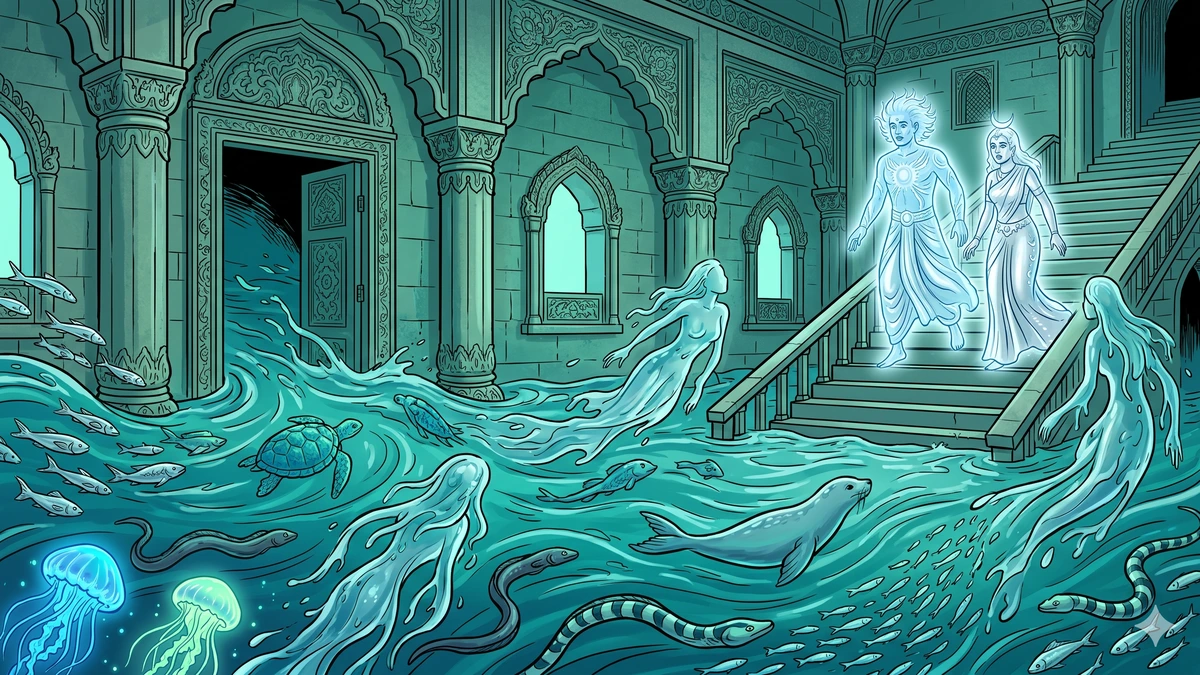
Water flowed gently into the great hall. And behind Water came his friends. A great shoal of silver fish wriggled across the floor. A long winding knot of sea snakes followed, swimming through the water that was now ankle-deep across the room. A patient bale of turtles paddled in next, settling under the tables. Octopuses came after, eight-armed and curious. Bright dancing shrimp followed, and quick darting eels, and slow grave crabs, and seahorses bobbing above the rising water.
The Sun and the Moon stood at the side of the hall, smiling and a little wide-eyed. “There are more of you than I expected, my friend,” said the Sun.
“Oh, these are only the first,” said Water cheerfully. “There are a great many more behind me.”
Act Four — A flood of friends
And so they kept coming. Whales — yes, even whales, slipping in through the great doorway as easily as if they had been invited specially. Dolphins. Sharks. Manatees, calm and old. Schools of tiny minnows that came in like clouds. Then came the things from the colder parts of the sea — seals, walruses, and even great pale icebergs, drifting in slowly through the doors and rising as the water rose.
The water in the great hall was no longer ankle-deep. It was knee-deep. Then waist-deep. Then chest-deep. The Sun and the Moon climbed onto the long banquet table to keep their feet dry. The water rose to the table. They climbed onto the rafters of the lower ceiling. The water rose to the rafters. They climbed up the stairs to the second floor. The water followed them up the stairs, calm and patient and unstoppable.
“My friend,” called the Sun a little anxiously down through a hole in the floor, “are there many more of your friends still to come?”
“Oh yes,” called Water from somewhere in the rising flood. “A great many more. I told you my friends were many.”
The Sun and the Moon climbed higher. They climbed onto the third floor. They climbed up to the high gallery. They climbed at last out onto the very roof of their great house, and stood there together, holding hands. The water reached the eaves. Then it reached the ridge of the roof. Then it began to rise above the roof.
The Sun and the Moon looked at each other. There was nowhere left on the earth for them to go.

“Up,” said the Moon quietly. “There is one place left.”
And the Sun and the Moon, holding each other’s hands tightly, rose up off the roof of their great house. They rose up past the treetops. They rose up past the birds. They rose up into the wide cool empty space of the sky itself — up and up, until they were so high that even Water, with all his many friends, could not follow them.
And that, my daughter, is where they live to this day. The Sun in his place by day, the Moon in her place by night, both of them looking down on the earth from a height that nothing can reach. They never came back down. The earth had become Water’s house, and they understood that they had given it to him for keeps.
So — are they still friends?
They are. Of course they are. The very best friends in the world live in the sky and on the sea, and they greet each other every dawn and every evening with great courtesy and great affection. The Sun rises and looks down at Water, and Water rises in his great tides to meet the Sun. The Moon rises at night, and Water turns toward her — every shoreline on every continent feels the gentle pull of her, every tide rolls in and out at her invitation. They are still friends. They are simply friends at a distance.
And that, perhaps, is the deepest lesson the old Efik storytellers were trying to give us when they first told this tale on the banks of the Cross River many centuries ago. Some loves are best held close. Other loves are best honored across a great cool empty space. Both are real. Both are true. The Sun and the Moon and the Sea are still in love with one another, even now, in a world that has built airports and sent satellites past their old friend the Moon. And every tide that comes in to kiss the beach is the Sea remembering, and every dawn that lights the world is the Sun remembering back.
Who’s who in this story
The Sun — In the original Efik tale, the husband; in this children’s retelling, the older sibling. Curious, quick to make decisions, generous, and a little impulsive — the kind of friend who builds a whole new house because his other friend cannot fit in the old one.
The Moon — In the original, the Sun’s wife; in this retelling, his sister. Quiet, patient, the careful one. The Moon is the one who notices first that the water has nowhere to stop, and the one who finally says, “Up. There is one place left.” Without her steady presence, the Sun would have stayed on the roof too long.
Water (also called the Sea) — The third friend. Honest from the start about why he cannot visit. Water never deceives the Sun and Moon — he tells them the exact truth about how many friends will come. The trouble is not that Water lies, but that the Sun cannot quite imagine how vast the sea really is, and how many lives it carries inside itself.
The “many friends” of Water — Every fish, every whale, every sea snake, every iceberg, every grain of sand at the bottom of the ocean. The story is gently asking the listener to feel, perhaps for the first time, how truly enormous the sea is — how many living things it shelters — and how small even the largest house on earth is compared to it.
The lesson
The surface of this tale is a “why” story — it is the Efik people’s gentle answer to the same question my daughter asked. Why do the sun and moon live in the sky? Why do they not come down? The story answers: because once they were friends with the sea, and they learned that some friends are too big to invite indoors. So they made room in the only way that was left.
But the deeper lesson is about friendship itself, and about the kind of love that knows how to stand at a respectful distance. We are taught from childhood that closeness is the highest form of love — that the deepest friends are the ones who live next door, who can drop in unannounced, who fill our houses with their presence. This story quietly disagrees. It says that some loves are too vast for that, and that the truest courtesy a friend can offer is sometimes a polite step backward, into a sky big enough to hold them. The Sun did not love Water any less when he climbed into the sky. He loved Water enough to give the earth to him.
It is also, gently, a story about hospitality and limits. A good host wants to say yes to every guest. But a wise host knows what their house can hold. There is no shame in admitting that a friendship needs a little more room than your roof can offer. And there is great wisdom in the old Efik storytellers’ insight that you can rebuild your whole house, and rebuild it again, and still find that some loves require the open sky.
Why this story still matters
The Efik people, like every people, have always had to think about how to share a small piece of the earth with neighbors who needed more space than the earth could give them — fishermen sharing rivers, farmers sharing soil, families sharing the same small plots of ground for generations. The story of the Sun, the Moon, and the Sea is a poem about that very ancient problem, dressed up as a cosmological “why” tale. It says that the answer is not always to make the house bigger. Sometimes the answer is to give the earth itself to your friend, and find a higher place for yourself.
For modern readers — children at bedtime, parents at the end of a long day, anyone who has ever loved someone whose presence took up more room than any house could hold — the story has not aged a single day in a thousand years. The natural fact it explains is still true: the sun and moon are still in the sky, the sea is still on the earth, and every dawn and every tide is still a small remembered conversation between three old friends.
Frequently asked questions
Where does this story actually come from? It is a folk tale of the Efik and Ibibio peoples of southern Nigeria, in the Calabar region around the Cross River — modern-day Cross River State in southeastern Nigeria. It was passed down orally for many generations before being written in English in 1910 by Elphinstone Dayrell in his collection Folk Stories from Southern Nigeria, West Africa. The story you have just read is a faithful retelling of that Efik original.
Is this story from the Panchatantra? No. Some retellings, including older versions of this post, mistakenly call this a Panchatantra tale. It is not. The Panchatantra is an Indian collection of beast-fables traditionally attributed to Vishnu Sharma around 200 BCE, and it does not contain the story of the Sun, the Moon, and the Sea. This tale belongs to West African oral tradition. The mistake is a common one in popular retellings, which is part of why we have rewritten this version of the story to give the Efik people their proper credit.
Are the Sun and Moon really siblings in the original? No — in Dayrell’s 1910 transcription of the Efik original, they are husband and wife. Many children’s retellings change the relationship to siblings or close friends because that fits a young listener’s experience of family life better. The choice to call them “twins” or “brother and sister” is a soft modernization. The original Efik telling makes them a married couple. The story works both ways — the deeper lesson about friendship and distance survives the change.
What is the moral, briefly? Some loves are best honored at a distance. Friendship is not always closeness; sometimes it is the courteous, steady, dawn-and-tide affection that two old friends keep across a great empty space. And no matter how big you build your house, there are some things in this world too vast to be kept indoors.
What can children learn from this story? Children can learn that it is good to be generous — to build a bigger house for a friend who needs more room — but also that limits are not unkind. They learn that asking honest questions (“Why don’t you ever visit?”) is the foundation of every real friendship. And they learn the lovely cosmic image of the Sun and Moon up in the sky as old friends keeping their distance from a much bigger friend below — an image they will carry with them every dawn and every full moon for the rest of their lives.
Related folk tales you may enjoy
Did you know?
- This story was first written down in English in 1910, in Folk Stories from Southern Nigeria, West Africa by Elphinstone Dayrell. It was the very first story in his collection — story number one.
- The Efik people of southeastern Nigeria, who first told this tale, have lived along the Cross River for many centuries and built a wealthy trading civilization in pre-colonial Calabar.
- “Pourquoi” or “why” stories — tales that explain how some natural fact came to be — exist in every culture on earth. Aesop has them, the Panchatantra has them, the Norse had them, the Maori have them. The story of the Sun, Moon, and Sea is one of the loveliest of them all.
- In the original Efik telling, the Sun and Moon are a married couple. The “siblings” version is a softening for younger listeners; both versions are equally legitimate retellings of the tale.
- The image of the sea “with all its friends” is a quietly stunning piece of pre-modern ecological insight — the Efik storytellers were teaching their children that the ocean was not an empty thing but a vast living country, full of more lives than any roof could hold.
Frequently Asked Questions
What is the story Home (far) away from home about?
What is the moral of Home (far) away from home?
Is Home (far) away from home a traditional Indian folk tale?
What age group is Home (far) away from home best for?
Why do the sun and moon stay in the sky in this story?
You May Also Like
 Panchatantra Stories
Ages 3-5
Panchatantra Stories
Ages 3-5
The Story of the Cobra and the Crow
The Story of the Cobra and the Crow: Somewhere in the country, under a banyan tree, therelived a pair of crows, husband and wife. Now, wheneverthe female
 Panchatantra Stories
Ages 6-8
Panchatantra Stories
Ages 6-8
The Story of the Enmity Between Crows and Owls
The Story of the Enmity Between Crows and Owls: Once upon a time, all the birds, the swans, the parrots, cranes, cuckoos, nightingales, owls, peacocks, doves
 Panchatantra Stories
Ages 3-5
Panchatantra Stories
Ages 3-5
The Monkey and the Log
A restless monkey pokes at what he does not understand — and pays a painful price that has lasted thousands of years in the Panchatantra.