The Jackal and the Drum: A Panchatantra Tale
The Jackal and the Drum: A Panchatantra Tale: Once upon a time, in a forest, there lived a jackal. He was a greedy jackal and would always eat up any animal
Origin & Canonical Placement
“The Jackal and the Drum” is one of the Panchatantra’s most compact and instructive tales about fear, investigation, and the relationship between alarming appearances and prosaic realities. The story belongs to Vishnu Sharma’s Pancatantra (c. 300 BCE–300 CE) and appears in the Hitopadesha and several regional Sanskrit collections. It is thematically aligned with Book V: Aparikshitakaraka (“Ill-considered Action”) — specifically the section that addresses the error of treating unexplained phenomena as threats without first investigating their actual nature. The tale’s lesson is the complementary opposite of the mongoose story’s: while that story warns against acting without investigation when one is alarmed, this story warns against being paralysed by alarm without investigation when action is required.
“Bhayam drisyate tatra yatra viveko nasti; viveki tu nirbhayah sarvatra.”
“Fear arises where discrimination is absent; the discriminating person is fearless everywhere.”
— Panchatantra maxim, Book V
Beat I — The Hungry Jackal and the Mysterious Sound
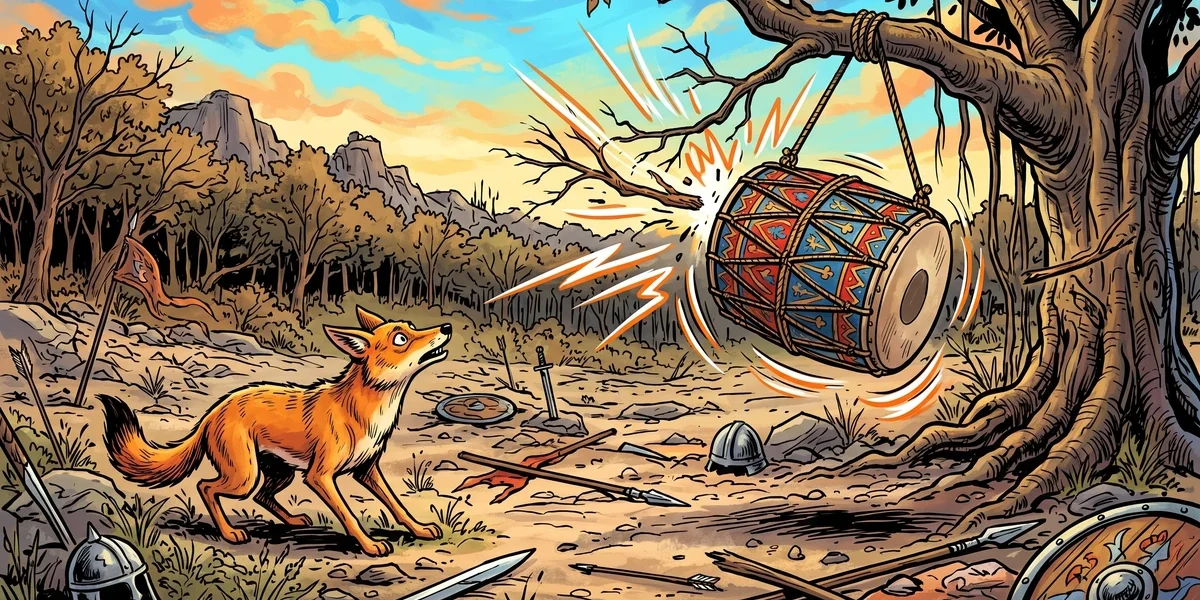
A hungry jackal was wandering through a forest in search of food when he came upon an abandoned battlefield. The battle had been fought some time ago — the field was empty of soldiers, but the detritus of conflict remained: broken weapons, torn banners, discarded equipment. Among the abandoned items was a large war drum that had been left against a tree at the field’s edge. The wind moved through the branches above the drum, and as it did so, the branches struck the drum’s taut skin in an irregular, booming rhythm that carried across the field.
The jackal heard this sound and was immediately alarmed. It was a large, resonant, inexplicable noise — the kind of noise that in a jackal’s experience is associated with dangerous animals, human activity, or some other threat that a prudent creature should avoid. His first instinct was to run. He turned to leave, paused, and then — in a moment that the story presents as the pivot between wisdom and foolishness — asked himself the question that the Panchatantra consistently identifies as the mark of viveka (discriminating intelligence): what is actually making that sound?
Beat II — Investigation and Its Reward
The jackal circled carefully around the source of the sound, approaching from different angles, using the cover of the field’s scattered debris to keep himself concealed while he gathered information. He observed: the sound came from a fixed location; it was rhythmic but not regular; it varied with the wind; there was no movement around the drum that would suggest an animal or human presence. The sound that had initially triggered an alarm response was, on investigation, entirely consistent with something inanimate — an object being struck by the wind, or branches, or some other environmental force.
He moved closer still. The drum resolved itself into a large object — clearly manufactured, clearly abandoned, clearly incapable of causing harm on its own. He approached it directly, examined it, struck it with his paw, and produced the same large resonant boom that had frightened him. He was not frightened now. He was curious. He explored further and found that the drum, which was made of a wooden frame covered with animal skin, contained within its hollow interior a cache of food — dried grain and other provisions that soldiers had stored there and never returned to claim.
The jackal ate well that day. His investigation, which had cost him a few cautious minutes of circling, had converted a threat-signal into a resource. The hunger that had brought him to the field was resolved precisely because he had asked the question — what is actually making that sound? — rather than simply running from an alarming noise.
Beat III — The Analysis: Fear as Information vs. Fear as Paralysis
The Panchatantra’s analysis of the jackal’s story focuses on the relationship between fear and investigation. Fear, in the text’s treatment, is not a weakness or an error — it is appropriate and useful information about the environment that signals the presence of something unknown and potentially threatening. The error is not in feeling fear but in allowing fear to function as a substitute for investigation rather than a trigger for it. The jackal who hears the drum and runs has received the fear-signal appropriately — the unknown large noise is correctly categorised as requiring caution — but has failed to convert the signal into the investigation that would allow him to determine whether the caution was warranted.
The story is the Panchatantra’s most direct treatment of what the text elsewhere approaches obliquely: the virtue of curiosity as a complement to caution. The jackal who investigates is not reckless — he circles carefully, uses cover, approaches from multiple angles, and gathers information before committing to a conclusion. He is performing a precise and disciplined act of information-gathering under conditions of uncertainty, which is exactly what the text prescribes in the face of the unknown. What he avoids is the false binary between running from the unknown and charging at it — neither of which is investigation.
Kautilya’s Arthashastra addresses this pattern in its treatment of intelligence operations: before any significant military or diplomatic action, the relevant terrain, opponent strength, and environmental conditions must be investigated rather than assumed. Fear of the unknown, if allowed to prevent investigation, produces worse outcomes than either careful investigation or, in some cases, calculated boldness. The general who moves his army away from an alarming noise without sending scouts to identify its source has acted on fear rather than information — and may be moving toward a worse threat than the one he fled.
Beat IV — Moral Dimension & Enduring Relevance
The tale’s moral addresses the relationship between courage and curiosity. In the Panchatantra’s tradition, courage is not the absence of fear but the capacity to respond to fear appropriately — by gathering the information that converts an alarming unknown into a known quantity, which can then be responded to appropriately. The jackal’s courage is not heroic; it is investigative. He does not charge the drum; he circles it. He does not suppress his fear; he uses it as a signal that something requires investigation and then conducts the investigation.
In contemporary personal and professional life, the drum-alarm pattern is common: an unexplained development — a change in a colleague’s behaviour, an unusual market signal, an unexpected communication — produces alarm, and the alarm produces one of two responses: avoidance (run from the drum) or premature closure (it must be X, so I will respond to X). Neither response involves the investigation that would actually determine what the drum is and what it contains. The jackal’s practice — methodical, careful, genuinely curious investigation under conditions of appropriate caution — is what converts alarm from a paralysing response into a useful input.
For children, for whom this tale is often primarily told, the lesson is foundational: unknown things are not automatically dangerous things, and the appropriate response to something that frightens you is not to run from it but to look at it carefully, from a safe distance if necessary, until you understand what it is. This is the beginning of both scientific thinking and practical courage.
Moral: Fear is a signal to investigate, not to run; the unknown that frightens may turn out to be the very thing you were looking for.
Why This Story Has Lasted 2,000 Years
The jackal and the drum have remained among the Panchatantra’s most-told tales because the story encodes a lesson that is simultaneously appropriate for young children (unknown things that sound scary often turn out to be harmless) and for adults (alarm without investigation produces worse outcomes than alarm followed by methodical inquiry). Its brevity, its clear narrative structure, and the satisfying reversal — threat-signal becomes food-source — give it the quality of a perfectly formed teaching instrument: compact, memorable, and productive of a specific habit of mind that is valuable at every stage of life. The Panchatantra’s genius was to embed this lesson in a story so simple that it can be told to a five-year-old and so precise that it rewards re-reading in adulthood as a study in the epistemology of fear.
About the Panchatantra
The Panchatantra (“Five Treatises”) was composed in Sanskrit by the scholar Vishnu Sharma around 300 BCE–300 CE as a niti-shastra — a guide to wise conduct and statecraft — framed as animal fables for the instruction of young princes. Its five books cover the dissolution of allies, the winning of allies, war and peace, the dangers of naivety, and the hazards of rashness. The text spread westward through Pahlavi and Arabic translations to become the most widely translated secular book of the ancient world after the Bible.
Frequently Asked Questions
**Q: Why is this story important?**
You May Also Like
 Panchatantra Stories
Ages 9-12
Panchatantra Stories
Ages 9-12
The Musical Donkey: A Panchatantra Fable
The Panchatantra's hard-edged little fable of Uddhata — the "haughty" washerman's donkey — who feasts on stolen cucumbers under the moon, mistakes his longing for talent, and brays the song that brings the farmers running with sticks. The story is found in Book V of the Panchatantra (Aparīkṣitakāraka, "Ill-Considered Action"), and it is one of Vishnu Sharma's quietest and most devastating lessons: a donkey called Raised On High is going to be brought low, and the only question is how.
 Panchatantra Stories
Ages 9-12
Panchatantra Stories
Ages 9-12
The Story of the Lion and the Donkey
The Story of the Lion and the Donkey: In a certain jungle, there lived a lion, by the nameof Karalakesara. He had a servant, a jackal named Dhusaraka, who was
 Panchatantra Stories
Ages 9-12
Panchatantra Stories
Ages 9-12
The Lion and The Jackal
The Lion and The Jackal: Vajradanstra was a lion living in a forest. He had two friends, a jackal named Chaturaka and a wolf named Kravyamukha. Because of