Echo and Narcissus
The nymph Echo can only repeat others’ words, and proud Narcissus, who scorns her, falls in love with his own reflection in a spring.
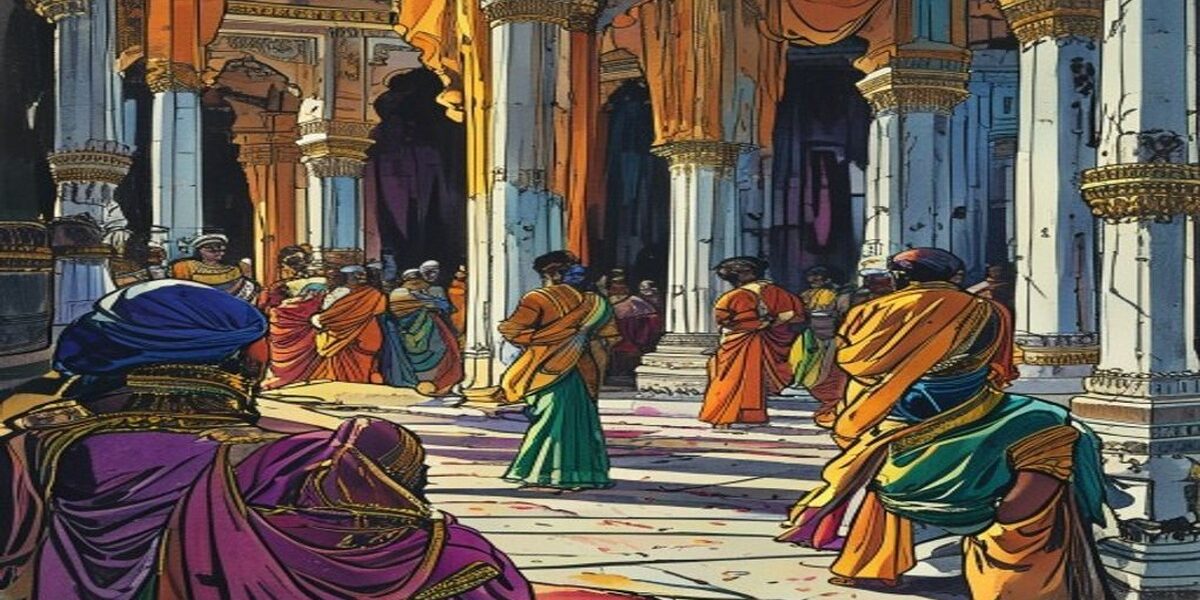
Echo was a beautiful nymph who loved the woods and hills and spent her days hunting there. She was a favourite of Diana, the goddess of the hunt, and went with her in the chase. But Echo had one fault: she loved to talk, and whether she was chatting or arguing, she always had to have the last word.
One day Juno, queen of the gods, came looking for her husband, because she suspected he was off amusing himself among the nymphs. Echo kept the goddess talking until the nymphs had slipped away. When Juno found out, she punished her. “You shall lose the use of the tongue you tricked me with,” she said, “except for the one thing you love best: answering. You will still have the last word, but you will never be able to speak first.”
Echo saw Narcissus, a beautiful young man, hunting on the mountains, and she fell in love with him and followed him everywhere. How she longed to speak to him gently and win him over! But she could not. She had to wait for him to speak first, with her answer ready.
One day Narcissus lost his friends and shouted, “Is anyone here?” “Here,” answered Echo. Narcissus looked around, saw no one and called, “Come!” “Come!” answered Echo. When nobody came, he called, “Why are you avoiding me?” and Echo asked the same question back. “Let us meet,” said the young man. “Let us meet,” Echo answered with all her heart, and she hurried towards him, ready to throw her arms round his neck.
He jumped back. “Hands off! I would rather die than let you have me!” “Have me,” she said, but it was no use. He left her, and she went away to hide her shame deep in the woods. From then on she lived in caves and among the mountain cliffs. She faded away with grief until there was nothing left of her body; her bones became rocks, and only her voice remained. She still answers anyone who calls to her, and she still has the last word.
Echo was not the only one Narcissus treated so coldly. He turned away all the other nymphs too. At last one of them, whom he had rejected, prayed that one day he might know what it was like to love someone who would not love him back. The goddess of vengeance heard her prayer and granted it.
There was a clear spring with water like silver, where shepherds never brought their flocks and no goats or wild animals came to drink. No fallen leaves or branches spoiled it; fresh grass grew around it, and rocks shaded it from the sun. One day Narcissus came there, hot, thirsty and tired from hunting. He bent down to drink and saw his own face in the water. He thought it was a beautiful water spirit living in the spring.
He gazed in wonder at the bright eyes, the curling hair, the round cheeks and the glowing face, and he fell in love with himself. He leaned down to kiss it and plunged his arms in to hold it, but the image fled at his touch, then came back again a moment later. He could not tear himself away. He forgot all about food and rest and stayed bending over the water, staring at his own reflection.
He spoke to it: “Beautiful being, why do you avoid me? The nymphs love me, and you don’t seem to dislike me either. When I reach out my arms, you reach out yours; you smile at me and wave back when I wave.” His tears fell into the water and broke up the image. As it disappeared he cried, “Stay, please! If I cannot touch you, at least let me look at you.”
So he went on, until little by little he lost his colour, his strength and the good looks that had once charmed Echo. She stayed near him all the same, and when he cried, “Alas! Alas!” she answered him with the same words. He wasted away and died. Even as his spirit was carried across the river of the dead, it leaned over the side of the boat to catch one more glimpse of itself in the water.
The nymphs mourned him, especially the water nymphs, and when they beat their breasts in grief, Echo did the same. They built a funeral fire, but his body was nowhere to be found. In its place was a flower, purple inside and surrounded by white petals, which still carries his name: the narcissus.
Where this story comes from
This myth is best known from the Roman poet Ovid’s Metamorphoses. This telling follows Thomas Bulfinch’s retelling of Ovid in The Age of Fable (1855), part of Bulfinch’s Mythology. Bulfinch uses the Roman names Juno and Diana for the Greek goddesses Hera and Artemis.
The myth imagines origins for a repeating voice and a flower named Narcissus. These are poetic explanations, not an account of how sound works or a botanical history.
Read the original: Thomas Bulfinch, Bulfinch’s Mythology (Project Gutenberg)
Reading guidance: Ages 9–12 with adult preview; rejection, prolonged grief, neglect of food and rest, and death. Discuss boundaries without treating death as deserved punishment for refusing love.
A closer reading
Echo and the reflection both return something to Narcissus without initiating a response. Yet they are not the same: Echo is a person with feelings whose speech has been restricted, while the image has no independent intention. His attention passes from a real person he cannot understand to an apparent person who only mirrors him.
The repeated dialogue changes meaning according to who speaks. ‘Let us meet’ is his search for an unseen caller and her hope for intimacy; her remaining words cannot explain that difference. Readers can trace how repetition creates an illusion of agreement.
Narcissus can refuse an embrace or a relationship, even though his words are cruel. Rejection does not make anyone deserving of death, and Echo’s suffering does not entitle her to his affection. The tragic punishment belongs to the myth’s world, not a rule about love or a diagnosis to apply to classmates.
Try this with the story
Read the exchange twice, giving each speaker a separate thought before the repeated words. Then compare an echo with a mirror: what does each return, and what can neither tell you about another person’s intentions?
Talk about it
- How can identical words express different wishes in Echo’s dialogue?
- How is Echo different from the reflection despite their shared repetition?
- How could Narcissus refuse an embrace without cruelty?
- Why should the myth’s punishment not become a rule about rejection?
Related stories
- The Oak and the Reed — a fable about pride from ancient Greece
- The Fox and the Grapes — an Aesop fable about wanting what you can’t have
- The North Wind and the Sun — another story from ancient Greece
Also known as: Narcissus and Echo
Frequently Asked Questions
Why can Echo only repeat words?
What does Narcissus mistake for another being?
Does the myth provide a scientific explanation of echoes?
Which telling is followed?
You May Also Like
 Korean Folk Tales
Ages 9-12
The Awful Little Goblin
An uninvited, silent boy appears at a Seoul nobleman's feast. When the guests try to force him out, even ten strong men cannot move him.
 Indian Folk Tales
The Wonderful Ring
A spendthrift uses his wife's last jewel to buy four animals. A serpent's ring brings a palace and a new marriage, but recovering the abducted princess requires the animals' help.
 Panchatantra Stories
Ages 9-12
The Elephant and the Sparrow
A careless elephant smashes a sparrow’s nest, and the grieving mother joins with a woodpecker, a gnat and a frog to bring the giant down.