The Awful Little Goblin
The Awful Little Goblin: There was an occasion for a celebration in the home of a nobleman of Seoul, whereupon a feast, to which were invited all the family
The Contest Nobody Asked For
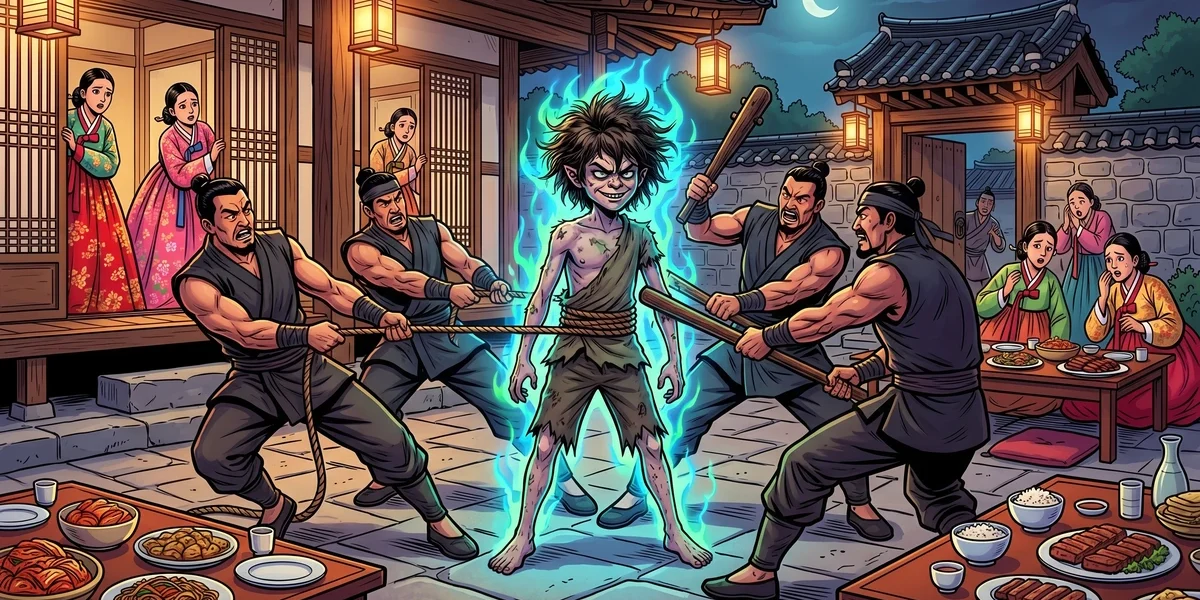
The dokkaebi — Korea’s distinctive goblin figure — is not like the demons and devils that populate other traditions. It does not want your soul. It does not seek to possess you or corrupt you or drag you to some infernal destination. What it wants is considerably more specific and, from a certain angle, more reasonable: it wants a good wrestle. A fair fight. The particular satisfaction of a physical contest engaged in good faith by both parties, with the outcome genuinely uncertain until it is decided. The dokkaebi is, in this sense, the least threatening supernatural entity in the Korean folk repertoire — which does not prevent it from being, as the title of this story correctly identifies, perfectly awful when it catches you alone on a mountain path at dusk.
The awful little goblin of this story is specifically awful in the way that dokkaebi are: not frightening in any dignified sense, but deeply inconvenient. It has the characteristic dokkaebi attributes — single horn or no horn depending on the version, carrying a magical club that it brandishes with more enthusiasm than precision, covered in coarse hair, smelling of damp wood and something unidentifiable, and possessed of a laugh that is simultaneously threatening and ridiculous. It materialises in front of a traveller — a farmer returning home late from the market, as the story usually has it — and announces, with great confidence in its own terribleness, that the traveller must wrestle it or suffer unspecified consequences.
Beat I — The Encounter on the Mountain Path
The farmer had not had an excellent day at the market. He had sold his rice at a lower price than he had hoped, bought seed at a higher price than he intended, and consumed rather more makgeolli (rice wine) than he had planned to while commiserating with fellow farmers in the same situation. He was returning home in the dark, tired and slightly aggrieved, when the dokkaebi stepped out from behind a pine tree and presented its challenge.
The farmer’s first response, the story records, was not fear but exasperation. He had a great deal to think about already. The goblin’s challenge — delivered with tremendous self-importance, its magical club waving, its single horn catching the moonlight — was an additional demand on an already taxed evening. He considered his options: run (dokkaebi are surprisingly fast), argue (dokkaebi are surprisingly persistent), or accept the challenge and see what could be done.
He accepted the challenge, partly because the makgeolli gave him a degree of equanimity he might not otherwise have managed, and partly because he noticed — with the specific attentiveness of a man who has spent his life working with the physical world — that the goblin, for all its bluster, was actually rather small. Its arms were short. Its centre of gravity was high. It telegraphed its moves with theatrical preparatory gestures. In wrestling terms, it was what experienced wrestlers call very readable.
Beat II — The Rules That Governed the Contest
Korean traditional wrestling — ssireum (씨름) — is a specific discipline with specific rules. The contestants grip each other’s cloth band tied around the waist and upper thigh; the goal is to bring any part of the opponent’s body above the knee into contact with the ground. Victory is clear, incontestable, and achieved through technique, leverage, and the intelligent use of the opponent’s own momentum rather than through brute strength alone. It is, notably, a discipline in which a smaller but technically superior contestant can and regularly does defeat a larger but less skilled one.
The dokkaebi, when it challenges humans to wrestle, demands ssireum — the formal Korean wrestling discipline — rather than simply grappling until the human is defeated by superior supernatural strength. This choice is, in Korean folk tradition, the dokkaebi’s characteristic peculiarity and, simultaneously, the human’s characteristic opportunity. The dokkaebi is strong, but it plays by the rules of ssireum. And the rules of ssireum are rules that a skilled human can win by, because they are about technique and leverage, not about which contestant could theoretically exert the most force.
The farmer, who had wrestled at every village festival since he was old enough to compete and had a fair record, recognised ssireum when he saw it. He gripped the goblin’s cloth band. The goblin gripped his. The contest began.
Beat III — The Dokkaebi’s Fair Engagement and What It Means
The dokkaebi’s insistence on fair engagement — on a governed contest rather than simple overwhelming — is one of the most philosophically interesting features of its folk character. A creature with supernatural strength and magical tools could simply pick the farmer up and deposit him in a ditch. It does not do this. It offers the fair contest, abides by the contest’s rules, and accepts the outcome.
Korean folk tradition understands this through the concept of nongjang (농장, the field/arena as governed space) — the idea that even supernatural encounters, when they occur in the context of a recognised contest form, are governed by the rules of that form. The ssireum ring is a democratic space: inside it, what determines the outcome is technique and the intelligent application of strength, not the contestants’ respective social positions, sizes, or supernatural capacities. By demanding ssireum, the dokkaebi has agreed to enter a governed space in which the human has a genuine chance.
Why does it make this choice? Korean folk storytellers offer several implicit explanations. The dokkaebi, animated by objects that have been used with sustained care, retains something of the human world’s value system — including its sense of fair play. It is not a malevolent entity seeking to harm; it is a mischievous entity seeking the specific satisfaction of a genuine contest. A contest it wins through superior supernatural force is not a genuine contest; it is mere domination, and the dokkaebi, for all its awfulness, is not interested in mere domination. It wants to be surprised. It wants the contest to be real.
This folk-psychological portrait of the dokkaebi encodes something about the nature of genuine play and genuine contest: they require the real possibility of either outcome. A being that can simply win whenever it chooses to cannot have a genuine contest; it can only have a demonstration. The dokkaebi constrains itself within the rules of ssireum precisely to make the contest genuine — and in doing so, it creates the conditions for its own possible defeat.
Beat IV — How the Farmer Won and What He Took Home
The farmer won by the second throw. He had identified the dokkaebi’s high centre of gravity and its habit of over-committing to its initial forward motion, and he used the dokkaebi’s own momentum to flip it onto its back with a technique he had first learned at a festival twenty years earlier. The dokkaebi lay on the path for a moment, looking at the stars, making a sound that was part complaint and part admiration. Then it got up, shook itself, said something that the farmer took as a combination of congratulations and mild threat, and disappeared back into the trees.
The farmer completed his walk home, feeling considerably better about the day than he had an hour earlier. He told the story at the village well the next morning. His neighbours listened with the specific mix of scepticism and avid interest that these accounts typically generated. The detail that everyone noted and discussed was the dokkaebi’s choice to wrestle: not to simply overpower, not to use its magic club for anything other than gesture, but to offer the fair contest and accept its outcome.
The storytelling tradition that preserved the account understood why this detail mattered. A world in which supernatural forces could simply overwhelm any human they encountered would be a world without human agency. The dokkaebi’s fair engagement — its insistence on the governed contest — is what preserves the space in which human skill, human cleverness, and human experience can matter. The awful little goblin is, in this sense, a better friend to human dignity than a more powerful one that simply won every encounter would be.
“Thank the dokkaebi for wrestling instead of just winning. It is the only monster that gives you a chance.” — Korean village saying
The awful little goblin has remained a beloved figure in Korean folk tradition for precisely the quality this story illuminates: its combination of genuine awfulness and structural fairness. It is troublesome, it appears at inconvenient moments, it smells bad, it is loud, and it will absolutely demand your participation in a contest you did not sign up for. But it plays by the rules. It accepts the outcome. And if you know the rules better than it does — if you have been going to village festivals for twenty years and have learned something about how to use an opponent’s momentum against them — you have a genuine chance of walking home victorious, tired, slightly muddy, and with a story considerably better than anything that happened at the market that day.
Frequently Asked Questions
What is the moral of The Awful Little Goblin?
The story’s moral is that even supernatural forces operating by rules of fair engagement give the prepared and skilled human a genuine chance. The dokkaebi’s choice of ssireum wrestling — a governed contest with clear rules and genuine uncertainty of outcome — rather than simple supernatural overpowering creates the space in which the farmer’s experience and technique can determine the result. Knowing the rules of the contest — and having spent twenty years practising the skills those rules reward — is what allows the ordinary farmer to defeat the supernatural goblin.
What happens in The Awful Little Goblin?
A farmer returning home from market late at night encounters a dokkaebi on a mountain path. The goblin demands a wrestling match. The farmer, slightly drunk on makgeolli but experienced at ssireum from twenty years of village festivals, accepts. He identifies the dokkaebi’s weaknesses — high centre of gravity, telegraphed movements, tendency to over-commit to its initial motion — and defeats it by the second throw. The dokkaebi acknowledges the outcome in its characteristic manner (simultaneously congratulatory and threatening) and disappears. The farmer finishes his walk home with a better story than he started with.
What is a dokkaebi and what makes it distinctive among Korean supernatural beings?
A dokkaebi (도깨비) is a Korean goblin animated by objects that have been used with sustained human care over long periods of time. Unlike ghosts (gwisin), which are spirits of the dead, or foxes (gumiho), which are animal spirits with human transformation, the dokkaebi is animated inanimate matter — a broom or club that has accumulated enough human-use energy to develop independent agency. This origin gives dokkaebi their distinctive folk-fair-play character: they retain something of the human world’s value system, including a preference for the governed contest over simple domination, making them peculiarly defeatable by clever and experienced humans.
Why does the dokkaebi choose wrestling rather than simply overpowering the farmer?
Korean folk tradition offers a folk-psychological explanation: the dokkaebi, animated by objects of sustained human use, seeks the genuine contest — the encounter with genuinely uncertain outcome — rather than the demonstration of its own superiority. A contest it wins by supernatural force alone is not a genuine contest; it is domination, and the dokkaebi finds domination unsatisfying. By demanding ssireum and abiding by its rules, the dokkaebi enters a governed space where technique and cleverness can override strength differentials — creating the real possibility of its own defeat and therefore the possibility of a genuinely satisfying contest.
How does the dokkaebi figure function in Korean folk culture?
The dokkaebi serves multiple functions in Korean folk culture: as a comic supernatural figure that domesticates the spirit world by making it ridiculous as well as dangerous; as a vehicle for the folk principle that even supernatural power is governed by rules that the prepared human can exploit; and as a reminder that the ordinary activities of daily life — caring for one’s tools, practising skills at village festivals, maintaining the habits that accumulate into competence over decades — are the resources that matter when extraordinary situations arise. The farmer who wins against the dokkaebi wins with skills he developed for entirely different purposes. The story rewards the ordinary life lived with sustained attention and care.
You May Also Like
 Korean Folk Tales
All Ages
Korean Folk Tales
All Ages
The Woodman And The Mountain Fairies
The Woodman And The Mountain Fairies: Over a half thousand years ago there lived in a northern village, near Ping Yang, a wood-cutter named Keel Wee. He owned
 Korean Folk Tales
All Ages
Korean Folk Tales
All Ages
The Fortunes Of Yoo
The Fortunes Of Yoo: There was a man of Yong-nam, named Yoo, who lived in the days of Se-jong. He had studied the classics, had passed his examinations, and
 Korean Folk Tales
Ages 6-8
Korean Folk Tales
Ages 6-8
The Man On The Road
During the 1636 Manchu invasion, a quick-witted man uses observation and calm judgment to survive.