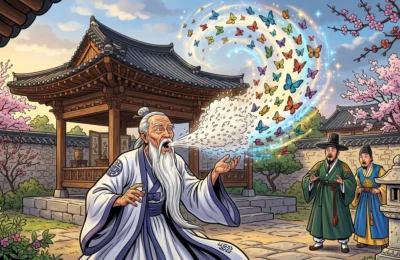
The Sneezing Colossus
The Sneezing Colossus: Kim, who lived at the foot of the mountains, was a lazy lout. He had a family to support, but he did not like steady work. He preferred
Origin & Tradition
“The Sneezing Colossus” belongs to the Korean tradition of geoin iyagi (거인 이야기, giant stories)—a narrative genre in which beings of cosmic scale interact with the ordinary human world, producing consequences both comic and instructive. Korean mythological tradition maintains a substantial corpus of giant-being narratives, most fully developed in the creation myths of Jeju Island (Cheonjiwang bonpuri, 천지왕 본풀이, and related texts) where the giant female figure Seolmundae Halmang (설문대 할망) is said to have formed the island’s landscape with her body—each step creating a valley, each rest creating a hill. In the mainland Korean tradition, giant stories typically take a more comic register: the colossus is not a creator deity but a being of ill-defined supernatural origin whose excessive size makes every ordinary bodily function an event of catastrophic local consequence. Eating empties rivers; sleeping redirects them; sneezing—the most uncontrollable and involuntary of all bodily functions—is the comic climax of the genre. The sneezing colossus is the genre’s purest expression of a genuinely philosophical question dressed in comic clothing: what are the responsibilities of beings whose involuntary actions have consequences for entire communities, and how can those responsibilities be recognized and honored by beings whose scale makes ordinary human proportions impossible to perceive?
Beat I — The Colossus Arrives
The colossus is not malevolent. This is the story’s first and most important establishment: the giant being that settles near the village is not a predator or an aggressor; it is simply very large and apparently unaware, or at least not yet aware, of the specific consequences its proximity creates for the human-scale community nearby. It eats from the river, which is reasonable from its perspective (the river is there, the fish are available) and catastrophic from the village’s perspective (the river is the village’s primary water and food source, and the colossus’s eating empties it with the casual thoroughness of someone drinking from a cup). It walks across the hillside, which is reasonable from its perspective (the hillside is solid ground) and destructive from the village’s perspective (its footprints are the size of ponds and its walking collapses the terraced fields that represent years of labor).
The village cannot flee and cannot fight. What it can do, and what the story’s comic intelligence begins to explore, is communicate—or attempt to communicate—with a being whose scale makes communication a technical problem as well as a social one. How does a community of ordinary humans convey to a being whose ear is above the clouds that they exist, that their needs are real, and that the colossus’s involuntary actions are having consequences the colossus may not know about? This is the story’s first comic premise: the gap between scales of existence that makes ordinary communication impossible and that requires the smaller party to develop extraordinary ingenuity simply to be heard.
Beat II — The Sneeze
The colossus sneezes. This is presented in the story with the full comic weight of an event that is both perfectly ordinary—beings sneeze; it is the most involuntary and unavoidable of physiological responses—and perfectly catastrophic for the scale at which the sneeze occurs. The blast of air flattens a section of the village. The nasal accompaniment floods the low-lying areas. The colossus, if it notices at all, notices the way that a person notices a slight disturbance—and then the sense-memory fades and it turns its attention back to whatever it was doing before the sneeze interrupted it. The village, which was already dealing with the river-fishing and the hillside-walking, is now also dealing with collapsed structures and flooding, and the colossus has already moved on without registering that anything of consequence occurred.
The comedy here is the comedy of scale mismatch taken to its philosophical extreme: an action so involuntary that it is beneath the threshold of moral responsibility at human scale has become an event of communal catastrophe at the colossus’s scale. No one can be blamed for sneezing. And yet the sneeze has destroyed houses. This paradox—the innocence of involuntary action combined with the reality of its consequences—is the story’s central philosophical problem, and the community’s response to it is the story’s real subject.
Beat III — Jangsin and the Responsibilities of Scale
Korean mythological tradition treats giants (jangsin, 장신, or geoin, 거인) with a mixture of awe, humor, and a specific kind of ethical expectation that applies to beings of cosmic power: the expectation that scale brings responsibility. The Jeju creation giant Seolmundae Halmang is enormous but not careless; her enormous size is attended by an enormous consciousness that includes awareness of the consequences of her actions for the landscape she is shaping. The comedy giants of mainland folk narrative are enormous and careless, or more precisely enormous and unaware—they have not yet developed the awareness of consequence that their scale requires. The sneezing colossus is the purest version of this narrative type: a being whose involuntary actions have consequences it genuinely does not know about, because its perspective does not naturally include the human scale at which those consequences are experienced.
This positions the story’s moral problem as perceptual rather than simply ethical: the colossus is not morally deficient, but it is perceptually limited in the specific way that great scale makes inevitable. From far above, human-scale consequences are below the threshold of visibility. The village is too small to see; the collapsed houses are too small to see; the flooded paths are too small to see. The colossus cannot simply decide to perceive what its scale makes imperceptible. What it can do—and what the story’s human protagonists work to enable—is be made aware of what it cannot naturally perceive, through extraordinary communication efforts that bridge the scale gap by creating signals large enough to reach a perception calibrated for cosmic scale.
The village’s solution varies across versions: large fires lit on hilltops that spell out messages in smoke visible from above; drums built of hollowed mountains whose resonance the colossus can feel in its feet; a delegation that manages, through improbable ingenuity, to climb high enough to address the giant ear directly. All of these solutions share the same structure: the smaller party solving, through intelligence and collective effort, the communication problem that scale alone would make insurmountable. This is the human contribution to the relationship: the ingenuity that compensates for the power differential by solving the perceptual problem that power differential creates.
Beat IV — Recognition and Adjustment
Once the colossus becomes aware—in whatever way the story’s version of communication makes possible—it responds with the generosity of a being that genuinely did not know. It adjusts its position, redirects its eating to more distant waters, takes its steps more carefully around the areas human-scale beings occupy. The sneeze cannot be prevented—the colossus sneezes when it sneezes, like everyone else—but it can be oriented: the colossus learns to sneeze away from the village rather than toward it, which is both a minimal and a genuinely significant form of consideration. The village is not perfectly safe; it is simply less catastrophically at risk than before the communication succeeded. The relationship between the colossus and the community is not resolved into safety but into a form of managed coexistence in which the larger party has accepted some constraints on its involuntary actions in acknowledgment of the smaller party’s existence.
The tale’s moral is specific: power at cosmic scale brings obligations that smaller-scale beings cannot simply ignore, and the first step toward those obligations being honored is the smaller-scale beings making their existence and their needs visible to the larger-scale power. The colossus does not spontaneously develop human-scale awareness; it has to be told. But being told, it responds. This is the story’s most optimistic proposition: that power not ill-intentioned, only unaware, can be moved toward responsibility if the communication gap can be bridged.
“A giant who does not know you exist is not your enemy; a giant who knows you exist and is willing to know it is something better than neutral.”
— Korean proverb associated with the geoin (giant) narrative tradition
Why This Story Has Lasted
“The Sneezing Colossus” endures because it takes a comic premise—the sneeze as cosmic catastrophe—and uses it to explore a genuinely important political and ethical proposition: that the relationship between vastly unequal powers is not necessarily hostile but is necessarily communicative, and that the smaller party’s most important task is solving the perceptual problem that makes its existence invisible to the larger one. The colossus’s sneeze is funny; the village’s situation is dire; the solution is ingenious; and the result is a workable coexistence rather than either annihilation or the implausible triumph of the small over the large. This is a more realistic and more useful model for navigating power differentials than either despair or heroic defeat of the giant, and its combination of comic surface and serious substrate has kept it alive across many generations of Korean storytelling.
Korean Giant Mythology and the Seolmundae Halmang Tradition
Korean giant mythology is most fully developed in the traditions of Jeju Island, where the figure of Seolmundae Halmang (설문대 할망)—the Great Grandmother of Creation—is credited with forming the island’s distinctive landscape through her bodily scale and actions. She waded through the sea; the sea came to her waist. She piled soil to form the central volcanic peak of Hallasan; the leftover soil formed the small satellite cones scattered across the island. Her mythology encodes the island’s geological formation in the narrative of a giant female body engaging with landscape on equal terms. On the Korean mainland, giant mythology takes a more comic register: the giant is not a creator deity but a being of excessive scale whose interaction with human-scale communities produces mishaps, comedy, and occasional instructive encounters. The mainland giant tradition’s emphasis on scale mismatch as a source of both comedy and ethical reflection represents a distinct development from the Jeju creation giant, but both share the fundamental proposition that beings of cosmic scale inhabit the same world as ordinary humans and that the relationship between these scales of existence requires navigation.
Frequently Asked Questions
- What is the moral of “The Sneezing Colossus”?
- That power at cosmic scale brings obligations toward smaller-scale beings that the larger power cannot naturally perceive and must be made aware of through the smaller party’s extraordinary communication efforts. The colossus is not malevolent; it is unaware. The village’s task is bridging the perceptual gap that scale creates, and the colossus’s task, once aware, is accepting some constraints on its involuntary actions in acknowledgment of the smaller beings’ existence.
- What happens in “The Sneezing Colossus”?
- A giant being of cosmic scale settles near a village, unknowingly disrupting its river, its fields, and finally its structures when it sneezes. The village, unable to flee or fight, finds ingenious ways to make its existence perceptible to the colossus. Once aware, the colossus adjusts its behavior—redirecting its feeding, stepping more carefully, orienting its inevitable sneezes away from the village. The result is managed coexistence rather than resolution, with both parties navigating the relationship that scale has created.
- Why is the sneeze the climactic moment rather than a more violent action?
- Because the sneeze is perfectly involuntary—the most uncontrollable of physiological responses—which makes it the purest expression of the story’s philosophical problem: actions below the threshold of moral agency at one scale of existence become catastrophic events at another scale. No one can be blamed for sneezing, and yet the sneeze destroys houses. This paradox captures the core difficulty of navigating power differentials between vastly unequal beings more precisely than any deliberately violent action could.
- How does Korean giant mythology differ from Western traditions?
- Western giant traditions (Greek Titans, Norse Jotnar, Jack-and-the-beanstalk giants) tend to frame the giant as an adversary to be defeated, often through the wit of a smaller human hero. Korean giant mythology more often frames the giant as a being whose scale makes ordinary relationship difficult but whose intentions are not primarily hostile, and whose interaction with human-scale communities requires navigation and communication rather than defeat. The Korean tradition’s emphasis on coexistence through managed communication reflects a different set of assumptions about how power differentials can be navigated.
- What does the story suggest about communicating with powerful beings?
- That the smaller party’s most important task is solving the perceptual problem that scale creates—making themselves visible and legible to a power that cannot naturally perceive them. This requires extraordinary ingenuity and collective effort rather than force, and the reward for solving the communication problem is not equality but acknowledgment: the larger power becomes aware of the smaller party’s existence and, if not ill-intentioned, accepts some constraints on its behavior in recognition of that existence.