Haunted Houses
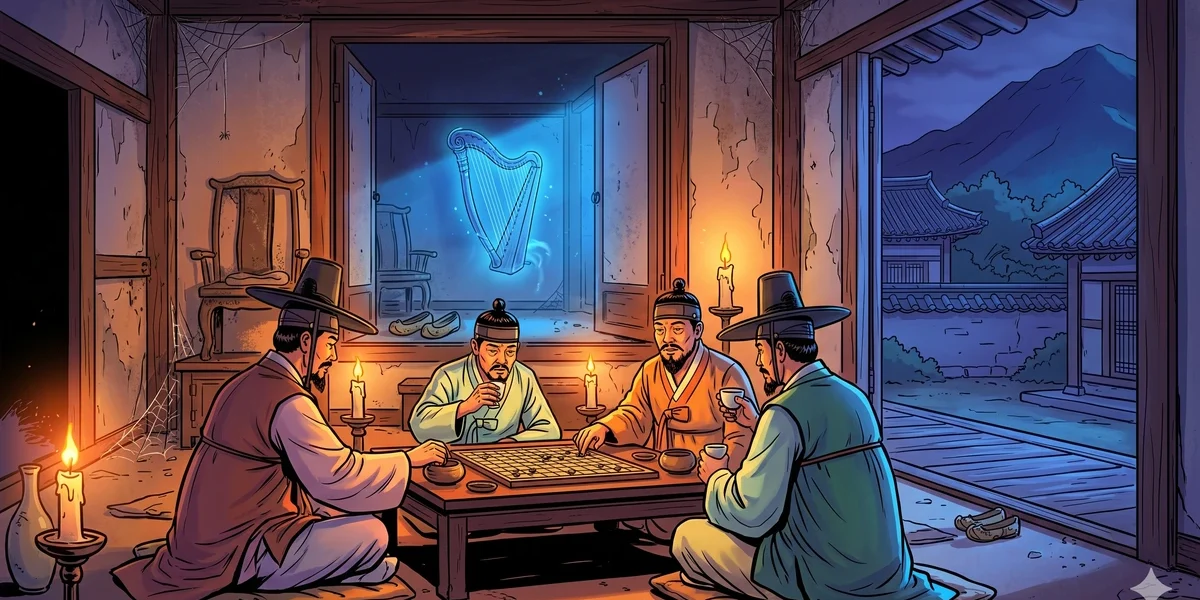
Haunted Houses: There once lived a man in Seoul called Yi Chang, who frequently told as an experience of his own the following story: He was poor and had no
The Houses That Would Not Stay Empty
In the villages and market towns of the Korean peninsula, certain houses carried a reputation no amount of whitewashing could remove. These were the gwisin-jip — ghost houses — dwellings where candles guttered without wind, where footsteps sounded on empty floors, where the names of the dead were heard called softly in the night. Neighbours gave them wide berths. New tenants, if they moved in at all, seldom lasted a season before departing shaken and silent-eyed. The houses stood between the world of the living and something older, rawer, and unfinished.
Korean folk tradition preserved dozens of such accounts, each slightly different in its particulars but unified in a single underlying logic: a ghost — a gwisin (귀신) — does not haunt because it chooses cruelty. It haunts because it cannot leave. And it cannot leave because something essential was left undone at the moment of death or in the grief-work that followed. The haunted house in Korean understanding is not a monument to evil but a symptom of incompleteness — a visible wound in the membrane between the living and the dead.
Beat I — The Household That Broke Apart
One of the most frequently told versions concerns a prosperous household on the outskirts of a small Joseon-era town. The family patriarch had worked forty years to establish his home — a tile-roofed compound with a main hall, a women’s quarters, and a small ancestral shrine in the eastern corner of the yard. When he died, however, his two sons quarrelled bitterly over the inheritance. The elder son, resentful and rigid, drove his widowed mother from the compound before the formal mourning period had concluded. She died in a relative’s outbuilding a few months later, cold and estranged from everything she had built her life around.
Within a year the compound began to change. Servants reported hearing an old woman’s voice calling from the women’s quarters long after dark. The well water tasted brackish though the source was clean. Roosters crowed before midnight — in Korean folk belief, a sure sign that the boundary between ijung (this world) and jeoseung (the next) had grown dangerously thin in that place. The elder son, attributing it to rats and bad dreams, held on grimly. But the younger son — now living elsewhere and nursing his own guilt — began having dreams in which his mother stood before him in her mourning dress, her hair loose, her face turned slightly away, never quite looking at him.
Korean tradition is precise about this detail: the gwisin turns her face away not in anger but in sorrow. She is not fully gone because no one has truly seen her off.
Beat II — The Mudang’s Reading
The younger son eventually sought out a mudang — a Korean shamanic practitioner — whose role in the community was not merely ritual but diagnostic. The mudang’s first task was not exorcism but listening: she held a gut (구트) ceremony at the edge of the property, calling on the intermediary spirits to let the mother speak. What came through was not rage but a recitation of incompleteness: the mourning rites had been shortened, her death in the outbuilding had been attended by no one from her own household, her personal belongings had been dispersed without ceremony, and the ancestral tablet in the shrine had not been updated to include her name among the household dead.
The haunting, the mudang explained to the brothers, was not punishment. It was request. The mother’s han (한) — that layered Korean term encompassing grief, resentment, and thwarted longing — had accumulated to the point where it could not disperse naturally. Han in Korean metaphysics is not merely an emotion but a spiritual accumulation, a density. Left unresolved, it condenses around a place, particularly a place the deceased was deeply attached to, and it holds the spirit there like amber holds an insect — preserved, immobilised, unable to complete the passage.
The mudang prescribed a three-day ssitgim-gut — a cleansing ritual in which the accumulated han is washed away through song, invocation, symbolic cloth-passing, and the formal recitation of the spirit’s name and accomplishments. The brothers were required to be present, to apologise aloud, and to make public acknowledgement of their mother’s place in the household lineage. The younger son wept throughout. The elder son, rigid to the end, managed only silence — but silence held steady through all three days, which the mudang accepted as sufficient.
On the morning of the fourth day the house was quiet. The well water ran clear. The roosters crowed at proper dawn. Something had completed its passage.
Beat III — Gwisin, Han, and the Ethics of Departure
The story of the haunted compound illuminates one of the most distinctive features of Korean ghost belief: the moral weight it places on the living rather than the dead. In many ghost traditions worldwide the haunting figure is coded as threatening — an intrusion from outside the natural order that must be expelled. In Korean musok tradition, by contrast, the gwisin is understood primarily as a person who was failed. The haunting is the dead’s last recourse, their only remaining tool for communicating an unmet need to those who should have met it.
This reframing carries significant ethical implications. If a house is haunted, the first question Korean tradition asks is not “how do we drive the ghost out?” but “what did we fail to do?” The haunting is a form of testimony — the dead speaking through cold drafts and misplaced objects and dreams about what the living owe them. The han-puri (한 풀리) — the “untying” or “releasing” of han — is therefore not an act of power over the dead but an act of restitution to them. The ritual healer’s skill lies in correctly identifying what was left unfinished and designing the ceremony that completes it.
Korean folk tales about haunted houses also encode a sophisticated understanding of what makes a death “good” or “bad” by communal standards. A person who dies surrounded by family, with proper rites, with their grievances aired and acknowledged, with their name properly recorded — such a person departs cleanly. A person who dies in isolation, unacknowledged, unmourned, or with serious relational ruptures unrepaired — that person carries unresolved han into death, and the han clings to familiar spaces. The haunted house is thus a communal diagnostic: it tells the neighbourhood that something went badly wrong in the social fabric of that household.
There is also a gendered dimension worth noting. A disproportionate number of Korean haunted house narratives feature women ghosts — mothers-in-law driven out, young brides who died in childbirth, daughters who were prevented from expressing grief, widows who outlived their social usefulness. This pattern reflects the particular vulnerability of women in hierarchical Joseon society to precisely the kind of deaths — isolated, unacknowledged, occurring outside the ritually protected domestic centre — that generate gwisin. The ghost story, in this reading, is also social criticism: a way of naming what the living community preferred not to name directly.
Beat IV — The Moral and Its Modern Resonance
The haunted houses of Korean folk tradition offer a moral that is both specific and transferable. At its most concrete: the dead require proper ceremony, and the living are responsible for providing it. Cutting short the mourning period, dispersing possessions without acknowledgement, failing to include the deceased in the household ancestor record — these are not merely social lapses but spiritual ones with material consequences. The haunted house is the consequence made visible.
At a more abstract level, the stories articulate something about the relationship between grief and completion. Han accumulates wherever something important was left unsaid, unacknowledged, or unfinished. The person who died angry, or lonely, or feeling erased carries that accumulation forward. The ritual work of han-puri is the community’s method of retroactively completing what death interrupted — providing the acknowledgement that was withheld, saying aloud what should have been said while there was still time. In this sense the haunted house is not a place of horror but a place of invitation: come and finish what you started.
Modern Korean society, which has seen rapid urbanisation and the erosion of traditional mourning practice, continues to grapple with what to do with the dead who were not properly seen off. Contemporary Korean literature and cinema — from the quiet hauntings in the films of Hong Sang-soo to the more explicit ghost stories in works like “A Tale of Two Sisters” — consistently return to this motif: the person who lingers at the edge of domestic space because something between them and the living was never resolved. The ancient village logic survives in sophisticated new forms.
“A house does not become haunted by the dead who loved it. It becomes haunted by the living who failed to love the dead back.” — Korean village elder, recorded oral tradition
The haunted house stories of Korea have lasted not because they frighten — though they do — but because they are morally serious in a way that purely entertainment-driven ghost fiction rarely achieves. They insist that the boundary between the living and the dead is maintained by sustained communal effort: by rites performed on time, by names recorded faithfully, by grief allowed to run its full course. Where that effort lapses, the boundary thins. The cold spot in the corner of the room is not supernatural randomness but the accumulated weight of what was left undone. Doing the work — the ritual, the apology, the acknowledgement — is what clears the air and closes the passage. The house then becomes, once more, simply a house.
Frequently Asked Questions
What is the moral of Haunted Houses?
The central moral is that the dead do not linger out of malice but out of incompleteness: they remain where grief, neglect, or unresolved relational ruptures left them tethered. The living bear responsibility for providing the rites and acknowledgements that allow the dead to depart. A haunted house is therefore a diagnostic of communal failure rather than a sign of supernatural hostility, and its remedy lies in completing — however belatedly — what death interrupted.
What happens in Haunted Houses?
A prosperous Joseon-era household falls into haunting after the family patriarch dies and his sons quarrel bitterly, driving their widowed mother from the compound before the mourning period ends. She dies isolated and unacknowledged. Within a year the compound shows classic signs of gwisin presence — voices, brackish water, roosters crowing at midnight. A mudang is called, conducts a gut ceremony, and determines that the mother’s han has crystallised around the house because her death was unattended, her name unrecorded, and her contributions unacknowledged. A three-day ssitgim-gut cleansing ritual, requiring both sons to be present and to offer public acknowledgement, resolves the haunting.
What is a gwisin in Korean ghost tradition?
A gwisin (귀신) is the spirit of a recently deceased person whose han — accumulated grief, resentment, or thwarted longing — prevents them from completing the passage to jeoseung (the afterlife realm). Unlike Western ghost concepts that often emphasise menace, the gwisin in Korean musok tradition is understood primarily as a person in need: someone who was failed by the living community and who lingers at familiar spaces because the failure was never addressed. Gwisin are particularly associated with women who died isolated, young people who died violently, and anyone whose death was unattended by proper rites.
How does han connect to Korean haunted house stories?
Han (한) is a layered Korean concept encompassing grief, resentment, injustice, and thwarted longing. In Korean metaphysics it functions almost as a spiritual substance — it accumulates where something important was suppressed or denied, and its density can hold a spirit in place after death. Han-puri (the untying or releasing of han) is the ritual process of addressing these accumulations: naming the wrong, acknowledging the person, and providing the ceremony that was withheld. Haunted house stories consistently dramatise this mechanism — the haunting as condensed han, the ritual as han-puri, the cleared house as evidence that the release was successful.
How do Korean haunted house stories compare to ghost traditions elsewhere in Asia?
Korean ghost tradition shares the pan-Asian concern with proper burial and ancestor rites but differs from Chinese ghost belief (which often emphasises material provision — paper money, grave goods — as the primary obligation) and Japanese yurei tradition (which places greater emphasis on the emotional state of the dying moment itself, particularly jealousy or obsessive attachment). Korean gwisin are more consistently framed as victims of relational neglect, and the musok response is more explicitly relational — requiring the living to speak aloud, to acknowledge, and to apologise rather than simply to perform material offerings. This makes Korean haunting lore among the most ethically explicit in the Asian tradition.
You May Also Like
 Korean Folk Tales
Ages 6-8
Korean Folk Tales
Ages 6-8
The Awful Little Goblin
The Awful Little Goblin: There was an occasion for a celebration in the home of a nobleman of Seoul, whereupon a feast, to which were invited all the family
 Korean Folk Tales
Ages 9-12
Korean Folk Tales
Ages 9-12
The Goblin’s Magic Bat (Dokkaebi)
The Goblin's Magic Bat (Dokkaebi): In the mountains of Korea, where mist clung to the peaks like ancient dreams and the forest held secrets older than memory
 Korean Folk Tales
All Ages
Korean Folk Tales
All Ages
The Woodman And The Mountain Fairies
The Woodman And The Mountain Fairies: Over a half thousand years ago there lived in a northern village, near Ping Yang, a wood-cutter named Keel Wee. He owned