The Unforgiving Monkey
A king orders his monkeys killed to cure his burned horses, and the one monkey who escaped uses a demon’s pearl necklace to take revenge.
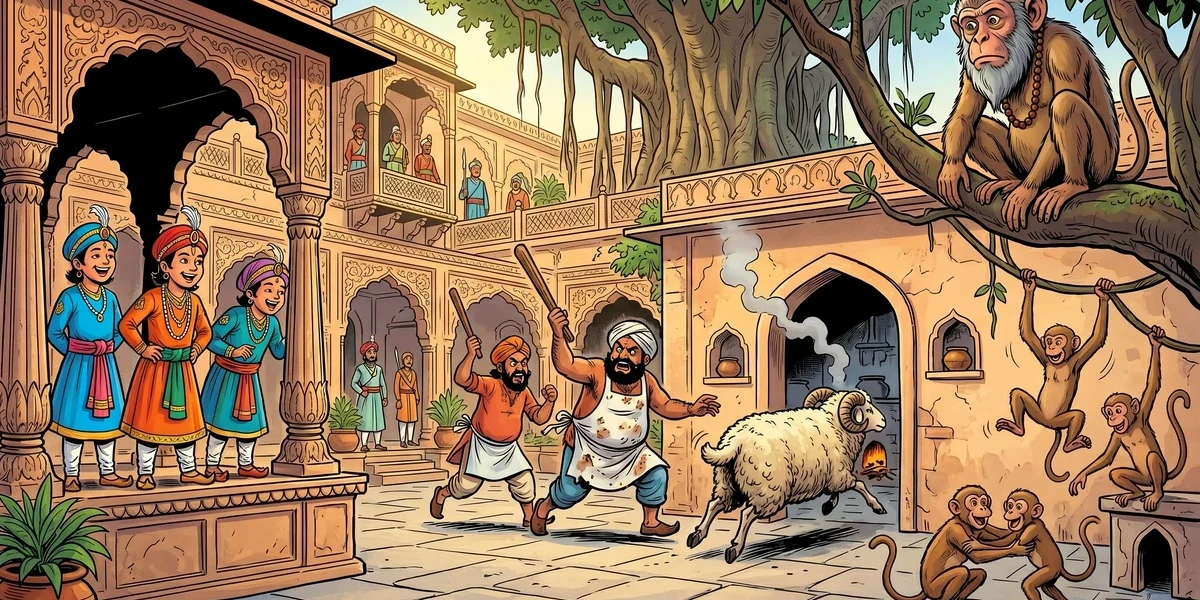
In a certain city ruled a king named Moon. To amuse his son he kept a troop of monkeys, well fed every day with all kinds of good food. For the prince’s fun there was also a flock of rams. One of these rams was terribly greedy. He wandered into the kitchen at every hour of the day and night and gobbled up whatever he could find, and the cooks would beat him with whatever they could lay their hands on.
The chief of the monkeys watched this and grew worried. “This quarrel between the ram and the cooks will be the death of us monkeys,” he thought. “The ram is a glutton, and the cooks hit him with anything they find. One day they will find nothing but a burning stick from the fire. Then his thick woolly back will catch fire. If he runs into the stable, which is mostly straw, it will blaze up and the horses will be burned. And the old books on horse medicine say that burns on horses are cured with monkey fat. We are all in danger.”
So he called the monkeys together and told them, “The quarrel between the ram and the cooks threatens every one of us. When a house is full of foolish quarrels, those who want to stay alive should leave. Let us go to the forest before we are all killed.”
But the proud young monkeys laughed at him. “You are old, and your mind is going,” they said. “Why should we give up the wonderful treats the princes give us with their own hands, just to eat bitter, sour fruit in the forest?”
“You are fools,” said the monkey chief sadly. “This easy life tastes sweet now, but it will turn to poison. I will not stay to see my family die. I am going to the forest.” And he left them all and went away.
Not long after, the ram wandered into the kitchen once again. The cook could find nothing else, so he grabbed a half-burnt stick still blazing from the fire and struck him with it. With his wool on fire, the ram ran bleating into the stable next door and rolled about until flames burst out on every side. Some of the horses tied there were killed, and others, badly burned, broke their ropes and ran wild.
The king was distressed. He called his horse doctors and asked how to ease the horses’ pain. They remembered their books and said, “O King, the master of our craft wrote that monkey fat is the cure for burns on horses. Please use it before they die.” So the king ordered the monkeys killed, and every one of them was put to death.
The old monkey chief did not see this with his own eyes, but he heard the news as it passed from one creature to another, and he would not let it go unpunished.
Thirsty and wandering, he came to a lovely lake covered with lotus flowers. Looking carefully, he noticed footprints going into the water but none coming out. “There must be some dangerous creature in this lake,” he thought. “I will keep my distance and drink through a hollow lotus stalk.” As he did so, a man-eating water demon rose from the lake, wearing a necklace of pearls.
“I eat everyone who comes into the water,” said the demon, “but you are cleverer than anyone, drinking like that. I like you. Ask me for whatever you want.” “How many can you eat?” asked the monkey. “Hundreds, thousands, as many as come into the water,” said the demon. “On land, even a jackal could beat me.” “I have a deadly quarrel with a king,” said the monkey. “Give me your pearl necklace, and I will tempt that king and all his followers into your lake.” So the demon gave him the necklace.
Soon people saw the monkey chief climbing over the trees and palace roofs with a dazzling pearl necklace around his neck. “Chief, where have you been all this time?” they asked. “And where did you get that necklace?” “Deep in the forest is a hidden lake made by the god of wealth,” said the monkey. “Anyone who bathes in it at sunrise on a Sunday comes out wearing a pearl necklace like this.”
The king heard of it and sent for the monkey. “Is this true, chief?” he asked. “O King, you can see the necklace for yourself,” the monkey replied. “If you want one too, come with me and I will show you the place.” The king’s greed was roused, and he set off with all his household and servants.
They reached the lake at dawn. “O King,” said the monkey, “the magic only works at sunrise. Tell all your followers to jump in together. But you must come in with me, because I will take you to the very spot where I found mine.” So all the king’s followers plunged into the lake, and the demon ate every one of them.
When they did not come back, the king asked, “Chief, why are my people taking so long?” The monkey quickly climbed a tree and called down, “Wicked king, your people have been eaten by a demon who lives in the water. You killed my family, and I have killed yours. Now we are even. I did not let you go in, because I remembered you were the king. Now go.” The king hurried home, full of grief.
When he had gone, the demon came out of the water, very pleased, and sang: “Well done, my monkey! You won a friend, you beat a foe, and you kept the pearls safe, all by drinking through a straw.”
Where this story comes from
In Arthur W. Ryder’s 1925 Panchatantra this tale is “The Unforgiving Monkey,” from Book V, “Ill-Considered Action.” It is the story the gold-finder tells about King Moon (Chandra in Sanskrit) to show where greed and careless orders lead. It is a story about revenge, not an example to copy: the king and monkey have each lost a community, while the revenge kills additional people who did not give the king’s original order.
The deaths in the stable and the lake are told briefly here, without the source’s more vivid details.
Read the original: Arthur W. Ryder, The Panchatantra (1925), Internet Archive
Best for ages 9–12 — a long, serious fable about greed and revenge; best read with an adult who can talk it through.
A closer reading
The chief’s warning follows a chain of possible consequences: kitchen punishment, burning wool, a straw stable, injured horses and a demand for monkey fat. His attention to connections first saves his life. The claimed treatment belongs to this historical tale and is not a valid instruction for treating burns.
At the lake he checks footprints before drinking, but later persuades the king with the necklace alone. A real object becomes misleading evidence for an invented explanation. The revenge deliberately spares the king so that he must grieve, while his followers pay with their lives. The demon’s approving song is therefore the praise of a beneficiary of the killings, not an impartial moral judgment.
Try this with the story
Draw the palace chain and the necklace deception as two separate cause-and-effect diagrams. Identify who makes each decision and who suffers from it. Discuss whether the people killed at the lake bear responsibility for the king’s command.
Questions to ask
- What links turn a kitchen quarrel into danger for the monkeys?
- What does the necklace prove, and what does it not prove?
- Why is the demon pleased, and should that determine the reader’s judgment?
You may also like
- The Monkey and the Crocodile — another clever Panchatantra monkey
- The Four Learned Fools — another Book V story
- Of Crows and Owls — Panchatantra tales of feuds and revenge
Also known as: King Chandra and the Monkey Chief
Frequently Asked Questions
Why does the king order the monkeys killed?
Who dies in the revenge?
You May Also Like
 Panchatantra Stories
Ages 9-12
The Brahmin’s Wife and the Sesame Seeds
A poor Brahmin warns his wife against hoarding with the tale of a greedy jackal, but when she sets out her sesame seeds to dry, a stray dog spoils the lot.
 Panchatantra Stories
Ages 9-12
The Potter Who Became a Warrior
A potter’s scar from a drunken fall is taken for a battle wound, until he honestly tells the king the truth and loses his place at court.
 Panchatantra Stories
Ages 9-12
The Story of the Monkey and the Log
Builders leave a wedged log at a half-finished temple; a curious monkey pulls the wedge and pays for meddling with a painful trap.