The Moon Rabbit – A Japanese Folktale for Children (Ages 3–5)
Read Tsuki no Usagi — a gentle Japanese moon rabbit story for ages 3–5. Fox, monkey, and a kind rabbit; why Japan sees a rabbit on the moon. Free bedtime read.
Origin Note
Long ago in Japan, people told a gentle story called Tsuki no Usagi — the Moon Rabbit. On clear nights, especially at autumn moon-viewing (Tsukimi / Otsukimi), families look up and say the dark shapes on the full moon look like a rabbit pounding mochi (rice cakes). This page tells that Japanese children’s folktale for ages 3–5.
A related older Indian Buddhist telling (the Sasa Jataka) lives separately in The Wise Hare: Generosity Writes Itself on the Moon — for deeper / older readers. This URL stays Japanese Folk, bedtime-length, and kids-safe.
The Story of Tsuki no Usagi
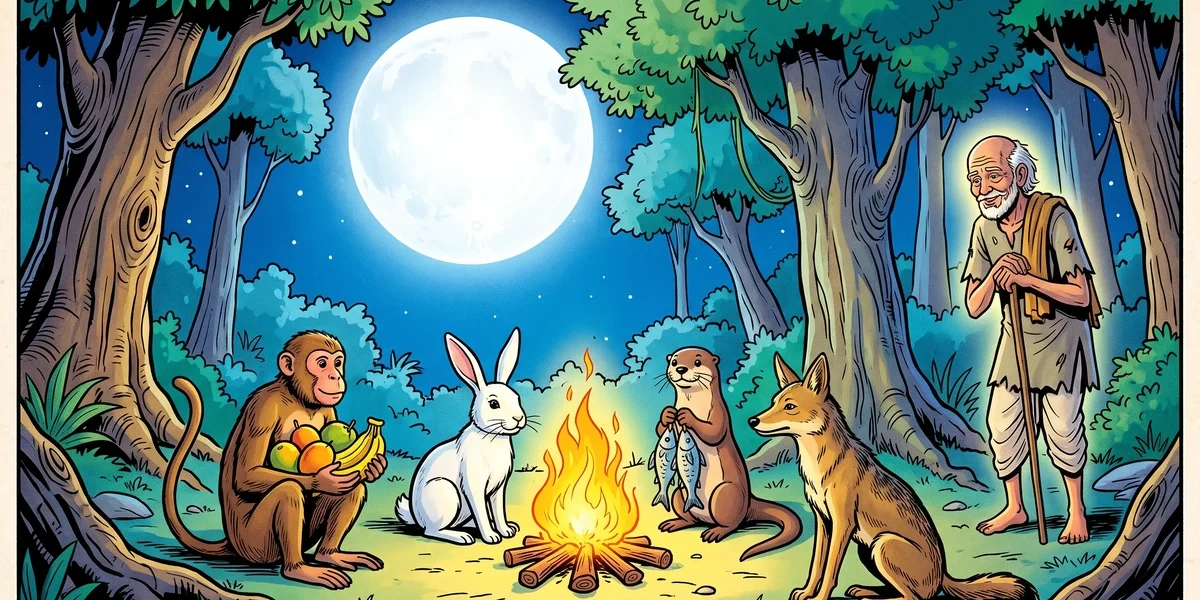
Once, in a quiet forest under a round silver moon, three friends lived side by side: a clever fox, a playful monkey, and a soft little rabbit.
They shared berries. They shared shade. They shared quiet walks when the leaves whispered. The rabbit was the smallest, but her heart was the biggest of all.
One cool evening, a hungry old traveler walked into their clearing. His clothes were dusty. His steps were slow. He sat down with a tired sigh.
“I have walked a long way,” he said gently. “I have nothing left to eat. Can you spare a little food?”
The friends looked at one another. Of course they would help!
The fox dashed into the woods and came back with fresh fish.
The monkey climbed high and brought sweet fruit.
They set their gifts before the traveler with proud, happy smiles.
The rabbit hopped this way and that. She found only soft green grass. Grass was good for a rabbit — but not much of a supper for a hungry person.
The rabbit’s ears drooped. Then she stood up tall.
“I do not have fish or fruit,” she said. “But I can still share. I can give what I have — myself. Please, build a fire. I will jump in, so you may eat and be strong again.”
The traveler’s eyes grew kind and bright. He was not an ordinary traveler at all. He was the Old Man of the Moon, come to see if the friends’ kindness was true.
He waved his sleeve. A warm fire appeared — not a scary fire, but a test of the rabbit’s generous heart.
The little rabbit did not run. She stepped toward the glow.
At once the Old Man of the Moon scooped her up in cool moonlight, soft as silk. The fire vanished. The rabbit was safe. Not a whisker was hurt.
“Dear rabbit,” said the Old Man of the Moon, “you offered the only gift you had. That is true kindness. Come with me. From tonight on, the whole world will see your generous heart.”
He carried the rabbit gently up, up, up — into the silver face of the moon.
If you look carefully on a clear night, you can still see her there. Many families in Japan say she is pounding mochi — rice cakes — sharing sweetness with the sky. When the harvest moon is bright, and people celebrate Tsukimi, they remember the rabbit who gave what she could.
Look up. The kind rabbit is still “working,” still giving, shining for everyone to see.
Frequently Asked Questions
Is this an Indian Jataka story?
What age is this story for?
Why do people in Japan say there is a rabbit on the moon?
Who are the rabbit’s friends in the Japanese story?
What is Tsukimi / Otsukimi?
Is the rabbit hurt in the fire?
You May Also Like
 Japanese Folk Tales
Ages 6-8
Japanese Folk Tales
Ages 6-8
Momotaro: The Peach Boy
Momotaro: The Peach Boy: In the days when Japan was still finding its own voice, there lived in a small village nestled between rice paddies and gentle hills
 Japanese Folk Tales
All Ages
Japanese Folk Tales
All Ages
An Old Chinese Story
An Old Chinese Story: Long, long ago there lived a great Chinese Empress who succeeded her brother the Emperor Fuki. It was the age of giants, and the Empress
 Japanese Folk Tales
All Ages
Japanese Folk Tales
All Ages
My Lord Bag Of Rice
My Lord Bag Of Rice: Long, long ago there lived, in Japan a brave warrior known to all as Tawara Toda, or “My Lord Bag of Rice.” His true name was Fujiwara