An Old Chinese Story
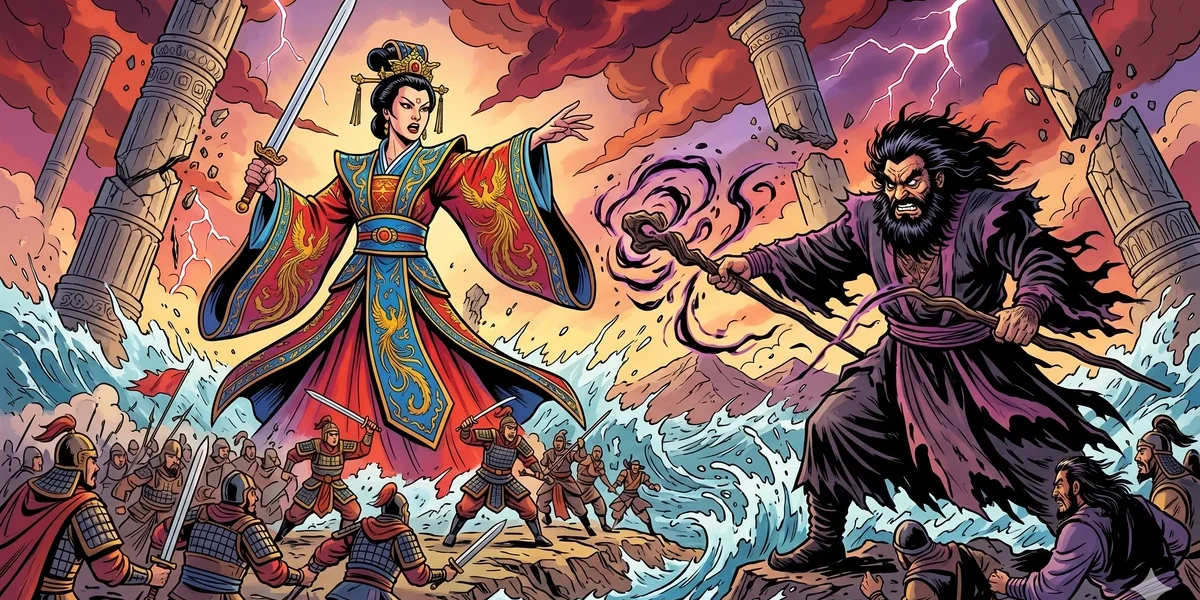
An Old Chinese Story: Long, long ago there lived a great Chinese Empress who succeeded her brother the Emperor Fuki. It was the age of giants, and the Empress
An Old Chinese Story: Patience, Perspective, and the Wheel of Fortune’s Long Turning
Among the most philosophically concentrated tales in the East Asian folk narrative tradition is the story known variously as “The Old Farmer and His Horse,” “Sai Weng Shi Ma,” or simply “An Old Chinese Story.” It follows a farmer whose life passes through an apparently random sequence of good fortune and bad, each event evaluated by neighbours who pronounce it “wonderful” or “terrible,” and each time receiving the farmer’s invariant reply: “Perhaps.” The tale is a sustained meditation on zhī zú (contentment-through-understanding) and the epistemological problem of judging events whose full consequences are not yet visible.
The story’s origin is often traced to the Huainanzi, a Han dynasty philosophical compendium compiled around 139 BCE, where it serves as an illustration of Taoist non-attachment to outcome. Its survival across two millennia and its wide distribution across Chinese, Japanese, Korean, and Vietnamese oral traditions testify to the universality of its central insight: that the valence of any event is determined not at the moment of occurrence but across the arc of time we cannot see from where we stand.
“Is this good fortune or bad? The old farmer only smiled. He had learned that time answers such questions better than wisdom does.”
Beat I — The Horse Runs Away
A farmer’s horse escapes and disappears into the northern steppe. His neighbours come to commiserate: what terrible luck. The farmer’s response—”Perhaps”—is not false modesty or evasion but a disciplined refusal to foreclose interpretation before events have completed their arc. Within days the horse returns, bringing with it a herd of wild horses. The neighbours return: what wonderful luck. Again: “Perhaps.” The structure is immediately established. Fortune and misfortune are not states but transitions; each apparent endpoint is in fact a midpoint in a sequence whose conclusion remains invisible.
Beat II — The Son and the Breaking
The farmer’s son attempts to tame one of the wild horses and is thrown, breaking his leg. Terrible luck, say the neighbours. The farmer: “Perhaps.” Shortly after, military conscription officers arrive to draft all able-bodied young men for a war that will claim most of them. The son, unable to walk, is passed over. Wonderful luck. “Perhaps.” The tale has now completed two full cycles, establishing that the rhythm is not accidental but structural—a claim about the nature of causality itself. Every event contains the seed of its apparent opposite; the question is only how many seasons the seed requires to germinate.
Beat III — The Epistemology of “Perhaps”
The farmer’s monosyllabic wisdom is more radical than it first appears. He is not saying “things could be worse” (consolation) or “things might improve” (optimism). He is making an epistemological claim: that the information available at any given moment is insufficient to determine whether an event is beneficial or harmful, because benefit and harm are defined by consequences that have not yet occurred. This is yuan thinking—the Taoist recognition that causality is a web rather than a chain, and that pulling one thread changes tensions elsewhere in ways that cannot be predicted from the point of pull. The farmer does not know what will happen next; he knows that he does not know, and he refuses to act as though he does. This is a very different disposition from resignation or passivity. The farmer continues farming throughout the tale; his “perhaps” does not paralyse action but liberates it from the distorting weight of premature judgment.
Source: Huainanzi (c. 139 BCE); oral tradition across East Asia
Alternate titles: Sai Weng Shi Ma (塞翁失馬), The Old Man at the Frontier
Themes: Zhī zú (knowing sufficiency), yuan (causal interconnection), epistemic humility, non-attachment to outcome
Beat IV — The Gift the Story Actually Gives
What the tale ultimately offers is not a philosophy of passive waiting but a practice of cognitive discipline: the habit of withholding final judgment long enough for more information to arrive. In modern decision science this is sometimes called “keeping options open” or “avoiding premature closure,” but the farmer’s version is more elegant—it is not a strategy for optimising outcomes but a recognition that outcome-optimisation is often premature certainty masquerading as wisdom. The farmer is not cleverer than his neighbours; he is simply more honest about the limits of what any of them can know. His “perhaps” is the most accurate statement available given the information on hand. The tale has lasted two thousand years because this accuracy never goes out of date.
Why This Story Lasted
An Old Chinese Story survives because it addresses the most common cognitive error in human experience: interpreting intermediate states as final ones. We celebrate windfalls and mourn losses with a conviction about their permanence that the actual structure of causality does not support. The farmer’s “perhaps” is not pessimism in disguise—it is equally applied to apparent good fortune as to apparent bad. This even-handedness is the tale’s ethical spine. It does not teach that things always get better (they don’t) but that our assessment of better and worse requires more time and more data than we typically allow before pronouncing judgment. In an age of instantaneous reaction and viral certainty, this is a teaching of extraordinary contemporary value.
Frequently Asked Questions
What is the Huainanzi and why is this story in it?
The Huainanzi is a Han dynasty philosophical encyclopedia commissioned by Liu An, Prince of Huainan, around 139 BCE. It synthesises Taoist, Confucian, and Legalist thought. This story appears to illustrate the Taoist concept of non-attachment to outcome and the limits of human foresight in a causal web.
Is the farmer’s “perhaps” a Taoist concept?
Yes, it reflects the Taoist principle of wu wei (non-forcing) and the recognition that the Tao operates through patterns too complex for human minds to fully trace. The farmer’s response is not apathy but a disciplined alignment with this recognition—continuing to act (farming) while releasing attachment to how events are categorised.
Why is this catalogued under Japanese stories?
The tale circulated widely across East Asian literary and oral traditions, including Japan, where it appeared in various retellings and was cited in philosophical contexts. Many Japanese collections included “old Chinese stories” as part of their inherited East Asian wisdom literature, recognising shared cultural territory across national boundaries.
Does the story have an ending?
Deliberately, no—or rather, the ending is the recognition that there is no ending to the sequence. Some versions add further cycles; others stop at the draft episode. The incompleteness is the point: the tale could continue indefinitely because the structure of event-followed-by-unexpected-consequence is the structure of life itself.
What is the practical lesson for modern readers?
The practical lesson is the cultivation of what might be called a “judgment lag”—a voluntary delay in pronouncing any event conclusively good or bad until more of its consequences have become visible. This is not paralysis but calibration: acting decisively while holding your interpretation of events lightly enough to update when new information arrives.
You May Also Like
 Japanese Folk Tales
All Ages
Japanese Folk Tales
All Ages
The Bamboo-Cutter And The Moon-Child
The Bamboo-Cutter And The Moon-Child: Long, long ago, there lived an old bamboo wood-cutter. He was very poor and sad also, for no child had Heaven sent to
 Japanese Folk Tales
All Ages
Japanese Folk Tales
All Ages
The Goblin Of Adachigahara
The Goblin Of Adachigahara: Long, long ago there was a large plain called Adachigahara, in the province of Mutsu in Japan. This place was said to be haunted by
 Japanese Folk Tales
All Ages
Japanese Folk Tales
All Ages
Momotaro, Or The Story Of The Son Of A Peach
Momotaro, Or The Story Of The Son Of A Peach: Long, long ago there lived, an old man and an old woman; they were peasants, and had to work hard to earn their