The Bamboo-Cutter And The Moon-Child
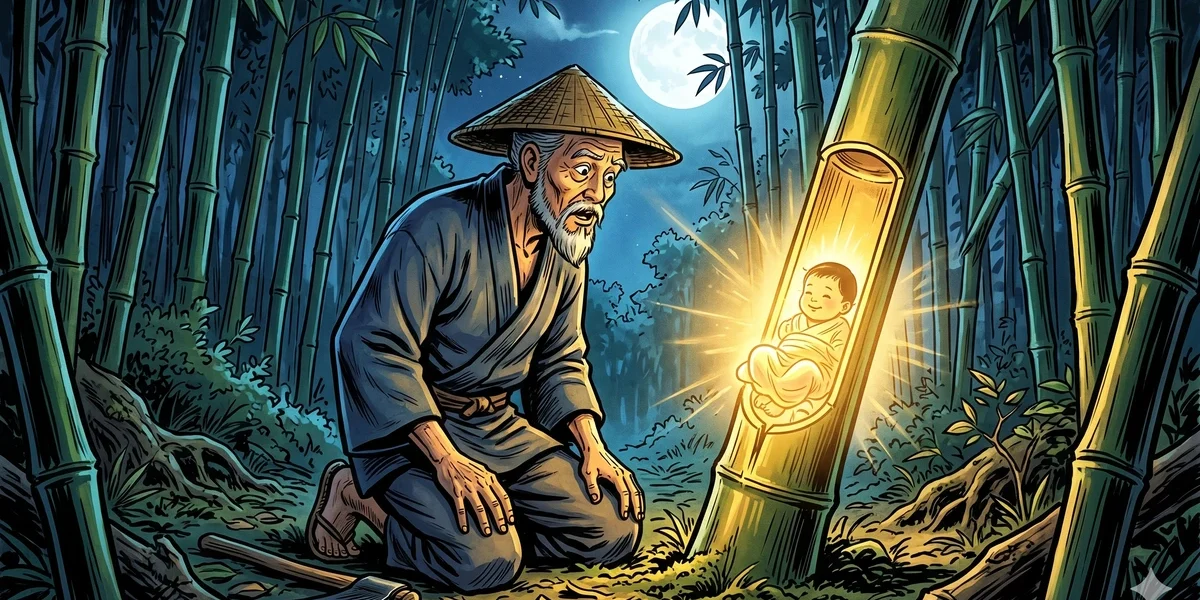
The Bamboo-Cutter And The Moon-Child: Long, long ago, there lived an old bamboo wood-cutter. He was very poor and sad also, for no child had Heaven sent to
Origin & Tradition
The Bamboo-Cutter and the Moon-Child (Taketori Monogatari, 竹取物語) is Japan’s oldest extant prose narrative, composed in the late Heian period (c. 900–950 CE) and considered the foundational text of Japanese fiction. It tells the story of Kaguya-hime (かぐや姫, “Princess Kaguya” or “Princess Radiance”) — a luminous being of celestial origin discovered as a tiny child inside a glowing bamboo stalk by an old bamboo-cutter, raised with profound love by him and his wife, sought in marriage by the highest nobles and the Emperor himself, and ultimately unable to remain on earth because she belongs to the Moon. The tale operates simultaneously as a romance, a satire of aristocratic pretension, a meditation on impermanence, and — in its final image — an origin myth for Mount Fuji’s smoke, which rises from the point where the Emperor burned the elixir of immortality rather than take it without the person he loved.
Beat I — Found in the Light of the Bamboo
The old bamboo-cutter Taketori no Okina finds a stalk of bamboo glowing from within. He cuts it open and discovers a tiny girl, three inches high, luminous as moonlight. He and his wife raise her as their own daughter, and she grows with supernatural speed — from a tiny child to a full-grown young woman of extraordinary beauty in three months. She is named Kaguya-hime, and the name is accurate: she radiates light that fills rooms, that calms illness, that makes those near her feel that the world is more beautiful than they had known.
The light attracts suitors. Five great nobles, each of considerable rank and persistence, seek her hand. She does not refuse them directly — instead she assigns each an impossible task: the jewelled branch from the dragon’s neck, the fire-rat’s fur robe, the swallow’s cowrie shell, the Buddha’s stone begging bowl, the jewels from the dragon king’s neck. Each attempts the task; each fails, either through genuine impossibility or through an attempt at deception that she sees through immediately. The Emperor himself visits and is refused — she cannot marry him because she is not of this world and the Emperor is bound to it.
Beat II — The Moon’s Recall
As the years pass, Kaguya-hime grows increasingly sad. She watches the moon, and her watching has the quality of homesickness. She tells her adoptive parents, finally, what she has always known: she is a native of the Moon, sent to earth as a form of celestial exile or protection, and on the night of the full moon in autumn the Moon people will come to take her back. She cannot prevent it. She does not wish to leave the people she loves, but she cannot disobey the law of where she belongs.
The Emperor sends an army to prevent her departure. The Moon people descend on a cloud of light, and the army is unable to act — their weapons fall, their movements slow, they can only watch. Kaguya-hime removes her earthly robe, puts on the celestial feather-robe, and rises. As she ascends she gives the Emperor a letter and the elixir of immortality — the only gift she has to offer him, the life without end that she cannot give him by staying.
The Emperor, reading the letter at the foot of Mount Fuji, understands that he cannot live in a world without her. He orders the elixir burned at the summit of the mountain nearest to heaven, hoping the smoke will reach her. The smoke rises from Fuji’s peak and, the tale implies, has been rising ever since.
Beat III — Kagayaki and the Impossibility of Integration
The suitors’ impossible tasks have been read across many centuries of Japanese commentary as Kaguya-hime’s unconscious strategy of delay. She cannot refuse directly — she is not cruel — but she cannot accept, because accepting would mean pretending to be something she is not: a terrestrial being capable of the permanent integration that marriage requires. The impossible tasks give the suitors every opportunity to demonstrate genuine devotion by attempting the impossible, while simultaneously ensuring that no genuine integration can occur. It is both kind and honest.
Her kagayaki (輝き, radiance) — the light she emits — is the mark that makes integration impossible even before the Moon’s recall is announced. Light of this quality, in Japanese aesthetic tradition, is not merely beautiful; it is numinous, which means it belongs to a category of being that is not fully of this world. The beauty that suitors seek to possess is the beauty of something that cannot be possessed — it can only be witnessed, briefly, in the time it allows itself to be present in this world.
Beat IV — The Elixir Burned for Love
The Emperor’s decision to burn the elixir of immortality rather than drink it is the tale’s most philosophically precise moment and one of the most emotionally compelling in all of Japanese literature. The elixir would allow him to live forever — but forever without Kaguya-hime is the immortality tale’s exact horror, which the Emperor understands intuitively. He does not want eternal life; he wants the specific life he had when she was in it. Since that life is no longer available, eternal duration is not a gift but a sentence.
Burning the elixir at Fuji’s summit — sending the smoke toward the Moon — is not resignation but the most active thing he can do: a declaration that the love was real, that he is not going to substitute duration for meaning, and that the smoke rising toward the sky is the only communication still available to him. The mountain nearest to heaven is where you burn what you cannot keep but will not pretend not to have loved.
“Beauty that arrives from another world will always return to it — and the love that formed around such beauty is real and lasting even when the beautiful one is gone, because the love was never for the other world but for what emerged from it into this one.”
Why This Story Lasted
Taketori Monogatari has lasted for eleven centuries because it tells the truth about the experience of loving someone whose nature cannot be fully contained by the life you share with them — and about what remains when they return to what they truly are. Kaguya-hime’s departure is not rejection; it is the nature of numinous beauty that it cannot stay. The Emperor’s smoke, rising from Fuji’s peak, is the image of love that has outlasted its object and found the only form of expression still available to it.
Taketori Monogatari in Japanese Literary History
Taketori Monogatari is described in the Heian-era novel The Tale of Genji as “the ancestor of all tales” — the foundational text of Japanese prose fiction. It is believed to have been composed in the late ninth or early tenth century, though its author is unknown. The story was illustrated in scroll form from the Heian period onward and has been adapted continuously: into kabuki, animated film (Studio Ghibli’s The Tale of Princess Kaguya, 2013, directed by Isao Takahata), manga, and contemporary fiction. The Mount Fuji origin myth in its final sequence connects the literary text to the most iconic image in Japanese geography.
Frequently Asked Questions
What is the moral of The Bamboo-Cutter and the Moon-Child?
Beauty that belongs to another world will return to it, regardless of the love that formed around it here. The love is real; the departure is not its negation. The Emperor’s decision to burn the elixir rather than use it is the story’s most honest statement: he would rather send smoke toward the Moon than live forever without what gave the living its meaning.
Why does Kaguya-hime give suitors impossible tasks?
The impossible tasks are her way of giving suitors genuine opportunity without making a genuine commitment she cannot keep — she is not of this world and cannot marry into it permanently. The tasks are also a test of devotion: the suitor who genuinely attempts the impossible demonstrates real love; the suitor who fakes the attempt reveals that what he wanted was the beauty without the person. All five suitors reveal themselves through their methods, and none passes.
What does Kaguya-hime’s radiance (kagayaki) signify?
Her light is the mark of celestial origin — the quality that makes her both irresistibly beautiful and ultimately impossible to fully integrate into terrestrial life. In Japanese aesthetic and religious tradition, numinous light is not merely beautiful; it signals a category of being that is temporarily present in this world but not fully of it. Her radiance is both gift and constraint: it draws everyone to her and ensures that no one can fully hold her.
Why does the Emperor burn the elixir at Mount Fuji?
Because Mount Fuji is the mountain nearest to heaven — the physical point where earth is closest to where Kaguya-hime has gone. Burning the elixir there is the Emperor’s final communication: a declaration that eternal life without her is not a gift worth taking, and that the smoke rising toward the sky is the only message he can still send. The tale implies that Fuji’s smoke has been rising ever since — the Emperor’s grief made permanent in the landscape.
Why is Taketori Monogatari considered the ancestor of all Japanese tales?
Because it established the formal and emotional conventions of Japanese prose fiction: the use of poetic passages embedded in prose narrative, the focus on love and loss rather than heroic action, the meditation on impermanence as the ground of feeling, and the specific combination of the realistic (an old bamboo-cutter’s household) with the supernatural (a Moon princess) that Japanese fiction has employed ever since. Its influence on The Tale of Genji — written a century later and the greatest work of Japanese literature — is explicit and acknowledged.
You May Also Like
 Japanese Folk Tales
Ages 6-8
Japanese Folk Tales
Ages 6-8
Samurai!”
Samurai!”: The samurai represent one of history's most fascinating warrior traditions. For nearly a thousand years, from roughly the 11th century until the
 Japanese Folk Tales
Ages 6-8
Japanese Folk Tales
Ages 6-8
Momotaro: The Peach Boy
Momotaro: The Peach Boy: In the days when Japan was still finding its own voice, there lived in a small village nestled between rice paddies and gentle hills
 Japanese Folk Tales
Ages 9-12
Japanese Folk Tales
Ages 9-12
The “Shinansha,” Or The South Pointing Carriage
The “Shinansha,” Or The South Pointing Carriage: The compass, with its needle always pointing to the North, is quite a common thing, and no one thinks that it