The Adventures Of Kintaro, The Golden Boy
The Adventures Of Kintaro, The Golden Boy: Long, long ago there lived in Kyoto a brave soldier named Kintoki. Now he fell in love with a beautiful lady and
Origin & Tradition
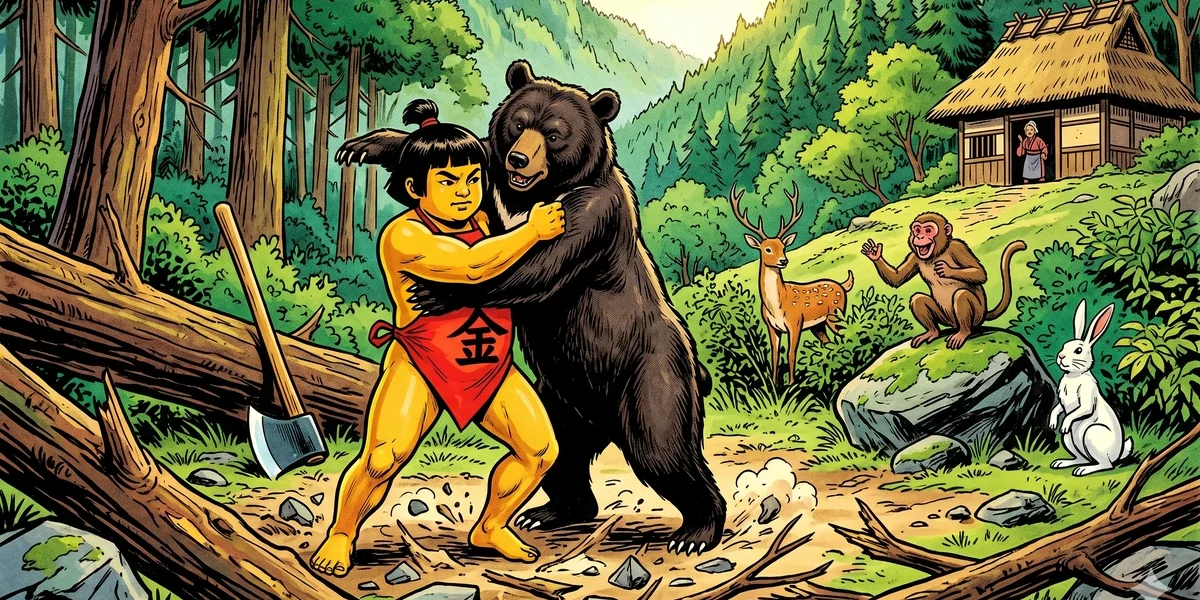
Kintarō (金太郎, “Golden Boy”) is one of Japan’s most beloved folk heroes — a figure whose image (red-cheeked, round-bodied, carrying an axe, riding a bear) decorates children’s rooms, festival dolls, and candy wrappers across Japan. The legend is documented in Edo-period popular literature and is widely understood to derive from the historical figure of Sakata no Kintoki (坂田金時), a retainer of the famous samurai Minamoto no Raikō who lived in the late Heian period. The folk tradition strips away the historical figure’s court career and focuses instead on his childhood in the mountains of Ashigara — raised by a wild-woman (yamauba) or a widow among the animals of the forest, wrestling bears for sport and speaking with the creatures of the mountain as naturally as with people. The story belongs to the genre of yūsha seichō-tan (勇者成長譚, tales of the hero’s formation) and is among the first narratives Japanese children encounter.
Beat I — The Mountain Child
Kintarō is born in the mountains — in most versions raised by his mother after being separated from his father, in some versions the son of a mountain spirit or raised by the yamauba (山姥, mountain witch) after his mother’s death. He grows up in the forests of Ashigara without formal education, without human community, without the structures of Heian court culture that would have shaped a nobleman’s son. What he has instead is the mountain: its animals, its terrain, its demands and its gifts.
He is prodigiously strong from childhood — he wrestles bears not to defeat them but because the bears are the strongest things available to wrestle, and wrestling is his form of play. He speaks with the mountain animals in a way that the legend does not explain as magical but treats as natural: he grew up with them, they with him, and the communication is the product of shared habitat rather than supernatural gift. He is happy in the mountains in the way that creatures raised without constraint are happy — completely present, entirely at ease with what he is.
Beat II — The Samurai Who Sees What the Mountain Made
The warrior Minamoto no Raikō, travelling through Ashigara with his retinue, encounters a boy who has just uprooted a tree and is using it as a makeshift bridge for animals crossing a stream. The boy’s physical power is immediately apparent; his character — generous, unself-conscious, at ease — is equally apparent. Raikō recognises something that court training cannot produce: a person whose strength and directness are entirely unconstructed, the product of a formation that human civilization can benefit from but could not have engineered.
He invites Kintarō to join his service. In some versions Kintarō must first say farewell to the mountain animals — a scene performed with the emotional weight of a departure from family, because for Kintarō the distinction between animal family and human family is not the one his culture usually makes. He joins Raikō’s retinue, receives the adult name Sakata no Kintoki, and becomes one of Raikō’s four guardian warriors — the company that will later defeat the demon Shuten-dōji.
Beat III — Yasei and the Ethics of Wild Formation
Japanese literary tradition distinguishes between bunbu (文武, the cultivation of literary and martial arts through formal training) and the quality that Kintarō represents — a strength and directness that precedes and exceeds formal cultivation. This is not a binary that privileges one over the other: the legend does not argue that wild formation is superior to court training. It argues that wild formation produces something that court training cannot, and that a warrior culture needs both.
Kintarō’s yasei (野性, wild nature) is not savagery — he is conspicuously gentle with the mountain animals, generous with his help, uncalculating in his responses. What yasei provides is the absence of the political consciousness that court upbringing instils: the knowledge of hierarchy, the calculation of advantage, the management of appearance. Kintarō has none of this. He uproots trees when they are needed as bridges and does not consider whether uprooting trees is beneath him. He wrestles bears and does not consider whether winning or losing reflects on his honour. He is entirely what he is, without the mediation of performance.
Raikō’s recognition of this quality — and his choice to recruit rather than civilise it — is the legend’s most sophisticated moment. He does not send Kintarō to be educated in court manners; he takes him into service as he is. The mountain made something that court training cannot improve by substitution, only by addition. The samurai who understands this is the one capable of using what the mountain made.
Beat IV — The Wild Child as National Ideal
Kintarō’s persistent popularity in Japanese culture across many centuries reflects a specific national imagination about what strength should look like. The Edo-period image that became standard — the round-cheeked, red-bodied boy sitting astride a bear with an axe over his shoulder, entirely cheerful — is not an image of violence or dominance. It is an image of ease: a child so completely at home in a world that most humans find terrifying that his relationship with danger is one of play rather than conquest. This is the quality that Japanese festival culture has enshrined in Kintarō dolls for boys’ festivals (Kodomo no Hi): not the trained warrior but the child who is already, by nature, more than most training can produce.
“Strength raised in the wild, in communion with the natural world rather than in competition with it, produces a character that human society can use without corrupting — the mountain shapes the warrior before society claims him, and what the mountain made cannot be unmade.”
Why This Story Lasted
Kintarō has lasted because every culture needs an image of natural, uncorrupted strength — power that has not been bent by hierarchy, calculation, or the management of appearances. The mountain child who wrestles bears for fun and builds bridges for stream-crossing animals is the folk tradition’s image of what human potential looks like before institutions get to it, and what the best institutions recognise and preserve rather than replace.
Kintarō in Festival Culture and Art
Kintarō figures are traditional gifts for boys on Kodomo no Hi (Children’s Day, May 5), where they stand alongside representations of Momotarō and warrior dolls as images of courageous childhood. The standard iconography — red-cheeked boy, bear mount, golden axe — was established in Edo-period woodblock prints and has remained stable since. His historical counterpart, Sakata no Kintoki, appears as one of Minamoto no Raikō’s four guardian warriors (Shitennō) in the legends of Raikō’s demon-slaying campaigns, particularly the defeat of Shuten-dōji on Mount Ōe. Kintoki’s grave is maintained in Kyoto and is a site of local veneration.
Frequently Asked Questions
What is the moral of Kintarō, the Golden Boy?
Formation in the natural world, without the mediating structures of social hierarchy and political calculation, produces a quality of strength and directness that human cultivation cannot engineer — only recognise and preserve. The legend argues that the best use of wild formation is to bring it into service without attempting to replace it with court sophistication.
Why does Kintarō wrestle bears?
Because the bears are the strongest things available in the mountain, and wrestling is how Kintarō plays. The legend presents this not as violence or display but as the natural activity of a child raised among powerful animals without the human social context that would make such wrestling seem dangerous or strange. The bears and Kintarō are peers in the mountain world, and wrestling between peers is friendship.
Who is Minamoto no Raikō and why does he recruit Kintarō?
Minamoto no Raikō (948–1021 CE) is one of the great warrior figures of the Heian period, famous for his demon-slaying campaigns with his four guardian retainers (Shitennō). He recognises in Kintarō a quality that court training cannot produce — uncalculating strength, directness, complete absence of performance — and recruits him because a warrior who needs warriors capable of confronting supernatural threats needs people who have not had their natural power mediated away by courtly formation.
What is a yamauba and what role does she play in the Kintarō legend?
The yamauba (山姥, mountain witch or mountain woman) is a complex figure in Japanese folklore — sometimes frightening, sometimes maternal, always associated with the wild spaces above human settlement. In versions of the Kintarō legend where she raises him, she functions as the mountain’s maternal principle: the force that nurtures the child the mountain has claimed, ensuring that what the wilderness makes is capable of survival and eventually of service to the human world below.
Why is Kintarō associated with Children’s Day in Japan?
Kodomo no Hi (Children’s Day, May 5) celebrates the health, strength, and happiness of children, particularly boys in the traditional festival. Kintarō’s image — joyful, physically powerful, entirely at ease in a demanding world — represents the ideal of robust, uncorrupted childhood vitality. His association with bears and the natural world makes him the folk tradition’s image of a child who has not yet been diminished by civilization and whose potential is therefore fully visible.
You May Also Like
 Japanese Folk Tales
Ages 6-8
Japanese Folk Tales
Ages 6-8
Momotaro: The Peach Boy
Momotaro: The Peach Boy: In the days when Japan was still finding its own voice, there lived in a small village nestled between rice paddies and gentle hills
 Japanese Folk Tales
All Ages
Japanese Folk Tales
All Ages
The Story Of The Old Man Who Made Withered Trees To Flower
The Story Of The Old Man Who Made Withered Trees To Flower: Long, long ago there lived an old man and his wife who supported themselves by cultivating a small
 Japanese Folk Tales
All Ages
Japanese Folk Tales
All Ages
The Quarrel Of The Monkey And The Crab
The Quarrel Of The Monkey And The Crab: Long, long ago, one bright autumn day in Japan, it happened, that a pink-faced monkey and a yellow crab were playing