The Happy Hunter And The Skillful Fisher
The Happy Hunter And The Skillful Fisher: Long, long ago Japan was governed by Hohodemi, the fourth Mikoto (or Augustness) in descent from the illustrious
Origin & Tradition
The Happy Hunter and the Skillful Fisher is the Japanese mythological narrative of the brothers Hoderi (火照命, “Fire Elder”) and Hoori (火遠理命, “Fire Far”), also known as the Sea-Hunter and Mountain-Hunter myth, recorded in the Kojiki (古事記, Record of Ancient Matters, 712 CE) and the Nihon Shoki (日本書紀, Chronicles of Japan, 720 CE) — Japan’s two oldest extant texts and the foundational documents of Shinto mythology. The myth belongs to the cycle of stories about the Age of the Gods and serves as a cosmological explanation for the relationship between sea sovereignty and mountain sovereignty — and for the source of the Japanese imperial family’s ability to control the tides. It is one of the most structurally complex and symbolically rich narratives in the Shinto tradition.
Beat I — The Brothers and the Exchange
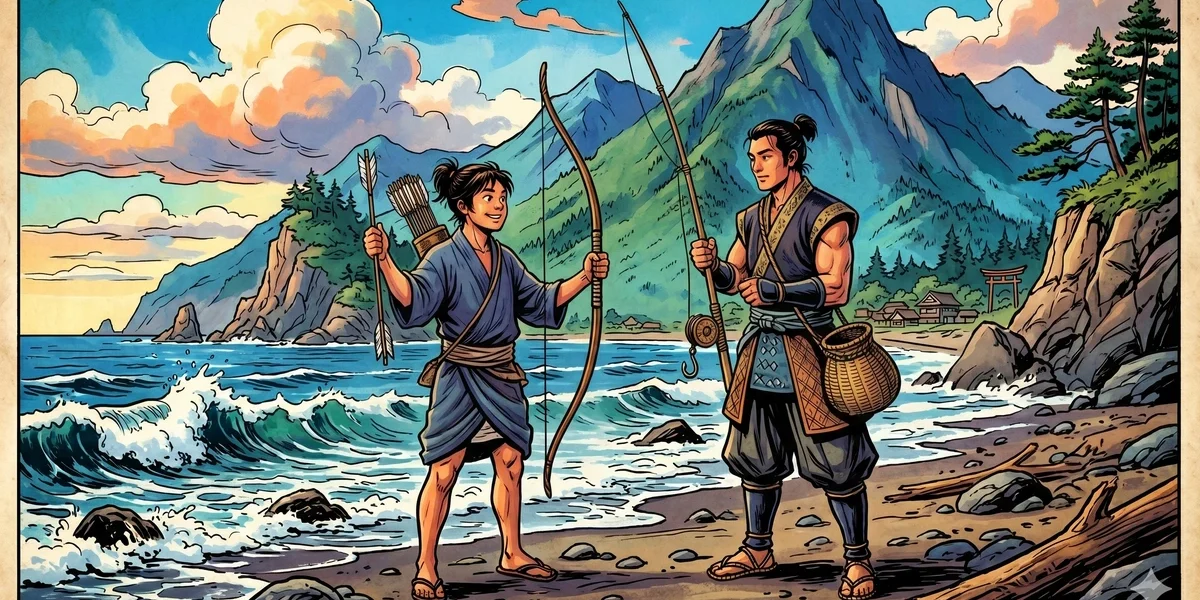
The elder brother Hoderi is a skilled fisherman; the younger brother Hoori is a skilled hunter. One day they agree to exchange their tools — Hoori takes Hoderi’s fishhook and goes to the sea; Hoderi takes Hoori’s bow and goes to the mountain. The exchange is a disaster: Hoderi catches nothing with the bow, and Hoori loses Hoderi’s fishhook in the sea. When they return and Hoori confesses the loss, Hoderi is furious. He will not accept replacement hooks — many are offered — because it is the specific hook that matters. The original tool, the one given in trust, is the one he wants returned.
Hoori sits weeping at the seashore, not knowing what to do. An old man appears — the sea deity Shio-tsuchi-no-Oji, the salt-path elder — who fashions him a small boat and directs him to the palace of the Sea King (Watatsumi, 海神). In this underwater realm, Hoori will find what he lost.
Beat II — The Sea King’s Palace and the Lost Hook
Hoori descends to Watatsumi’s palace, where he is received as an honoured guest. The Sea King’s daughter, Toyotama-hime (豊玉姫, “Abundant Jewel Princess”), sees him and falls in love. They marry and live in the palace for three years. Hoori is content in a way that makes him forget, temporarily, what he came for.
Eventually he remembers — he thinks of his brother and the fishhook and the reason he descended — and grows sad with homesickness. Toyotama-hime tells her father. The Sea King summons the fish and finds the hook in the throat of the red sea bream. He gives Hoori the hook and instructs him in the magic tidal jewels — the kanju (干珠, tide-ebbing jewel) and the manju (満珠, tide-flowing jewel) — with which Hoori will be able to control Hoderi’s fate and compel his submission. Hoori returns to the surface world.
He gives Hoderi the hook and uses the tidal jewels to alternately drown and rescue his brother until Hoderi submits and acknowledges Hoori’s sovereignty. Toyotama-hime comes to the surface to give birth to their child, but Hoori breaks the prohibition against watching her birth, sees her transform into a dragon, and she returns to the sea in shame. Their son — raised by Toyotama-hime’s sister, Tamayori-hime — will eventually become the grandfather of Japan’s first emperor, Jimmu.
Beat III — Sakaime: The Inviolable Boundary Between Domains
The myth’s foundational cosmological claim is about sakaime (境目, the boundary between sovereign domains). The mountain and the sea are distinct realms — each has its tools, its creatures, its sovereign logic. When Hoderi and Hoori exchange tools and enter each other’s domains, neither succeeds. The mountain bow does not work at sea; the sea hook does not work on land. The boundary between domains is not a matter of preference but of fundamental nature: the tools that work in one world are shaped by and for that world, and carry it with them.
The lost fishhook is the symbol of this violation: it fell into the sea because a mountain-man was using it in a sea-world, where it did not belong. The sea claimed it — appropriately, from the sea’s perspective — and returning it required Hoori to enter the sea’s world on its own terms, through the Sea King’s mediation, as a respectful visitor rather than an interloper. His three-year stay in Watatsumi’s palace is not a punishment but the correct duration for a negotiation between sovereign domains: long enough for the sea to understand his sincerity and his genuine relationship to the sea world (cemented by his marriage to Toyotama-hime).
The tidal jewels — the tools the Sea King gives Hoori for his return — are the sea’s acknowledgement that Hoori has now established a legitimate relationship to the sea domain, earning the right to use instruments of sea sovereignty in the surface world. His ability to control the tides thereafter is the mythological explanation for why the Japanese imperial line — descended from Hoori through Jimmu — has a special relationship to the ocean: it is earned, through respectful engagement, not simply claimed.
Beat IV — The Watching Prohibition and the Dragon’s Shame
Toyotama-hime’s departure after Hoori sees her dragon form repeats the structure of the heavenly-maiden tales: the celestial or aquatic being who is seen in their true nature cannot remain in the terrestrial world. Her shame is not at being a dragon — it is at being seen as one, which collapses the boundary between her sea-nature and her surface presentation. The prohibition against watching a birth in the sea tradition is a prohibition against seeing across the sakaime — the boundary between what creatures of the sea are in their own world and what they present to the surface world.
The violation ends the marriage but not the relationship: Toyotama-hime’s sister Tamayori-hime raises the child, and through this grandchild the bloodlines of mountain sovereignty and sea sovereignty are united in the imperial line — which is the myth’s ultimate cosmological point. The emperors of Japan are the product of a boundary-crossing successfully completed, a negotiation between domains that ended in genuine union rather than mutual destruction.
“What belongs to the sea must be returned to the sea, and what belongs to the mountains must be returned to the mountains — the tools of one world do not work in another, and the person who borrows across the boundary between worlds incurs a debt that only honesty and humility can repay.”
Why This Story Lasted
The Happy Hunter and the Skillful Fisher has lasted because it encodes the foundational principle of Japanese cosmological thinking: that the world is composed of distinct sovereign domains, each with its own order, its own tools, and its own intelligence, and that the human capacity to move between these domains requires genuine respectful engagement rather than appropriation. Hoori’s successful negotiation with the sea world — patient, honest, ending in a real relationship — is the model for how boundary-crossing is done when it is done well.
The Kojiki and Nihon Shoki
The Kojiki (712 CE) and Nihon Shoki (720 CE) are Japan’s oldest extant texts, compiled at imperial command to document the myths, genealogies, and historical records of the Japanese state. The Hoori-Hoderi narrative appears in both, with some variation, as part of the Age of the Gods cycle that establishes the divine origin of the imperial family. It is studied as both mythology and as early political theology — the story of how the imperial line came to possess both mountain sovereignty and sea sovereignty through Hoori’s negotiation with Watatsumi. The tidal jewels (kanju and manju) appear in later historical records as actual sacred objects held in imperial custody.
Frequently Asked Questions
What is the moral of The Happy Hunter and the Skillful Fisher?
Each domain — mountain, sea, celestial — has its own sovereign order and its own tools, which do not function correctly in another domain. When you borrow across a boundary and incur a debt to another world, the correct way to repay it is through honest engagement with that world on its own terms, not through substitution or force. Hoori’s patient residence in the sea world is the model for how boundary debts are honoured.
Why does Hoderi refuse substitute fishhooks?
Because the specific hook — the original tool given in trust — is the one that carries the relationship. Substituting a different hook would be paying the debt with something that costs Hoori nothing and acknowledges nothing about what was lost. Hoderi’s insistence is a statement about the non-fungibility of trust: you cannot replace what was lost with something of equivalent commercial value and expect the relationship to be restored.
What are the tidal jewels (kanju and manju)?
The kanju (干珠, tide-ebbing jewel) and manju (満珠, tide-flowing jewel) are instruments of sea sovereignty — the ability to command the tide to recede or rise. The Sea King gives them to Hoori as the expression of his legitimate relationship to the sea domain, established through his marriage to Toyotama-hime and his three years of respectful residence. With these jewels, Hoori can control Hoderi — drowning him with the rising tide, rescuing him with the ebbing tide — until Hoderi acknowledges his sovereignty.
Why does Toyotama-hime leave after Hoori sees her in her true form?
Because being seen across the sakaime — the boundary between what sea creatures are in their own world and what they present to the surface world — collapses the boundary that made the relationship possible. Her true form is her sea-nature; the surface world knows her as a princess. When Hoori sees her as a dragon, the boundary between the two natures is destroyed, and she cannot maintain a presence in the surface world where both natures are now simultaneously visible. Her departure is not anger but the consequence of the boundary’s collapse.
How does this myth explain the Japanese imperial family’s relationship to the sea?
Through the bloodline: Hoori’s marriage to Toyotama-hime and his negotiation with Watatsumi established a genuine relationship between the mountain sovereignty of the imperial line and the sea sovereignty of the Dragon Palace. Their descendant, Jimmu, carries this dual sovereignty as the first emperor — able to command the tides because his ancestor earned the right through patient, honest engagement with the sea world on its own terms. The tidal jewels, held in imperial custody in later historical records, are the physical expression of this inherited right.
You May Also Like
 Japanese Folk Tales
Ages 6-8
Japanese Folk Tales
Ages 6-8
The Bamboo Cutter and the Moon Princess (Kaguya-hime)
The Bamboo Cutter and the Moon Princess (Kaguya-hime): In the time when Japan was young and still learning to speak its own language, there lived in a village
 Japanese Folk Tales
Ages 9-12
Japanese Folk Tales
Ages 9-12
The Snow Woman (Yuki-Onna)
The Snow Woman (Yuki-Onna): In the mountains of Japan, where winter descended with the weight of ancient spirits and snow fell so thickly that the world became
 Japanese Folk Tales
Ages 6-8
Japanese Folk Tales
Ages 6-8
Samurai!”
Samurai!”: The samurai represent one of history's most fascinating warrior traditions. For nearly a thousand years, from roughly the 11th century until the